What Is Artificial Intelligence (AI)? A Simple Guide for Everyone
A friendly, jargon-free introduction to artificial intelligence (AI) for everyone. Learn what AI is, how computers learn from examples, where you already use it every day, a short history, and what AI can and can't do.

On this page
When you unlock your phone with your face, AI is at work. When a junk email lands in your spam folder instead of your inbox, that's AI too. When a map app warns you about traffic, a streaming service suggests a show, or a chatbot answers your question in plain English, AI is behind all of it.
Artificial intelligence, or AI, is everywhere now, and everyone seems to be talking about it. But what actually is it? Is it a robot? A digital brain? Something to be excited or worried about?
This article explains AI in plain language, with no technical background needed. By the end, you'll know what AI is, how it learns, where it came from, and what it can and can't do.
You probably used AI today already
AI isn't just the chatbots in the news. It's been quietly working inside everyday technology for years:
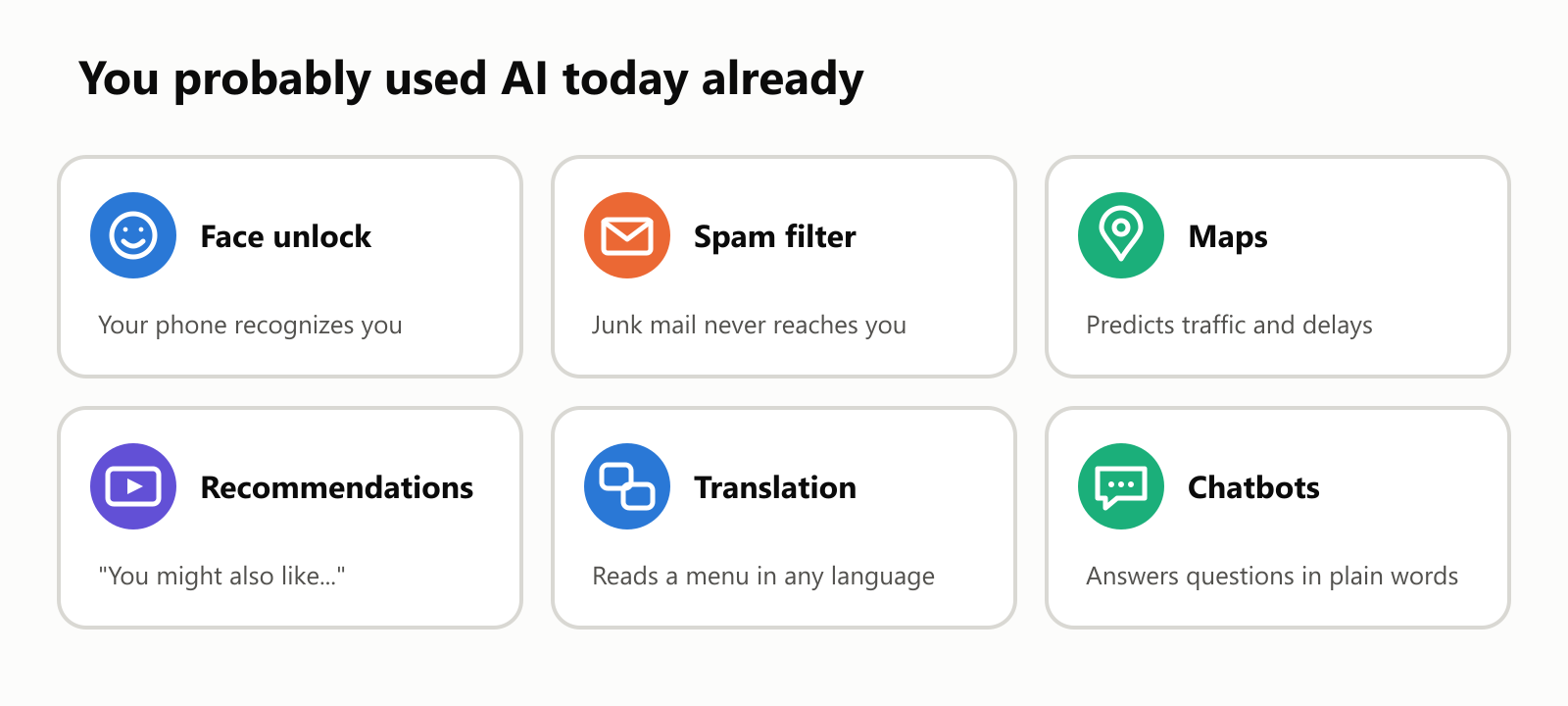
None of these feel like science fiction, and that's the point. Most AI is useful, a bit invisible, and focused on one job.
So what is AI?
Artificial intelligence is when a computer does something that would normally need human intelligence. Things like:
- Seeing: recognizing faces, reading handwriting, spotting a tumor in an X-ray.
- Understanding language: reading a question, translating a sentence, summarizing a long document.
- Listening and speaking: turning your voice into text, reading text out loud.
- Predicting: guessing what you'll want to watch, how long a drive will take, whether a payment looks like fraud.
- Creating: writing text, drawing pictures, composing music.
The word "artificial" just means made by people, as opposed to natural. "Intelligence" here means the ability to handle tasks like these. It doesn't mean the computer is conscious or has feelings. More on that below.
How is AI different from a regular program?
For most of computing history, programs worked like a recipe. A person wrote down every step: "If the email contains this word, move it to spam." The computer followed those rules exactly, and it could only handle situations the programmer had thought of.
Most AI today works the other way around. Instead of giving the computer the rules, you give it lots of examples along with the right answers, and it works out the rules itself. This is called machine learning.
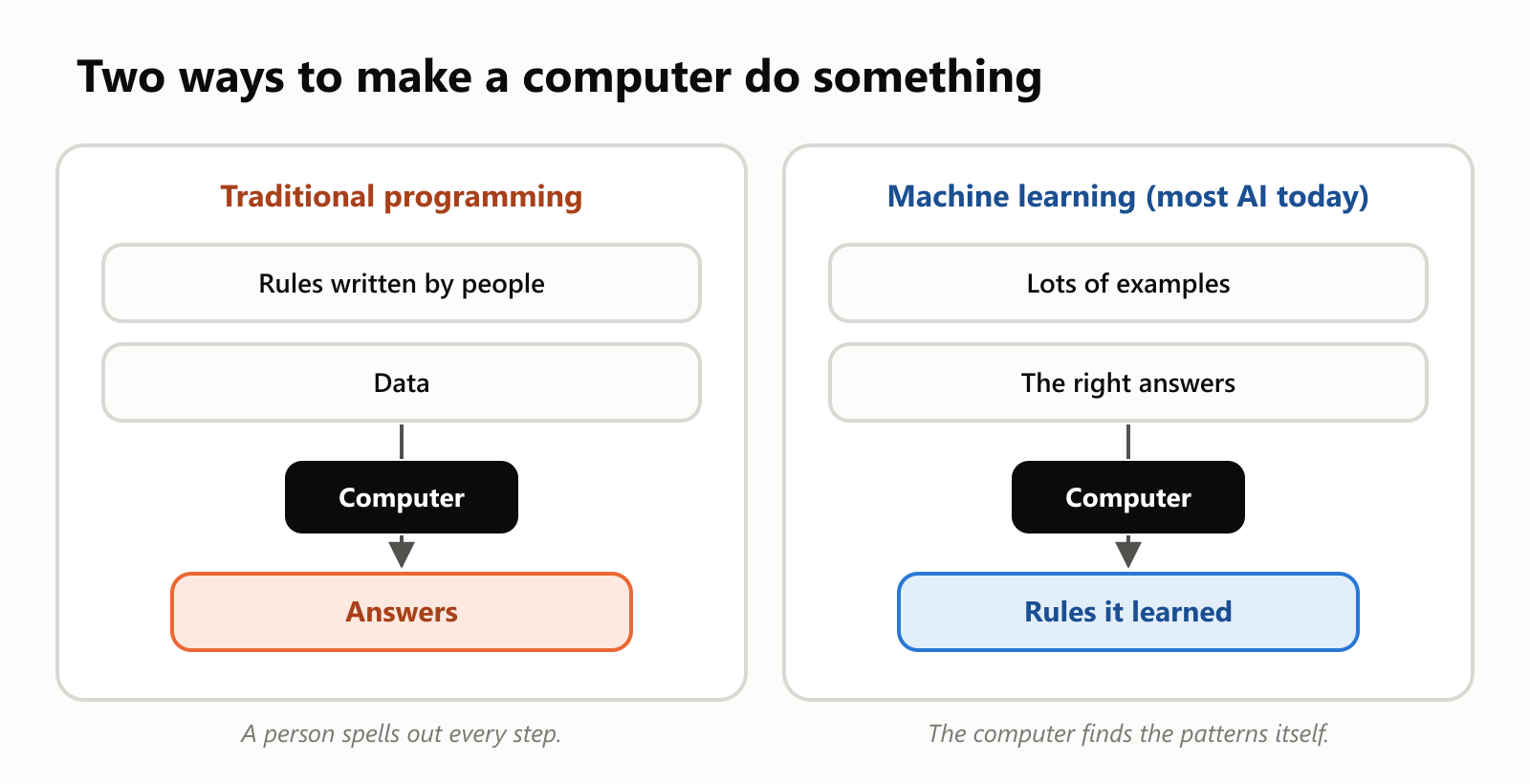
Why does this matter? Because many things are almost impossible to write rules for. Try writing step-by-step instructions to recognize a cat in a photo: pointy ears? Some cats have folded ears. Whiskers? So do dogs. But show a computer a million photos labeled "cat" or "not cat", and it can learn to tell the difference better than any rulebook.
Learning from examples, step by step
Let's see how a spam filter learns. It's one of the oldest everyday uses of machine learning, and it shows the whole idea:
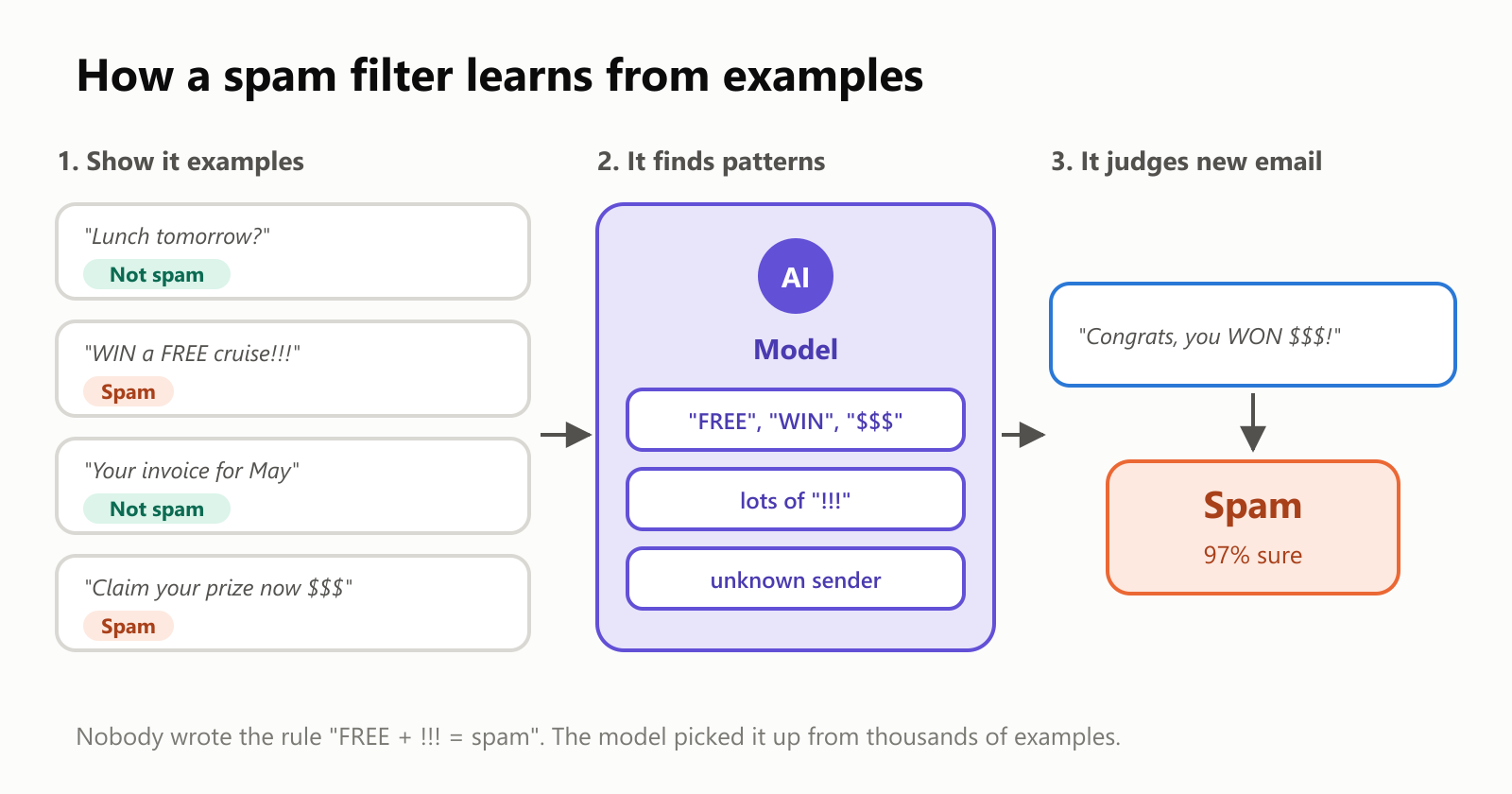
- Show it examples. Thousands of emails that people have already marked as spam or not spam.
- It finds patterns. The computer notices what spam tends to have in common: certain words, lots of exclamation marks, strange senders. Nobody tells it these clues; it discovers them.
- It judges new emails. When a new email arrives, it compares it to what it learned and makes a prediction, often with a level of confidence.
The thing it ends up with, the learned "rules", is called a model. And notice that the model doesn't know anything for certain. It makes educated guesses based on patterns, which is why spam filters occasionally get it wrong.
The AI family tree
You'll hear a lot of terms thrown around: AI, machine learning, deep learning, generative AI. They aren't competing ideas. Each one sits inside the one before it:
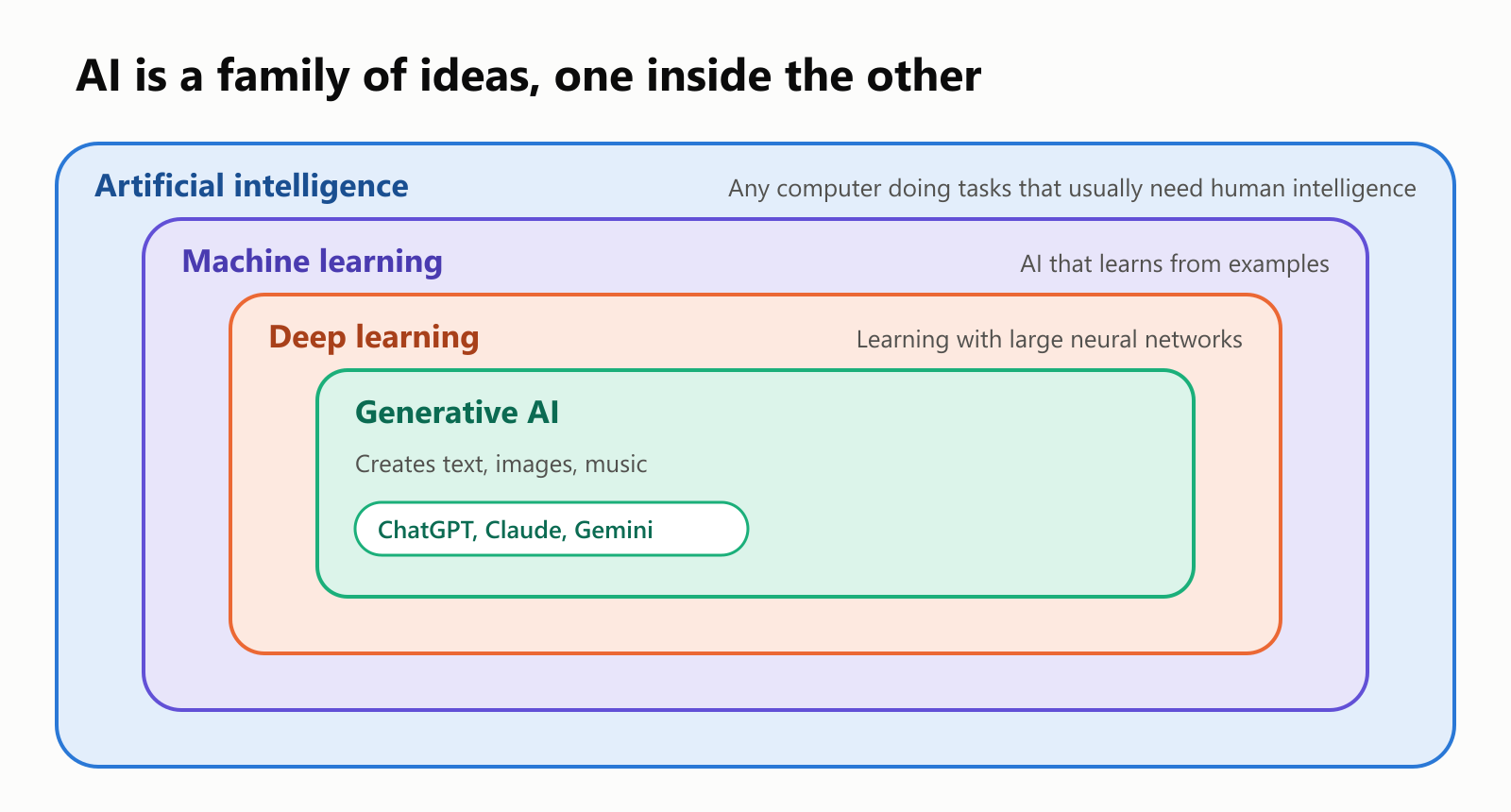
- Artificial intelligence is the whole field: any computer doing "smart" tasks, whether it learned them or was programmed by hand.
- Machine learning is the part of AI that learns from examples, like our spam filter.
- Deep learning is machine learning with neural networks: huge webs of simple math units, loosely inspired by how brain cells connect. "Deep" just means many layers stacked on top of each other. This is what made AI dramatically better at seeing and understanding language.
- Generative AI is deep learning that creates new things: text, images, music, video. Chatbots like ChatGPT, Claude and Gemini belong here.
A short history of AI
AI might feel brand new, but the idea is over 70 years old:
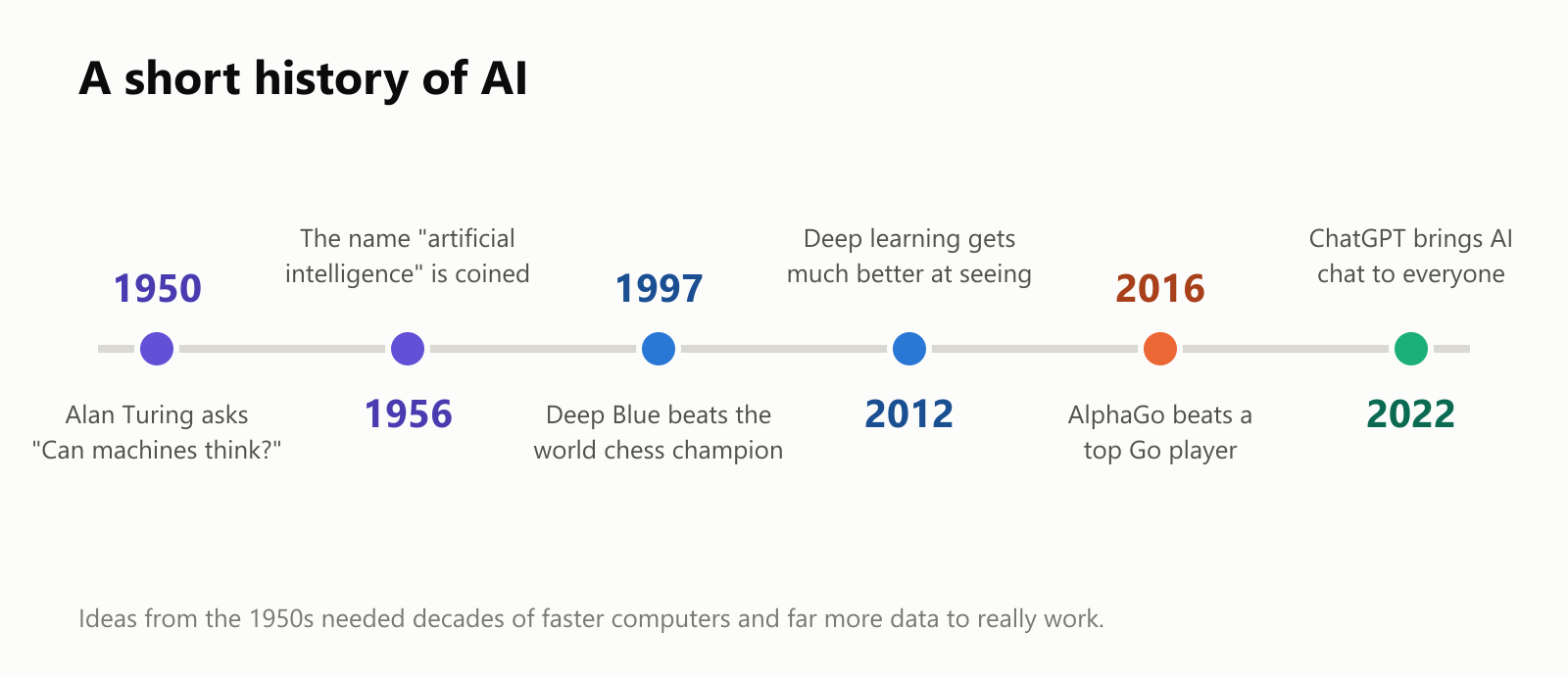
- 1950: British mathematician Alan Turing published a famous paper asking, "Can machines think?"
- 1956: The term "artificial intelligence" was coined by John McCarthy for a summer workshop at Dartmouth College, often called the birth of AI as a field.
- 1997: IBM's Deep Blue computer beat world chess champion Garry Kasparov.
- 2012: A deep learning system called AlexNet blew away the competition at recognizing objects in photos, kicking off the modern AI boom.
- 2016: Google DeepMind's AlphaGo beat Lee Sedol, one of the world's best players of Go, a game long thought too complex for computers.
- 2022: OpenAI released ChatGPT, and suddenly anyone could talk to an AI in plain language.
Why did it take so long? Many of the core ideas existed decades ago, but they needed two things that only arrived recently: enormous amounts of data (thanks to the internet) and very fast computers (especially the graphics chips originally made for video games).
Why everyone is suddenly talking about AI
ChatGPT's launch was a turning point. For the first time, a powerful AI was free and easy for anyone to try, just by typing. People flocked to it faster than to almost any app before:
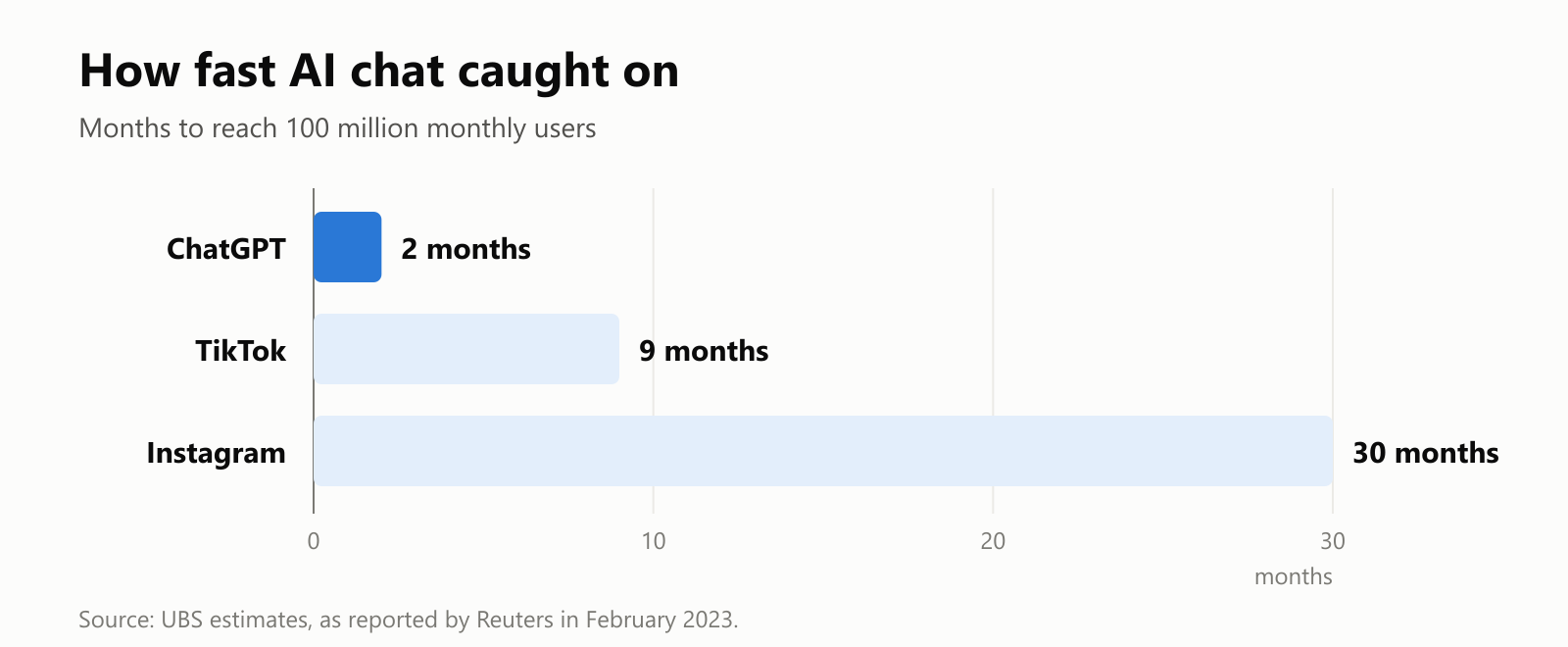
Since then, AI chat has spread into search engines, office software, phones and more, and AI tools have kept getting more capable, from writing and summarizing to working through multi-step tasks.
What AI is good at, and what it isn't
AI can be impressive, but it's not magic. Here's an honest picture:
| AI is often good at | AI often struggles with |
|---|---|
| Spotting patterns in huge amounts of data | Knowing when it's wrong |
| Repetitive tasks, done quickly and tirelessly | Common sense in unusual situations |
| Writing, summarizing and translating text | Facts it wasn't trained on, or very recent events |
| Recognizing images and speech | Understanding context it wasn't given |
| Suggesting ideas and first drafts | Taking responsibility for important decisions |
A few things worth knowing:
- AI can be confidently wrong. Chatbots sometimes make up facts that sound completely believable. This is called a hallucination.
- AI learns from data, including its flaws. If the examples it learned from were unfair or one-sided, the AI can repeat that unfairness. This is called bias.
- Today's AI doesn't think or feel like a person. It's very good at patterns, not a mind with wants or awareness. Every AI system today is what experts call narrow AI: good at the tasks it was built for. A machine that could learn anything a human can, sometimes called artificial general intelligence (AGI), is something researchers debate and work toward, but people disagree about if and when it will arrive.
The good and the worrying
Like any powerful technology, AI brings real benefits and real concerns.
Some benefits:
- Health: helping doctors spot diseases earlier in scans, and speeding up research into new medicines.
- Accessibility: live captions for people who are deaf or hard of hearing, and descriptions of photos for people who are blind or have low vision.
- Language: instant translation that helps people communicate across borders.
- Everyday help: drafting emails, explaining confusing documents, tutoring, and taking boring tasks off people's plates.
Some concerns:
- Mistakes and misinformation: AI can be wrong, and fake images, video and audio ("deepfakes") are getting harder to spot.
- Fairness: biased data can lead to unfair decisions about people.
- Privacy: AI systems are trained on and handle huge amounts of data, some of it personal.
- Jobs: AI is changing how many jobs are done, creating some roles and reshaping others.
Many governments, companies and researchers are working on rules and safety practices to get the benefits while limiting the harms.
How to start using AI wisely
You don't need to be technical to get value from AI. A few simple habits go a long way:
- Try it on low-stakes tasks first, like planning a meal, rewording an email or explaining a confusing term.
- Be specific about what you want. The clearer your request, the better the answer. (Our guide to prompt engineering shows you how.)
- Check anything important. Use AI as a starting point, not the final word.
- Keep private information private. Don't paste passwords, ID numbers or sensitive documents into tools you don't trust.
- Stay curious. AI is changing fast, and the best way to understand it is to try it.
A small glossary
- Artificial intelligence (AI): computers doing tasks that normally need human intelligence.
- Machine learning: AI that learns patterns from examples instead of following hand-written rules.
- Model: what an AI ends up with after learning: the learned patterns it uses to make predictions.
- Training: the process of teaching a model by showing it lots of examples.
- Neural network: a web of simple math units, loosely inspired by the brain, that can learn complex patterns.
- Deep learning: machine learning with large, many-layered neural networks.
- Generative AI: AI that creates new text, images, audio or video.
- Chatbot: a program you can talk to in everyday language.
- Hallucination: when an AI confidently states something that isn't true.
- Bias: unfair patterns an AI picks up from the data it learned from.
- Narrow AI: AI that's good at specific tasks, which describes all AI today.
- AGI (artificial general intelligence): a hypothetical AI that could learn and do anything a human can.
Where to go next
If you'd like to keep learning, these articles build on this one, step by step:
- What Is Machine Learning?: how computers learn from examples.
- What Is Deep Learning?: how neural networks learn to see, hear and talk.
- What Is Computer Vision?: how computers learn to understand photos and video.
- What Is Data Labeling?: the human work that teaches AI.
- What Is Pre-training?: how AI models get their general education.
- What Is Generative AI?: how AI creates text, images, music and more.
- What Is an LLM?: how AI chatbots work.
- What Is Prompt Engineering?: how to ask AI for exactly what you need.
- What Is MCP?: how AI connects to your apps and tools.
- What Is Loop Engineering?: how AI agents keep working until a job is done.
- What Is Graph Engineering?: how AI steps team up to do bigger jobs.
Wrapping up
Artificial intelligence is simply computers doing things that used to need human intelligence: seeing, understanding language, predicting and creating. Most AI today learns from examples rather than following hand-written rules, which is what makes it so flexible and, occasionally, so surprisingly wrong.
AI isn't magic, and it isn't a person. It's a powerful tool that's already part of your daily life, and the more you understand it, the better you can use it, and the better you can judge when not to trust it.
Read next
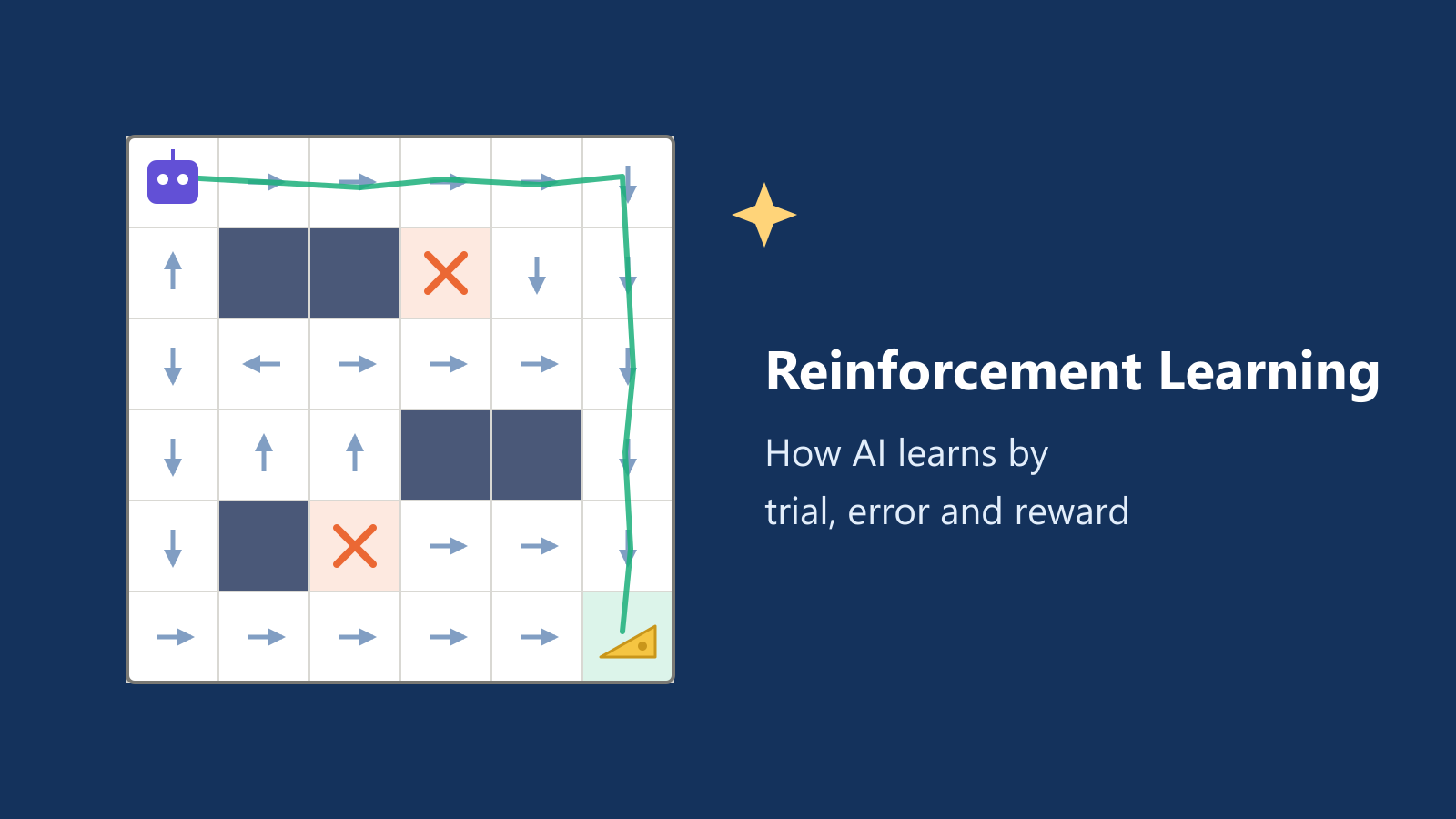
What Is Reinforcement Learning? How AI Learns by Trial, Error and Reward
A friendly, jargon-free introduction to reinforcement learning, how AI learns by trial, error and reward, like training a dog with treats. Watch a real robot learn a maze, see why exploring matters, and learn how it shapes chatbots.
 nbkhope
What Is Graph Engineering? How Today's AI Teams Up to Get Real Work Done
A friendly, jargon-free guide to graph engineering, the 2026 idea of building AI as a map of connected steps instead of one big loop. See how today's AI agents work, why small mistakes add up, and how checkers, branches and teamwork fix it.
nbkhope
What Is Loop Engineering? How AI Agents Keep Working Until the Job Is Done
A friendly, jargon-free guide to loop engineering, the 2026 idea of designing the loop that lets an AI agent keep working until a job is done, with clear goals, real feedback, smart stop rules and knowing when to ask a person.
nbkhope
Comments
Be kind and specific. Comments with links from new accounts appear after a moderator reviews them.