What Is an LLM? Large Language Models Explained Simply
A friendly, jargon-free guide to Large Language Models (LLMs), the technology behind ChatGPT, Claude and Gemini. Learn what they are, how they learn, how they write, and how to use them wisely.

On this page
You have probably chatted with one already. Maybe you asked ChatGPT to help write an email, had Claude summarize a long document, or saw Google's Gemini answer a question at the top of your search results. All of these tools are powered by the same kind of technology: an LLM, which stands for Large Language Model.
This article explains what an LLM is, how it learns, and how it writes, without math and without code. By the end, you will understand what is happening when you type a question into a chatbot, and you will know when to trust the answer and when to double-check it.
What does "LLM" stand for?
Let's take the name apart, one word at a time:
- Large: it is enormous. It learned from a gigantic amount of text, and it has billions of internal "settings" that were tuned during that learning.
- Language: it works with human language: reading, writing, summarizing, translating and answering questions in words.
- Model: in computing, a model is a program that has learned patterns from examples, so it can make good guesses about new situations it hasn't seen before.
Put together: an LLM is a very big computer program that learned the patterns of human language by reading a huge amount of text, so it can predict and produce text of its own.
The big idea: a super-powered autocomplete
Have you noticed how your phone keyboard suggests the next word while you type? Type "Happy" and it might suggest "birthday". An LLM works on the same basic idea, just on a vastly bigger scale.
At its heart, an LLM does one thing: it predicts what word should come next. Give it the beginning of a sentence, and it estimates how likely each possible next word is.
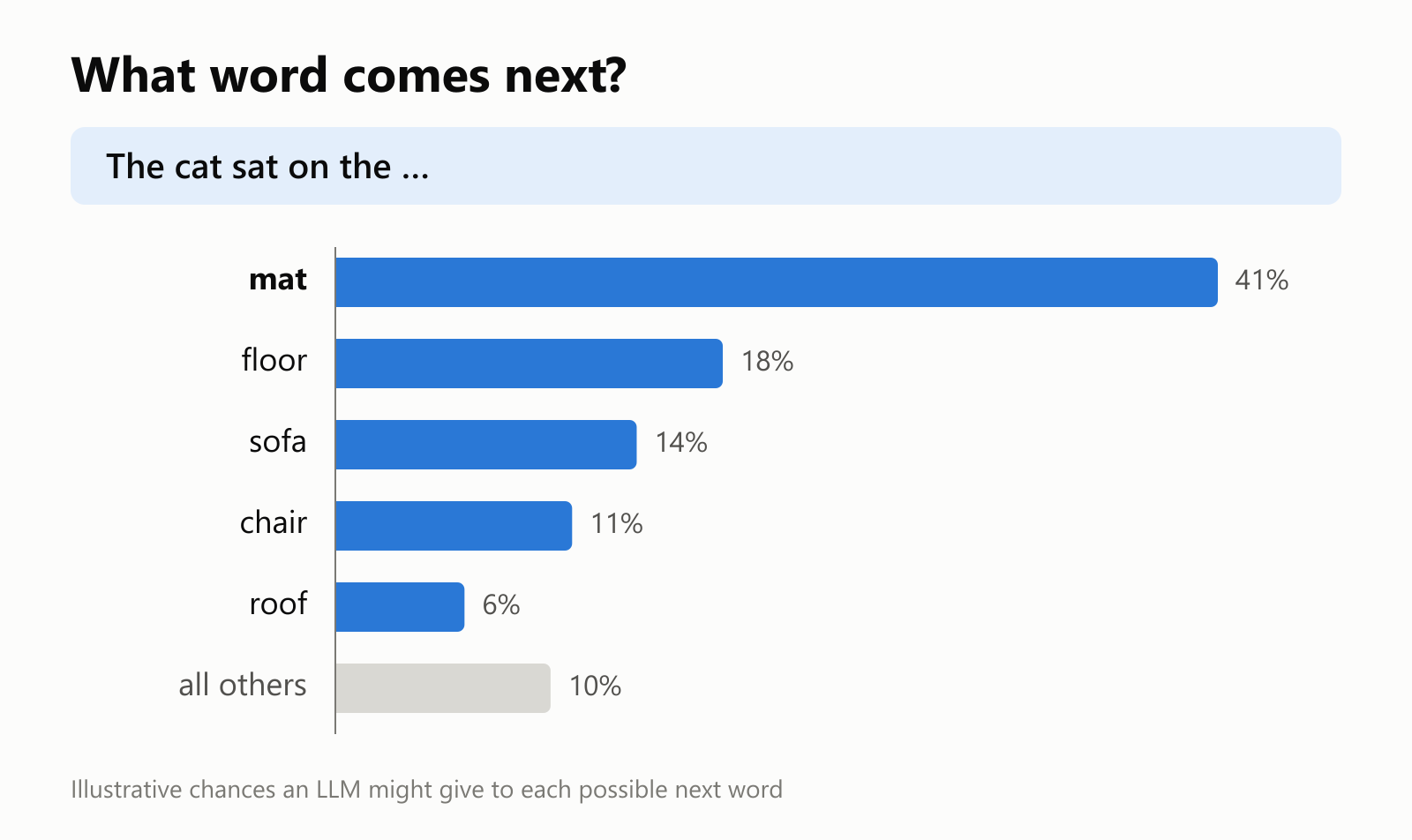
In the example above, "mat" is the most likely next word, but "floor" and "sofa" are perfectly reasonable too. The model doesn't always pick the top choice. A little bit of randomness is part of the recipe, which is why asking the same question twice can give you two differently worded answers.
That sounds simple, maybe even too simple. How can "guess the next word" write a poem, explain a tax form, or fix a bug in a computer program? The secret is in how much it learned, and how it learned it.
How does an LLM learn?
Think of how a child learns to speak. Nobody hands them a grammar book. They hear millions of sentences, notice patterns, try things, get corrected, and slowly get better. An LLM learns in a surprisingly similar way, only with far more reading.
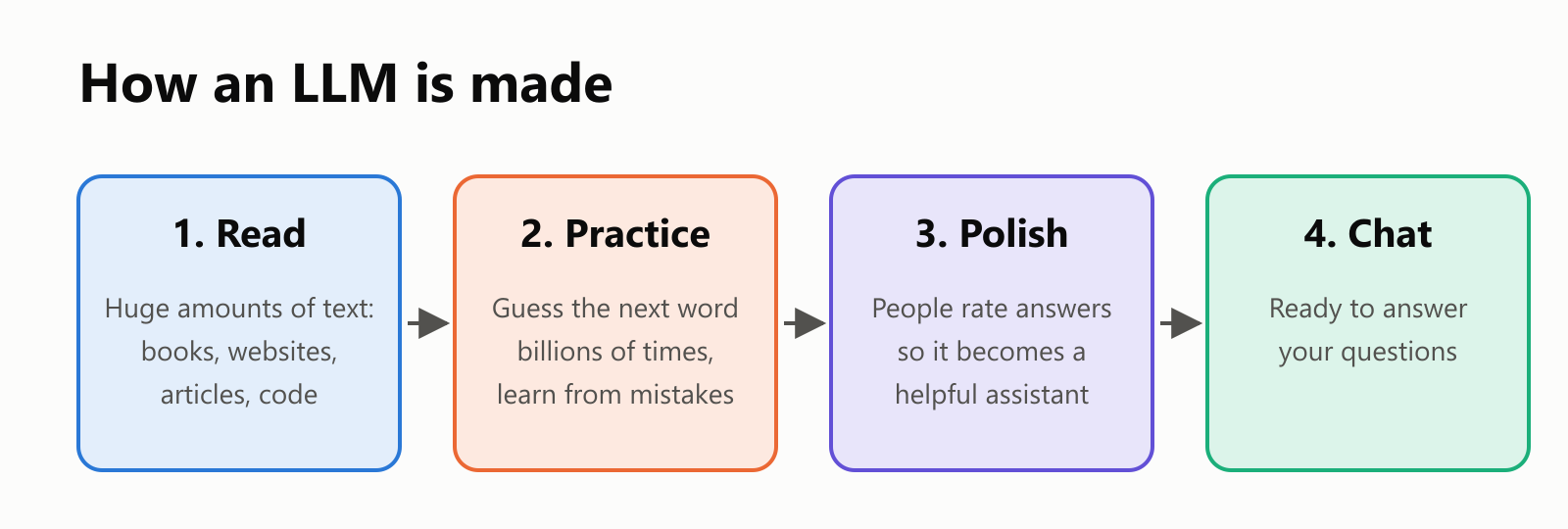
Step 1: Reading (a lot)
First, the model is shown an enormous collection of text: books, encyclopedias, news articles, websites, forums, computer code and more. Modern LLMs are trained on trillions of words. To put that in perspective, if you read for 8 hours every single day, it would take you well over 100,000 years to read that much.
Step 2: Practicing the guessing game
While reading, the model plays a game with itself, billions of times over. It hides the next word in a sentence, guesses it, then checks the real answer. Every time it's wrong, it slightly adjusts its billions of internal settings (called parameters) so that next time, its guess will be a little better.
Nobody programs in rules like "a verb usually follows a subject" or "Paris is the capital of France." The model picks up grammar, facts, writing styles, and even some reasoning patterns on its own, simply because knowing those things helps it guess the next word correctly.
Step 3: Polishing it into a helpful assistant
After step 2, the model is great at continuing text, but it isn't yet a good conversation partner. Ask it a question and it might just continue with more questions!
So there's a finishing stage. People write examples of good answers and compare the model's responses, rating which ones are more helpful, more accurate and safer. The model learns from that feedback. This is what turns a raw text predictor into the friendly assistant you chat with.
Step 4: Ready to chat
Once training is finished, the model's settings are "frozen." When you chat with it, it isn't learning from you in real time. It's using everything it absorbed during training to answer.
Words become tokens
There's one small detail worth knowing: LLMs don't actually read whole words the way we do. They break text into small pieces called tokens. A token can be a whole word, part of a word, or a punctuation mark.
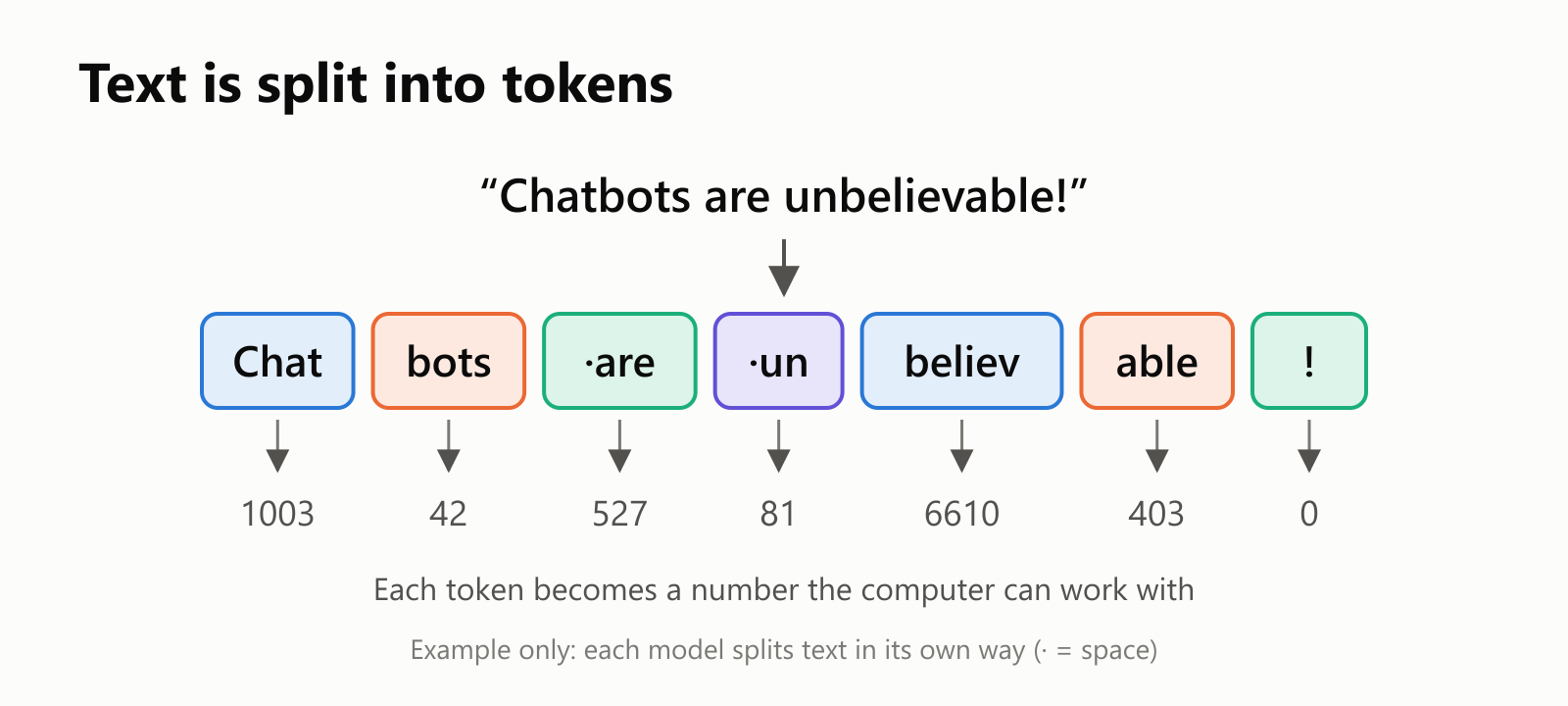
Computers are good with numbers, not letters, so each token is turned into a number. Everything the model does happens with those numbers, and its answer is turned back into text before you see it.
How does it write a whole answer?
Here's where it all comes together. When you ask a question, the LLM writes its answer one token at a time:
- It reads your question (and the conversation so far).
- It predicts the most fitting next token and adds it to the text.
- It reads everything again, including the token it just wrote, and predicts the next one.
- It repeats until the answer is complete.
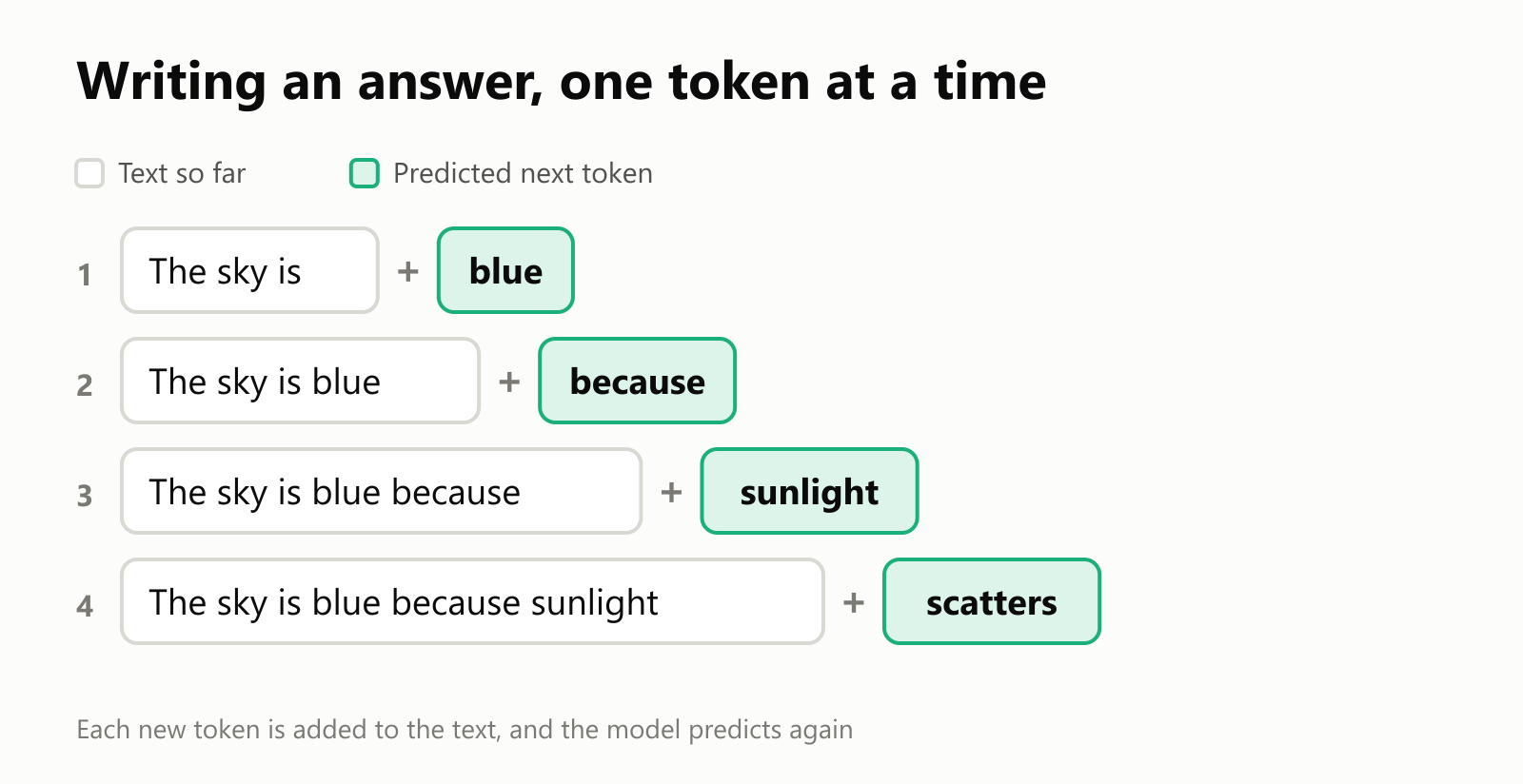
That's why chatbot answers often appear on the screen word by word, as if someone were typing. They really are being produced piece by piece!
Why does it seem so smart?
If an LLM "only" predicts the next word, why can it explain a recipe, write a cover letter, or summarize a 30-page report?
Because predicting the next word really well requires a lot of knowledge. To finish the sentence "The capital of Japan is…", the model needs to have picked up geography. To continue a recipe sensibly, it needs to have absorbed how cooking works. After reading so much text, the model has captured an enormous web of patterns about how words, ideas and facts relate to each other.
Whether that counts as truly "understanding" is a question that scientists and philosophers still debate. What we know for sure is that it's an extraordinarily good pattern-matcher, and that has some important consequences.
What LLMs are good at, and where to be careful
| Great for | Be careful with |
|---|---|
| Drafting emails, letters and posts | Facts, numbers, dates and quotes (always verify) |
| Summarizing long texts | Very recent news (it may not know about it) |
| Explaining ideas in simple words | Medical, legal or financial decisions |
| Brainstorming ideas and names | Exact math and counting |
| Translating and rewriting text | Sharing private or sensitive information |
It can "hallucinate"
Sometimes an LLM states something false with complete confidence: a book that doesn't exist, a wrong date, a made-up quote. This is called a hallucination. It happens because the model is producing text that sounds right based on patterns, not looking facts up in a database.
Its knowledge has a cutoff date
Since the model learned from text collected up to a certain point, it may not know about recent events. Some chatbots can search the web to fill the gap, but the model itself doesn't automatically keep up with the news.
It reflects the text it learned from
Human writing contains mistakes, stereotypes and biases, and a model trained on it can pick some of those up. Companies work hard to reduce this, but it's worth keeping in mind.
Tips for using LLMs well
- Be specific. "Write a friendly two-paragraph email to my landlord asking to fix the heater" works much better than "write an email."
- Give context. Tell it who the audience is, what tone you want, and any details it should include.
- Have a conversation. If the first answer isn't right, say what to change. "Shorter, please" or "make it more formal" works great.
- Ask it to explain. "Explain this like I'm new to the topic" or "walk me through it step by step" often gets clearer answers.
- Verify what matters. Check facts, figures and anything you'll act on.
- Protect your privacy. Avoid pasting passwords, ID numbers, or other people's private information.
A quick glossary
- AI (Artificial Intelligence): computer systems that do tasks that normally need human intelligence.
- LLM (Large Language Model): an AI trained on huge amounts of text to understand and generate language.
- Chatbot: an app you talk to in conversation, often powered by an LLM.
- Prompt: the question or instruction you type to the AI.
- Token: a small piece of text (a word or part of a word) that the model works with.
- Parameters: the billions of internal settings the model adjusts while learning.
- Training: the process of learning patterns from lots of examples.
- Hallucination: when the AI confidently says something that isn't true.
Wrapping up
An LLM is, at its core, a very large program that learned to predict the next piece of text by reading an enormous amount of human writing. That simple skill, practiced at a massive scale and then polished with human feedback, produces tools that can write, explain, summarize and chat in a surprisingly natural way.
Knowing how it works helps you use it well: lean on it for drafting, explaining and brainstorming, and keep your own judgment switched on for facts and important decisions.