What Is Generative AI? How AI Creates Text, Images, Music and More
A friendly, jargon-free introduction to generative AI, the technology that creates new text, images, music, video and code from a simple request. Learn how it works, what it's good at, where it goes wrong, and how to use it wisely.

On this page
Type "a cat wearing a spacesuit, floating past the Moon" into the right app, and a few seconds later you'll see a picture that never existed before. Ask a chatbot for a birthday poem for your grandmother, and it writes one on the spot. Describe a song, and some tools will compose it, lyrics and all.
This is generative AI: artificial intelligence that doesn't just analyze things, but creates new ones. It has gone from research labs to hundreds of millions of people in just a few years, and it's changing how we write, design, study and work.
This article explains generative AI in plain language: what it is, how it creates things, what it's good and bad at, and how to use it wisely.
What makes it "generative"?
For most of its history, AI has been about recognizing and predicting: Is this email spam? Is this a photo of a cat? Will this customer cancel their subscription? The answer is a label, a number or a yes-or-no.
Generative AI does something different. You describe what you want, and it produces new content: a paragraph, a picture, a melody, a video clip.
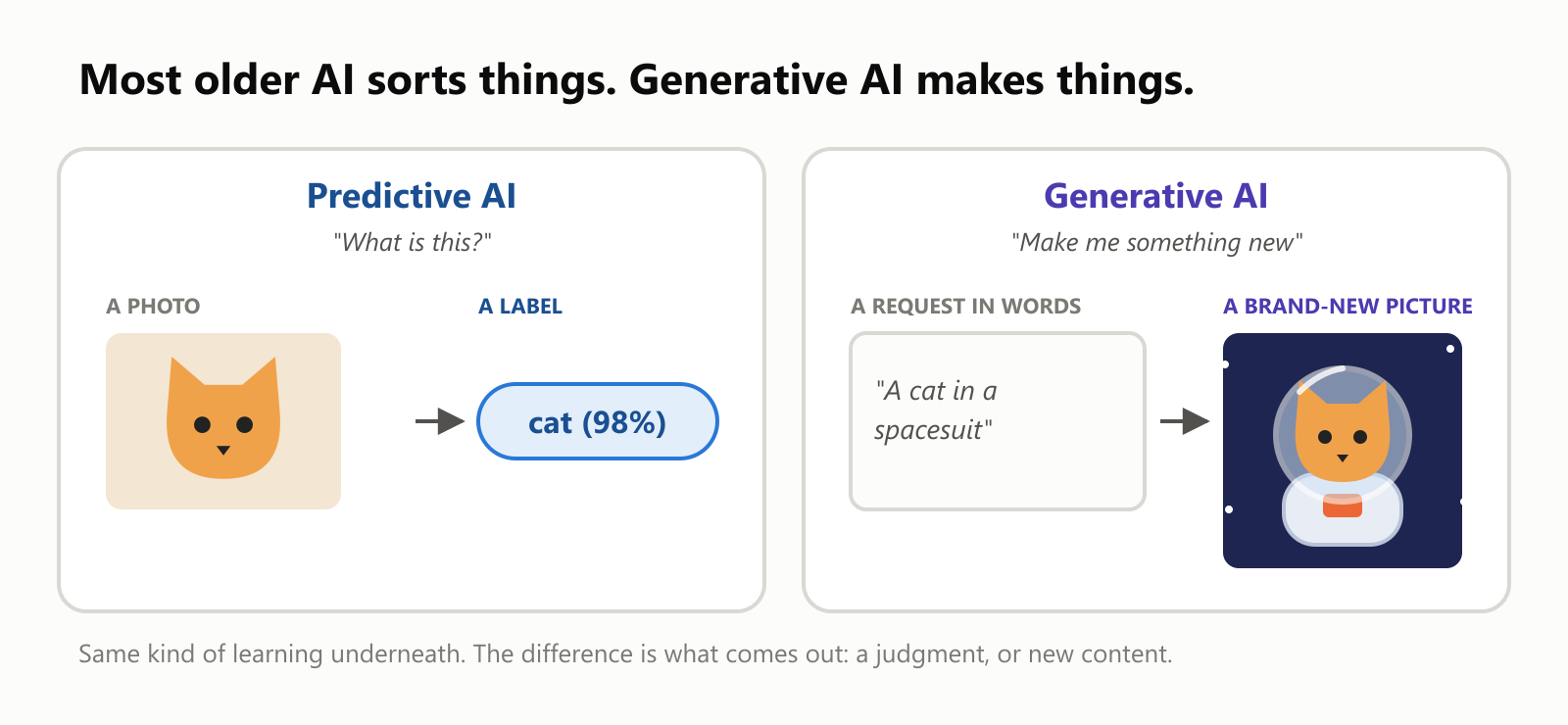
Underneath, both kinds learn from huge numbers of examples in a similar way. The difference is what comes out: a judgment about something that exists, or new content that didn't exist before.
What can it create?
Almost anything that can be stored as data:
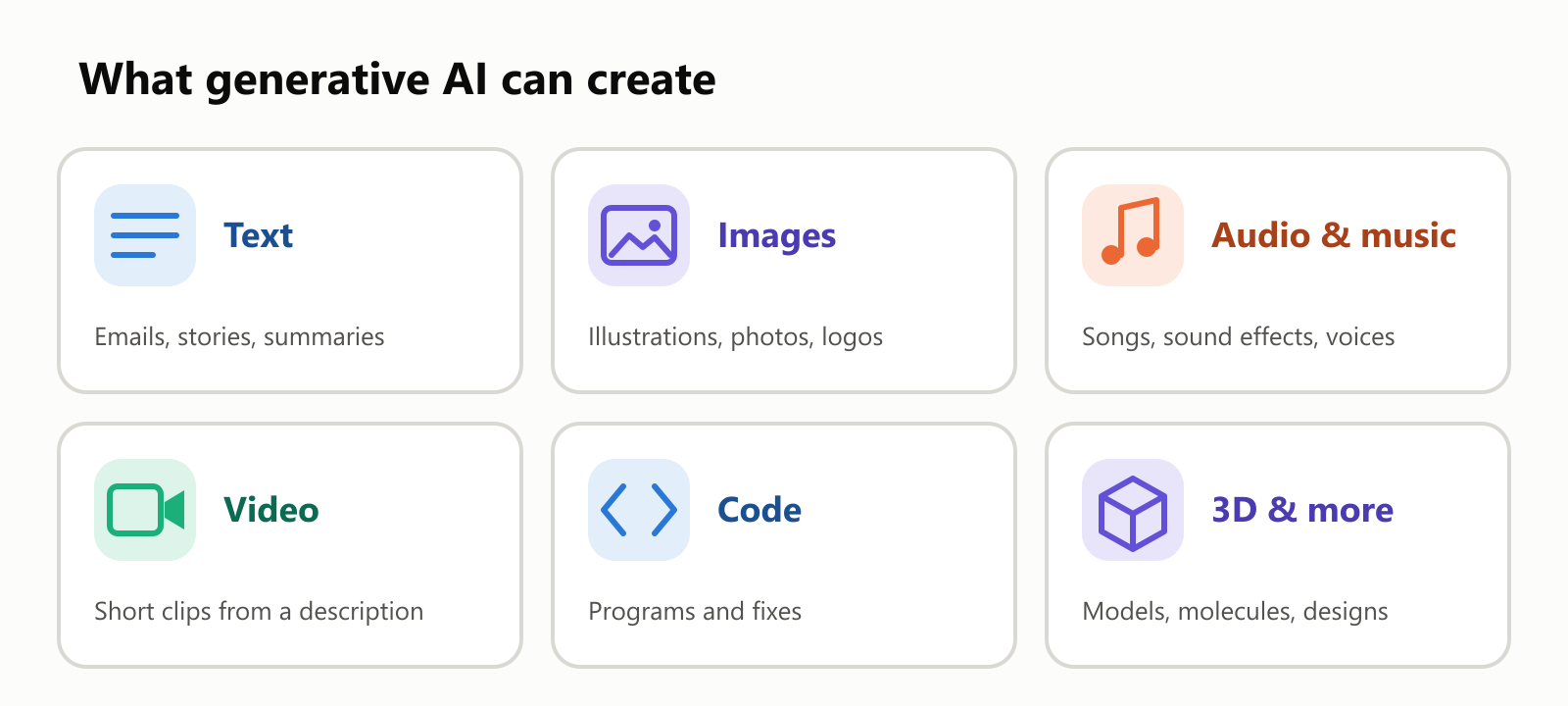
- Text: chatbots like ChatGPT, Claude and Gemini write emails, essays, summaries, translations and stories.
- Images: tools like DALL·E, Midjourney and Stable Diffusion turn a sentence into a picture, or edit a photo you give them.
- Audio and music: some tools create songs in a requested style, read text aloud in natural-sounding voices, or clean up recordings.
- Video: newer models generate short video clips from a description.
- Code: coding assistants write and fix computer programs.
- Science and design: researchers use generative models to propose new molecules for medicines and new materials.
How does it create something new?
The key idea is the same across all of them: learn the patterns in a huge number of examples, then produce something new that follows those patterns.
A generative model doesn't keep a copy of everything it saw and paste pieces together. It learns things like how sentences usually flow, what a cat's face looks like from many angles, or how a sunset's colors blend, and uses that to build something new. It's a bit like a person who has listened to thousands of jazz songs and can then improvise a new one in that style.
The details depend on what's being made.
Text: one word at a time
Chatbots write by repeatedly predicting the next word (more precisely, the next small piece of a word). For each spot, the model calculates how likely every possible next word is, then picks one, adds it, and repeats.
Here's the interesting part: it usually doesn't just pick the single most likely word. It picks at random, using the chances as weights. That's why asking the same question twice can give different answers. Many tools have a setting, often called temperature, that works like a creativity dial:
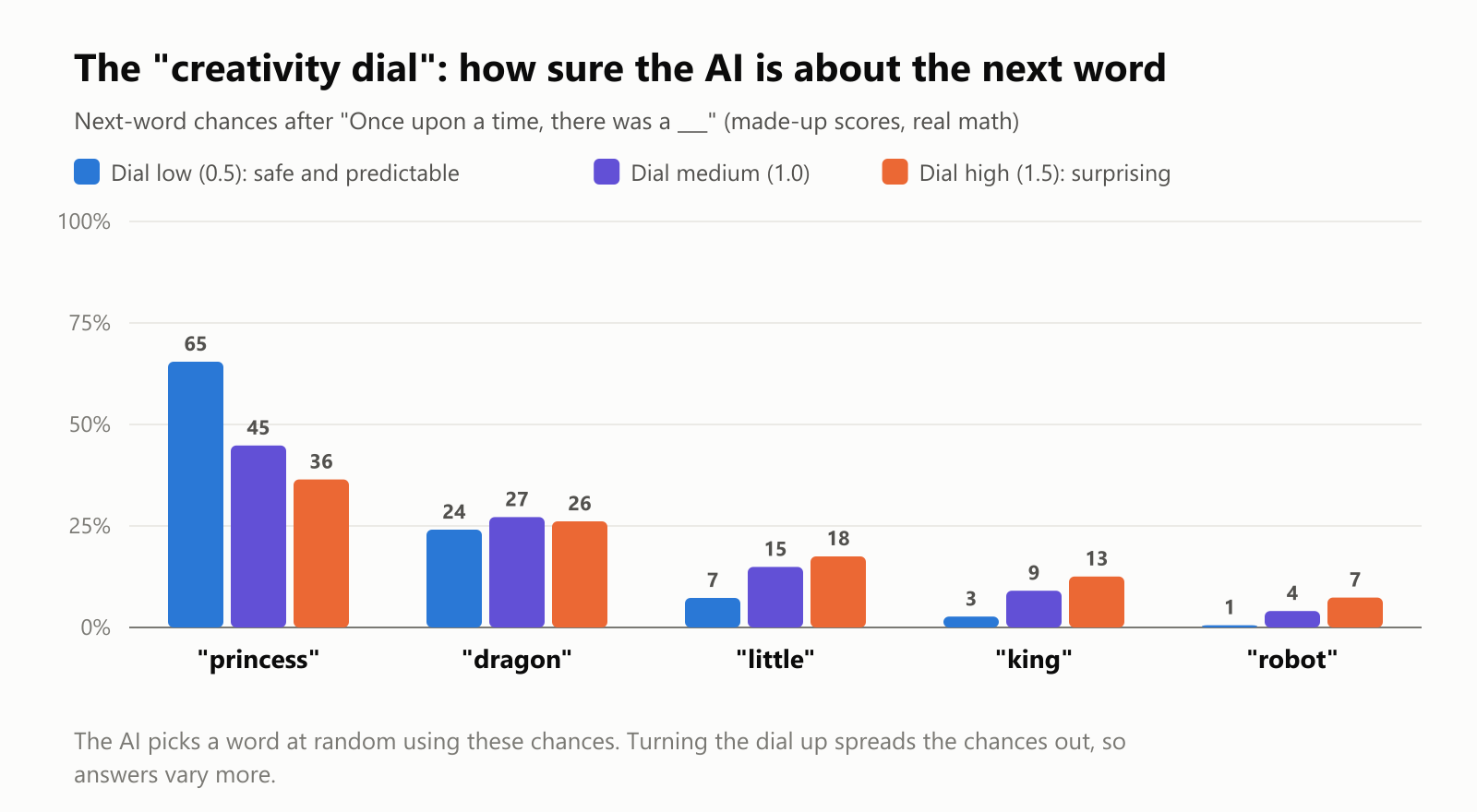
With the dial low, the most likely word wins most of the time: answers are safe, consistent and a bit predictable. With the dial high, the chances spread out, so less obvious words like "robot" get picked more often: answers become more varied and surprising, and occasionally stranger. (Learn more about how chatbots learn these chances in What Is Pre-training?.)
Images: from static to a picture
Most of today's image generators use a method called diffusion. During training, the model is shown millions of images with a little random "static" (noise) added, and it learns to remove that noise. Once it's very good at that, you can do something magical: start with pure static and let the model clean it up, step by step, guided by your description, until a brand-new picture appears.
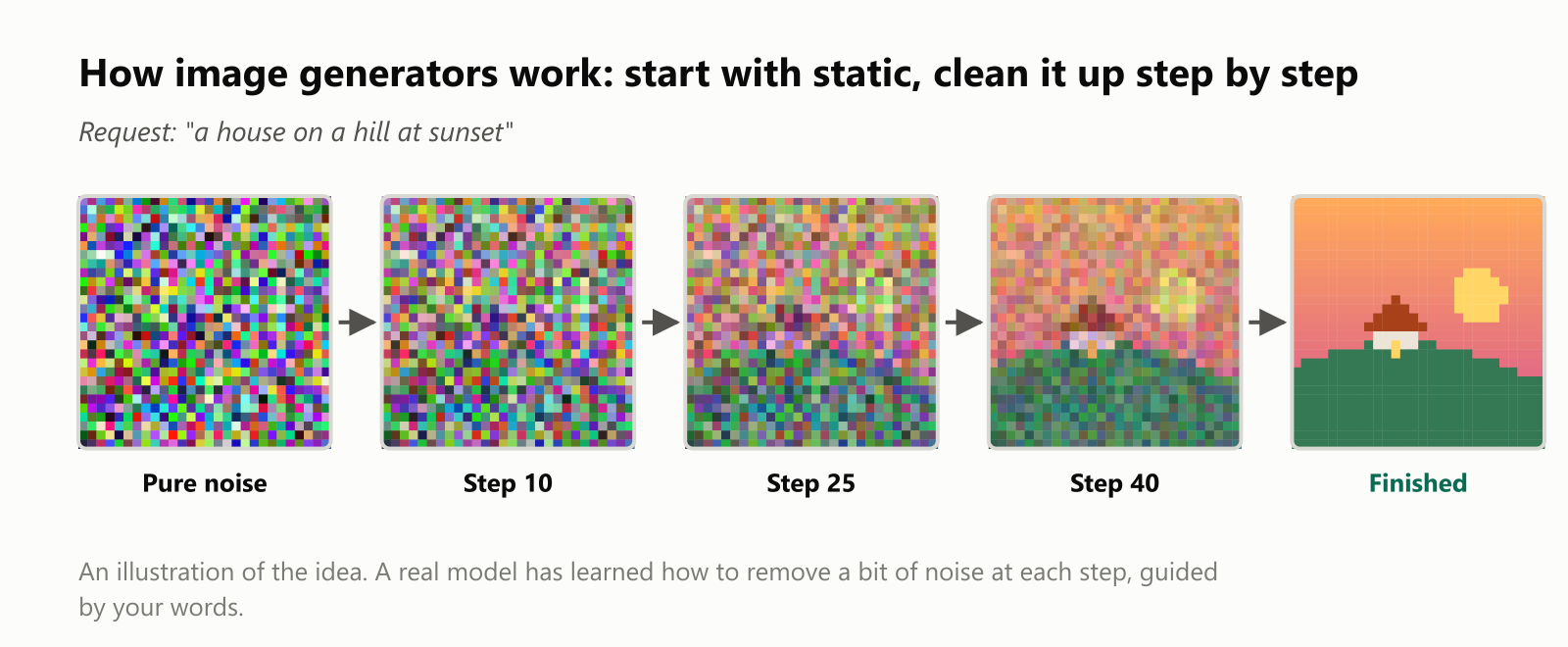
Because every run starts from different random static, the same request gives a different picture each time.
A short history
Generative AI feels sudden, but it was building for years:
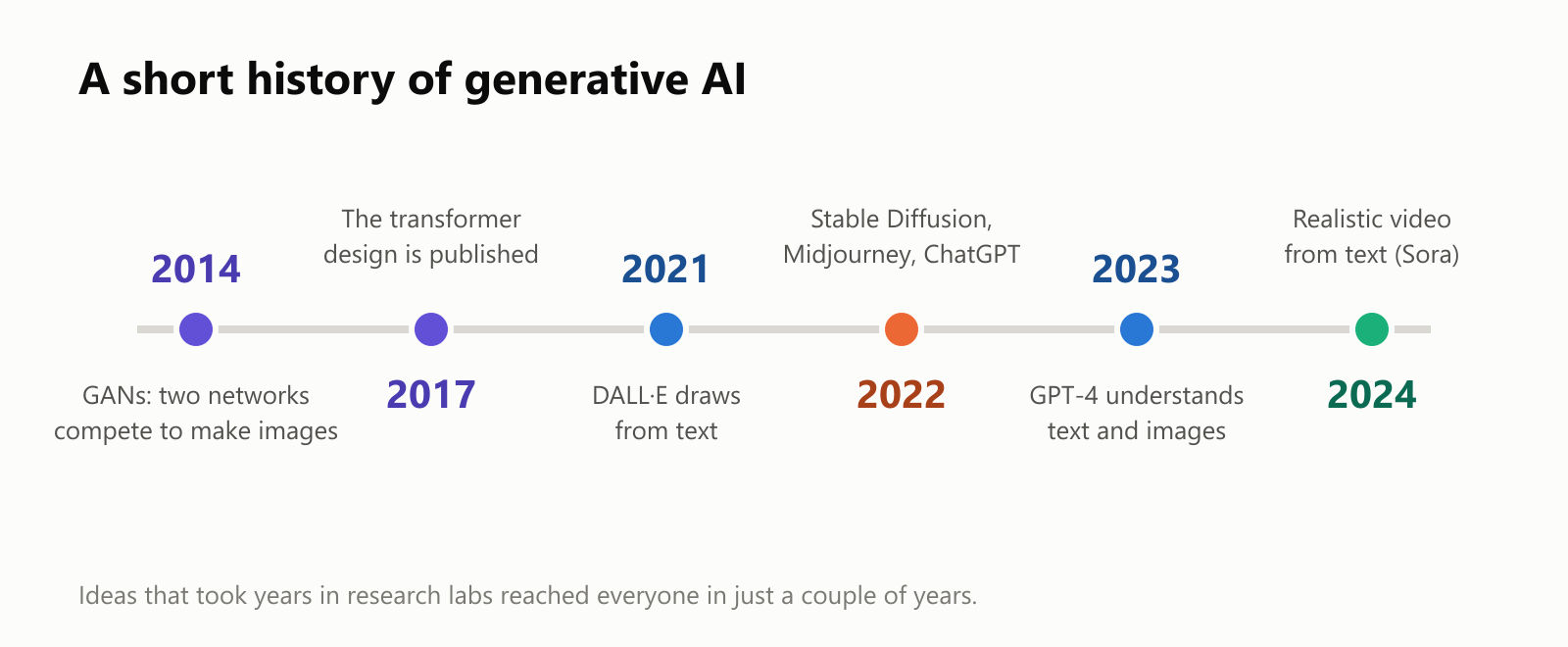
- 2014: researcher Ian Goodfellow and colleagues introduced GANs (generative adversarial networks), where two networks compete: one creates fake images, the other tries to spot the fakes, and both get better.
- 2017: Google researchers published the transformer, the design behind today's chatbots.
- 2021: OpenAI's DALL·E showed that AI could draw pictures from written descriptions.
- 2022: a breakout year. Midjourney and Stable Diffusion made image generation available to everyone, and in November, ChatGPT launched. That same year, a picture made with Midjourney won first prize in a digital art contest at the Colorado State Fair, sparking a big debate.
- 2023: GPT-4 could understand images as well as text.
- 2024: OpenAI showed Sora, which creates realistic video clips from text.
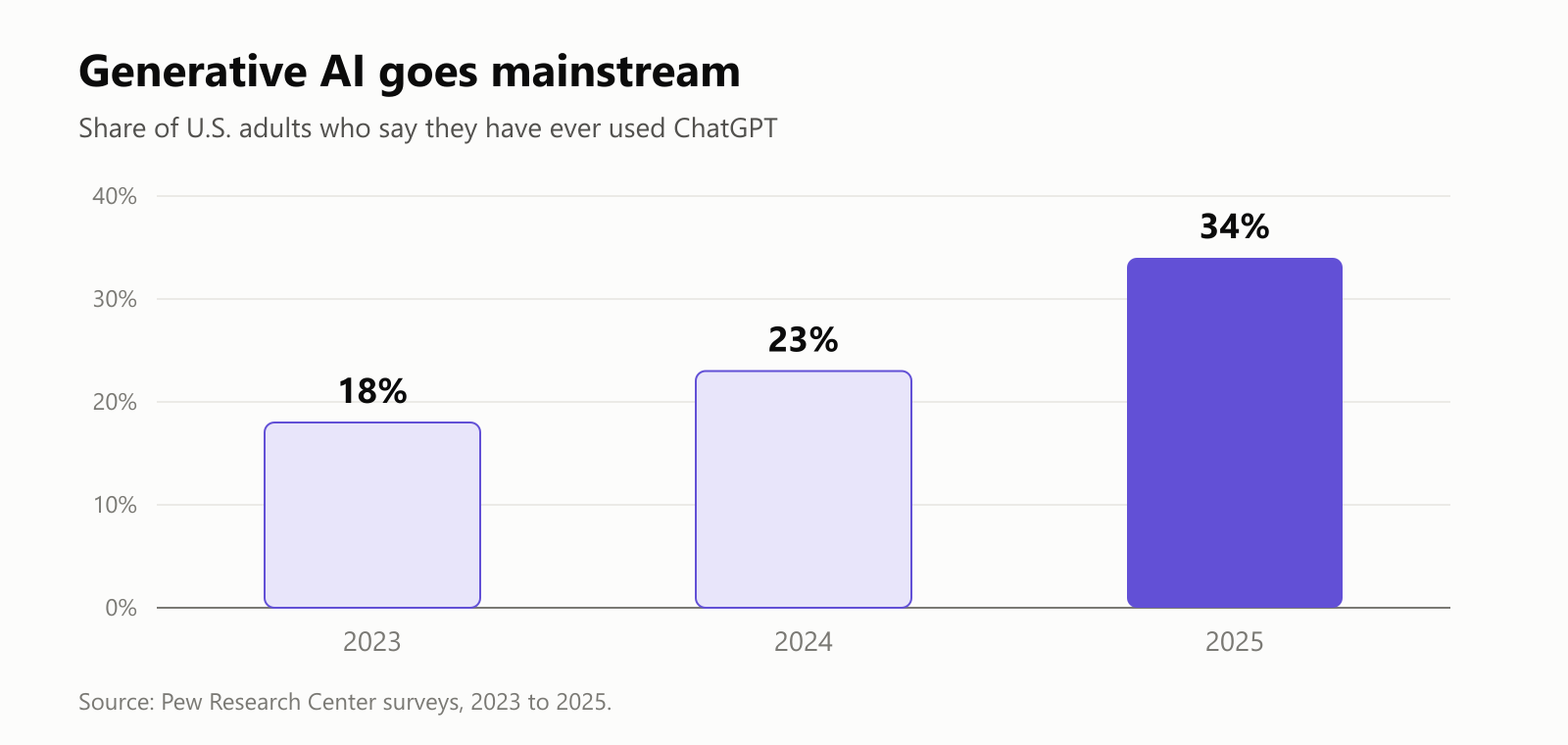
And people have embraced it quickly:
What it's good at, and where it goes wrong
| Generative AI is great for | Watch out for |
|---|---|
| First drafts of emails, posts and reports | Confident-sounding facts that are wrong |
| Brainstorming ideas and names | Bland, generic results without a good request |
| Summarizing and rewording long text | Copying the style or work of real artists and writers |
| Quick illustrations and mockups | Strange details, like extra fingers or garbled text in images |
| Explaining things in simpler words | Bias picked up from its training data |
| Translating and fixing grammar | Fake images, audio and video used to deceive |
A few of these deserve a closer look:
- Made-up facts ("hallucinations"): a generative model produces what's likely, not necessarily what's true. It can invent a quote, a statistic or even a book that doesn't exist, and say it with complete confidence.
- Deepfakes: realistic fake photos, voices and videos of real people. In 2024, police in Hong Kong reported that a finance employee was tricked into sending about 25 million US dollars after a video call in which the "colleagues" were deepfakes.
- Copyright and fairness: these models learned from enormous amounts of work made by real people, often without asking. Artists, authors and news organizations have taken AI companies to court, and the rules are still being worked out.
- Bias: if the training examples were lopsided, the output can be too. Ask for "a picture of a CEO", and some tools have shown mostly one kind of person.
How to tell if something was AI-generated
It's getting harder, but there are clues and tools:
- Look closely at images: hands, text, jewelry, reflections and backgrounds often have small mistakes.
- Check the source: who posted it first? Do trustworthy news sites report the same thing?
- Look for labels: many platforms now mark AI-generated content, and some companies add invisible watermarks (Google calls its version SynthID). An industry standard called Content Credentials (C2PA) attaches information about how an image was made.
- Be cautious with urgency: an unexpected voice message or video from a "family member" or "boss" asking for money right away is a classic scam pattern, now with AI help.
Using generative AI well
- Be specific. Say what you want, who it's for, the length, the tone and the style.
- Iterate. Treat the first result as a starting point and ask for changes.
- Stay in charge. You decide what to keep. The AI is a fast assistant, not the author of record.
- Check facts and give credit. Verify claims, and be open about using AI where it matters, like school or work.
- Respect people. Don't create fake content about real people, and think about the artists and writers whose work these tools learned from.
A small glossary
- Generative AI: AI that creates new content such as text, images, audio, video or code.
- Prompt: the request or description you give a generative AI.
- Large Language Model (LLM): the kind of generative AI that writes text, behind chatbots.
- Diffusion model: a type of image (or video) generator that turns random noise into a picture, step by step.
- GAN: generative adversarial network, an earlier method where two networks compete to make realistic content.
- Temperature: a setting that controls how random and varied the output is.
- Hallucination: when generative AI states something false as if it were true.
- Deepfake: realistic fake media of a real person, made with AI.
- Watermark / Content Credentials: hidden marks or attached information that show content was made with AI.
Wrapping up
Generative AI is AI that creates: words, pictures, sounds, video and code, from a simple description. It works by learning the patterns in enormous numbers of examples and producing new content that fits those patterns, one word at a time for text, or from static to picture for images.
It's a genuinely useful creative partner for drafting, brainstorming and explaining. But it doesn't know what's true, it can be misused, and it raises real questions about creativity and fairness. Use it like a talented assistant who works fast and occasionally makes things up: give clear directions, check the work, and keep the final say for yourself.
Read next
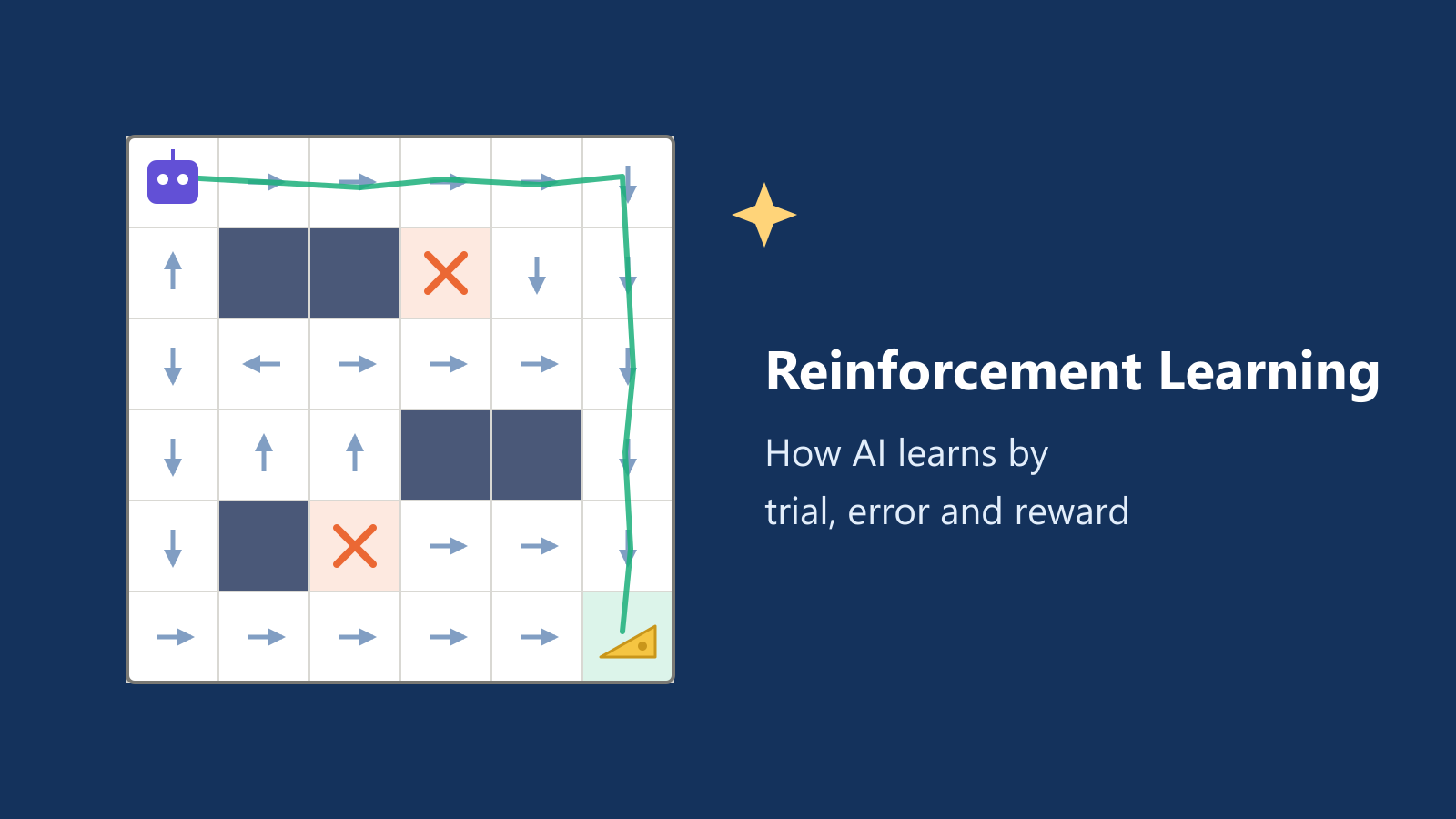
What Is Reinforcement Learning? How AI Learns by Trial, Error and Reward
A friendly, jargon-free introduction to reinforcement learning, how AI learns by trial, error and reward, like training a dog with treats. Watch a real robot learn a maze, see why exploring matters, and learn how it shapes chatbots.
 nbkhope
What Is Graph Engineering? How Today's AI Teams Up to Get Real Work Done
A friendly, jargon-free guide to graph engineering, the 2026 idea of building AI as a map of connected steps instead of one big loop. See how today's AI agents work, why small mistakes add up, and how checkers, branches and teamwork fix it.
nbkhope
What Is Loop Engineering? How AI Agents Keep Working Until the Job Is Done
A friendly, jargon-free guide to loop engineering, the 2026 idea of designing the loop that lets an AI agent keep working until a job is done, with clear goals, real feedback, smart stop rules and knowing when to ask a person.
nbkhope
Comments
Be kind and specific. Comments with links from new accounts appear after a moderator reviews them.