What Is NVIDIA? A Simple Guide to the Chip Company Powering AI
A friendly, jargon-free guide to NVIDIA, the company whose chips power video games and almost all of today's AI. Learn what a GPU is, see a real speed test of CPU vs GPU, find out why AI needs these chips and how NVIDIA became worth over $5 trillion.

On this page
A few years ago, NVIDIA was a name mostly known to video gamers, printed on the graphics cards inside their computers. Today it is one of the most valuable companies in the world. The reason is AI: almost every famous AI system, from ChatGPT to self-driving car software, was trained on NVIDIA chips.
This article explains, in plain language, what NVIDIA makes, why a chip designed for video games turned out to be perfect for AI and how the company became so important.
What is NVIDIA?
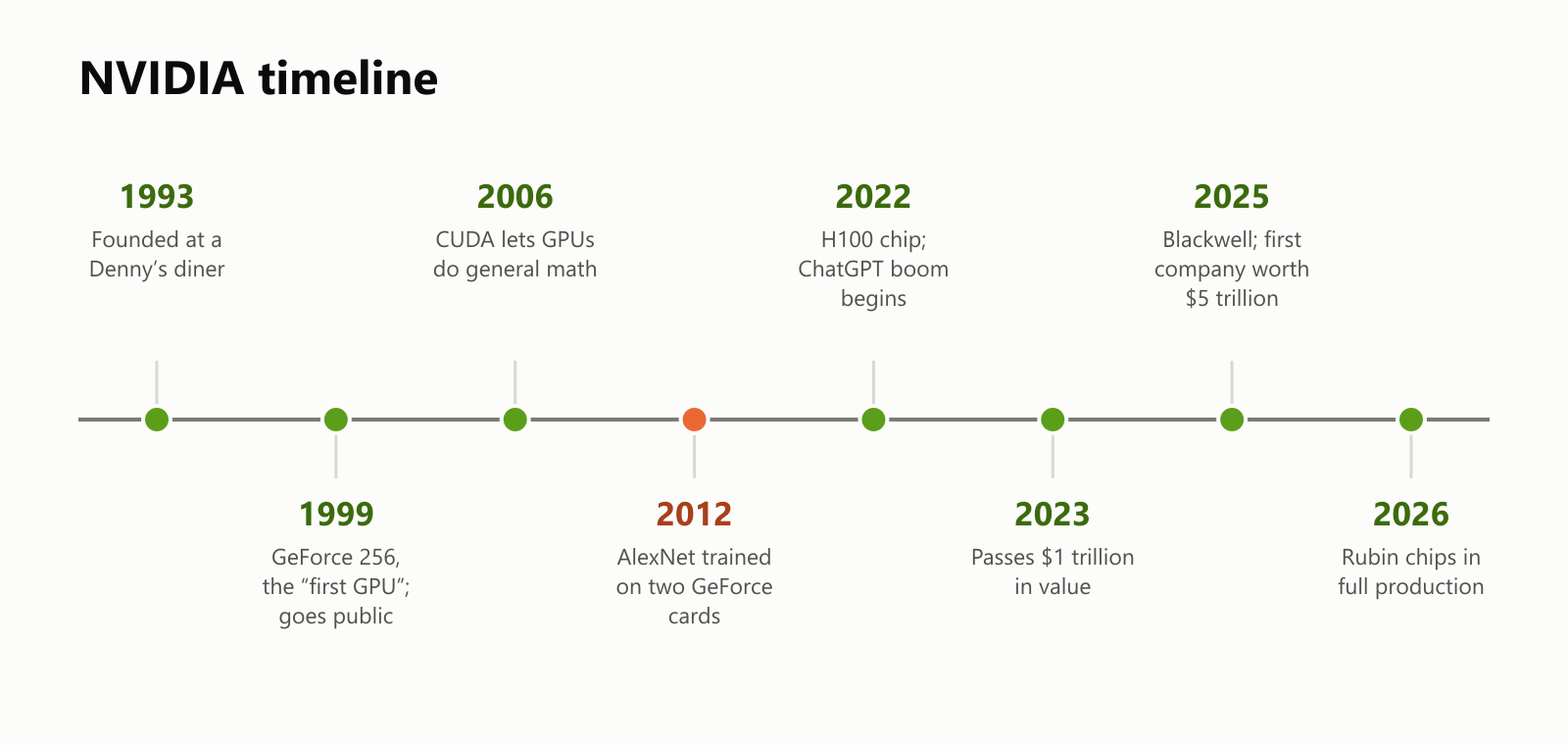
NVIDIA (pronounced "en-VID-ee-uh") is an American technology company based in Santa Clara, California. It was founded in 1993 by three engineers, Jensen Huang, Chris Malachowsky and Curtis Priem, who famously planned the company over meals at a Denny's diner in San Jose. Jensen Huang has been its chief executive ever since, which makes him one of the longest-serving founder-CEOs in the tech industry.
NVIDIA's best-known product is the GPU, short for graphics processing unit. Its GeForce graphics cards are among the most popular for gaming PCs. But today most of its money comes from much bigger GPUs that fill data centers, the giant warehouses of computers where AI models are trained and run.
CPU vs GPU: what's the difference?
Every computer has a CPU (central processing unit), the main processor. Many also have a GPU. Both do calculations, but in very different ways.
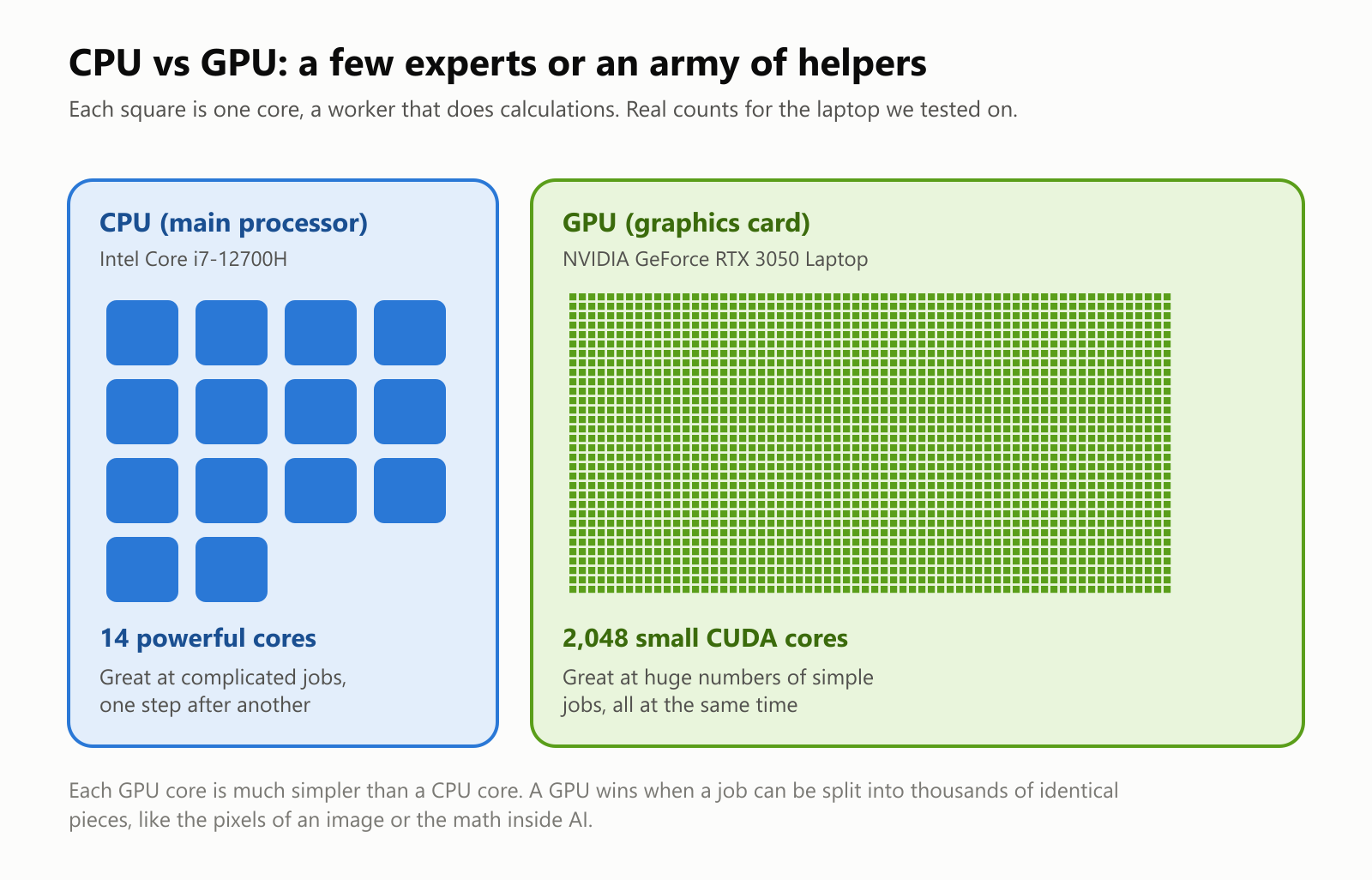
Think of a CPU as a small team of brilliant experts. Each one can handle complicated, step-by-step work, like running your operating system or opening a web page. A GPU is more like an army of thousands of helpers. Each one is much simpler, but together they can do a huge number of easy jobs at the same time.
The laptop we used for this article shows the difference: its Intel CPU has 14 cores, while its small NVIDIA GPU has 2,048.
Why video games needed GPUs
GPUs were invented for graphics, and graphics is the perfect job for an army of helpers.
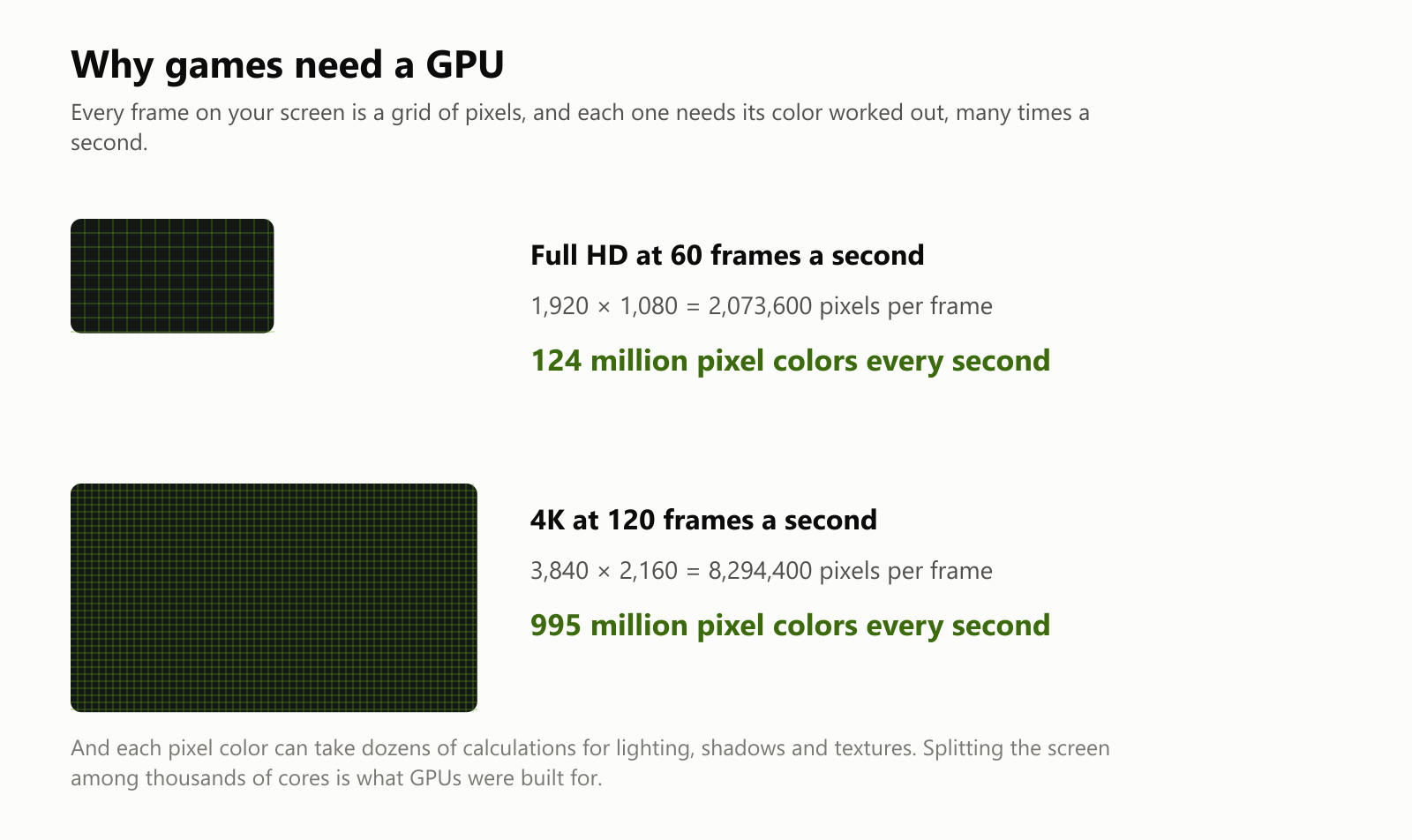
A screen is a grid of tiny dots called pixels. To show a moving game, the computer has to work out the color of every pixel many times a second, taking into account lighting, shadows and textures. At 4K resolution and 120 frames a second, that's about a billion pixel colors every second. Each pixel can be worked out independently, so the job can be split among thousands of cores. In 1999 NVIDIA released the GeForce 256, which it marketed as the world's first GPU.
From games to AI: CUDA and AlexNet
In 2006 NVIDIA released CUDA, free software that lets programmers use the GPU's thousands of cores for any kind of math, not just graphics. At first it was mostly used by scientists for things like weather and physics simulations.
Then, in 2012, a team at the University of Toronto entered a famous image-recognition contest with a neural network called AlexNet. They trained it on two ordinary NVIDIA GeForce gaming cards, and it beat every other entry by a huge margin. That moment is often seen as the start of the modern AI boom. (See What Is Deep Learning? and What Is Computer Vision?)
Why do GPUs fit AI so well? Because the core of AI is enormous amounts of simple math, mostly multiplying big tables of numbers, called matrices, together. That's exactly the kind of work that can be split among thousands of cores.
A real speed test: CPU vs GPU
We measured this ourselves on our laptop. First, we multiplied two tables of 4,096 × 4,096 numbers, which takes about 137 billion arithmetic operations, the same kind of math that happens inside AI models.
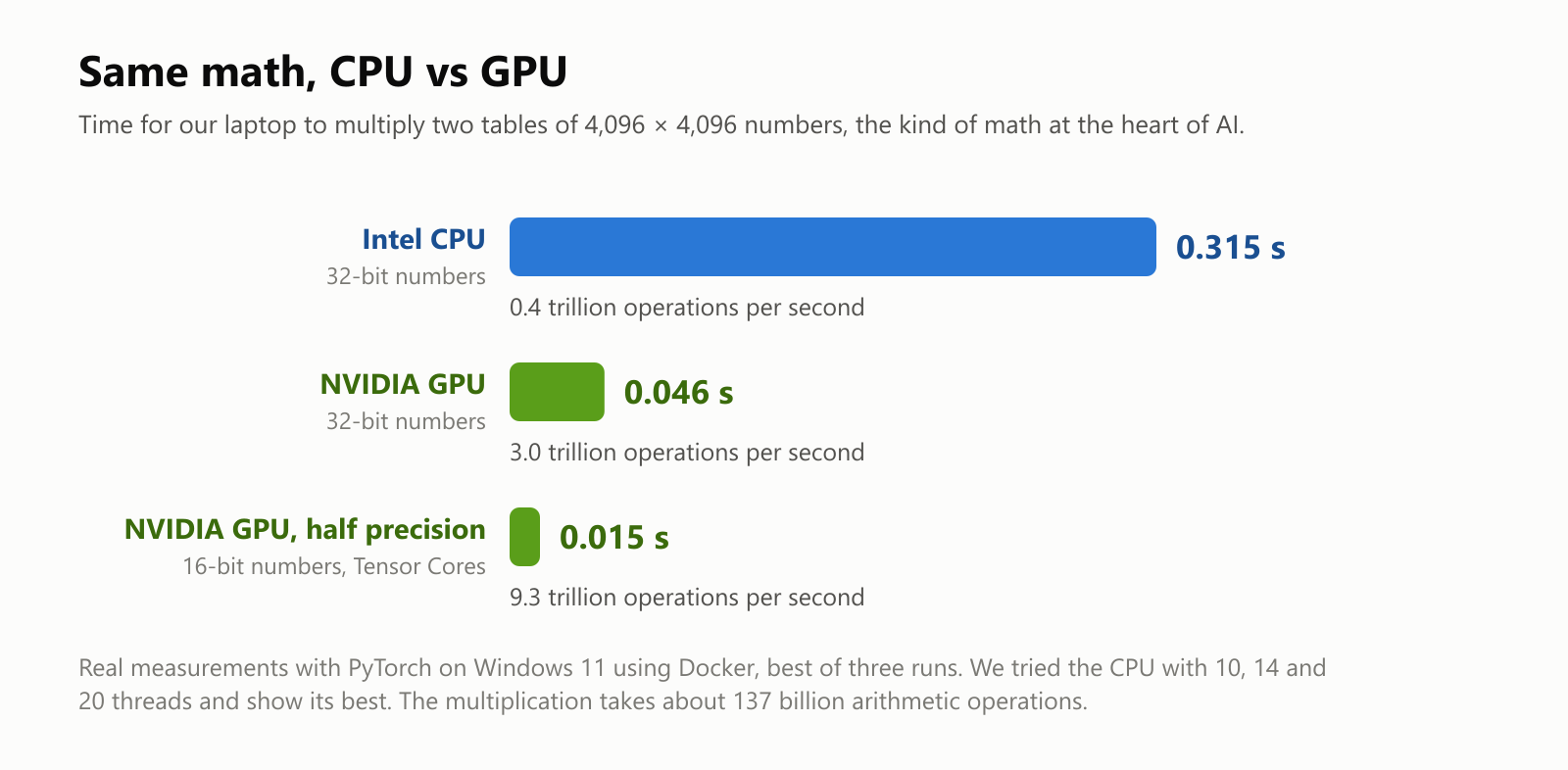
The CPU took about a third of a second. The small NVIDIA GPU in the same laptop did the same work in 0.046 seconds, almost 7 times faster. When we let it use 16-bit numbers, which is what AI usually runs on, its special Tensor Cores kicked in and it finished in 0.015 seconds, about 21 times faster than the CPU, doing over 9 trillion operations per second.
Then we tried a real AI task: OpenAI's GPT-2, a small language model from 2019, writing text.
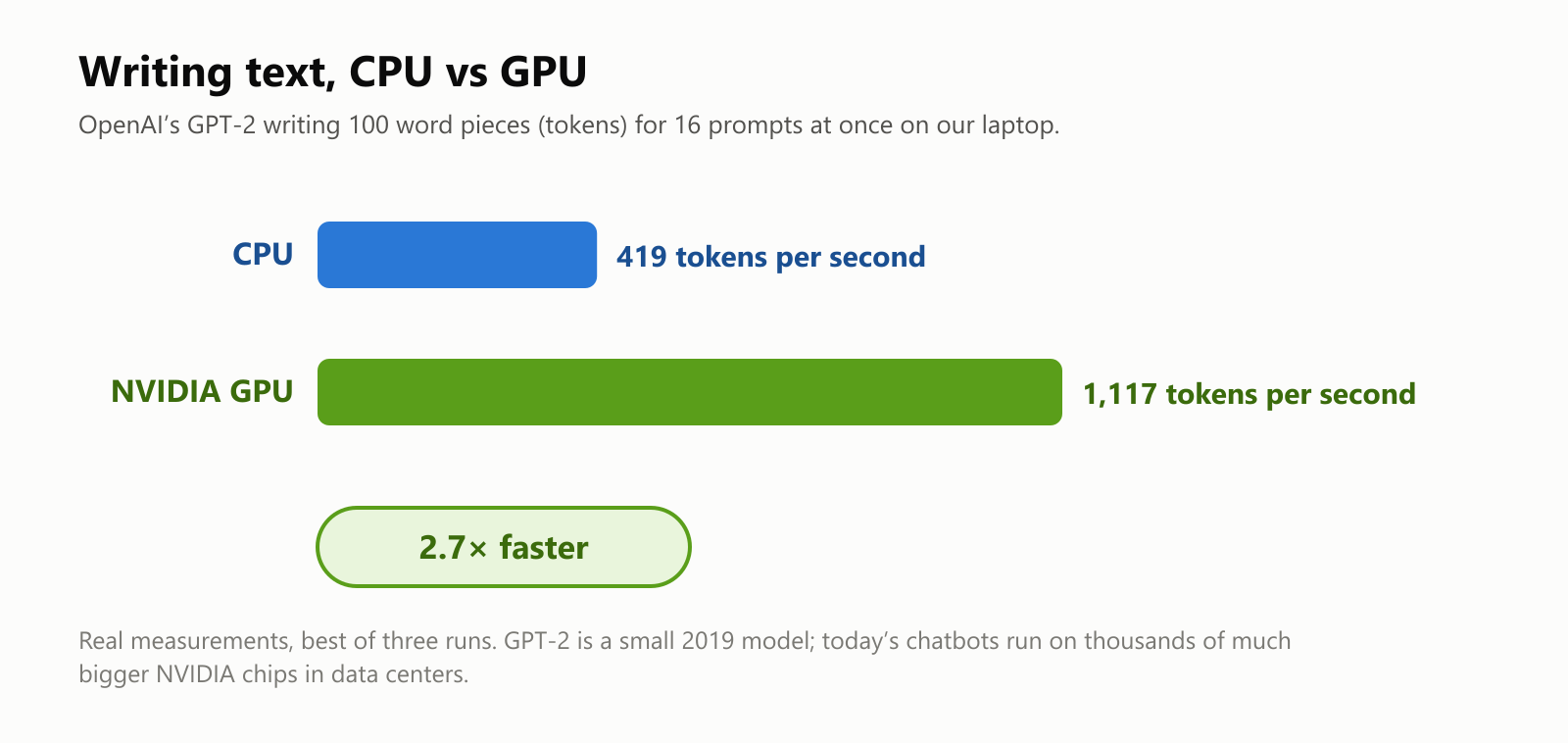
The GPU wrote about 2.7 times as many tokens (pieces of words) per second as the CPU. The gap is smaller than in the pure math test, because writing text one token at a time involves many small steps where a GPU can't use all of its cores at once.
And this was a small laptop GPU from 2021. The chips in AI data centers are vastly more powerful, and companies connect thousands of them together.
The chips behind AI
NVIDIA's data center GPUs have names like A100, H100, Blackwell and Rubin. They are some of the most complex objects humans have ever made.
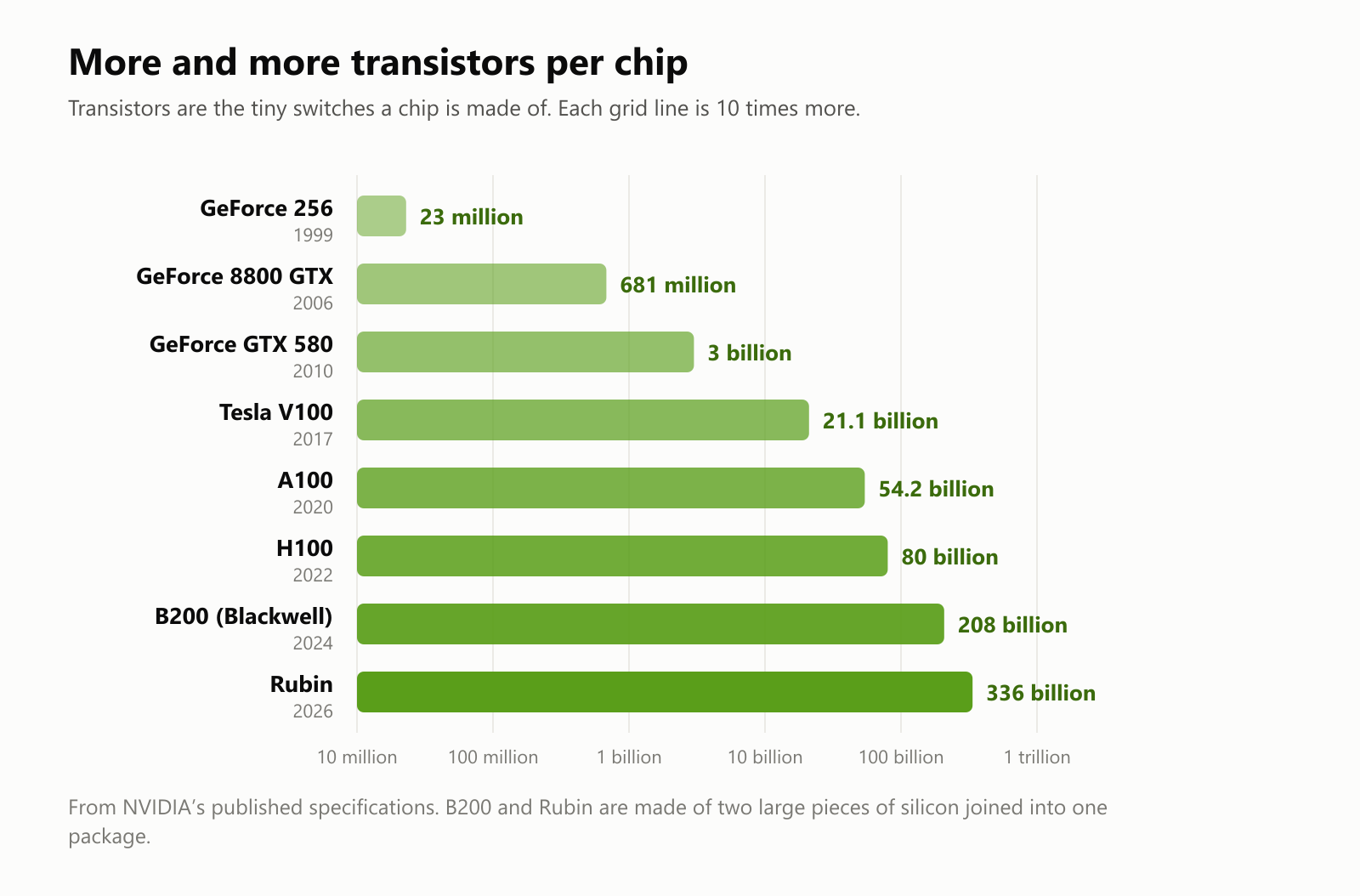
A transistor is a microscopic switch, the basic building block of every chip. The GeForce 256 had 23 million of them. A Rubin GPU, NVIDIA's newest design, which went into full production in 2026, has 336 billion, more than 14,000 times as many. A single top AI chip sells for tens of thousands of dollars.
NVIDIA doesn't build these chips in its own factories. Like many chip companies, it is fabless: it designs the chips, and other companies make them.
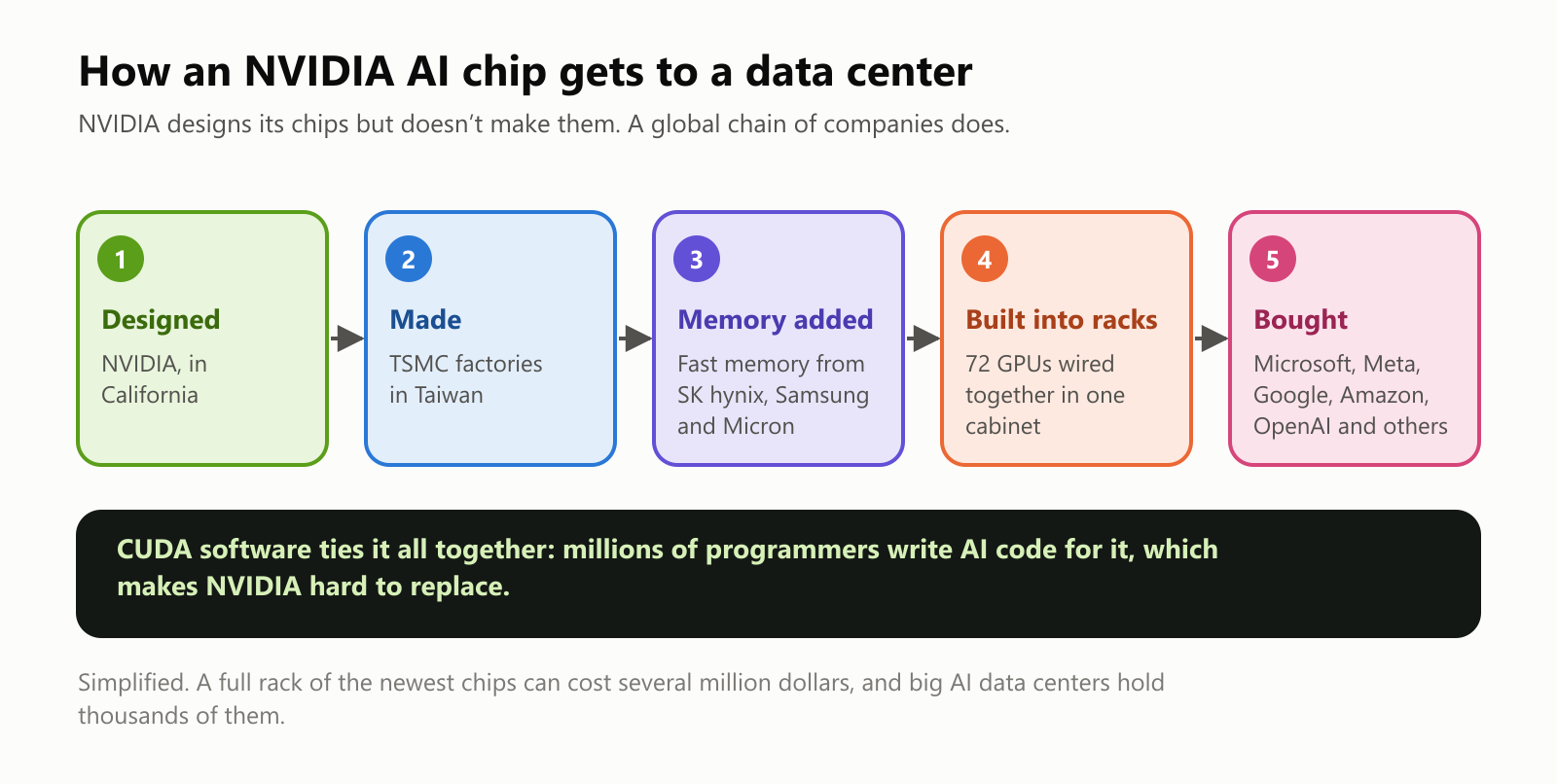
NVIDIA's real advantage isn't only the chips. It's CUDA, the software that almost all AI programs are built on, plus the high-speed networking that links thousands of GPUs into one giant machine. Competitors such as AMD, Intel and the custom chips made by Google, Amazon and others can build fast hardware, but moving years of software to a new platform is slow and expensive.
A business that exploded with AI
When ChatGPT launched at the end of 2022, every big tech company rushed to build AI, and they all needed NVIDIA chips. Here's what happened to NVIDIA's revenue:
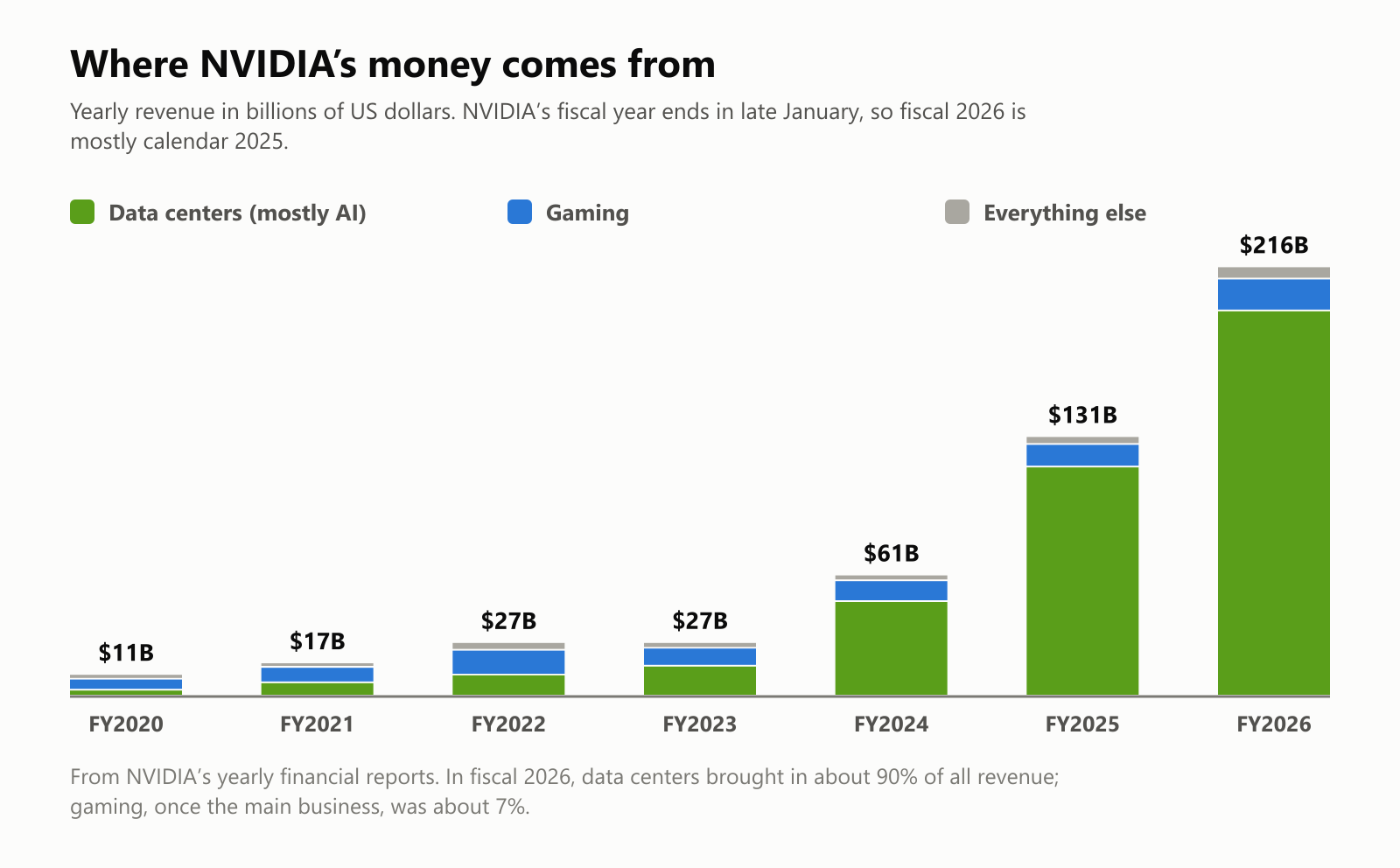
In just three years, yearly revenue grew eightfold, from about $27 billion to almost $216 billion. Gaming, once the main business, still grew, but data centers now bring in about 90% of the money. NVIDIA's fiscal year ends in late January, so "fiscal 2026" is mostly calendar 2025. The growth kept going: in the quarter that ended in April 2026, NVIDIA reported $81.6 billion in revenue, up 85% from a year earlier.
Investors noticed. NVIDIA's stock market value, the total worth of all its shares, soared.
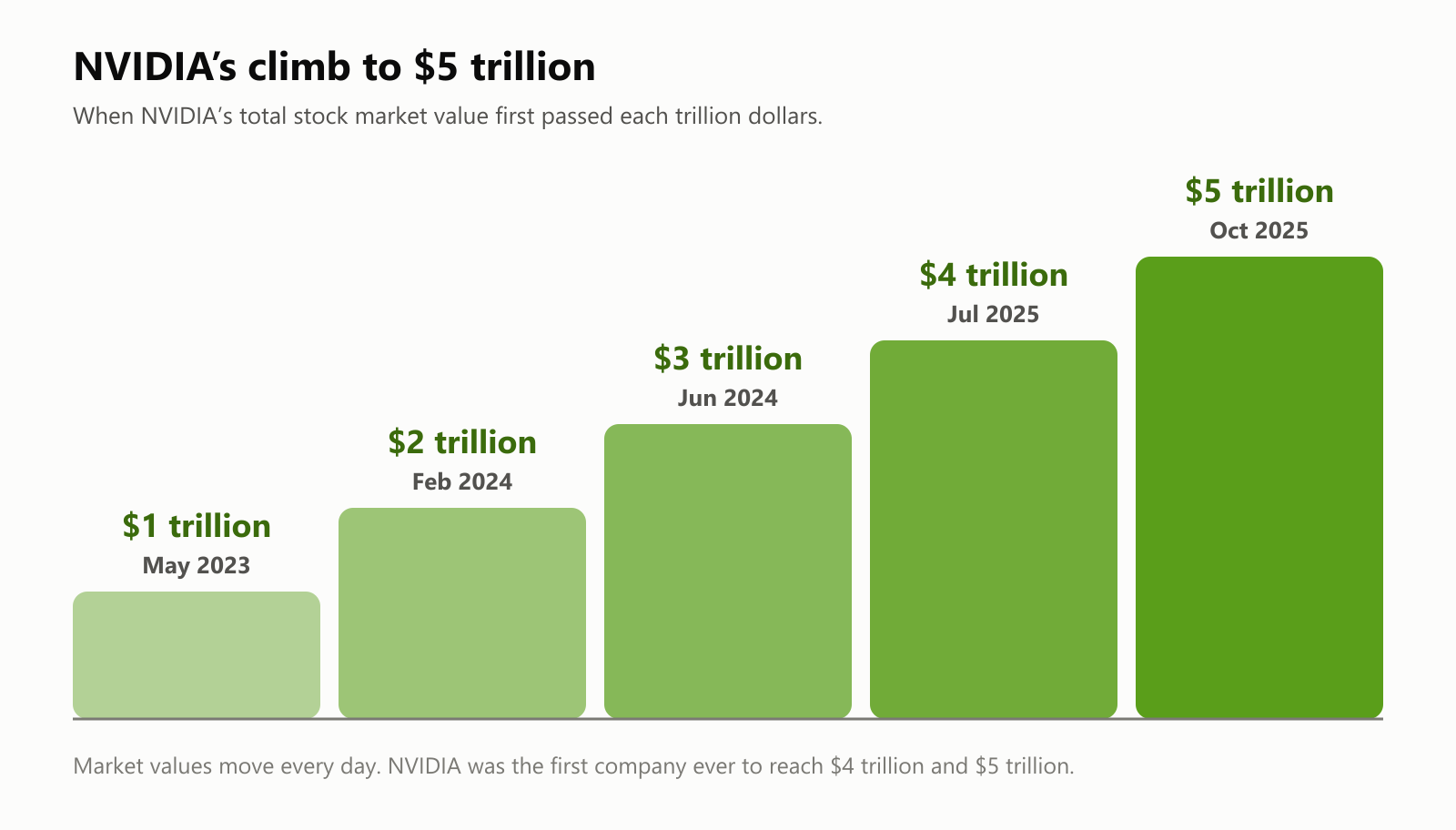
In July 2025 NVIDIA became the first company ever worth $4 trillion, and in October 2025 the first worth $5 trillion. For comparison, that's more than the yearly economic output of almost every country.
Challenges and debates
- Depending on a few customers: a handful of giant companies, such as Microsoft, Meta, Google and Amazon, buy a large share of NVIDIA's chips, and several are designing their own chips to depend on NVIDIA less.
- Depending on Taiwan: NVIDIA's most advanced chips are made by TSMC in Taiwan, so tensions in that region are a risk for the whole AI industry.
- China and export rules: the US government restricts which AI chips can be sold to China, and China has pushed its companies to use local chips instead. NVIDIA's sales there have dropped sharply.
- Is it a bubble? Some investors worry that companies are spending more on AI chips than AI will earn back. Others point out that NVIDIA's profits are real and still growing.
- Energy: AI data centers full of GPUs use enormous amounts of electricity, which raises concerns about power grids and the environment.
A short history
Try it yourself
- Check your own computer. On Windows, open Task Manager, click Performance and look for a GPU entry. On a Mac, click the Apple menu, then About This Mac.
- Watch your GPU work. Keep Task Manager open on the GPU page while you watch a video or play a game, and see its usage go up.
- Try AI in your browser. Many free AI demos, like the ones on Hugging Face, run on NVIDIA GPUs in the cloud.
- Programmers: if you have an NVIDIA graphics card, install PyTorch with CUDA support and try moving a calculation to the GPU with
.to("cuda").
Common questions
Do I need an NVIDIA card to use ChatGPT? No. Chatbots run on GPUs in the company's data centers. Your phone or computer just sends and receives text.
Is a GPU the same as a graphics card? Almost. The GPU is the chip; a graphics card is the board that holds the GPU, its memory and its fans.
Does NVIDIA make the processor in my computer? Usually not. Most PC processors come from Intel or AMD, and Macs use Apple's own chips. NVIDIA mainly makes GPUs, although it also makes some processors for data centers, cars and devices like the Nintendo Switch.
Why are NVIDIA's AI chips so expensive? They are among the most complex chips ever made, demand has been far greater than supply and the software around them is hard to replace.
Who are NVIDIA's competitors? AMD makes competing GPUs, Intel makes AI chips too, and Google, Amazon, Microsoft and Meta design their own AI chips for their data centers.
Glossary
- CPU: the main processor of a computer, great at complicated, step-by-step tasks.
- CUDA: NVIDIA's software platform for using GPUs for any kind of math, especially AI.
- Core: a single worker inside a processor that does calculations.
- Data center: a large building full of computers that run websites, apps and AI.
- Fabless: a chip company that designs chips but has other companies manufacture them.
- GPU: a graphics processing unit, a chip with thousands of simple cores that work in parallel.
- Matrix: a table of numbers; multiplying matrices is the main math inside AI.
- Tensor Core: a special part of newer NVIDIA GPUs built to do AI math even faster.
- Transistor: a microscopic switch; chips are made of billions of them.
Wrapping up
NVIDIA started by making video games look better, and it built chips that could do thousands of simple calculations at once. That same skill turned out to be exactly what modern AI needs. Thanks to its GPUs and its CUDA software, NVIDIA became the company that nearly all of AI is built on, and one of the most valuable companies in history.
Next time you see an AI tool write, draw or talk, there's a very good chance an NVIDIA chip somewhere did the math.
Read next

What Is a Transformer in AI? The Idea Behind ChatGPT, Explained Simply
A friendly, jargon-free guide to transformers, the AI design behind ChatGPT, Claude and Gemini. Learn how "attention" lets AI understand words in context, what happens inside a transformer, and why it changed AI so quickly.
 nbkhope
What Is Reinforcement Learning? How AI Learns by Trial, Error and Reward
A friendly, jargon-free introduction to reinforcement learning, how AI learns by trial, error and reward, like training a dog with treats. Watch a real robot learn a maze, see why exploring matters, and learn how it shapes chatbots.
nbkhope
What Is Graph Engineering? How Today's AI Teams Up to Get Real Work Done
A friendly, jargon-free guide to graph engineering, the 2026 idea of building AI as a map of connected steps instead of one big loop. See how today's AI agents work, why small mistakes add up, and how checkers, branches and teamwork fix it.
nbkhope
Comments
Be kind and specific. Comments with links from new accounts appear after a moderator reviews them.