What Is Anthropic? A Simple Guide to the Company Behind Claude
A friendly, jargon-free guide to Anthropic, the company behind the Claude AI models. Learn what it makes, why it talks so much about safety, what a constitution for an AI is, what people actually use Claude for and why the company is so often in the news.

On this page
Anthropic is the American company that makes Claude, a family of AI models you can chat with, much like ChatGPT. It was started in 2021 by a group of researchers who left OpenAI, and from the beginning it has described itself as an AI company focused on safety. In just five years it grew from a small research lab into one of the most valuable companies in the world.
This article explains, in plain language, what Anthropic is, what it makes, what its safety ideas actually mean and why it keeps showing up in the news.
What is Anthropic?
Anthropic is an artificial intelligence company based in San Francisco. Its name comes from the word anthropic, which means "relating to human beings." It was founded in 2021 by seven former OpenAI employees, led by the siblings Dario Amodei, who is the chief executive (CEO), and Daniela Amodei, the president. Dario had led research at OpenAI, including work on GPT-2 and GPT-3.
The founders left OpenAI because they wanted to build AI with a stronger focus on safety. Their bet is unusual: they believe powerful AI is coming whether or not they build it, so they would rather be at the frontier themselves, doing safety research on the most capable models and showing that a careful company can also succeed.
Anthropic is set up as a public benefit corporation (PBC), a type of company that must weigh a public mission alongside profits. The public purpose written into its founding documents is "the responsible development and maintenance of advanced AI for the long-term benefit of humanity." It also has a Long-Term Benefit Trust, a small group of independent people with no financial stake in the company, who over time elect a growing share of its board.
What does Anthropic make?
Almost everything Anthropic offers runs on its Claude models.
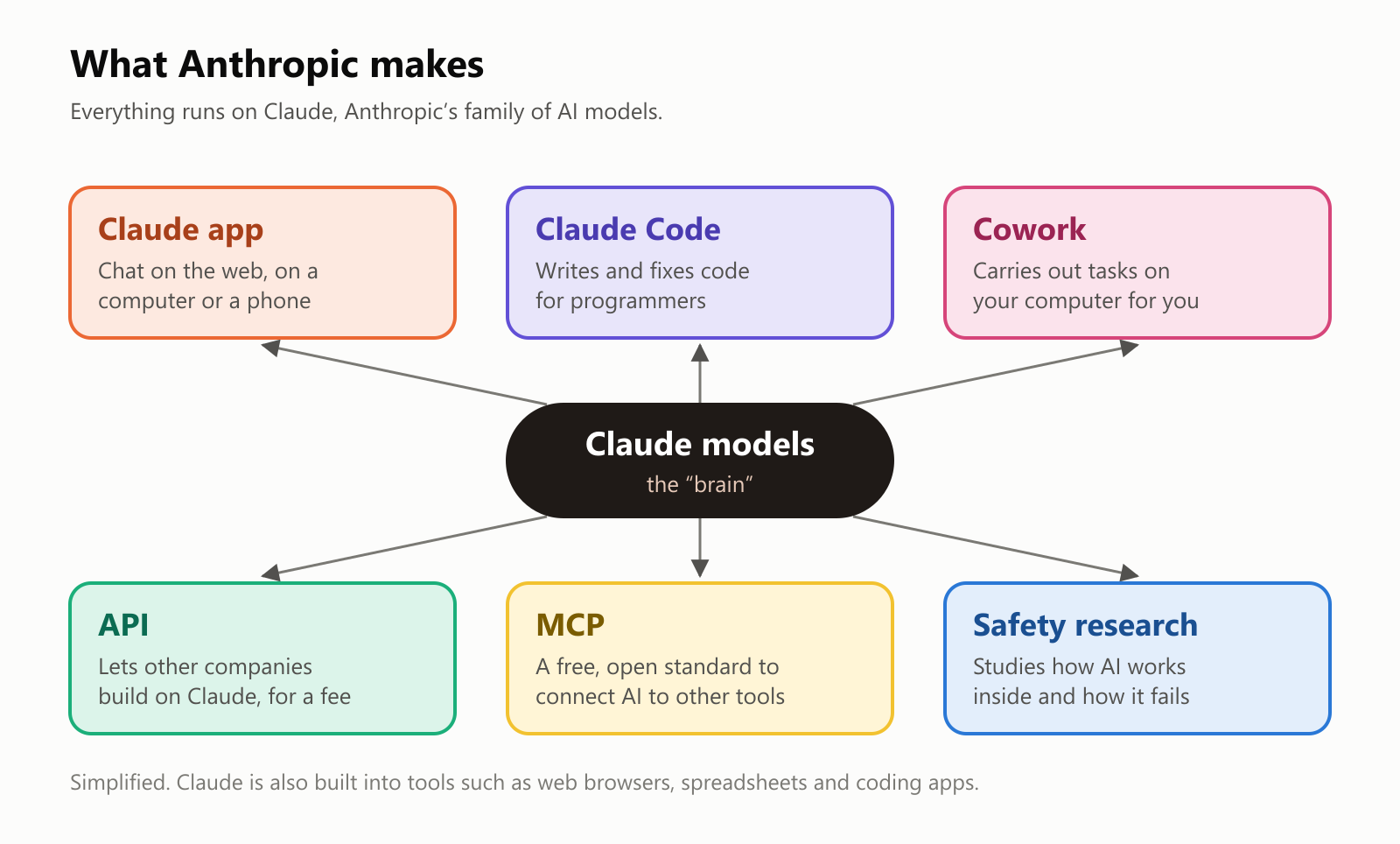
- The Claude app works in a web browser, as a computer program and on phones. You can ask it to explain, write, summarize, translate, analyze a document or help with a project. There is a free version and paid plans, starting with Pro at $20 a month.
- Claude Code is a tool for programmers. Instead of only suggesting code, it can read a whole project, make changes, run tests and fix mistakes, step by step. AI that carries out tasks on its own like this is called an agent.
- Cowork brings the same idea to people who don't write code, carrying out tasks such as organizing files or building documents on your computer.
- The API lets other businesses build Claude into their own apps and services and pay for what they use. Most of Anthropic's money comes from businesses and developers, not individual users.
- MCP, the Model Context Protocol, is a free, open standard Anthropic released in 2024 so AI apps can connect to other tools and data in a common way. Competitors such as OpenAI and Google adopted it too.
- Safety research is a big part of Anthropic's work, and much of it is published for anyone to read.
Haiku, Sonnet and Opus
Anthropic names its models after kinds of writing, from short to long.
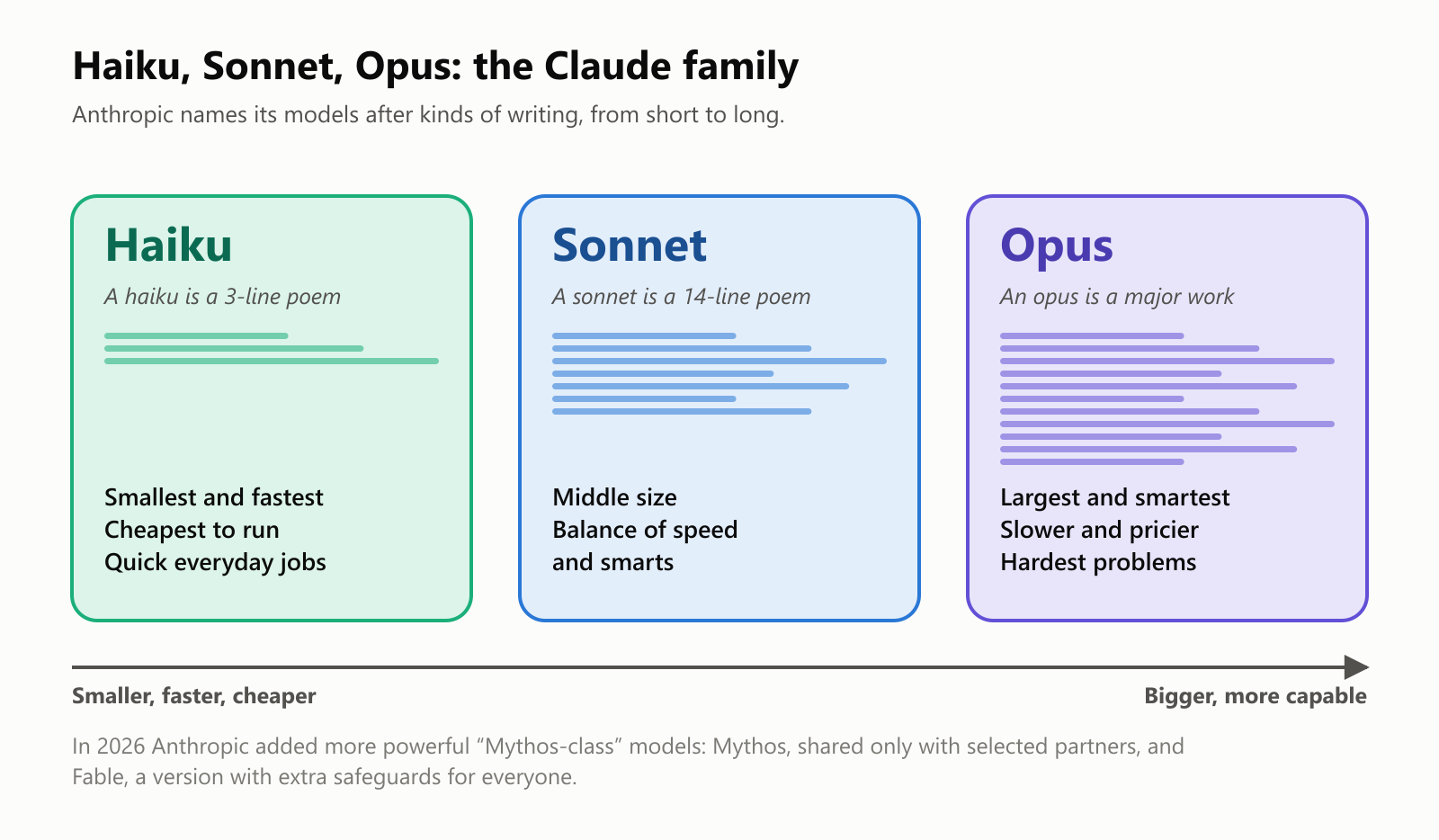
- Haiku models are small, fast and cheap, good for quick everyday jobs.
- Sonnet models balance speed and intelligence, and are the ones many people use most.
- Opus models are the biggest and most capable, used for the hardest problems.
New versions come out every few months. In 2026 Anthropic went a step further with Mythos, a model it considered so capable, especially at finding security holes in software, that it shared it only with selected partners at first. In June 2026 it released Claude Fable 5, a "Mythos-class" model with extra safeguards for everyone, and in July 2026 it released Claude Opus 5, which it said comes close to Fable 5 at half the price.
Claude models can also read a lot at once. The amount of text a model can look at in one go is called its context window, and it's measured in tokens, the small pieces of words that AI models read.
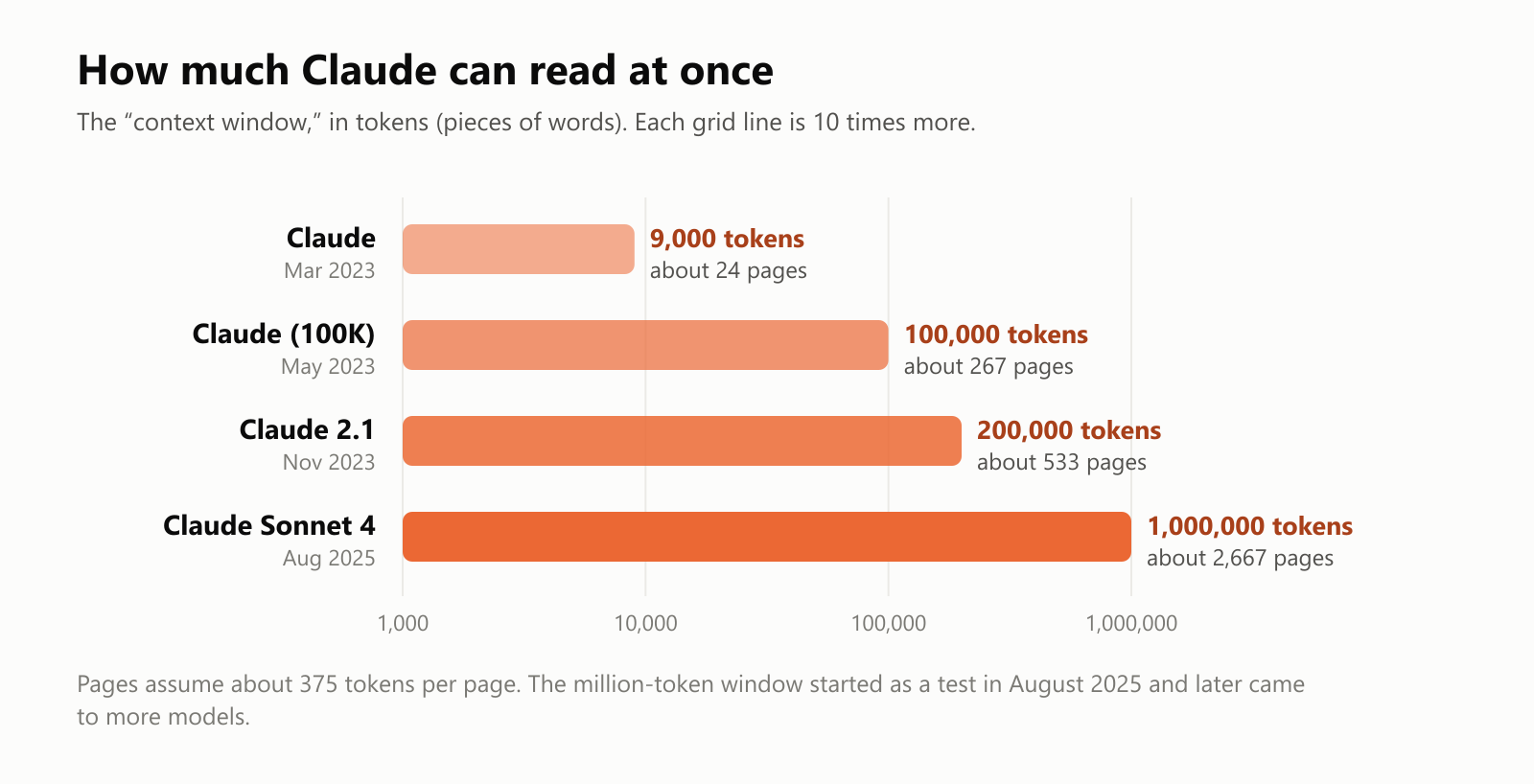
In 2023 Claude became one of the first AI assistants that could read an entire book in a single request. Today's largest context windows hold the equivalent of several thick novels.
Teaching an AI good values: Constitutional AI
Most AI chatbots learn good behavior partly from people who rate thousands of answers, a method called reinforcement learning from human feedback. (See What Is Reinforcement Learning?) In 2022 Anthropic published a different idea it called Constitutional AI.
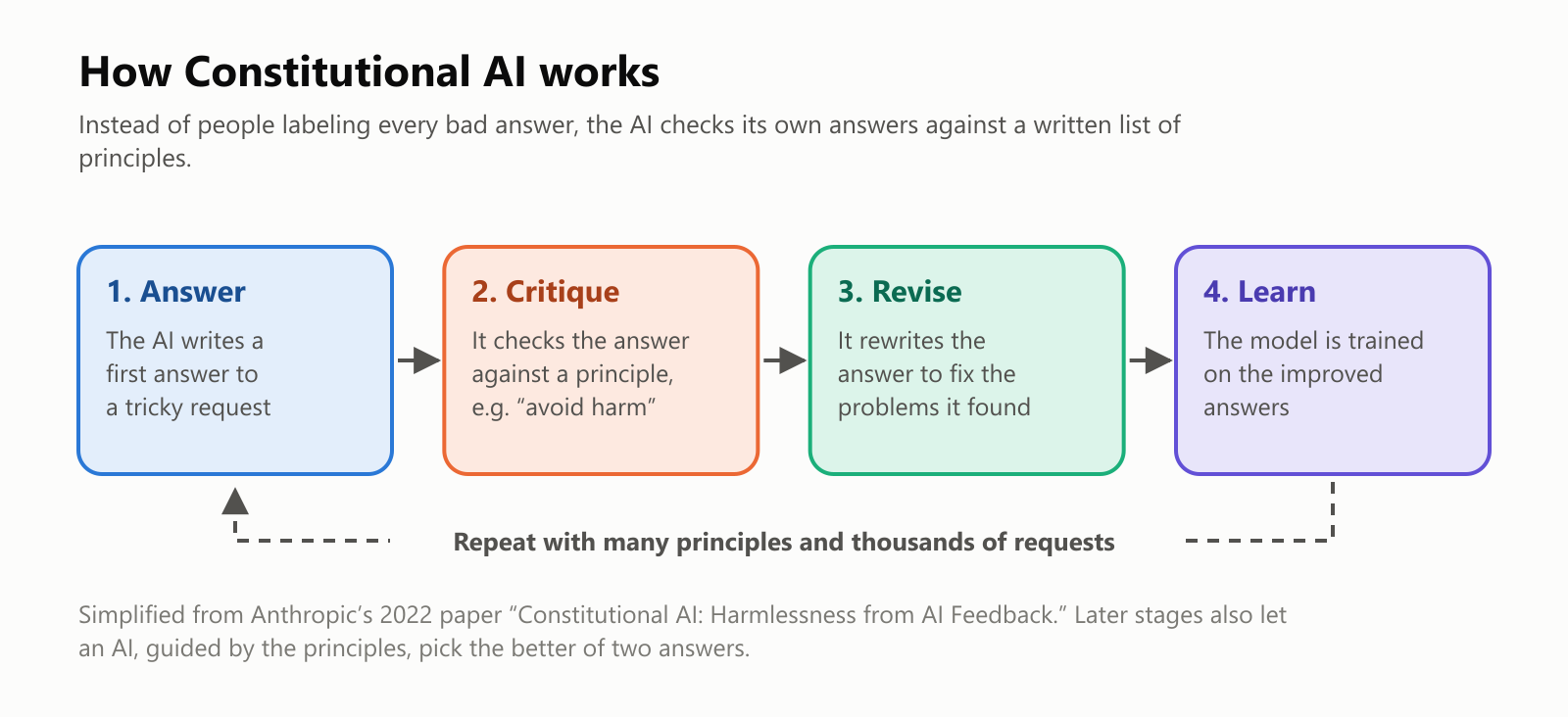
Instead of relying only on people to judge every answer, Anthropic wrote down a list of principles, a "constitution." The AI then critiques and improves its own answers using those principles, and it is trained on the better versions. This makes the rules the AI follows easier to see and discuss, because they are written in plain language.
In January 2026 Anthropic published a much longer, rewritten constitution for Claude, explaining not just rules but the reasoning behind them. It sets out four priorities:
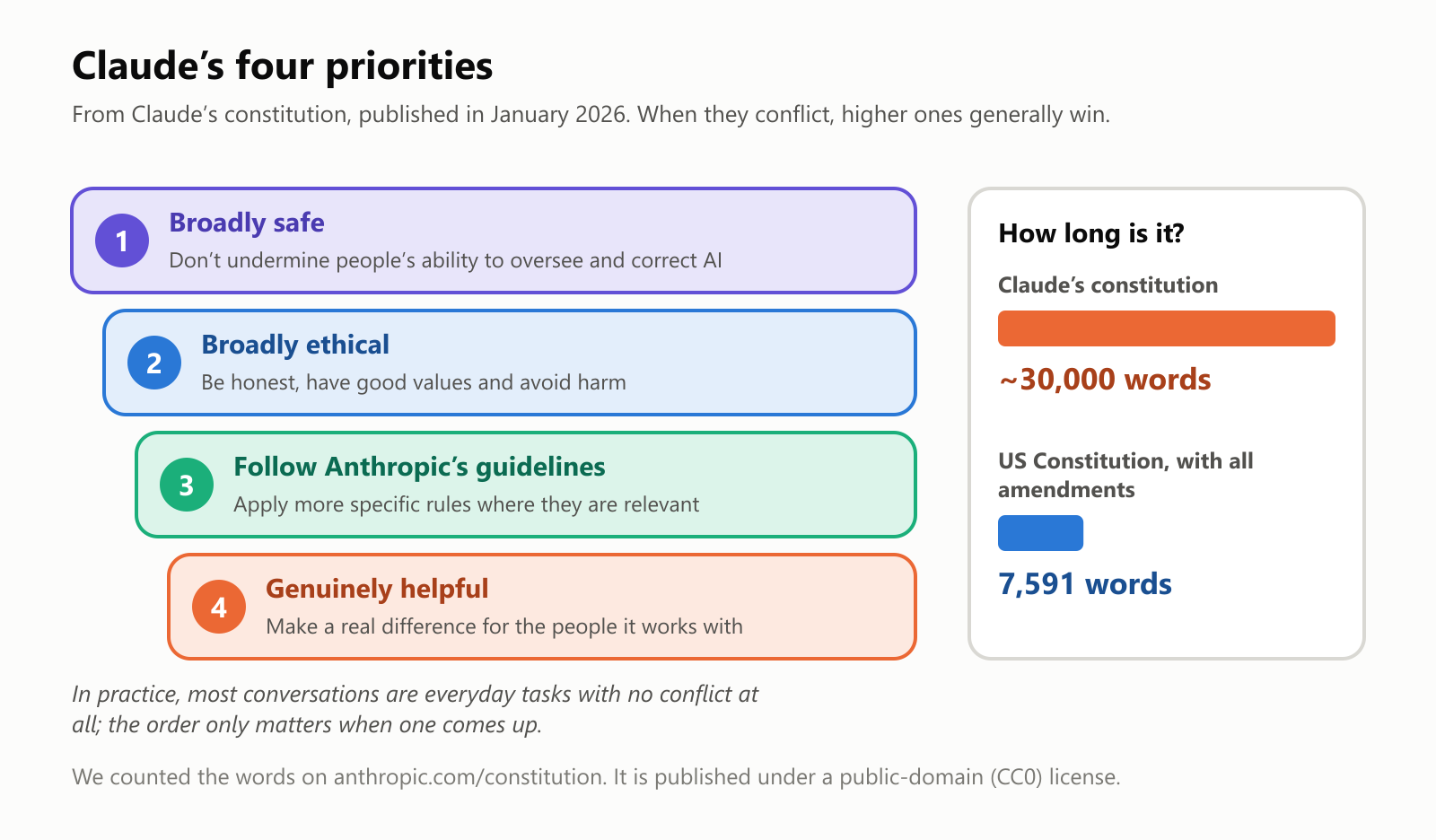
The document itself says most conversations are everyday tasks with no conflict between these goals, and that the order only matters when a real conflict comes up. We counted the words on the published page: about 30,000, roughly four times as long as the US Constitution with all its amendments. Anthropic released it into the public domain so anyone can reuse it.
Safety levels for AI
In 2023 Anthropic published a Responsible Scaling Policy. The idea is borrowed from the biosafety levels labs use for dangerous germs: the riskier an AI system could be, the stronger the protections must be before it is released.
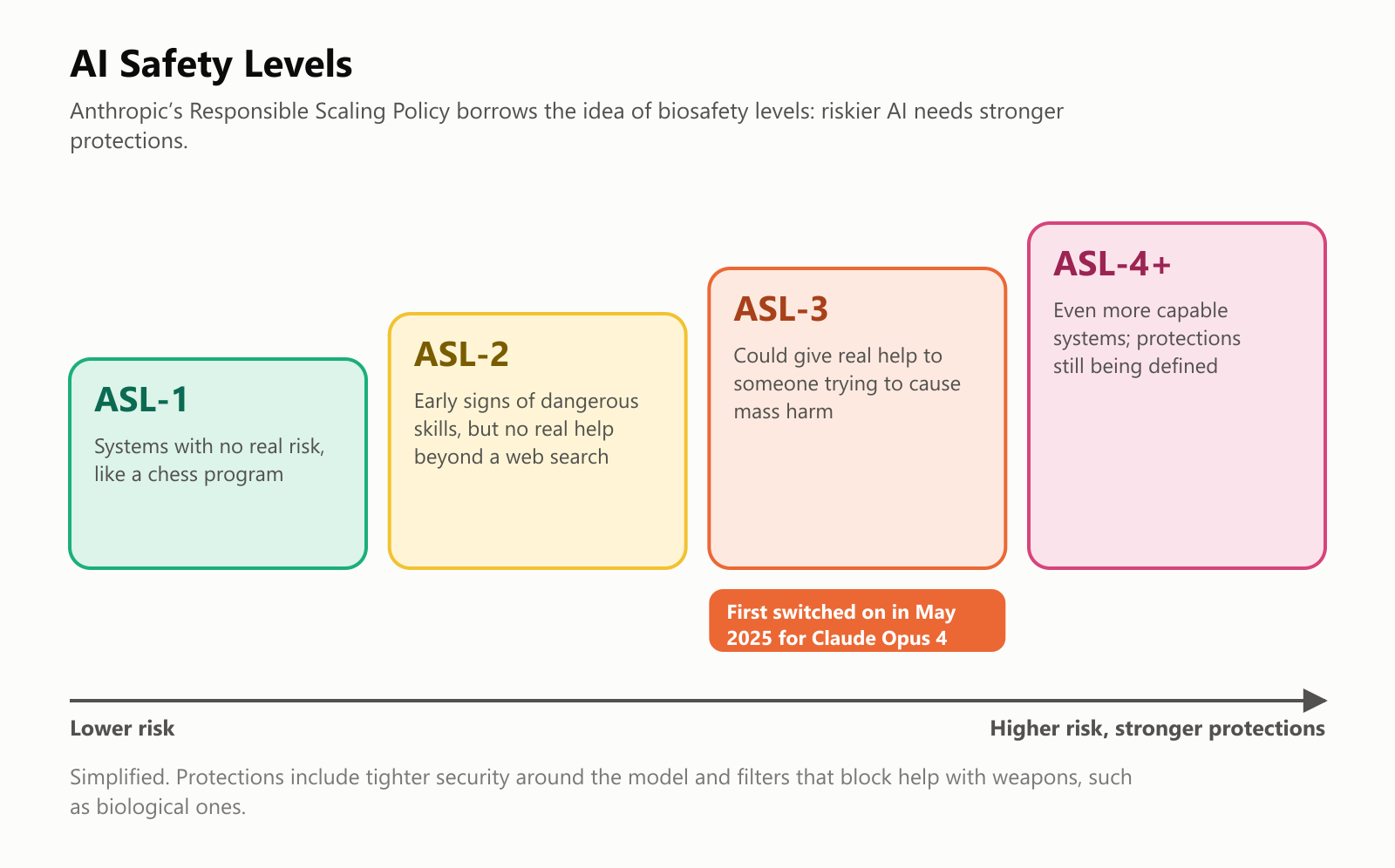
In May 2025, Anthropic turned on its ASL-3 protections for the first time when it released Claude Opus 4, as a precaution. Its tests couldn't rule out that the model might give meaningful help to someone trying to make a biological weapon, so it added tighter security and filters for those topics.
Anthropic also studies what happens inside AI models, a field called interpretability. In a famous 2024 demonstration, researchers found the pattern inside Claude linked to the Golden Gate Bridge and turned it up. The resulting "Golden Gate Claude" brought the bridge into almost every answer. It was a joke with a serious point: if researchers can find and adjust ideas inside a model, they may one day be able to check whether it is being honest.
What people actually use Claude for
Anthropic publishes regular data about how people use Claude, called the Anthropic Economic Index. Conversations are sorted into topics automatically, by a system designed so that no person reads them, and only totals are released. We downloaded the data published in June 2026 and computed the shares for May 2026:
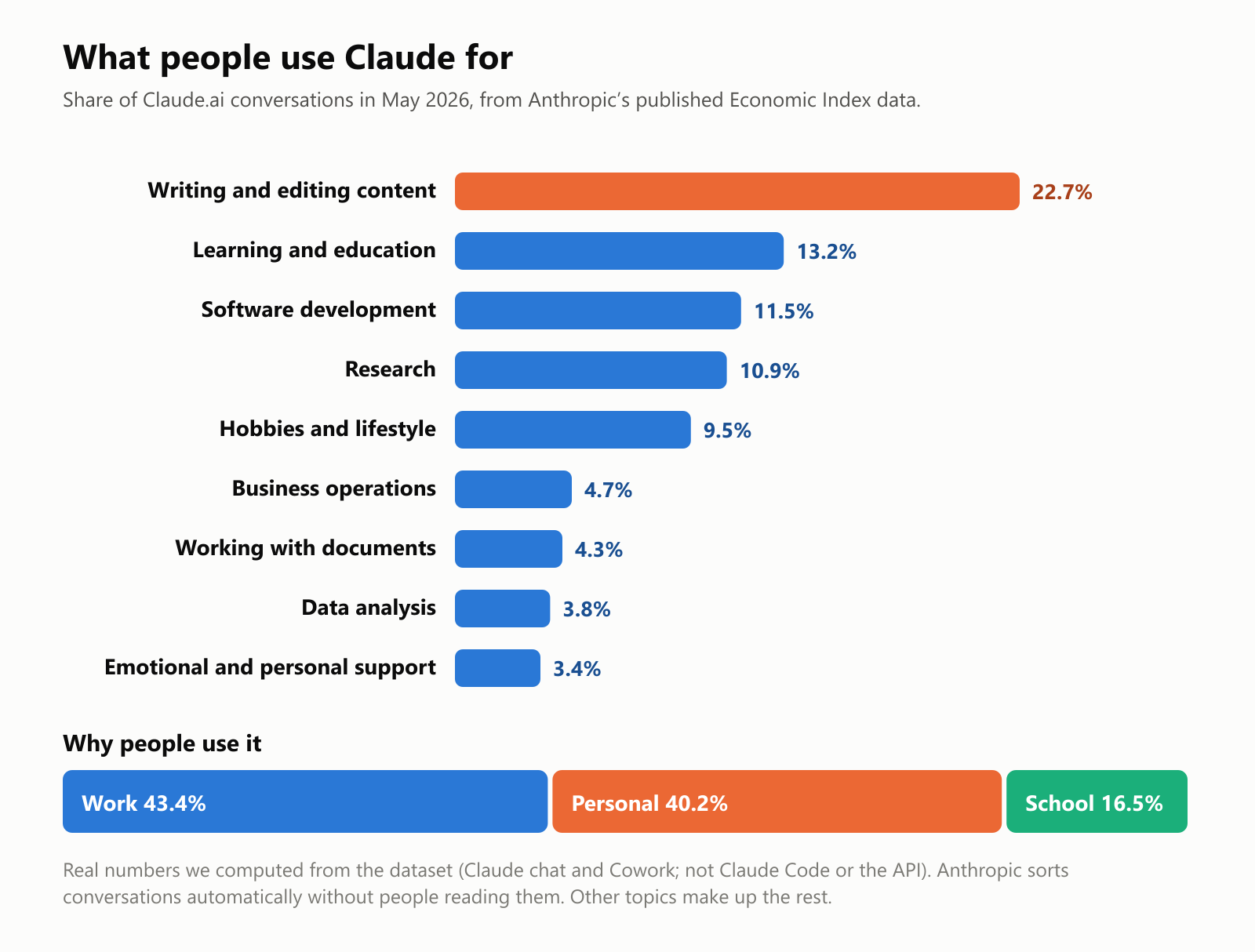
Writing is the biggest use, followed by learning and programming. The split between work and personal life is almost even.
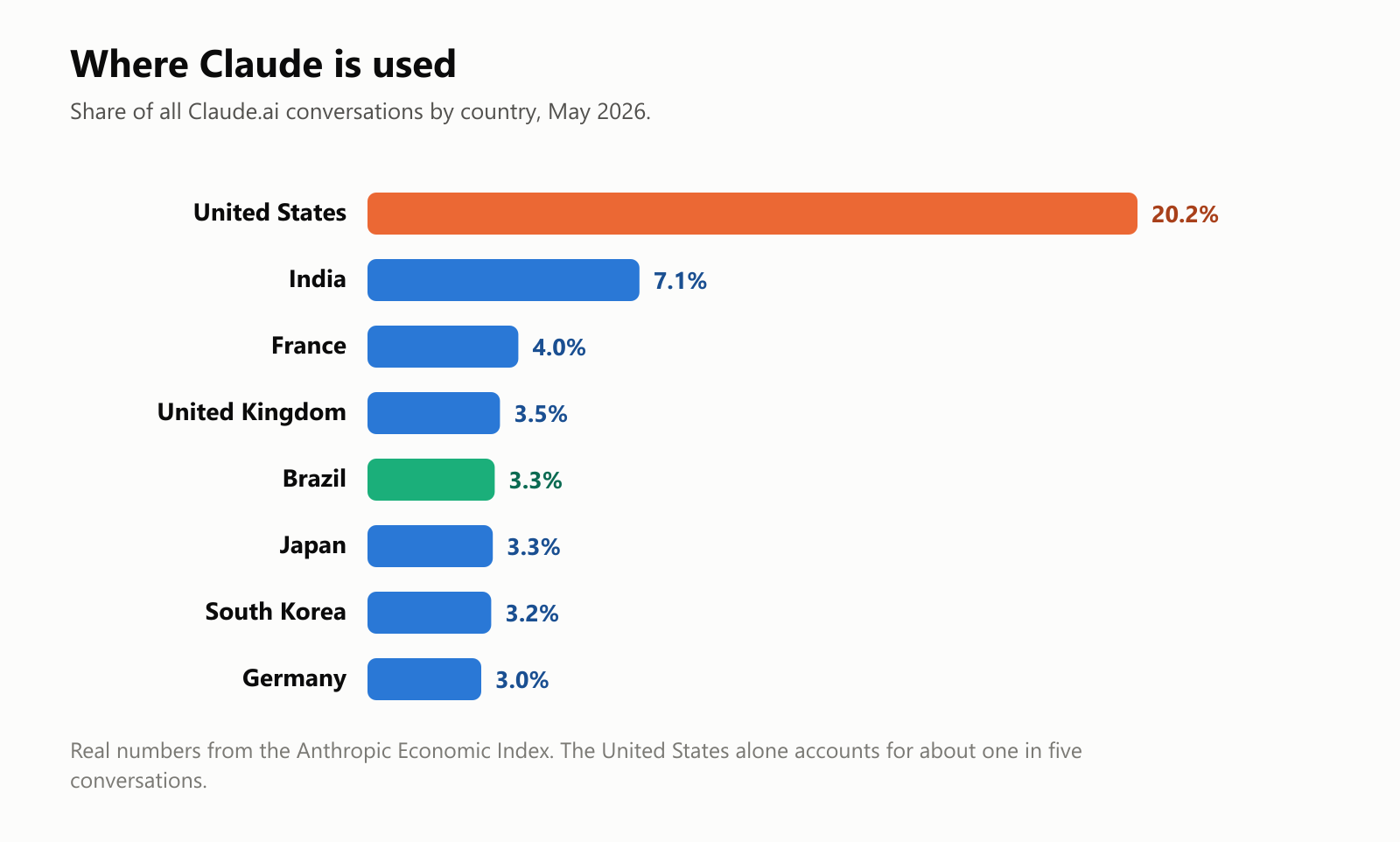
The United States accounts for about one in five conversations, with India a clear second.
Claude Code and the rise of AI agents
Anthropic's biggest hit of the last two years has been Claude Code, released as a preview in February 2025. Programmers type a request in plain English, such as "find why the login page is slow and fix it," and Claude Code reads the project, edits the files and checks its work.
We measured its growth using the public download counts from npm, the library where JavaScript tools are shared:
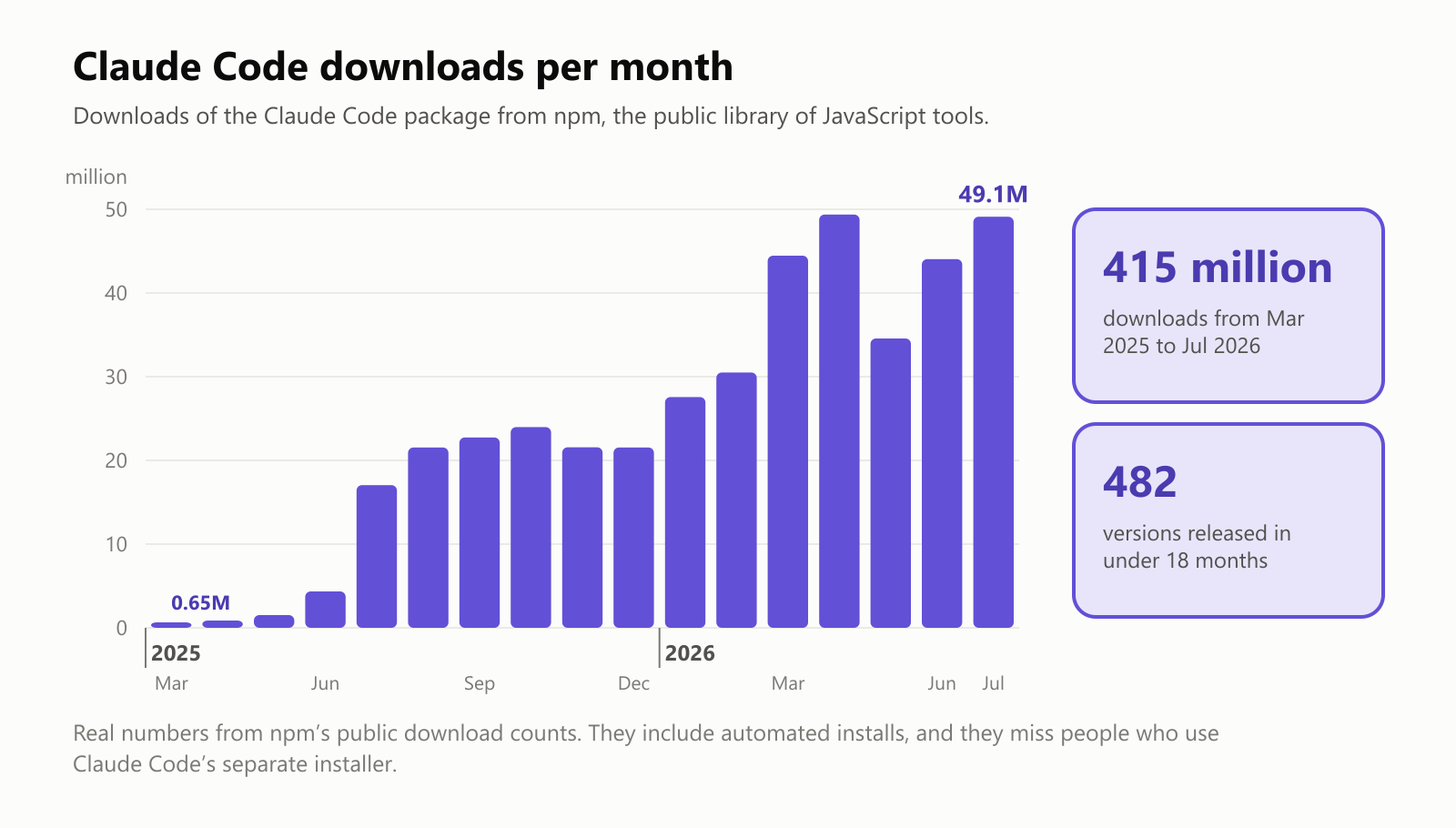
Monthly downloads grew about 75 times between March 2025 and July 2026, and the team shipped 482 versions in under 18 months, often more than one a day. These numbers include automated installs and leave out people who use Claude Code's separate installer, so they show the trend, not an exact count of users.
A business growing at record speed
Anthropic's revenue has grown faster than almost any company in history. Because it changes so quickly, the company usually reports a run rate: what it would earn in a year if every month were like the most recent one.
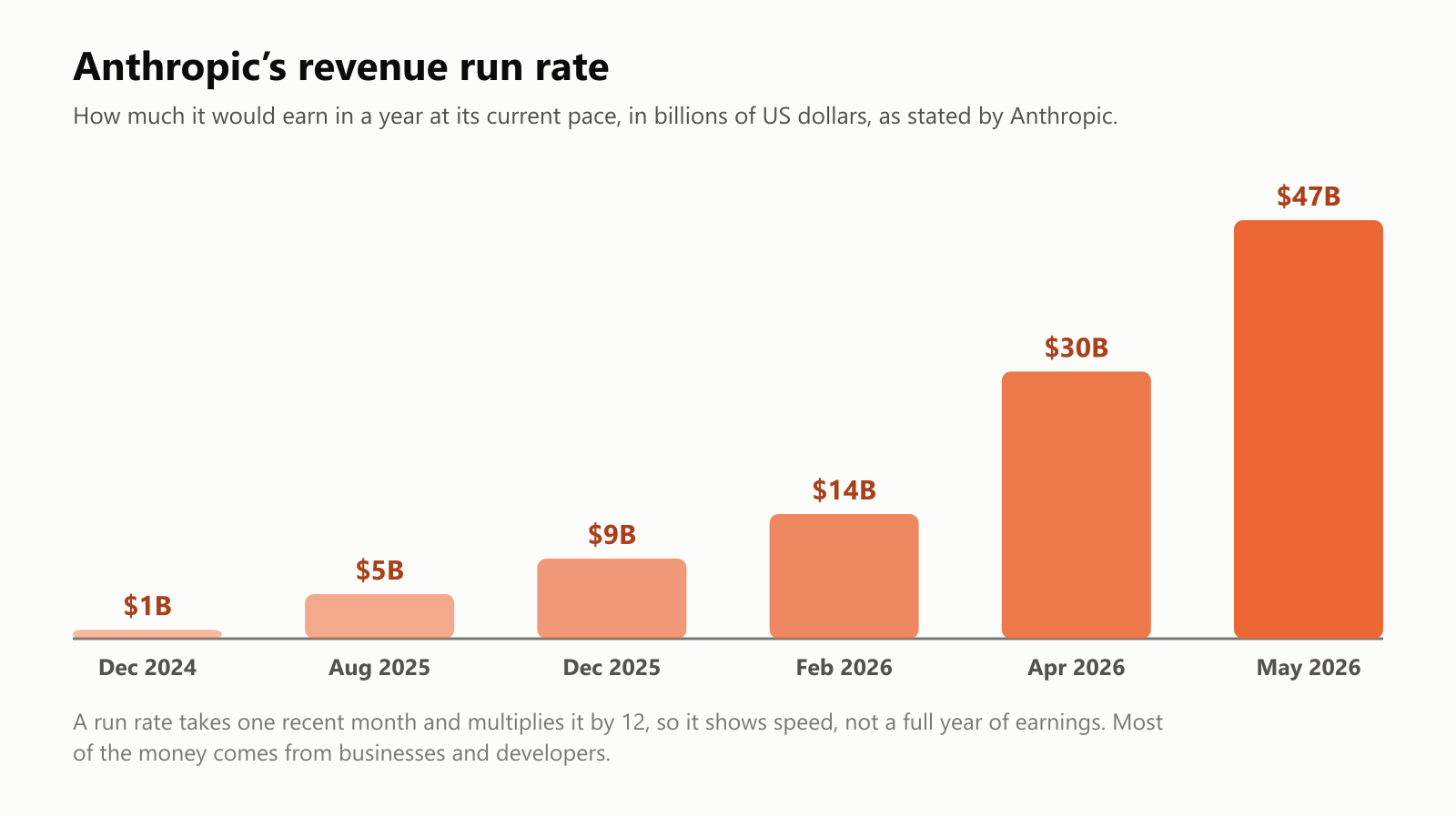
Investors have followed. Amazon has invested $8 billion and Google several billion more, and both rent Anthropic the huge computers it needs to train and run Claude.
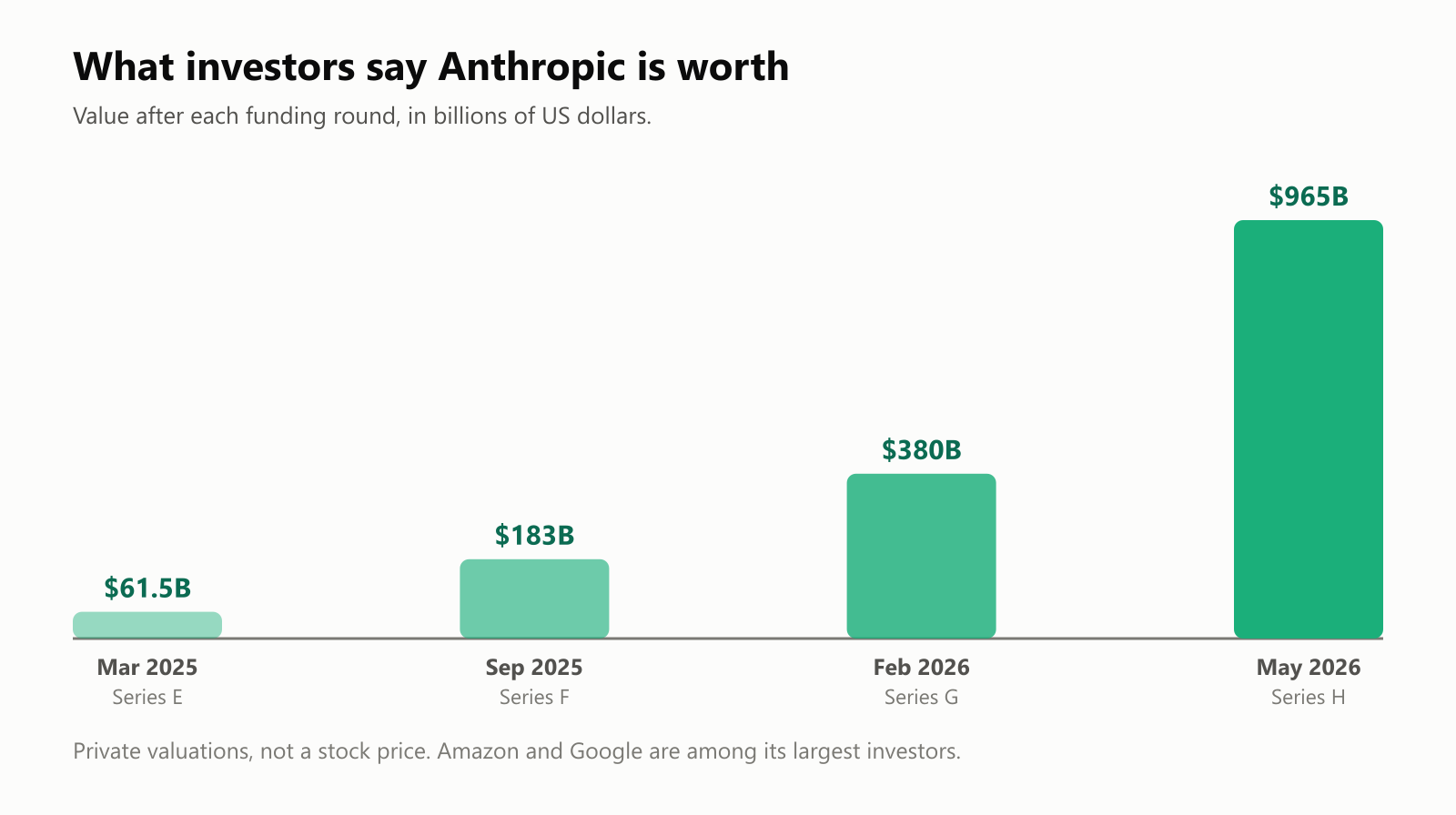
In May 2026, a funding round valued Anthropic at $965 billion, making it, for a time, the most valuable private AI company. On June 1, 2026, it said it had confidentially filed paperwork with US regulators to sell shares to the public.
Why Anthropic is often in the news
Anthropic's safety-first image and its rapid growth have put it at the center of several debates:
- Copyright. Authors sued Anthropic for training on books, including millions downloaded from pirate websites. In 2025 a judge ruled that training on books the company had bought was allowed, but the pirated copies were not. Anthropic agreed to pay $1.5 billion to settle, about $3,000 per book, one of the largest copyright settlements ever.
- The Pentagon dispute. In early 2026, Anthropic refused to drop two limits in its US military contracts: no mass surveillance of Americans and no fully autonomous weapons. The Defense Department then labeled it a "supply chain risk," a label normally used for foreign suppliers, and the president ordered federal agencies to stop using Claude. Anthropic sued, and the case was still in the courts in August 2026.
- Government limits on a powerful model. Days after Claude Fable 5 launched in June 2026, a US government order on national security grounds led Anthropic to switch it off for everyone. It came back about three weeks later once the restriction was lifted.
- No ads. In February 2026, Anthropic ran Super Bowl ads promising that Claude would stay free of advertising, a jab at rivals that had started testing ads.
- "Safety company" or race participant? Critics point out that a company warning about AI risks is also racing to build ever more powerful AI. Dario Amodei has also warned publicly that AI could wipe out many entry-level office jobs, and supporters and critics argue about whether such warnings help or mostly add to the hype.
Anthropic competes with OpenAI, Google, Meta, xAI and DeepSeek, among others.
A short history
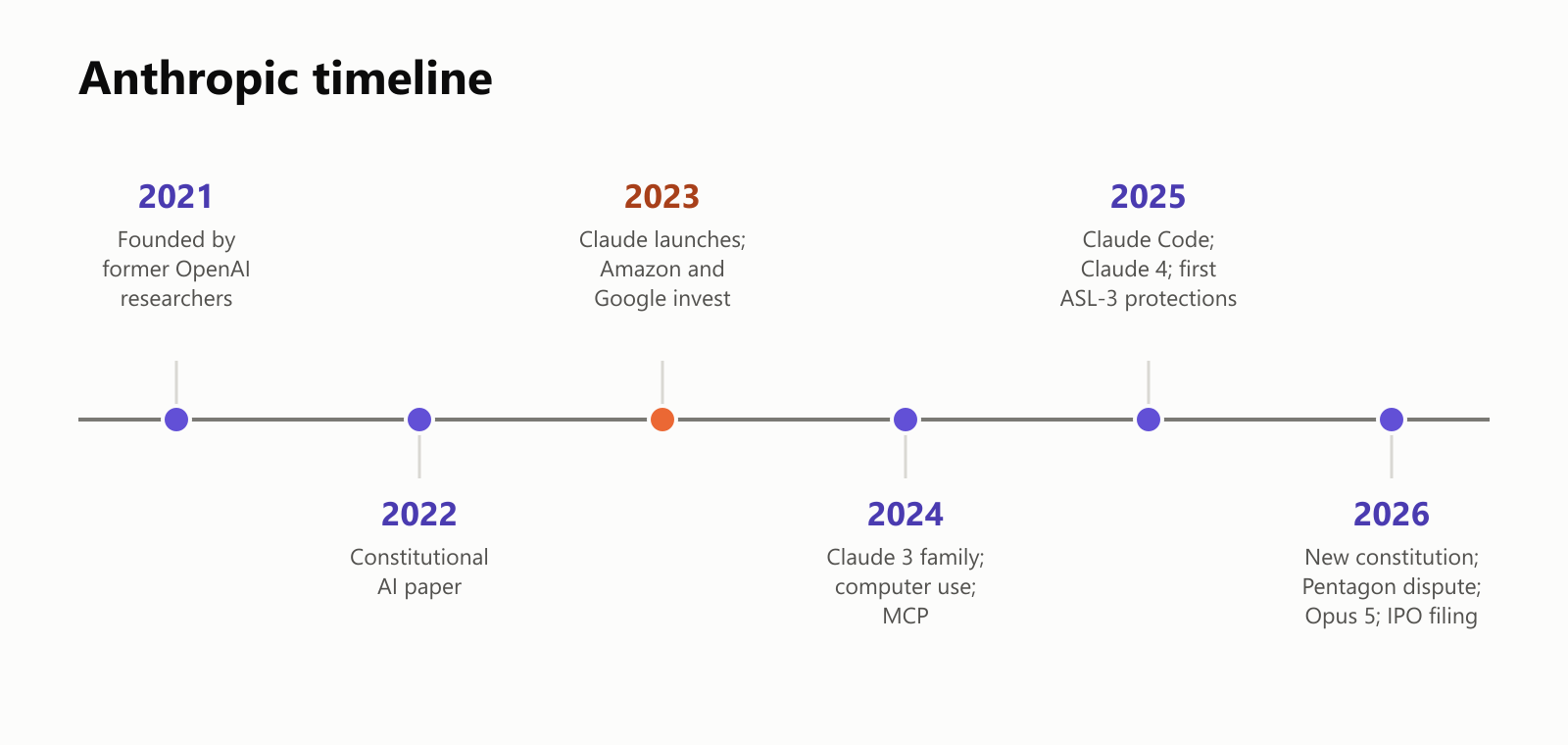
Try it yourself
- Use Claude. Go to claude.ai in any web browser or install the Claude app on your phone or computer. You can try it for free.
- Give it something long. Claude is good at reading long documents. Try pasting in a long article or a manual and asking for a summary or for answers to specific questions.
- Ask it to explain its reasoning. Ask it to show its steps or to point out what it's unsure about. Our guide to prompt engineering has more tips.
- Check what matters. Like every AI model, Claude can make mistakes. Check important facts, especially about health, money or the law.
- Protect your privacy. Don't paste passwords, ID numbers or other people's private information into any chatbot.
Common questions
Is Anthropic part of OpenAI or Google? No. Anthropic is an independent company. Its founders came from OpenAI, and Google and Amazon are investors, but neither controls it.
Is Claude free? Yes, there is a free version. Paid plans add more use, more capable models and extra features.
Who is Claude named after? Anthropic hasn't given an official explanation. Many people link the name to Claude Shannon, the father of information theory.
Is Claude safer than other AI models? Anthropic puts a lot of work into safety and publishes detailed reports about each model's risks. But every AI model can make mistakes or be misused, and independent experts disagree about how much difference any one company's approach makes.
Does Claude learn from my conversations? It depends on your settings. Check the privacy settings in the app to choose whether your chats can be used to improve future models.
Glossary
- Agent: an AI that carries out multi-step tasks by itself, such as editing files or using a browser.
- ASL (AI Safety Level): Anthropic's scale for how risky an AI system is and how strong its protections must be.
- Constitutional AI: Anthropic's method of training AI with a written list of principles.
- Context window: how much text a model can read at once, measured in tokens.
- Interpretability: research into what is happening inside an AI model.
- MCP (Model Context Protocol): an open standard for connecting AI apps to other tools and data.
- Public benefit corporation: a company that must balance a public mission with profits.
- Run rate: a company's recent monthly revenue multiplied by 12.
- Token: a small piece of text, often a word or part of a word, that AI models read and write.
Wrapping up
Anthropic began as a small group of researchers who wanted to build AI more carefully. Five years later, it makes some of the world's most capable AI models, its Claude Code tool has changed how many programmers work, and it is worth close to a trillion dollars.
Whether its safety-first approach proves to be a model for the industry or a hard promise to keep while racing competitors, it has shaped how people talk about AI: with written constitutions, published safety levels and open debate about what these systems should and shouldn't do.
Read next
What Is a Transformer in AI? The Idea Behind ChatGPT, Explained Simply
A friendly, jargon-free guide to transformers, the AI design behind ChatGPT, Claude and Gemini. Learn how "attention" lets AI understand words in context, what happens inside a transformer, and why it changed AI so quickly.
 nbkhope
What Is Reinforcement Learning? How AI Learns by Trial, Error and Reward
A friendly, jargon-free introduction to reinforcement learning, how AI learns by trial, error and reward, like training a dog with treats. Watch a real robot learn a maze, see why exploring matters, and learn how it shapes chatbots.
nbkhope
What Is Graph Engineering? How Today's AI Teams Up to Get Real Work Done
A friendly, jargon-free guide to graph engineering, the 2026 idea of building AI as a map of connected steps instead of one big loop. See how today's AI agents work, why small mistakes add up, and how checkers, branches and teamwork fix it.
nbkhope
Comments
Be kind and specific. Comments with links from new accounts appear after a moderator reviews them.