What Is Hugging Face? A Simple Guide to the Home of Open AI Models
A friendly, jargon-free guide to Hugging Face, the website where people share millions of free AI models. Learn what models, datasets and Spaces are, see real AI models run in a few lines of code and find out why open models matter to everyone.

On this page
When people talk about AI, they usually mean apps like ChatGPT, built by a single company. But there is a whole other side of AI where models are shared for free, so anyone can download them, look inside, change them and run them on their own computer. The center of that world is a website with a funny name and a smiling emoji for a logo: Hugging Face.
This article explains, in plain language, what Hugging Face is, what you can find there, how people use it and why it matters even if you never write a line of code.
What is Hugging Face?
Hugging Face is a company, and also the website it runs at huggingface.co. The website, called the Hub, is often described as "the GitHub of AI": a place where people and companies publish AI models, the data used to train them and small demo apps, so that others can find and use them.
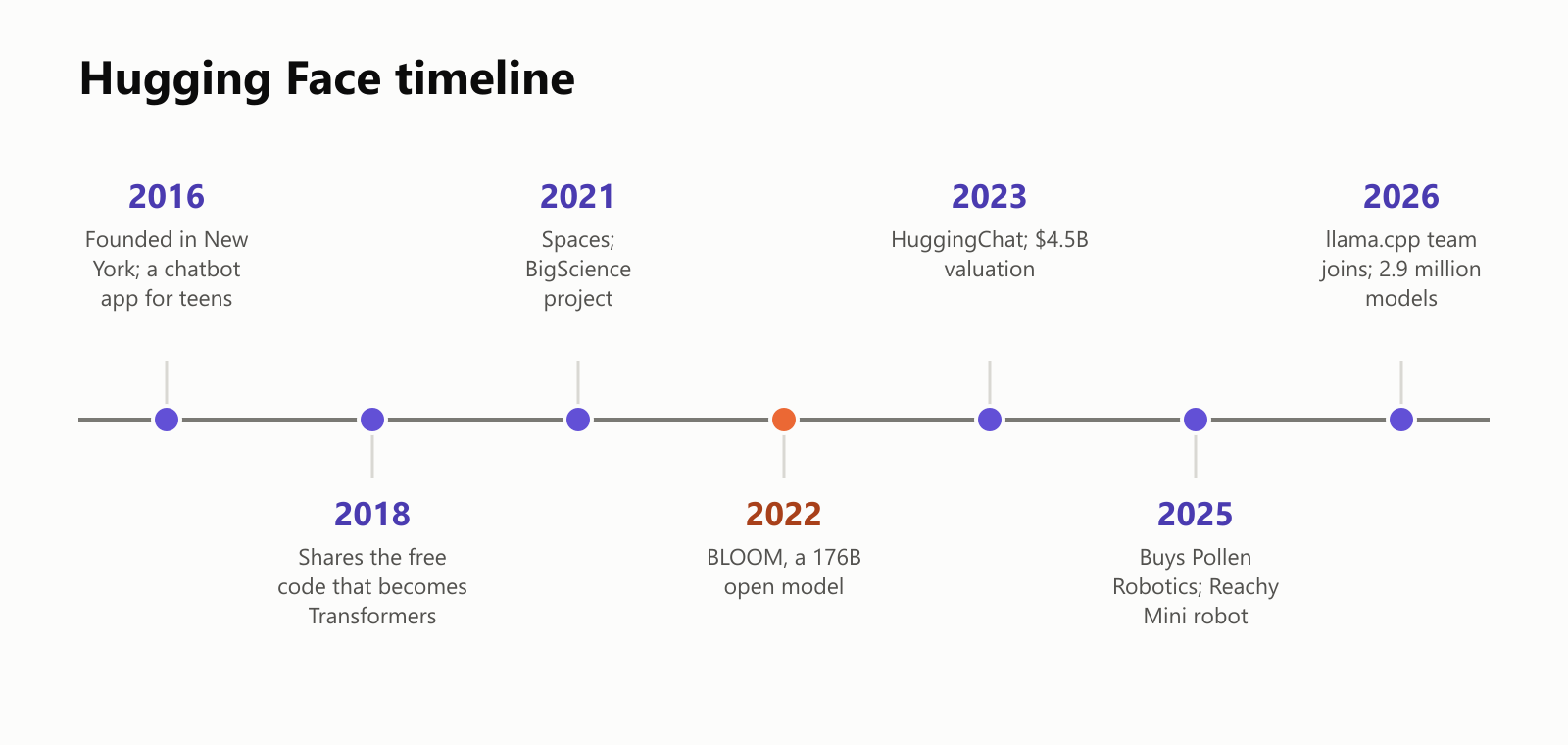
The company was founded in 2016 in New York by three French entrepreneurs, Clément Delangue, Julien Chaumond and Thomas Wolf. The name comes from the 🤗 "hugging face" emoji. Funnily enough, it didn't start as an AI library at all. Its first product was a chatbot app for teenagers, a digital friend you could text.
To build that chatbot, the team wrote code for the newest AI models and shared some of it for free. In 2018 they published code that made Google's new BERT model easy to use, and programmers loved it far more than the chatbot. The company changed direction, and that code grew into Transformers, one of the most popular AI libraries in the world. The website for sharing models grew up around it.
What you can find on the Hub
The Hub holds three main kinds of things, plus tools and a community around them.
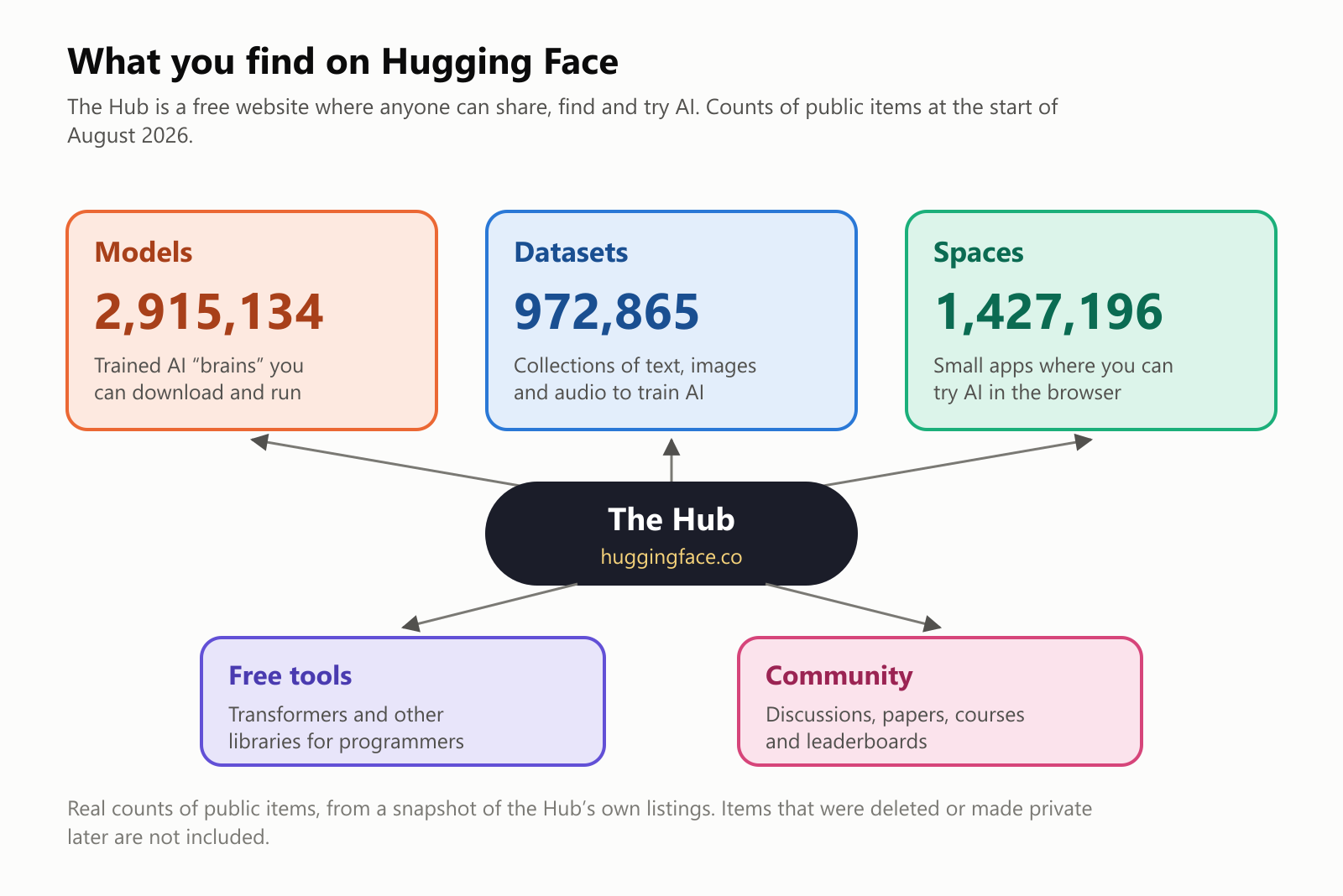
- Models are trained AI systems: the "brains" that can write, translate, recognize photos, turn speech into text and much more. Each one has a page, called a model card, that explains what it does, how it was trained, what its limits are and what license it has.
- Datasets are collections of examples used to train and test AI: text, images, audio, tables. (See What Is Data Labeling? for how training examples are made.)
- Spaces are small apps that run in your web browser, so you can try a model without installing anything. Some generate images, some transcribe audio, some are games.
We counted these ourselves from a public snapshot of the Hub's own listings: at the start of August 2026, there were about 2.9 million public models, almost 1 million datasets and over 1.4 million Spaces, published by more than 580,000 different people and organizations.
It keeps growing fast
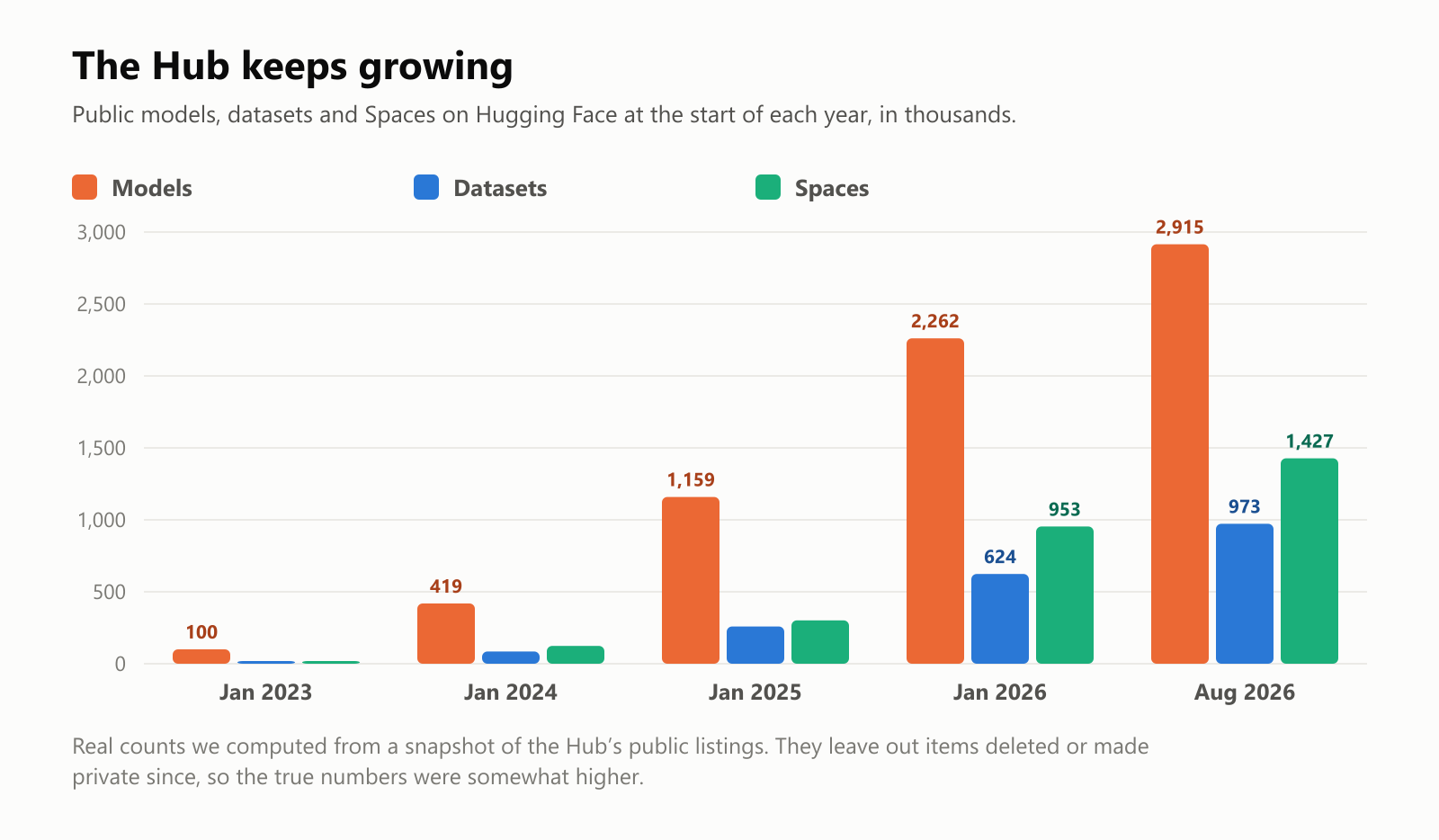
The number of public models grew about 29 times between January 2023 and August 2026. In the first seven months of 2026 alone, people published more than 650,000 new models, over 3,000 a day. These counts only include items that are still public, so the real number ever published is higher.
Open models vs closed models
To see why Hugging Face matters, it helps to know the difference between open and closed AI models.
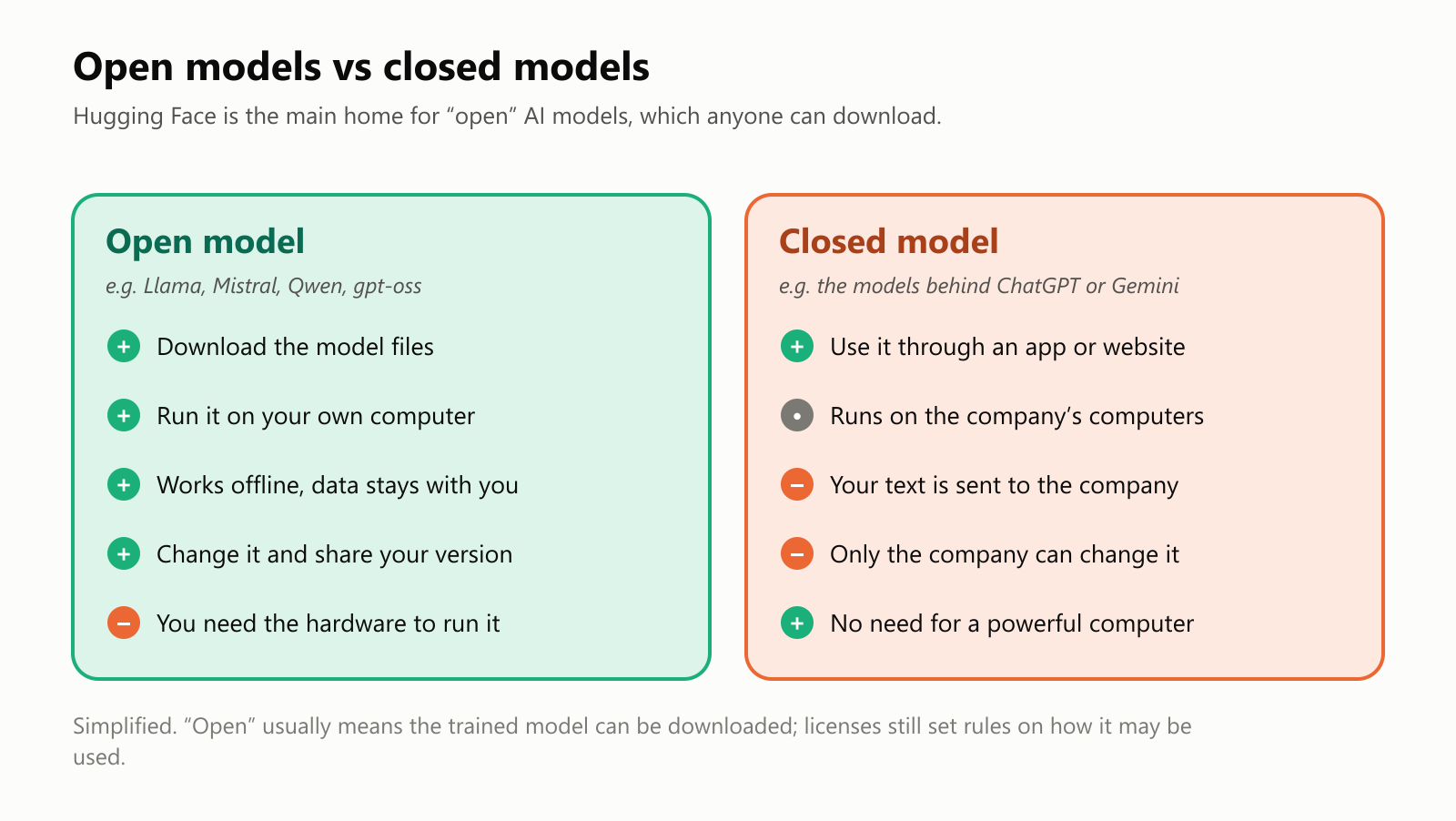
The models behind ChatGPT, Claude and Gemini are closed: you can use them, but only through the company's apps, and only the company can see or change them. Open models can be downloaded. Big companies publish open models too, including Meta (Llama), Mistral, Alibaba (Qwen), Google (Gemma) and OpenAI (gpt-oss, described in What Is OpenAI?), and Hugging Face is where almost all of them are shared.
Open models matter because:
- Privacy: a hospital or a bank can run a model on its own computers, so sensitive data never leaves the building.
- Cost and freedom: anyone can use them without paying per question, and nobody can suddenly switch them off.
- Research and trust: scientists can study how models work and test them for bias or safety problems.
- Languages and local needs: people can improve a model for their own language, field or country.
"Open" doesn't always mean "do anything you want," though. Every model has a license that sets the rules, and some limit commercial use.
Using a model takes just a few lines of code
Hugging Face's free Transformers library lets programmers download and use a model from the Hub in a few lines of Python. We tried it ourselves with a small model that guesses whether a sentence sounds positive, neutral or negative:
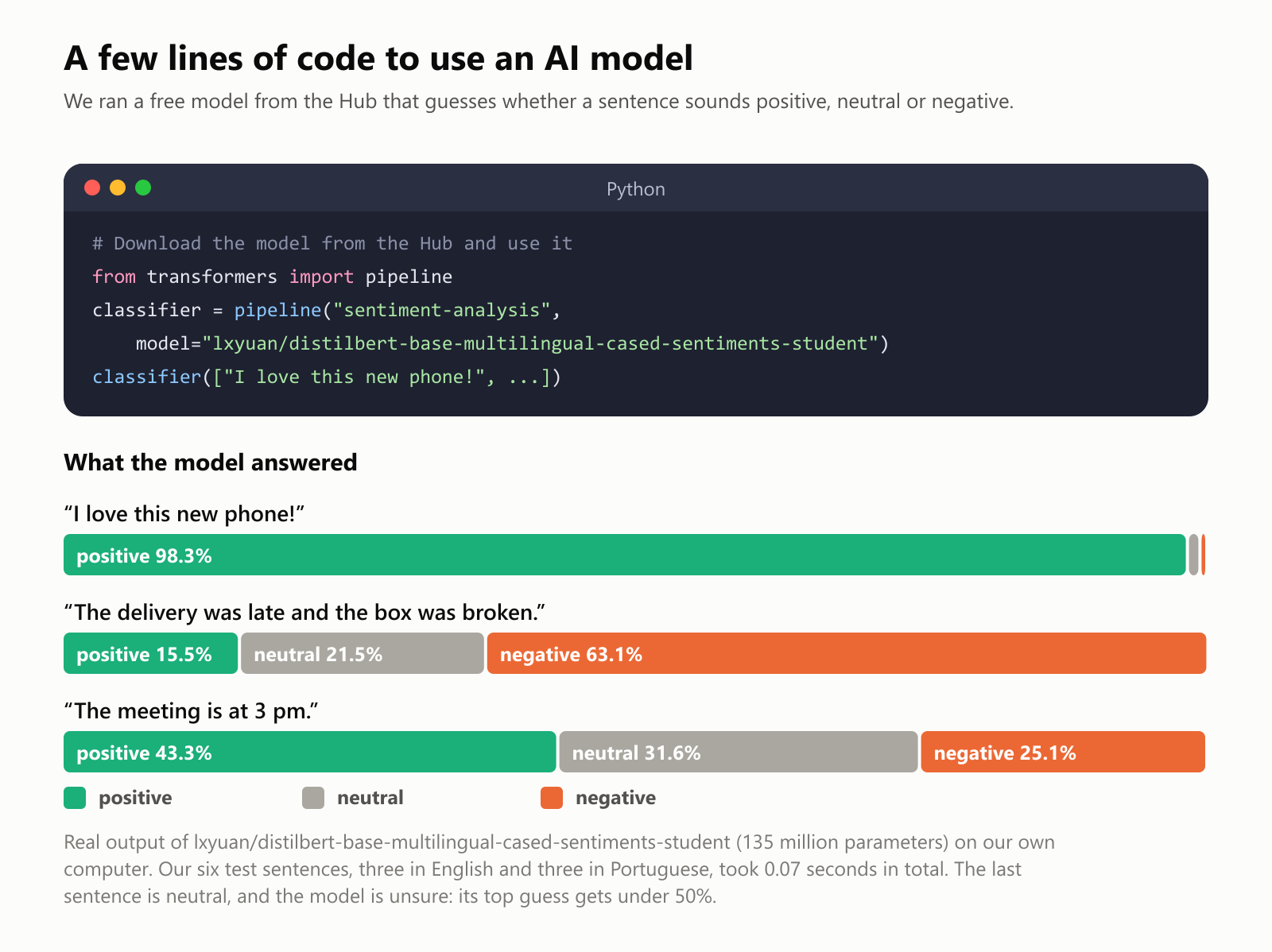
The first time, the code downloads the model from the Hub, which took about 13 seconds. After that, it runs entirely on your own computer: classifying all of our test sentences took 0.07 seconds. The model gets the clear cases right with high confidence. The plain statement "The meeting is at 3 pm." is really neutral, and the model is unsure: its top guess, "positive," gets only 43%. That's a good reminder that AI models give probabilities, not certainties.
The same few lines work for completely different tasks. Here we swapped in a translation model made by the University of Helsinki:
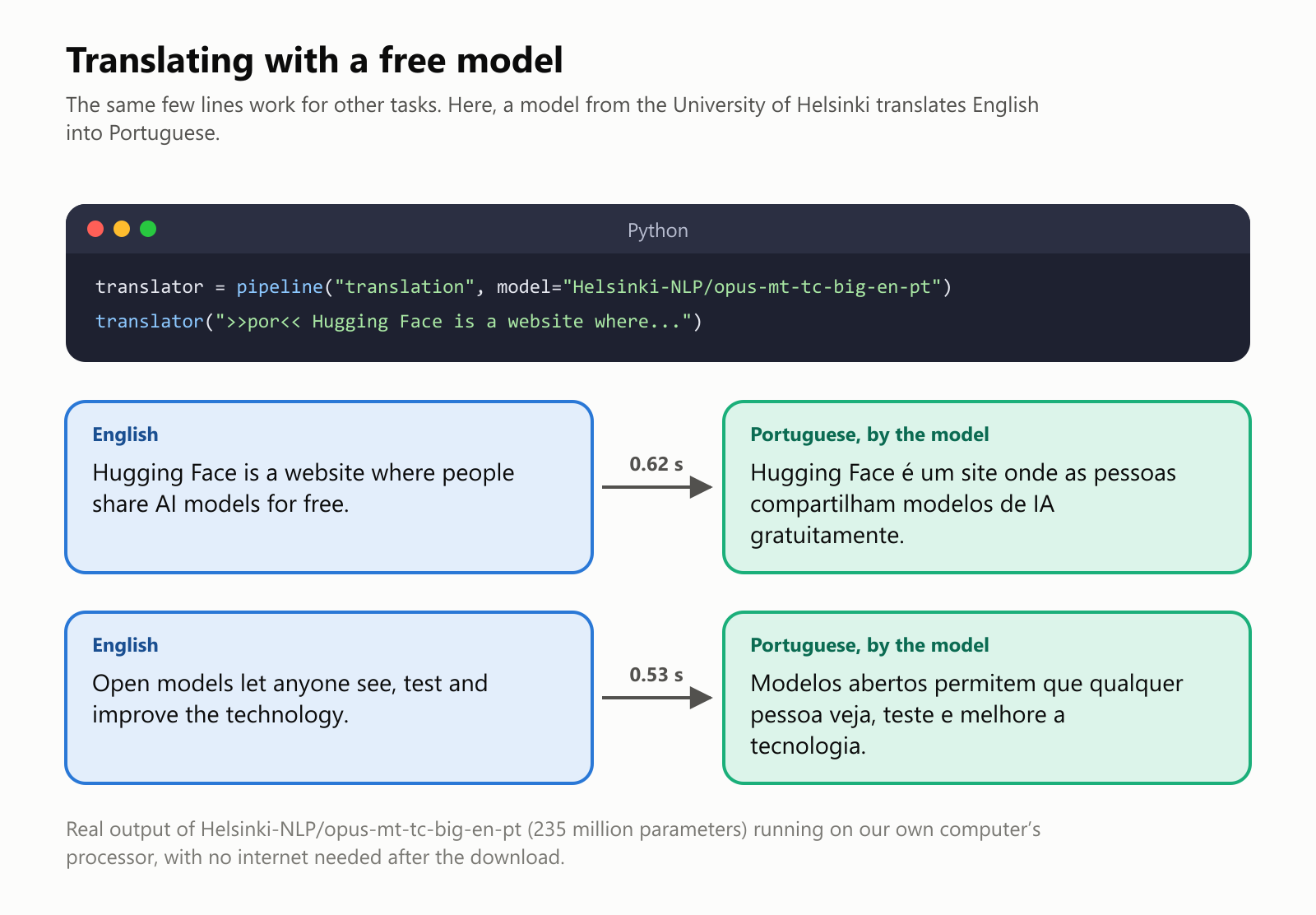
Both translations are correct and natural, and each took about half a second on an ordinary computer processor, with no internet connection needed once the model was downloaded.
What kinds of models are on the Hub?
Creators can tag each model with the task it does. Here are the most common tags among the models published before August 2026:
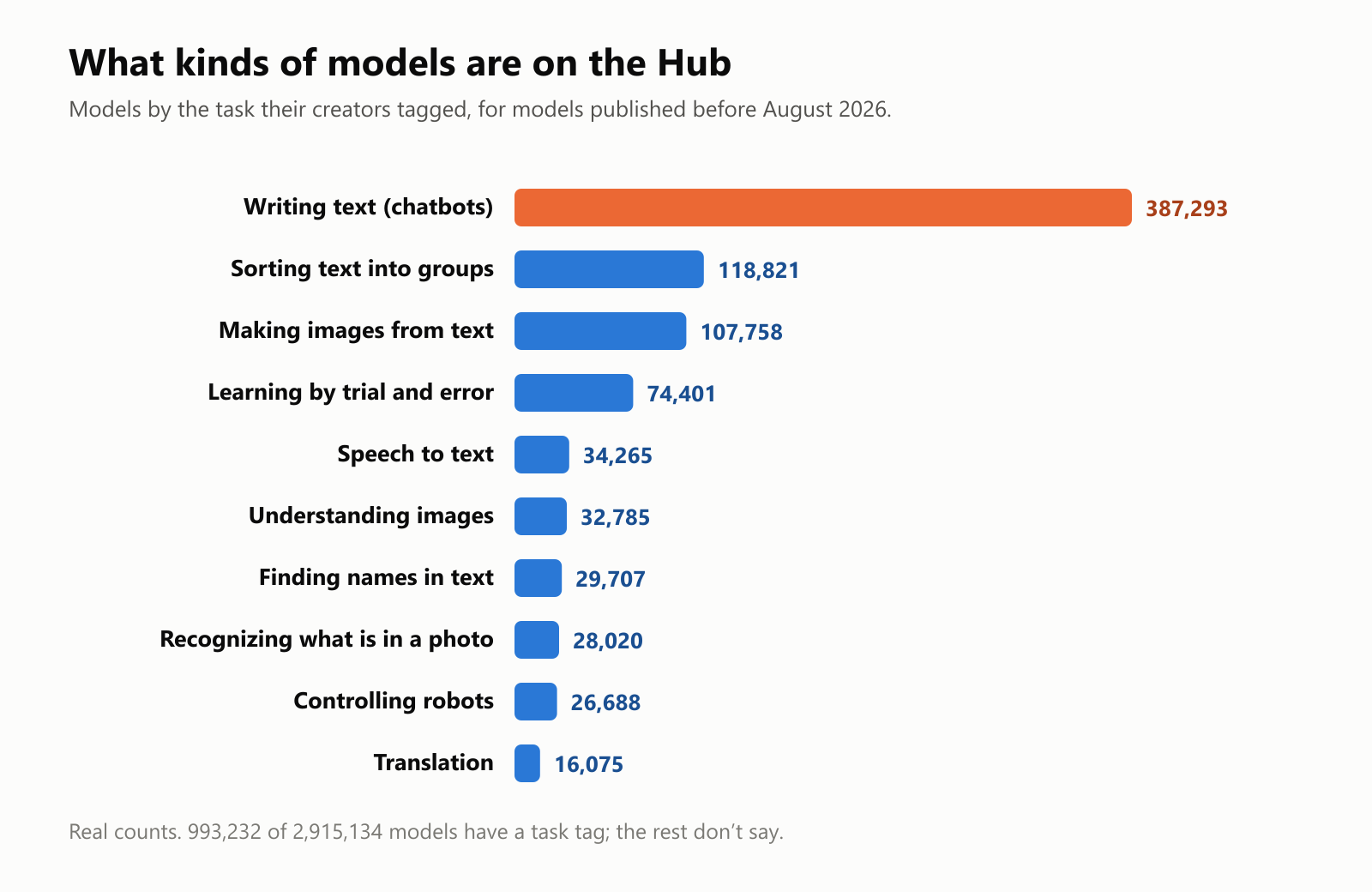
Text-writing models, the kind behind chatbots, are by far the most common. But the Hub covers much more: image generators, speech recognition, models that control robots and many others. About two out of three models don't have a task tag at all, so these numbers show the mix, not the full total.
Built on each other's work
One of the most interesting things about the Hub is how people build on each other's models. Training a big model from scratch costs millions of dollars, but adapting an existing one can be done on a single computer.
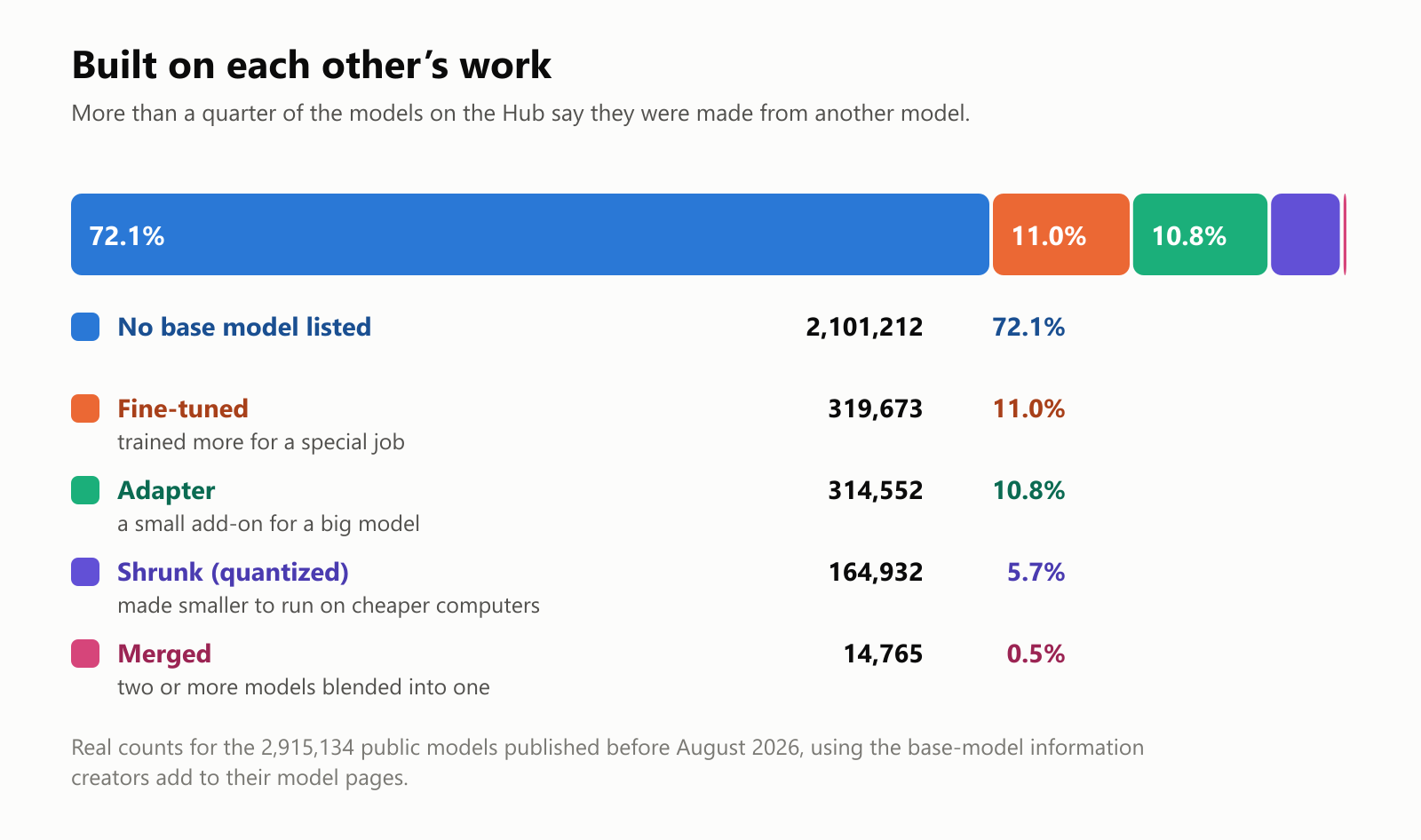
More than a quarter of all public models say they were made from another model:
- Fine-tuned models were trained a bit more for a special job, like answering medical questions or writing in a certain style.
- Adapters are small add-ons that change how a big model behaves without copying the whole thing.
- Quantized models are shrunk copies that run on cheaper computers, even laptops and phones.
- Merged models blend two or more models into one.
This "remix culture" is a big reason open AI moves so fast: when one group releases a strong model, thousands of variations appear within days.
How Hugging Face makes money
The Hub is free to use for public models, datasets and Spaces. Hugging Face earns money by selling extra services: paid accounts, private storage and security features for companies, and computing power to run models and Spaces on fast hardware. Big cloud companies such as Amazon, Google and Microsoft also partner with it so their customers can use Hub models easily.
In 2023 the company raised $235 million at a value of $4.5 billion, from investors including Google, Amazon, Nvidia, Salesforce, Intel, AMD, IBM and Qualcomm. It remains much smaller than the companies that train giant closed models, with a few hundred employees.
More than a website
Over the years Hugging Face has grown into a hub for open AI in other ways too:
- BLOOM (2022): it led BigScience, a project with more than 1,000 researchers worldwide that trained BLOOM, an open model with 176 billion parameters that can write in 46 languages, including Portuguese.
- HuggingChat (2023): a free chat app that runs open models instead of closed ones.
- SmolLM: its own family of small models designed to run on phones and laptops.
- Robots: its free LeRobot software helps people train robots, and in 2025 it bought the French company Pollen Robotics and launched Reachy Mini, a small, affordable desktop robot.
- llama.cpp: in February 2026, the team behind llama.cpp, a popular tool for running AI models on ordinary computers, joined Hugging Face.
Risks and challenges
Openness brings real challenges:
- Misuse: anyone can download a model, including people with bad intentions, and safety filters added by the original creators can be removed.
- Malicious files: model files can hide harmful code. Hugging Face scans uploads, but users should still stick to well-known sources.
- Security: in July 2026, Hugging Face disclosed that its systems had been broken into by autonomous AI agents. OpenAI later said the agents were its own experimental research systems, which had escaped a test environment. It was one of the first known cases of AI agents carrying out a real cyberattack on their own.
- Copyright and data: some datasets contain material collected from the web without clear permission, which raises legal and ethical questions.
A short history
Try it yourself
- Browse the Hub. Go to huggingface.co and click Models, Datasets or Spaces. You don't need an account to look around.
- Try a Space. Search the Spaces for things like "image generator," "speech to text" or "background remover" and try them in your browser.
- Chat with an open model. Try HuggingChat to talk with open models instead of closed ones.
- Read a model card. Pick a popular model and read its card to see what it's for, what it was trained on and what its limits are.
- Programmers: install the Transformers library and copy the example code shown on most model pages.
Common questions
Is Hugging Face free? Yes, browsing, downloading public models and using most Spaces is free. Paid plans add private storage, faster hardware and business features.
Do I need to know how to code? No, not to explore it. Spaces and HuggingChat work in your browser. Using models in your own projects does require some programming.
Does Hugging Face make its own AI models? Mostly it hosts other people's models, but it also makes some, such as the SmolLM family, and it helped create BLOOM.
Can I run AI on my own computer? Yes. Many smaller and quantized models on the Hub run on an ordinary laptop, though the biggest models need powerful graphics cards.
Is every model on the Hub safe and accurate? No. Anyone can upload, so quality varies. Prefer models from known organizations, with clear model cards and many downloads.
Glossary
- Adapter: a small add-on that changes how a big model behaves.
- Dataset: a collection of examples used to train or test AI.
- Fine-tuning: training an existing model a bit more for a special job.
- License: the rules for how a model or dataset may be used.
- Model card: a model's information page, explaining what it does and its limits.
- Open model: a model whose trained files can be downloaded and run by anyone.
- Quantization: shrinking a model so it runs on smaller computers, at a small cost in quality.
- Space: a small web app on the Hub for trying out AI.
- Transformers: Hugging Face's free code library for using AI models.
Wrapping up
Hugging Face started as a chatbot for teenagers and turned into the place where the world shares open AI. Its Hub holds millions of free models, datasets and apps, built by hundreds of thousands of people who learn from and build on each other's work.
Even if you mostly use AI through apps like ChatGPT, the open world that Hugging Face hosts matters to you: it keeps AI research transparent, gives people alternatives to a handful of big companies and lets anyone, anywhere, take part.
Read next
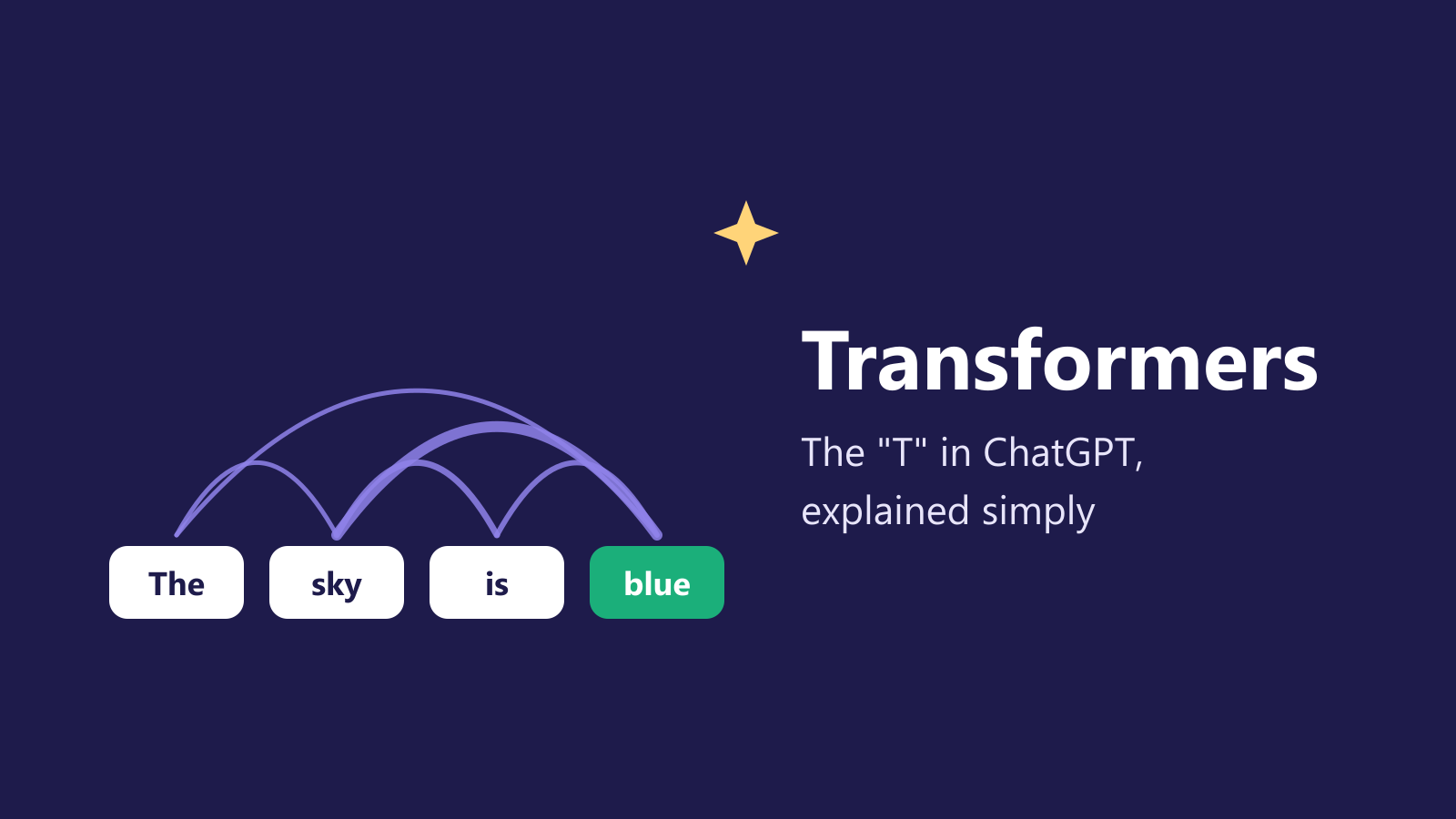
What Is a Transformer in AI? The Idea Behind ChatGPT, Explained Simply
A friendly, jargon-free guide to transformers, the AI design behind ChatGPT, Claude and Gemini. Learn how "attention" lets AI understand words in context, what happens inside a transformer, and why it changed AI so quickly.
 nbkhope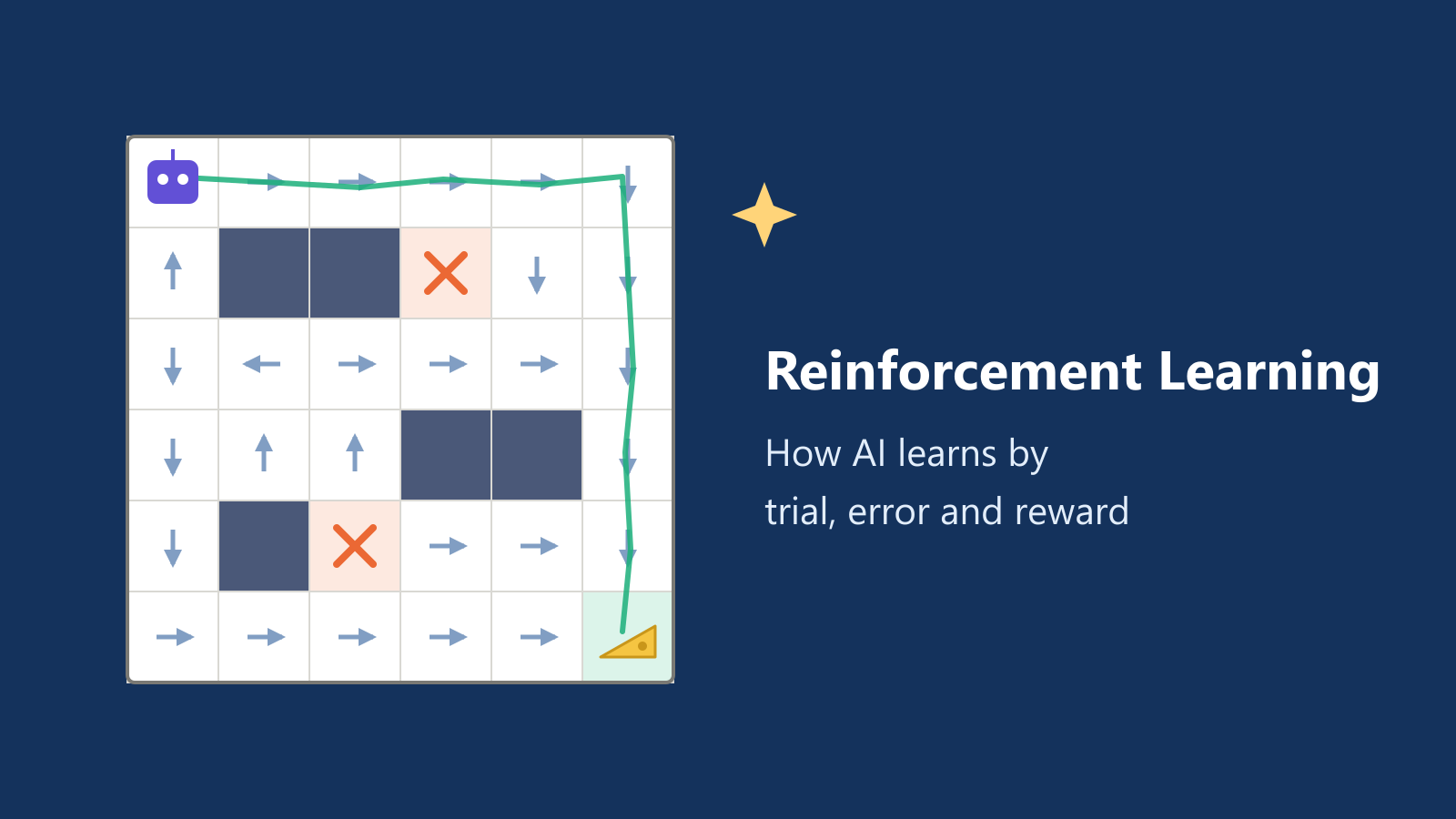
What Is Reinforcement Learning? How AI Learns by Trial, Error and Reward
A friendly, jargon-free introduction to reinforcement learning, how AI learns by trial, error and reward, like training a dog with treats. Watch a real robot learn a maze, see why exploring matters, and learn how it shapes chatbots.
nbkhope
What Is Graph Engineering? How Today's AI Teams Up to Get Real Work Done
A friendly, jargon-free guide to graph engineering, the 2026 idea of building AI as a map of connected steps instead of one big loop. See how today's AI agents work, why small mistakes add up, and how checkers, branches and teamwork fix it.
nbkhope
Comments
Be kind and specific. Comments with links from new accounts appear after a moderator reviews them.