What Is Google? A Simple Guide to the Search Engine That Grew Into a Giant
A friendly, jargon-free guide to Google, the search engine that grew into one of the world's biggest companies. Learn how search works, see a real experiment with a mini search engine and PageRank, and find out where Google's money comes from.

On this page
For most people, "google" isn't just a company; it's a verb. When you want to know something, you google it. Behind that simple search box is one of the largest and most valuable companies in the world, which also runs YouTube, Android, Gmail, Google Maps and one of the leading AI chatbots, Gemini.
This article explains, in plain language, what Google is, how its search engine actually works, how it makes money and why it is both admired and criticized.
What is Google?
Google is an American technology company based in Mountain View, California. It was started by Larry Page and Sergey Brin, two graduate students at Stanford University. In 1996 they built a search engine called BackRub as a research project, renamed it Google and founded the company in September 1998, working out of a rented garage. The name is a play on "googol," the number 1 followed by 100 zeros, a hint at how much information they wanted to organize.
Google's official mission is "to organize the world's information and make it universally accessible and useful." It started with web search and kept adding products. Since 2015, Google has been part of a parent company called Alphabet. Sundar Pichai has led Google since 2015 and Alphabet since 2019.
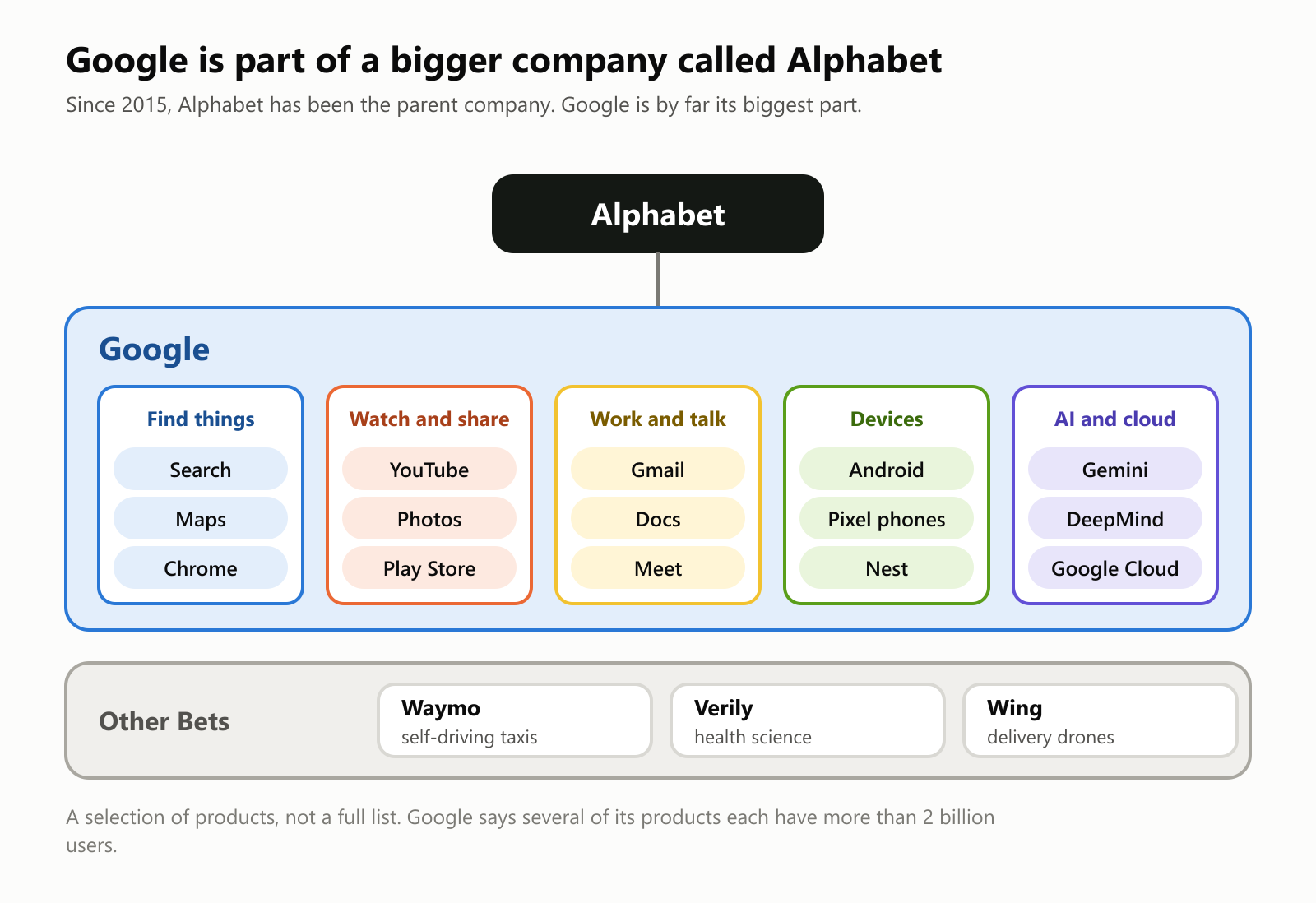
Google says several of its products each have more than 2 billion users. By mid-2026, Alphabet employed nearly 200,000 people.
How Google Search works
When you type a search, Google doesn't go out and look through the whole internet. That would take far too long. Most of the work has already been done.
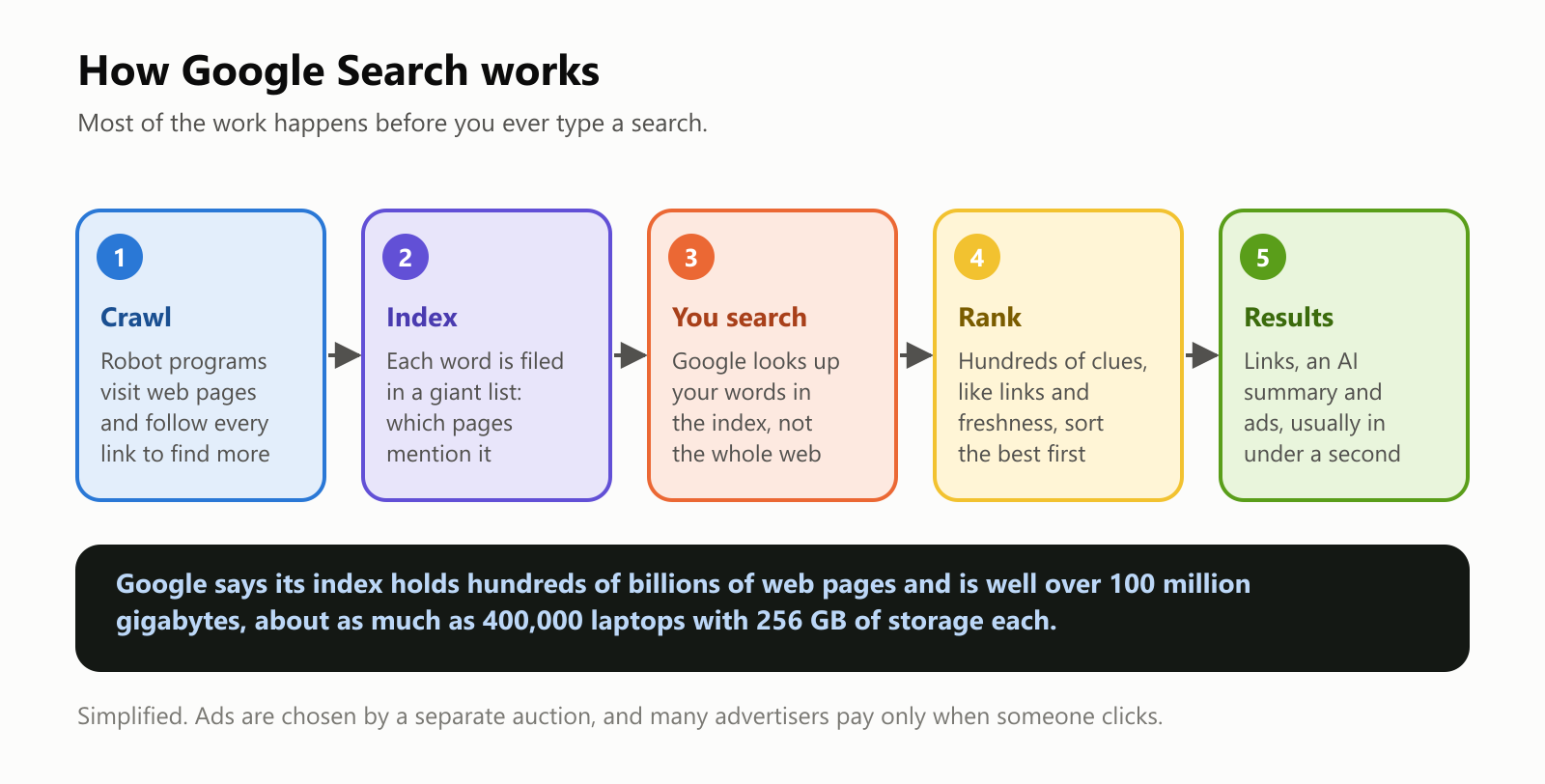
- Crawling. Google runs programs called crawlers (or "spiders") that visit web pages, save a copy and follow every link to discover more pages.
- Indexing. Google files every word it finds in a huge index, like the index at the back of a book: for each word, a list of the pages that contain it.
- Searching. When you search, Google looks up your words in the index.
- Ranking. Out of possibly millions of matching pages, Google decides which are most useful, using hundreds of signals, such as whether the words appear in the title, how fresh the page is, where you are and how many other sites link to it.
- Results. You see a list of links, often an AI-written summary at the top, and some ads.
A real experiment: a mini search engine
To see why an index matters, we built a tiny search engine for this website. It read all 31 articles we had published by the date of this article, about 48,000 words, and built an index. Then we timed the same searches two ways: looking the words up in the index, or reading every article from start to finish.
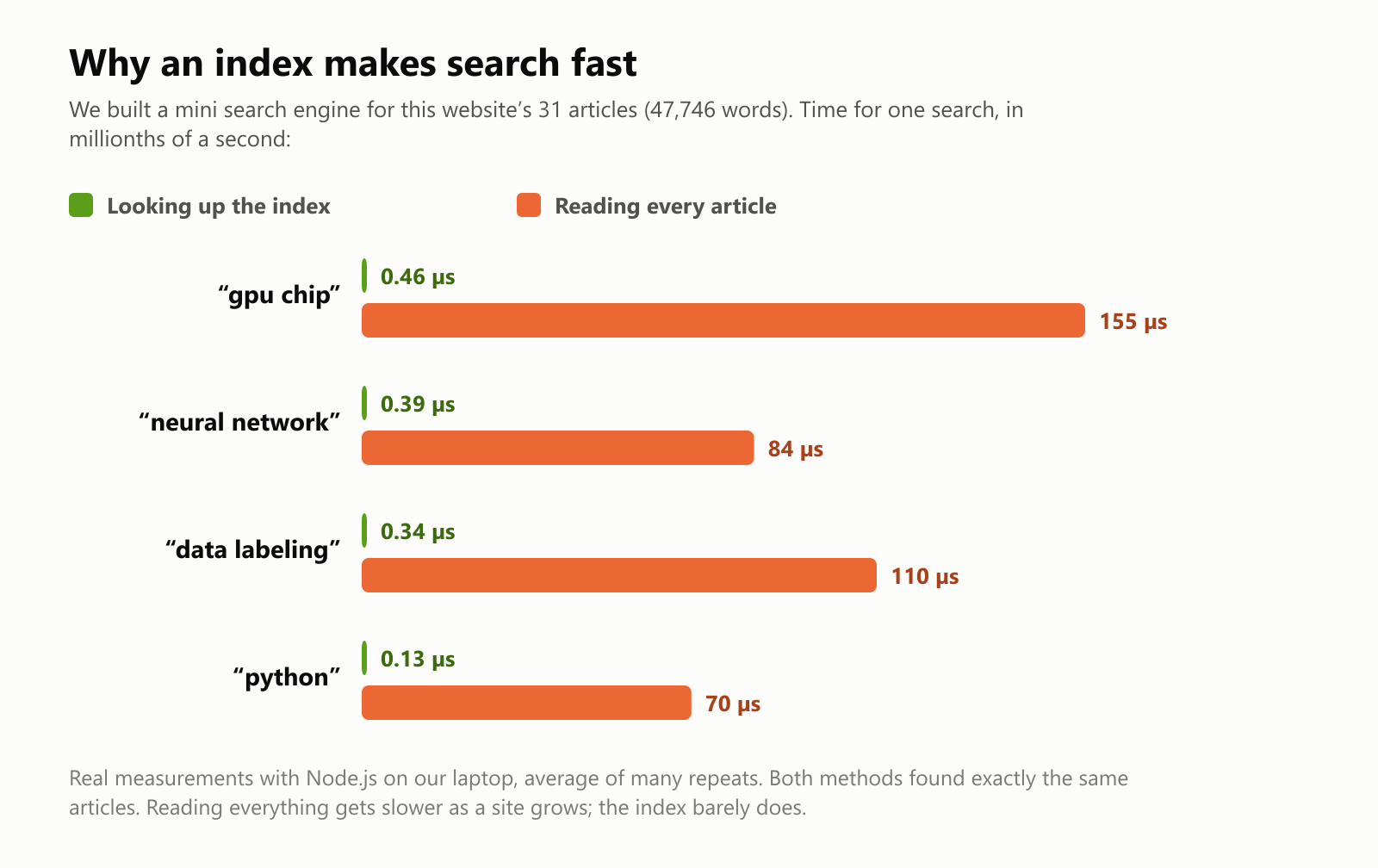
Both methods found exactly the same articles, but the index was about 200 to 500 times faster. A millionth of a second sounds tiny either way, but reading everything gets slower with every page you add. Google's index covers hundreds of billions of pages, so reading them all for each search would be impossible. With an index, finding the pages that mention a word takes about the same time no matter how big the web gets.
The big idea: PageRank
In the 1990s, search engines mostly ranked pages by how often they contained your words, which was easy to cheat by repeating words. Page and Brin's breakthrough was PageRank: treat every link as a vote. A page that many pages link to is probably important. And a link from an important page counts more than a link from an unknown one.
We ran the original PageRank formula on the links between the articles on this website:
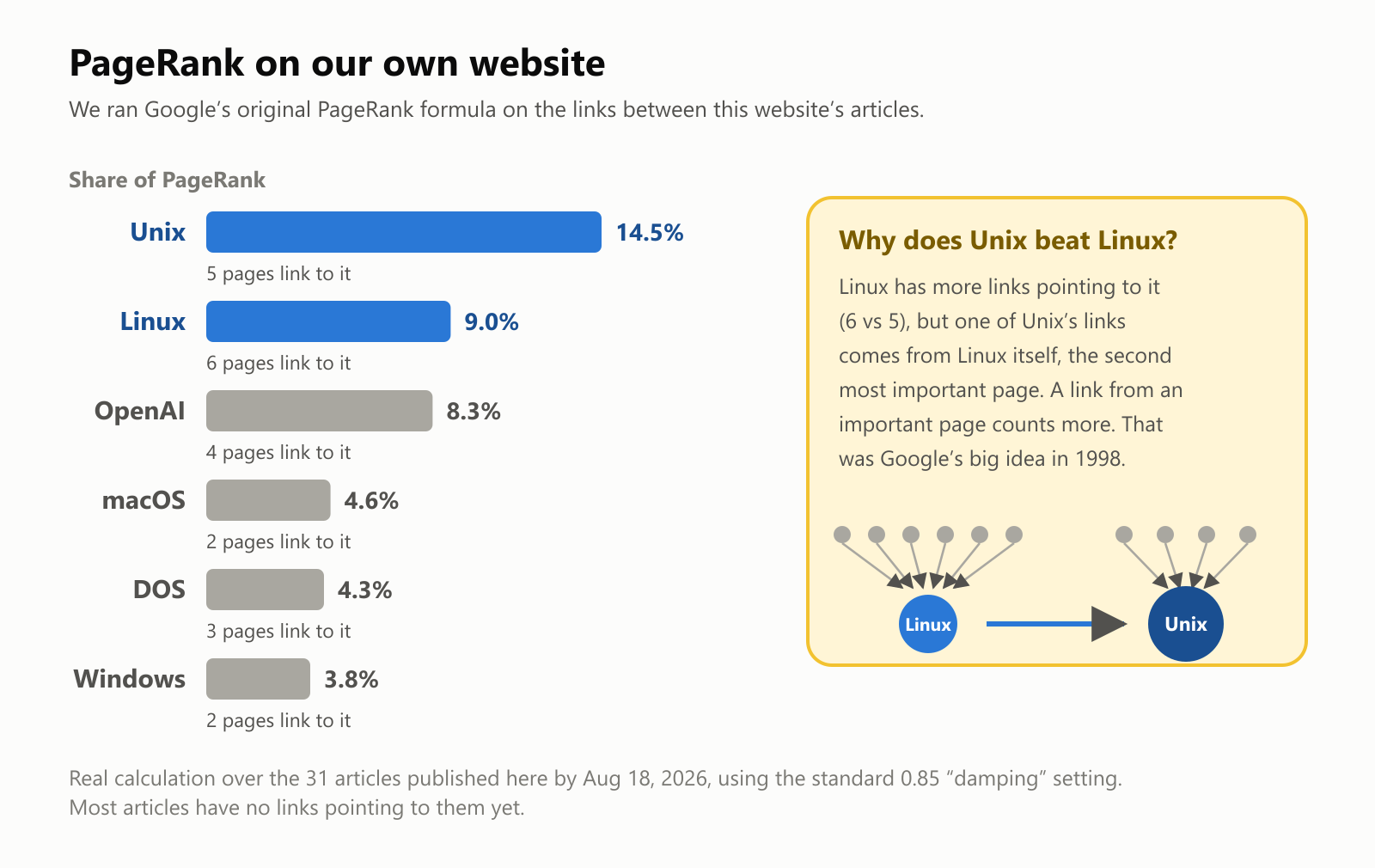
Notice the surprise: the Linux article has more links pointing to it than the Unix article, yet Unix wins. That's because Linux, an important page, links to Unix. Our articles explain that Linux was inspired by Unix, so the link makes sense. That idea, that the web's own links can show which pages matter, is what made Google's results so much better than its rivals' in 1998.
Today PageRank is just one of many signals Google uses, alongside language understanding and AI. But the idea still shapes the web.
Why Google is the default way to search
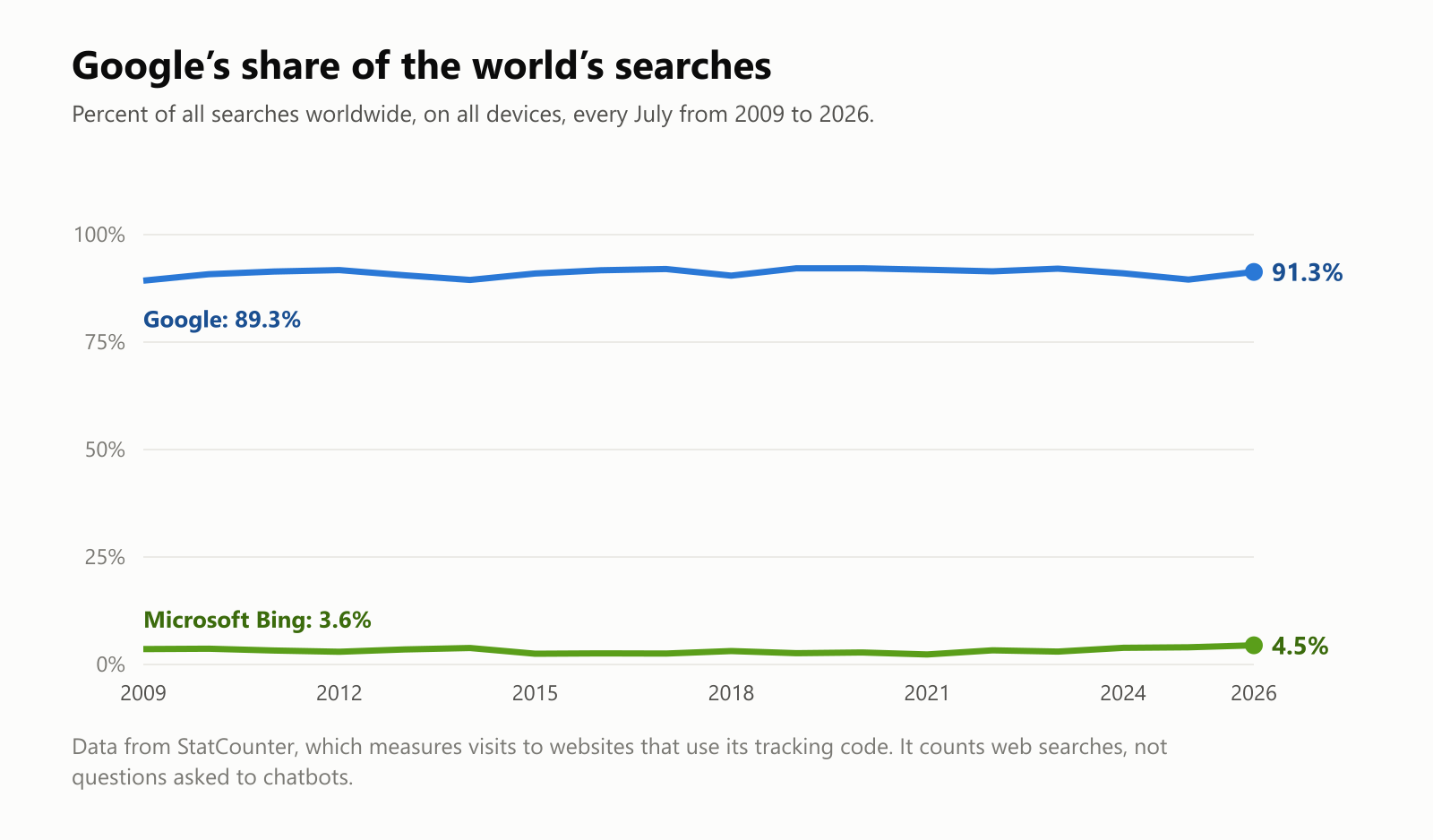
For more than 15 years, about 9 out of every 10 web searches worldwide have gone through Google. Part of the reason is quality. Another part is being the default: Google pays phone makers and browser companies, including Apple, Samsung and Mozilla, to make Google the search engine you get out of the box. Evidence in a US court case showed that Google paid Apple about $20 billion in 2022 alone.
How Google makes money
Google Search is free for you, because advertisers pay. When you search for "running shoes," shoe stores compete in an instant auction to show their ad next to the results, and many of them pay only when someone clicks.
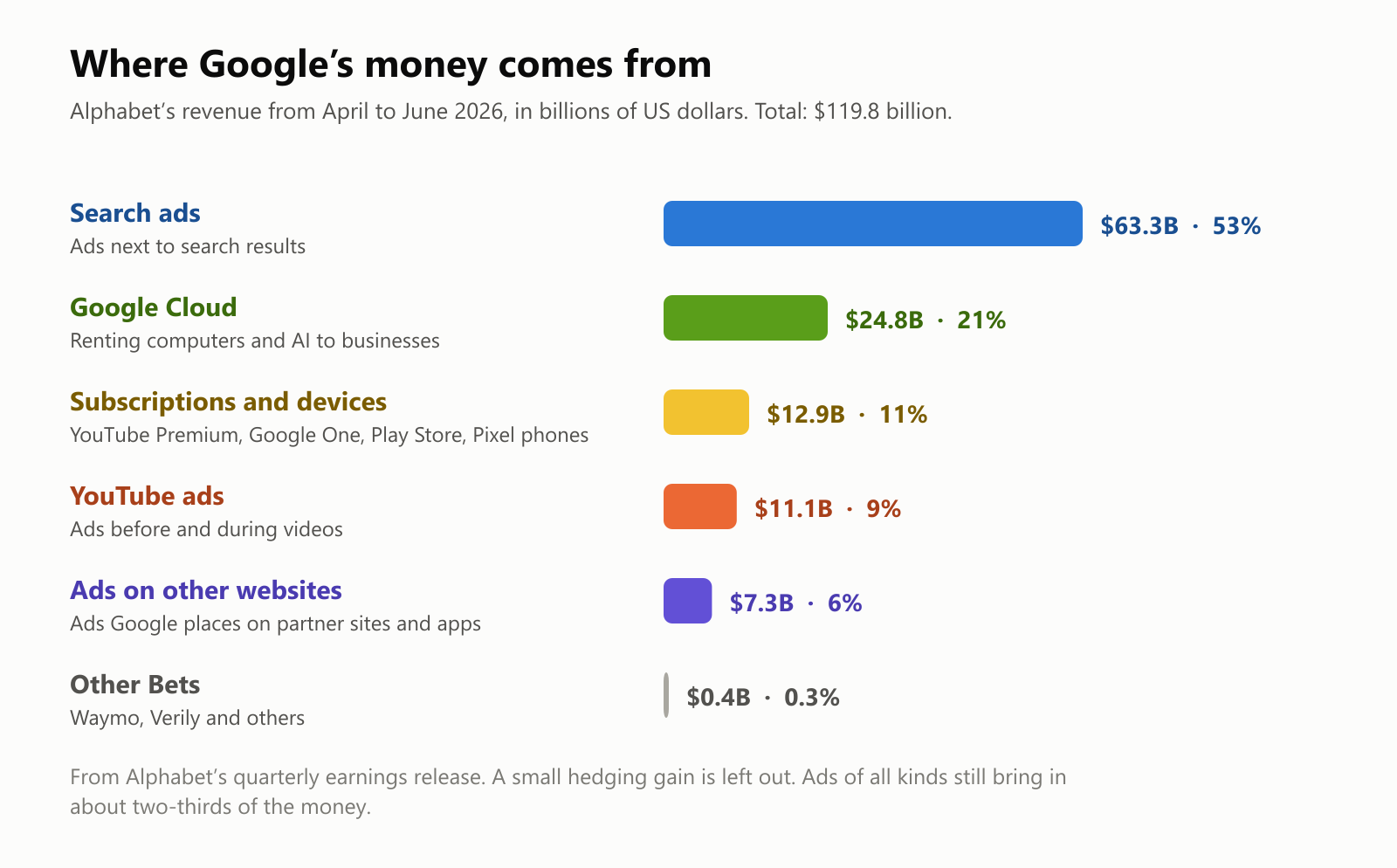
Ads of all kinds still bring in about two-thirds of the money. But the fastest-growing part is Google Cloud, which rents computers and AI to other businesses; it grew 82% in a year as companies rushed to use AI.
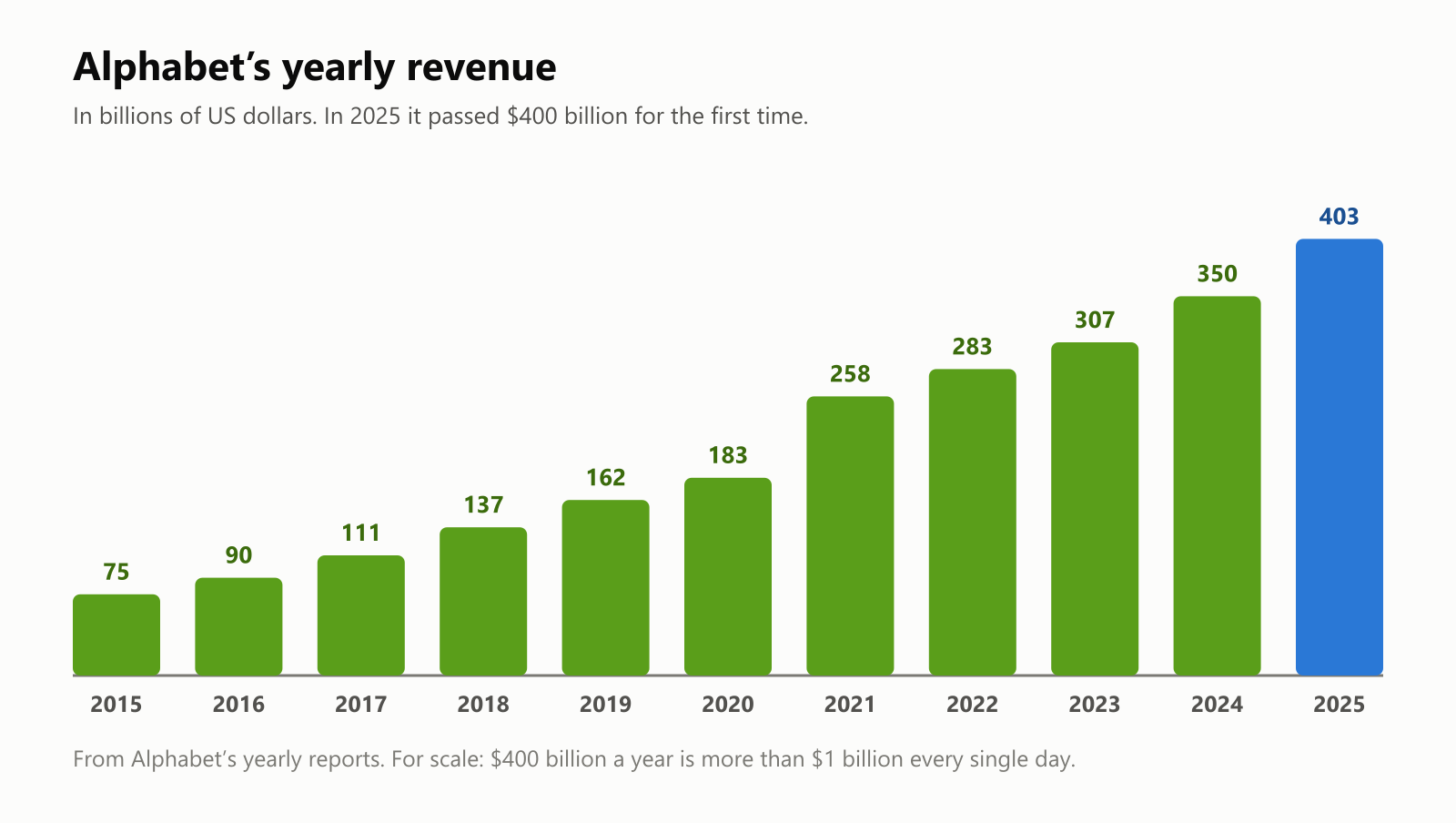
In 2025 Alphabet's revenue passed $400 billion for the first time, and it made $132 billion in profit. Investors have rewarded that growth: in January 2026, Alphabet became only the fourth company ever to be worth $4 trillion on the stock market.
Google and AI
Google has been one of the most important companies in AI for more than a decade:
- Google Brain and DeepMind. Google started an AI research team, Google Brain, in 2011 and bought the London lab DeepMind in 2014. DeepMind's AlphaGo beat a world champion at the board game Go in 2016, and its AlphaFold, which predicts the shapes of proteins, won two of its scientists a share of the 2024 Nobel Prize in Chemistry. (See What Is Deep Learning?)
- The Transformer. In 2017, Google researchers invented the Transformer, the design behind almost every modern chatbot, including ChatGPT and Claude. (See What Is a Transformer?)
- Its own AI chips. Google designs its own AI chips, called TPUs, instead of relying only on NVIDIA. (See What Is NVIDIA?)
- Gemini. After ChatGPT took the world by surprise in late 2022, Google rushed out its own chatbot, Bard, which became Gemini. By mid-2026, the Gemini app had about 950 million monthly users, and Apple announced in January 2026 that its own AI models would be built on Gemini.
- AI in Search. Since 2024, many Google searches show an AI Overview, a written summary at the top of the results, and there's an optional chat-style AI Mode.
Challenges and debates
- Monopoly cases. In August 2024, a US federal judge ruled that Google illegally kept a monopoly in search, largely through its default-search payments. In September 2025, the judge decided not to force Google to sell its Chrome browser, but banned exclusive deals and ordered it to share some search data with rivals. Both sides appealed. In a separate case, another judge ruled in April 2025 that Google illegally dominated technology used to sell online ads; the punishment was still being decided in August 2026. The European Union has also fined Google billions of euros in several cases.
- Privacy. Google's ad business is built on knowing what people are interested in, which raises concerns about how much data it collects. It has paid large settlements over privacy in several US states.
- AI answers and websites. News sites and other publishers say AI Overviews answer questions directly, so fewer people click through to their pages, which hurts their income. Google says its AI features send visitors to a wider range of sites.
- Accuracy. AI summaries sometimes make mistakes, so it's still worth checking the sources.
- Competition from chatbots. Some people now ask AI chatbots instead of searching. So far, Google says its searches are still growing.
A short history
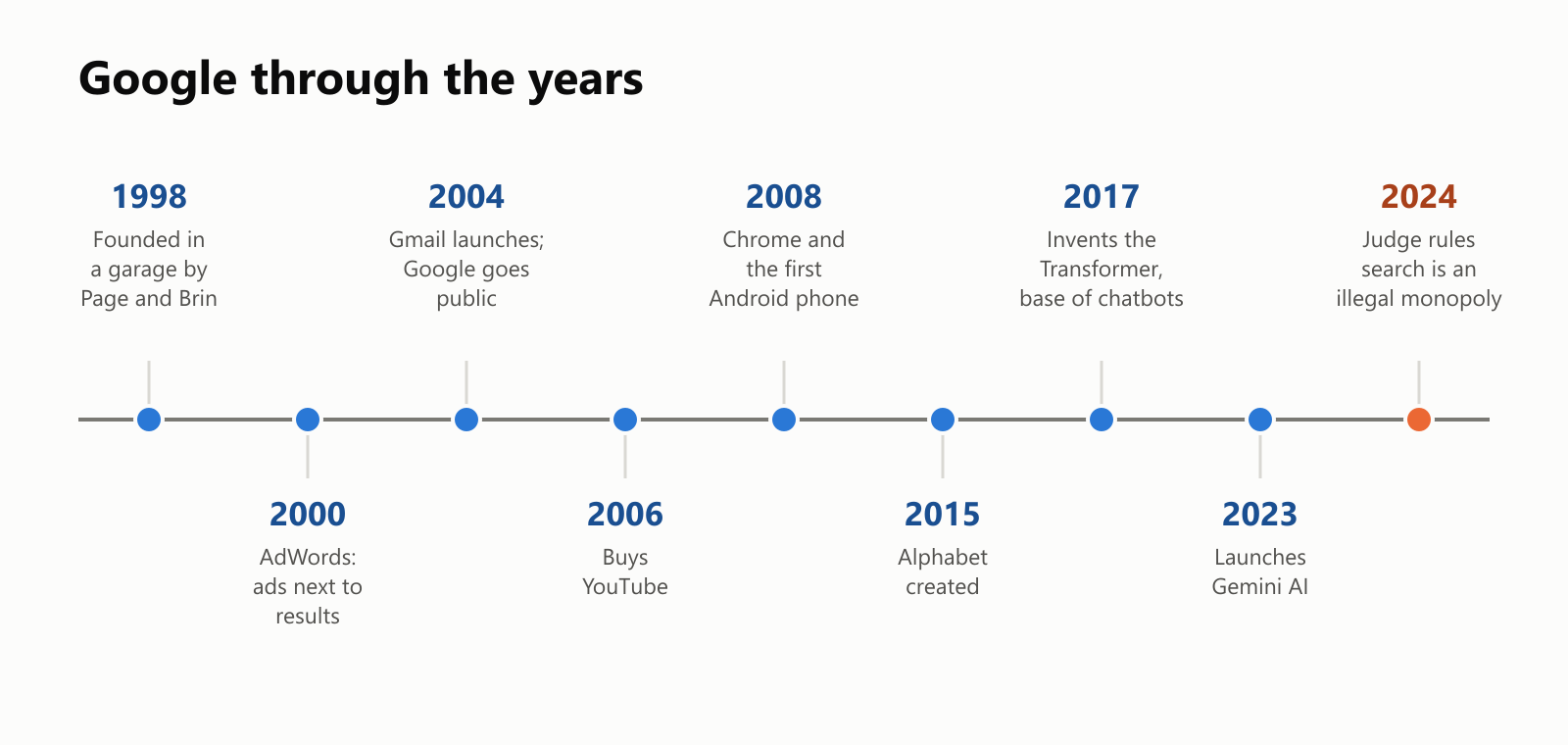
Try it yourself
- Search smarter. Put words in quotes, like
"page rank", to find that exact phrase. Add a minus sign to leave words out, likejaguar -car. Typesite:before a website address to search only that site. - Check what Google knows about you. Visit your Google account's "Data & privacy" page to see and delete your search and YouTube history, and to turn off personalized ads.
- Try Gemini. Ask the same question on Google Search and in Gemini, and compare the answers and their sources.
Common questions
Is Google free? For you, mostly yes. Advertisers pay for most of it. Some services, like extra storage or YouTube Premium, cost money.
What's the difference between Google and Alphabet? Alphabet is the parent company. Google is its main business, which includes Search, YouTube, Android and Cloud. Alphabet also owns smaller "Other Bets," like Waymo.
Does Google show the same results to everyone? No. Results can change depending on where you are, your language and, if you're signed in, your past activity.
Can websites pay to rank higher? Not in the normal results. Websites can pay for ads, which appear with a "Sponsored" label, but the regular results are ranked by Google's algorithms.
Is Google the only search engine? No. Alternatives include Microsoft Bing, DuckDuckGo, which focuses on privacy, Baidu in China and Yandex in Russia.
Glossary
- Algorithm: a set of step-by-step rules a computer follows, like the rules Google uses to rank pages.
- Crawler: a program that visits web pages automatically and follows their links.
- Default: the option you get automatically unless you change it.
- Index: a list of words with the pages that contain each one, so they can be found quickly.
- Monopoly: when one company controls almost all of a market and can keep competitors out.
- PageRank: Google's original method of ranking pages by the links that point to them.
- Search engine: a website or app that finds information on the web for you.
Wrapping up
Google began with one clever idea: use the web's own links to find the best pages. That made it the front door to the internet for billions of people, and selling ads next to search results turned it into one of the richest companies in history. Today it is also a leader in AI, and one of the most closely watched companies by governments around the world.
Next time you google something, remember that the answer was found in less than a second by looking it up in an index of hundreds of billions of pages.
Read next
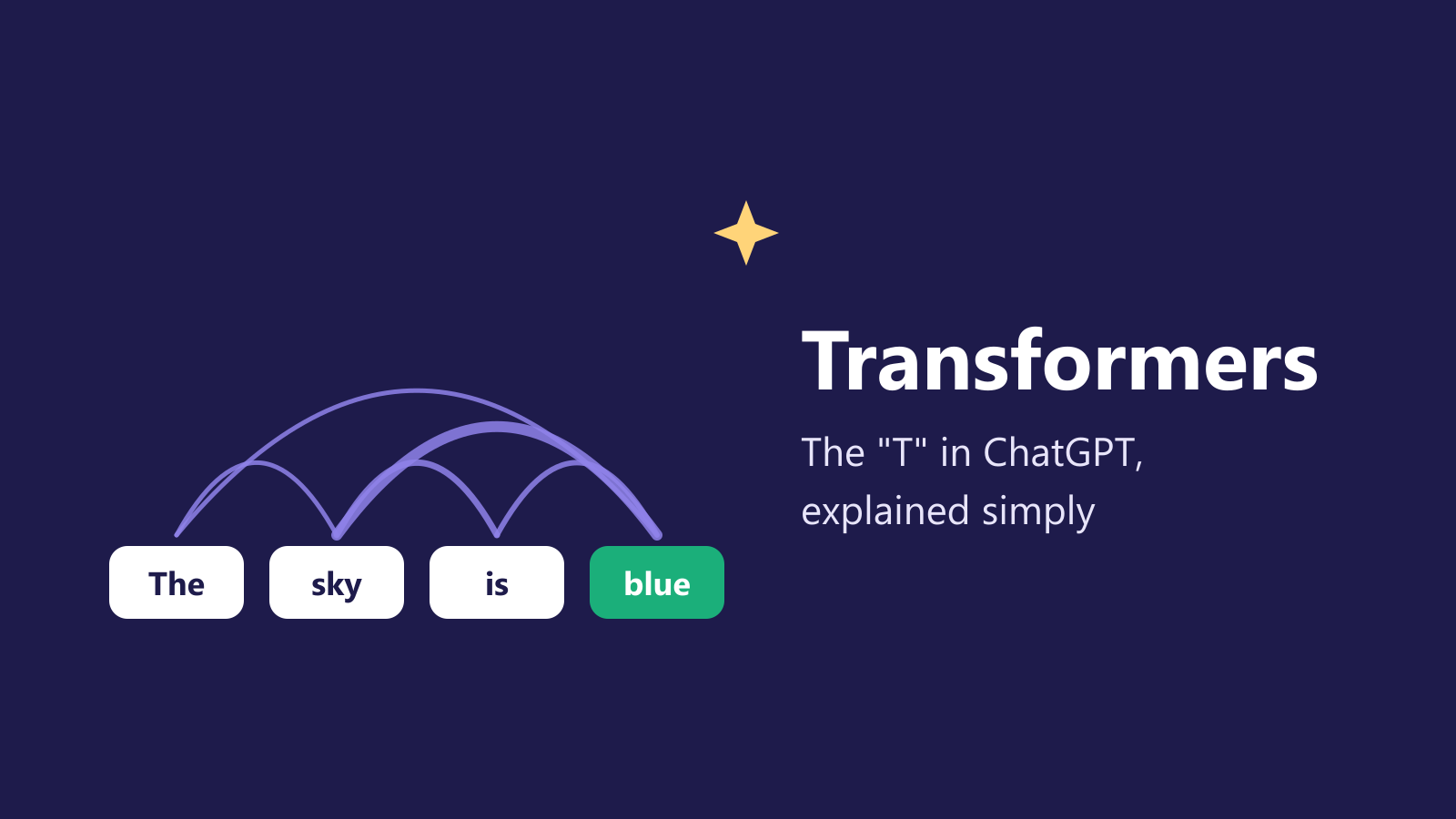
What Is a Transformer in AI? The Idea Behind ChatGPT, Explained Simply
A friendly, jargon-free guide to transformers, the AI design behind ChatGPT, Claude and Gemini. Learn how "attention" lets AI understand words in context, what happens inside a transformer, and why it changed AI so quickly.
 nbkhope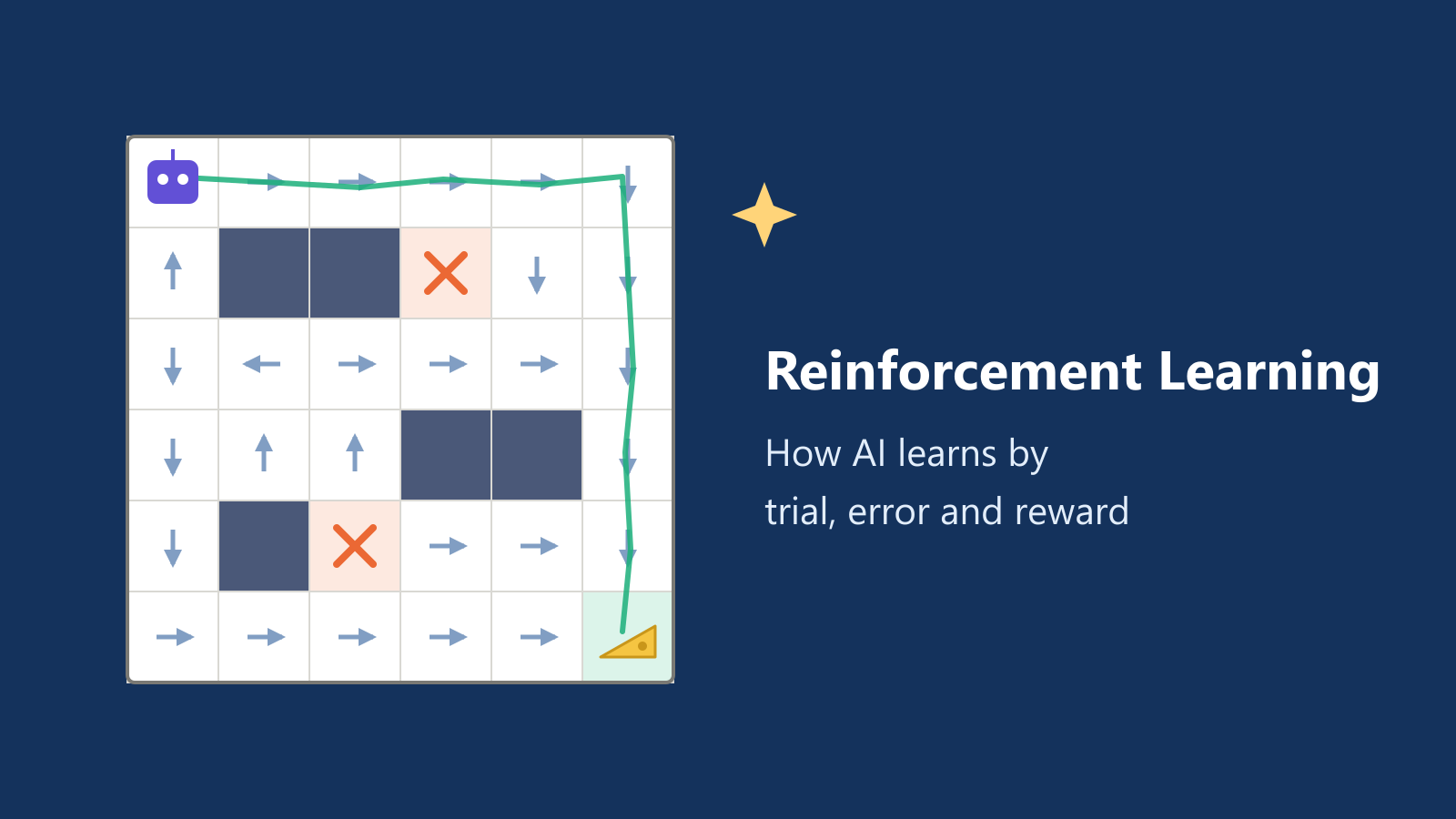
What Is Reinforcement Learning? How AI Learns by Trial, Error and Reward
A friendly, jargon-free introduction to reinforcement learning, how AI learns by trial, error and reward, like training a dog with treats. Watch a real robot learn a maze, see why exploring matters, and learn how it shapes chatbots.
nbkhope
What Is Graph Engineering? How Today's AI Teams Up to Get Real Work Done
A friendly, jargon-free guide to graph engineering, the 2026 idea of building AI as a map of connected steps instead of one big loop. See how today's AI agents work, why small mistakes add up, and how checkers, branches and teamwork fix it.
nbkhope
Comments
Be kind and specific. Comments with links from new accounts appear after a moderator reviews them.