What Is the Rust Programming Language? A Simple Guide to the Fast Language That Won't Let You Crash
A friendly, jargon-free guide to Rust, the programming language that is as fast as C but stops whole families of memory bugs before a program ever runs. Learn about ownership, why tech giants are adopting it, and where it is used.

On this page
For decades, programmers building the most important software, like web browsers and operating systems, faced a hard choice. They could use languages like C and C++, which are blazing fast but let tiny mistakes with memory turn into crashes and security holes. Or they could use safer languages, which protect memory but are usually slower or need a helper running in the background.
Rust is a programming language that refuses to choose. It aims to be as fast as C while catching memory mistakes before the program ever runs. Microsoft, Google, Amazon and the Linux project have all started using it in some of their most sensitive code. This article explains, in plain language, what Rust is, how it pulls off that trick, and why so many people are excited about it.
Born from a broken elevator
In 2006, a programmer at Mozilla (the organization behind the Firefox browser) named Graydon Hoare came home to find that the elevator in his apartment building was broken, again. Its software had crashed. He's said that the frustration of climbing 21 flights of stairs got him thinking: why is so much software so fragile?
That night he started a personal project to design a language where those kinds of crashes would be much harder to cause. He named it Rust, after a family of tough, resilient fungi. Mozilla began sponsoring the project in 2009, hoping to use it to build a faster, safer browser, and Rust 1.0 was released in 2015.
The problem Rust solves: memory mistakes
Every program uses the computer's memory to hold its data: names, numbers, pictures, web pages. Picture memory as a giant wall of numbered lockers. A program asks for some lockers, uses them, and should give them back when it's done.
In C and C++, the programmer manages those lockers by hand, and it's easy to slip up: writing past the end of your lockers into someone else's, using a locker after giving it back, or giving the same locker back twice. These are memory-safety bugs, and they're not just crashes. Attackers can use them to break into computers.
Here's the same kind of mistake in C and in Rust:
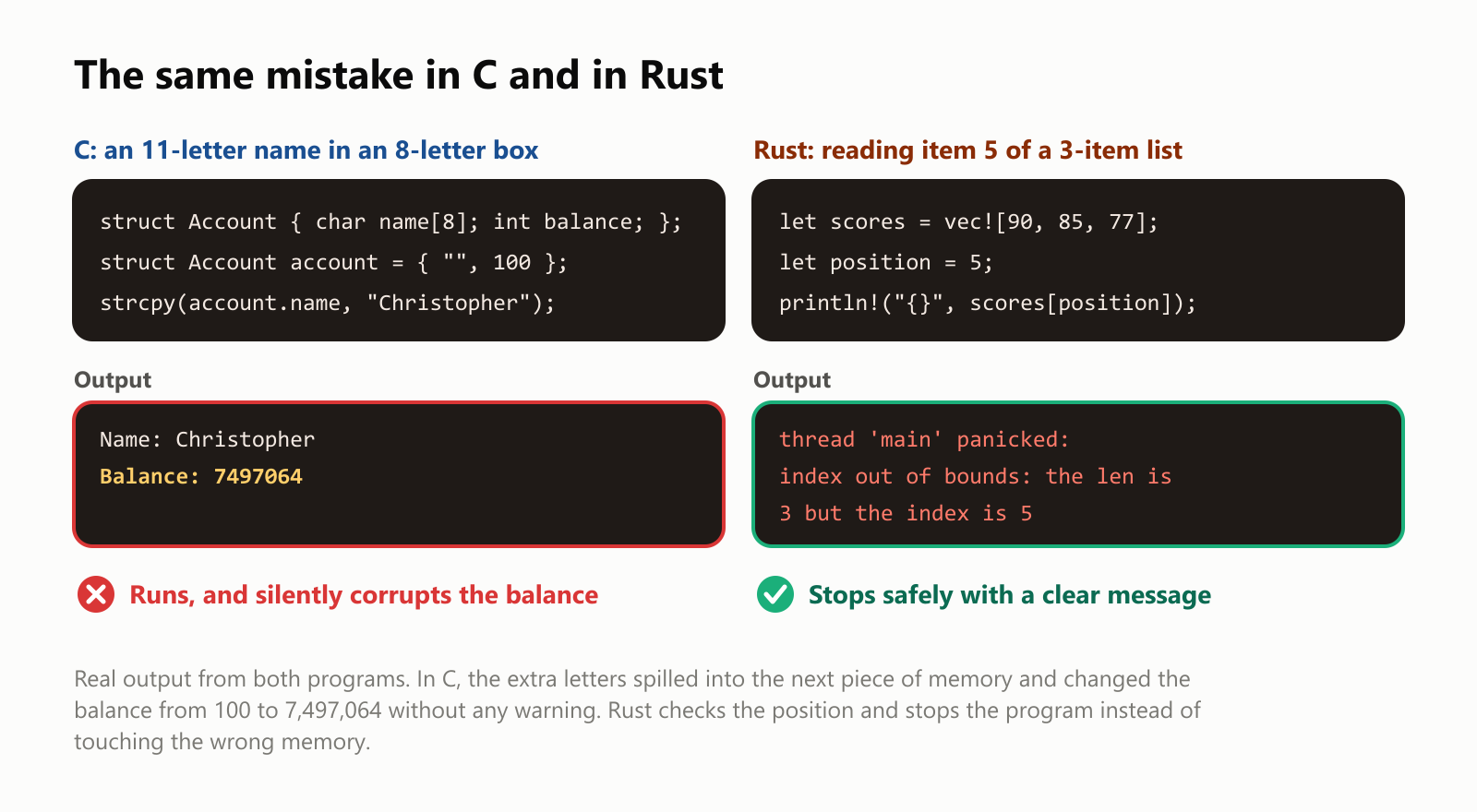
In the C program, the name "Christopher" didn't fit in its 8-letter box, so the extra letters spilled into the next locker, where the account balance was stored. The balance silently changed from 100 to 7,497,064, with no error at all. In Rust, a similar mistake stops the program immediately with a clear message, instead of quietly damaging other data.
How big is this problem? Bigger than you might think:
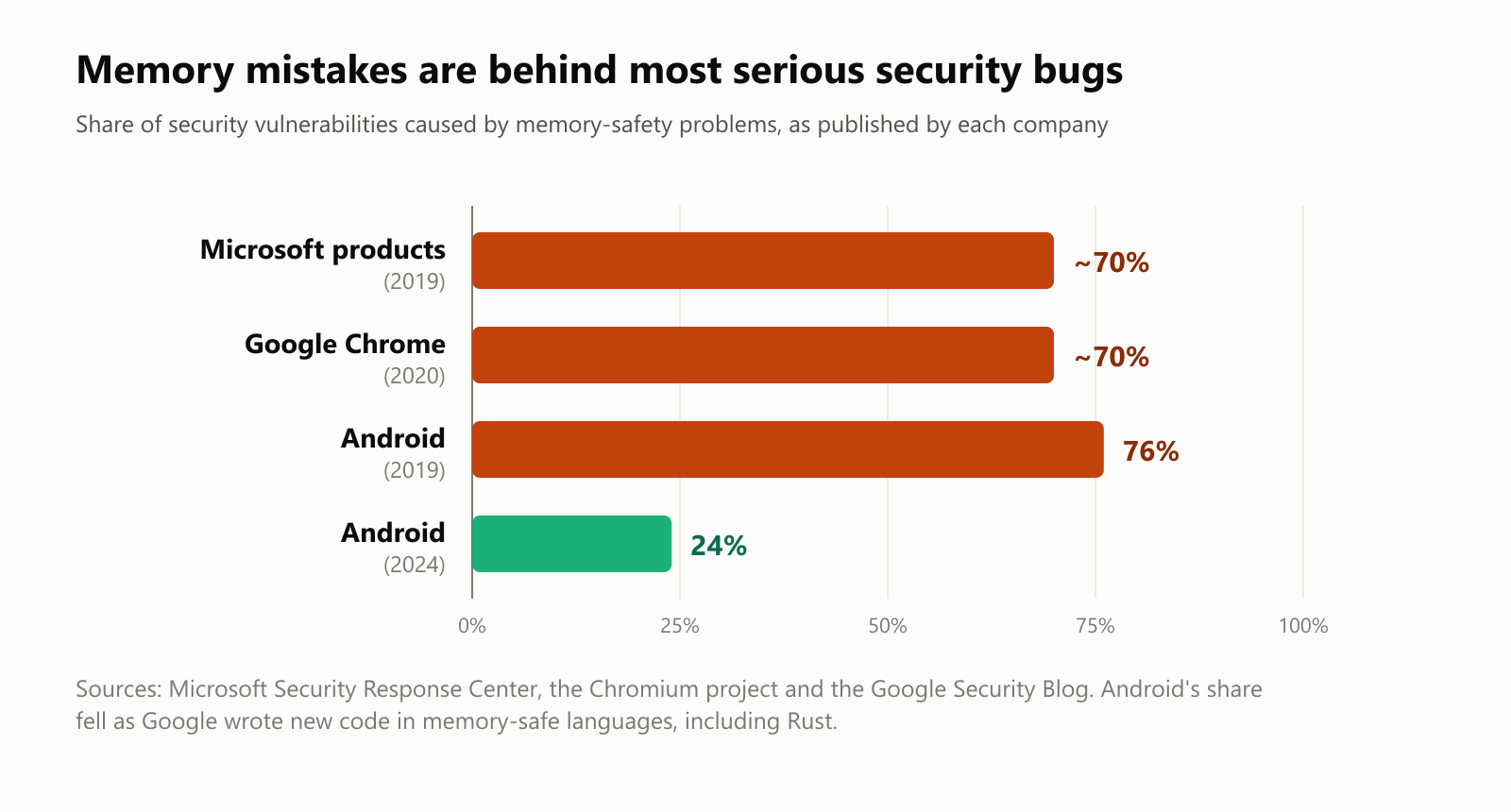
Microsoft and Google's Chrome team have each reported that about 70% of their serious security bugs come from memory-safety problems. On Android, Google started writing new code in memory-safe languages, including Rust, and reported that the share of memory-safety vulnerabilities fell from 76% in 2019 to 24% in 2024.
How other languages solve it, and how Rust does
Languages like Java, Go, Python and JavaScript avoid most of these bugs with a garbage collector: a helper that runs alongside your program, like a janitor, finding lockers nobody uses anymore and cleaning them out. That works well, but the janitor costs some speed and memory, and occasionally makes the program pause for a moment.
Rust takes a third path:
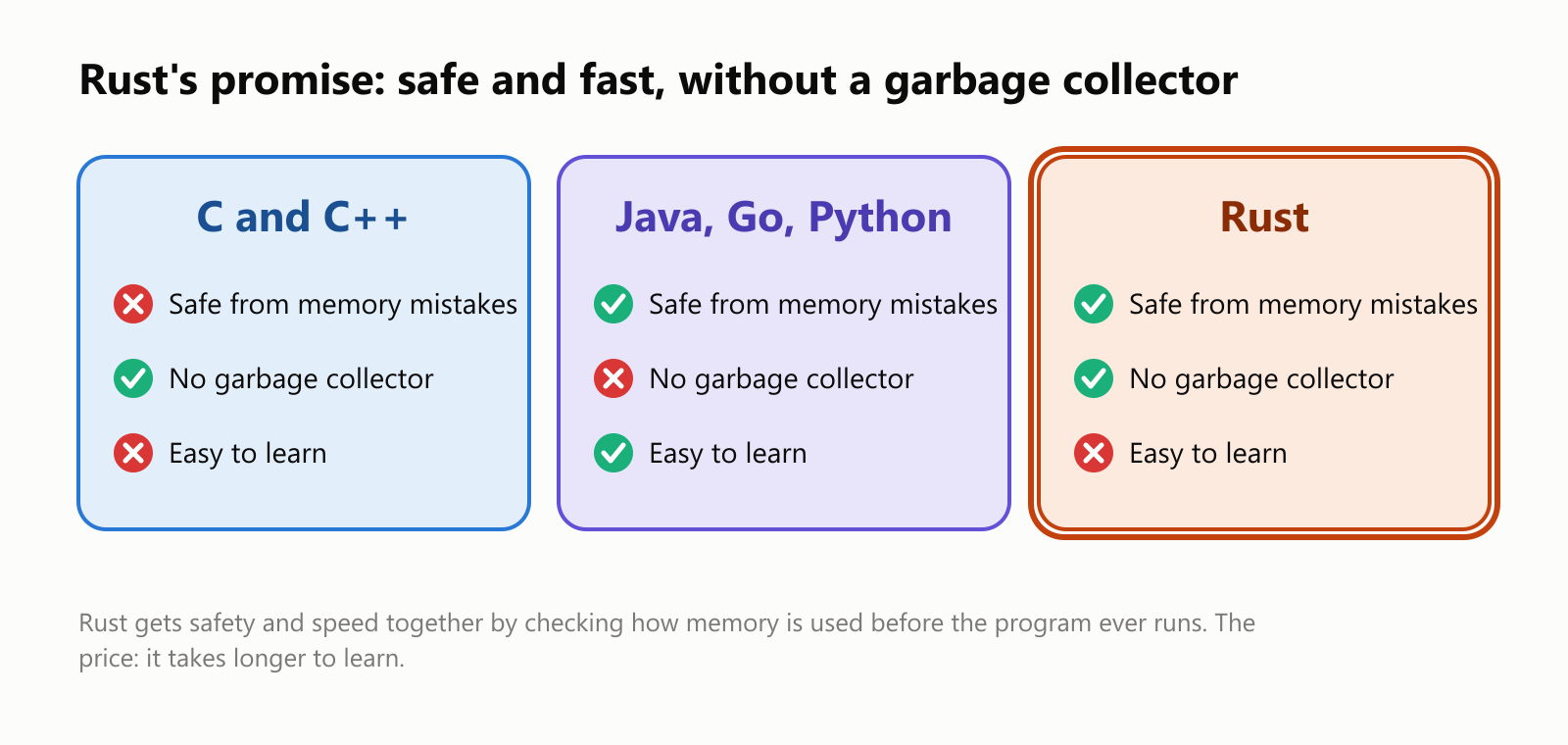
Instead of a janitor that cleans up while the program runs, Rust has a very strict compiler, the tool that translates your code into a program, that checks how every piece of memory is used before the program is built. If the rules could be broken, it refuses to build the program. No janitor needed, and no memory-safety bugs in normal Rust code.
Ownership: Rust's big idea
Rust's rules are called ownership, and they work a lot like borrowing books from a library:
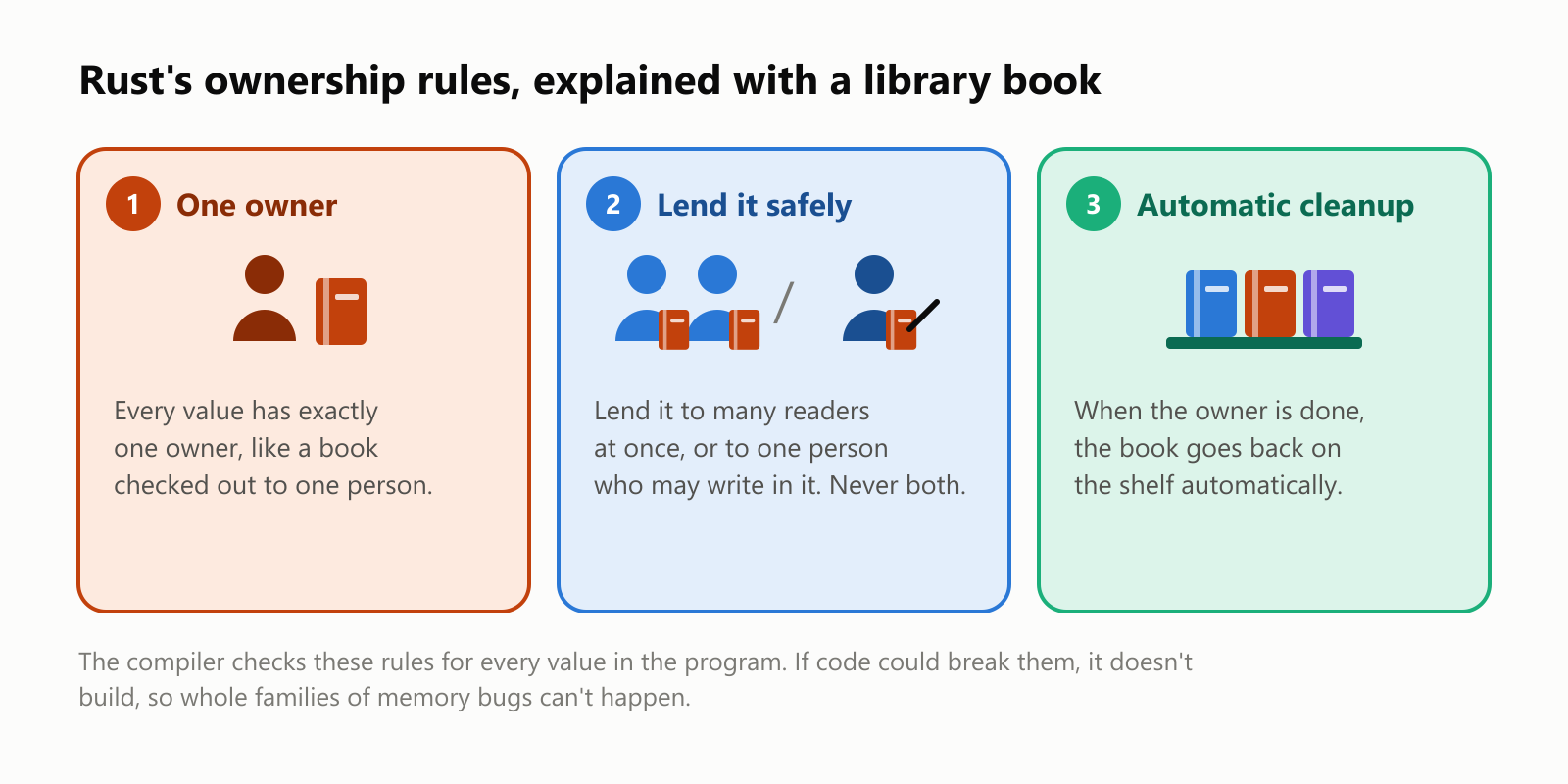
- Every value has exactly one owner. If you give your book to a friend, it's theirs now. You can't keep reading it.
- You can lend it. Either to many people who only read it, or to exactly one person who may write in it, but never both at the same time. That way nobody reads a page while someone else is rewriting it.
- When the owner is done, it's cleaned up automatically. The book goes back on the shelf the moment its owner leaves, so memory is never forgotten or returned twice.
Here's what happens when you break rule 1:
let book = String::from("Rust for Beginners");
let friend = book;   // the book is given away
println!("{book}");  // ...but we still try to read it
The compiler refuses, with a message that reads like a helpful teacher:
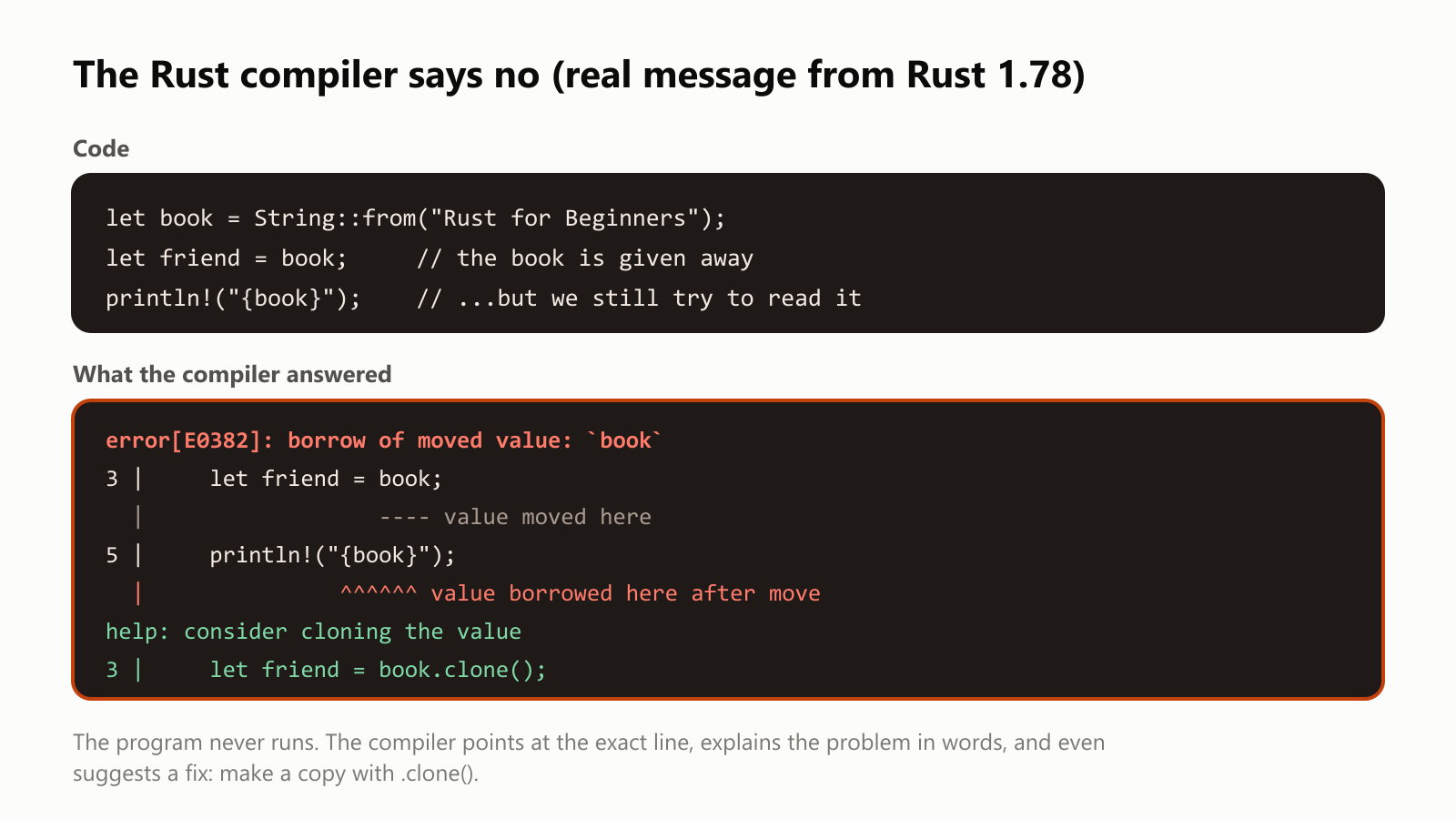
The program never runs. The compiler points at the exact line, explains that the book was "moved" (given away), and even suggests a fix: make a copy with .clone(). Rust's error messages are famous for being this friendly.
Lending looks like this. The & means "let this function borrow the book, but I still own it":
1fn count_letters(text: &String) -> usize {
2    text.len()
3}
4
5fn main() {
6    let book = String::from("Rust for Beginners");
7    let letters = count_letters(&book);
8    println!("\"{book}\" has {letters} characters");
9}
It prints "Rust for Beginners" has 18 characters. The book was lent out, returned, and is still ours to use.
What else Rust looks like
Here's the classic first program:
fn main() {
    println!("Hello, world!");
}
fn starts a function, main is where the program begins, and println! prints a line. And here's a small car, described with a struct (a bundle of named values) and an impl block that gives it abilities:
1struct Car {
2    color: String,
3    speed: u32,
4}
5
6impl Car {
7    fn accelerate(&mut self) {
8        self.speed += 10;
9    }
10}
11
12fn main() {
13    let mut my_car = Car {
14        color: String::from("red"),
15        speed: 0,
16    };
17    my_car.accelerate();
18    my_car.accelerate();
19    println!("My {} car is going {} km/h", my_car.color, my_car.speed);
20}
This prints My red car is going 20 km/h. Notice mut: in Rust, values can't be changed unless you say so. That's another small safety habit built into the language.
Is Rust fast?
Very. Rust compiles straight to machine code, like C, and has no garbage collector running in the background. We timed the same simple job, counting the prime numbers below 2 million, in six languages:
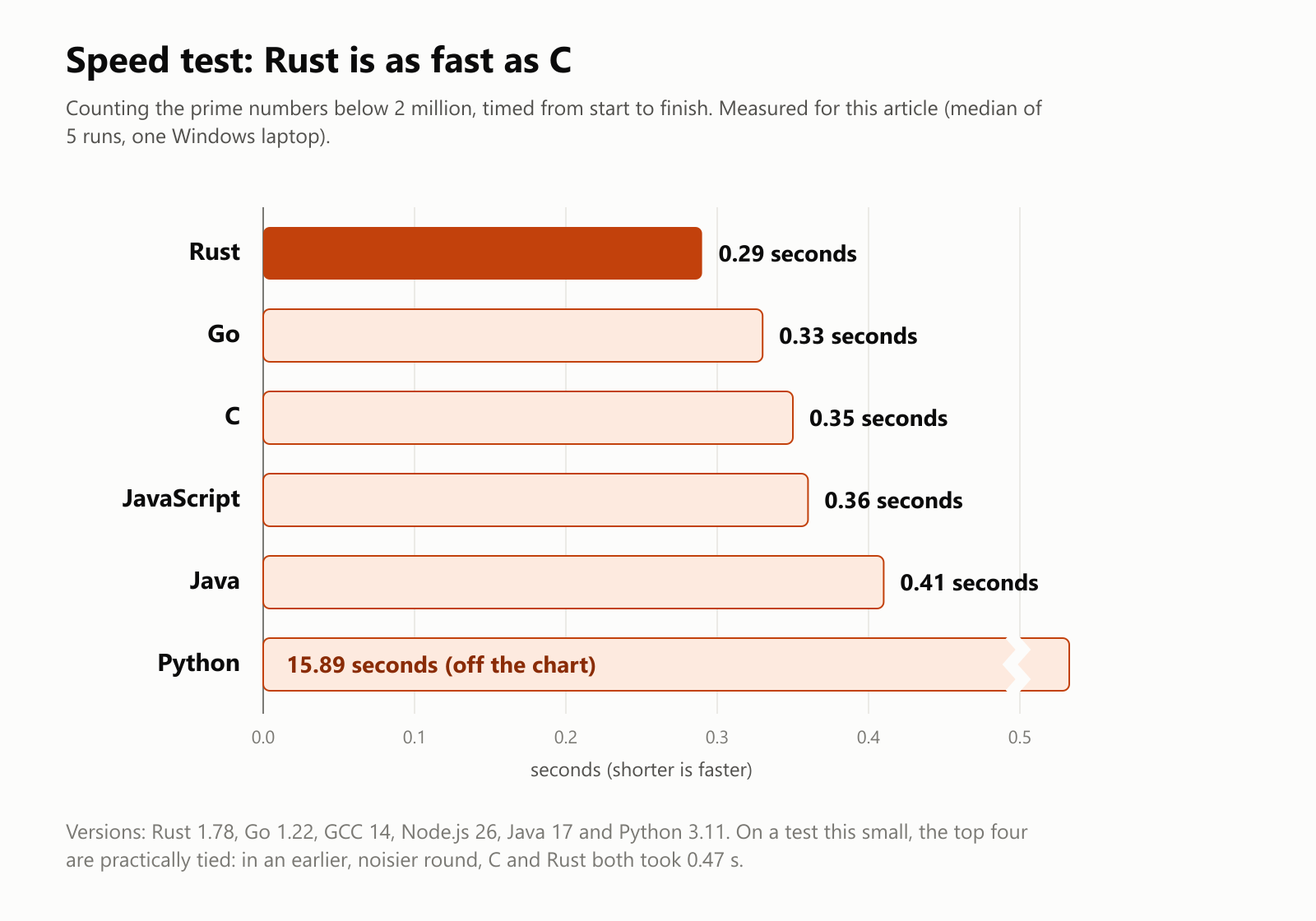
Rust came out on top at 0.29 seconds, but honestly, on a test this small, Rust, Go, C and JavaScript are practically tied: in an earlier round, while the laptop was busier, C and Rust took exactly the same time. The real point is that Rust plays in the same league as C, while also being memory-safe. Plain Python, for comparison, took almost 16 seconds.
Where Rust really shines is in big, long-running programs. Because there's no garbage collector, there are no surprise pauses. The chat app Discord famously rewrote one of its busiest services from Go to Rust in 2020 to get rid of the small, regular slowdowns caused by Go's garbage collector.
Where Rust is used
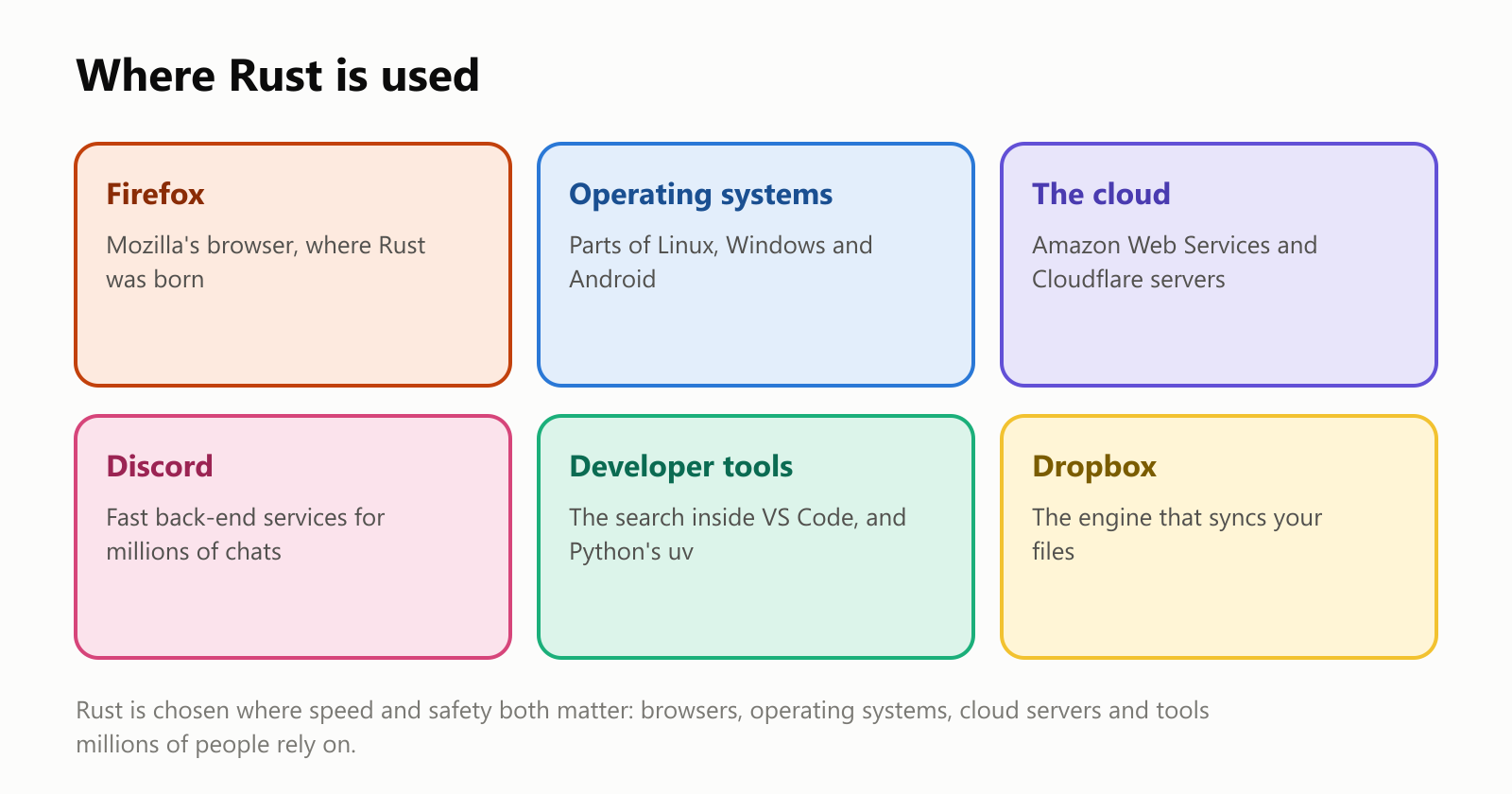
- Firefox: in 2017, Firefox shipped a new styling engine written in Rust, putting Rust code on hundreds of millions of computers.
- Operating systems: Linux, the system behind most servers and every Android phone, started accepting Rust code into its core, the "kernel", in 2022, alongside C. Microsoft has rewritten parts of Windows in Rust, and Google uses it heavily in Android.
- The cloud: Amazon built Firecracker, the technology behind its AWS Lambda service, in Rust. Cloudflare handles a huge share of the web's traffic with Rust-based software.
- Apps and services: Discord, Dropbox (whose file-syncing engine is written in Rust) and Figma all use it.
- Developer tools: when you search across files in Visual Studio Code, a Rust program called ripgrep does the work. Popular Python tools like uv and Ruff are written in Rust because they're dramatically faster.
In 2024, even the White House's Office of the National Cyber Director published a report urging software makers to move to memory-safe languages, a group that includes Rust.
The downsides
- A steep learning curve. Ownership and borrowing are new ideas for most programmers. Beginners often spend their first weeks "fighting the borrow checker", the part of the compiler that enforces the lending rules, until it clicks.
- Slow to compile. All those checks take time. Big Rust projects can take minutes to build, much longer than Go.
- Not the easiest first language. For learning to program, Python or JavaScript are gentler starts. Rust rewards people who already know some programming.
- Younger ecosystem. Rust has fewer ready-made libraries than C++, Java or Python for some areas, like games, AI research or apps with windows and buttons.
- Safety isn't magic. Rust prevents memory-safety bugs, but it can't stop logic mistakes, like a calculator adding when it should subtract. And code inside
unsafeblocks still relies on the programmer being careful.
A short history
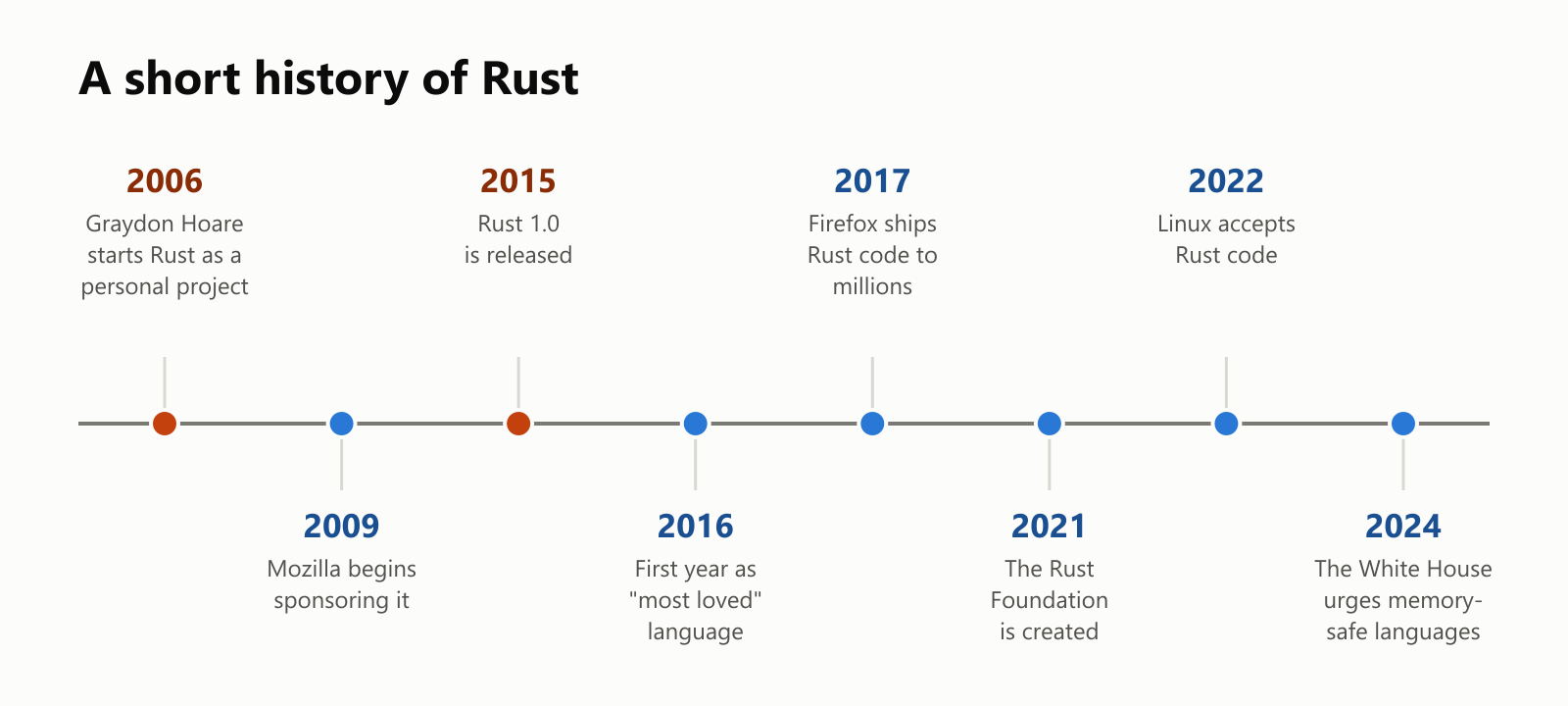
Programmers clearly enjoy it: in Stack Overflow's huge yearly developer survey, Rust was voted the most loved (later renamed "most admired") language for nine years in a row, from 2016 to 2024. In 2021, Amazon, Google, Huawei, Microsoft and Mozilla founded the Rust Foundation, a nonprofit that now looks after the language.
Should you learn Rust?
- Great reasons: you want to write software where speed and reliability really matter: system tools, game engines, browsers, embedded devices, cloud infrastructure or high-performance libraries. Even if you never use it at work, learning Rust teaches you how memory really works, which makes you a better programmer in any language.
- Good to know: Rust is free and runs on Windows, Mac and Linux. The official website, rust-lang.org, offers a free online book, The Rust Programming Language (nicknamed "the book"), and an online playground where you can try Rust in your browser.
If you're curious about the languages Rust is often compared to, see What Is the C Programming Language?, What Is the C++ Programming Language? and What Is the Go Programming Language?
A small glossary
- Rust: a programming language focused on speed and memory safety, released in 2015.
- Memory: where a running program keeps its data.
- Memory-safety bug: a mistake like using memory you don't own or after you gave it back. A leading cause of crashes and security holes.
- Garbage collector: a helper that automatically cleans up unused memory while a program runs.
- Compiler: the tool that translates code into a program, and in Rust's case, checks the ownership rules.
- Ownership: Rust's rule that every value has exactly one owner, and is cleaned up when the owner is done.
- Borrowing: temporarily lending a value to another part of the program, written with
&. - Borrow checker: the part of the Rust compiler that enforces the lending rules.
- Panic: Rust stopping a program on purpose when something is wrong, instead of continuing with bad data.
- unsafe: a keyword that marks code where the programmer, not the compiler, guarantees safety.
- Cargo and crates: Rust's build tool and its ready-made packages.
Wrapping up
Rust started with a broken elevator and a simple question: why does so much software crash? Its answer is ownership, a set of library-style rules that the compiler checks before your program is ever built. The result is a language as fast as C that stops whole families of memory bugs, the kind behind most serious security holes.
It asks more of you up front, and its compiler can feel strict. But that strictness is the point: every mistake it catches on your computer is one that never reaches anyone else's. That's why browsers, operating systems and cloud servers are slowly being rebuilt with a little help from a friendly orange crab.
Read next
What Is the Swift Programming Language? A Simple Guide to the Language Behind iPhone Apps
A friendly, jargon-free guide to Swift, the programming language Apple created for iPhone, iPad and Mac apps. Learn why it replaced Objective-C, how optionals prevent crashes, how an app is made, and how fast Swift really is.
 nbkhope
What Is the Go Programming Language? A Simple Guide to the Language of the Cloud
A friendly, jargon-free guide to Go, the simple and fast programming language Google created for the cloud. Learn what goroutines are, why Go programs are a single file, and how Go came to power Docker, Kubernetes and much of the internet.
nbkhope
What Is the Python Programming Language? A Simple Guide to the Language Behind Data Science and AI
A friendly, jargon-free guide to Python, the easy-to-read programming language behind data science and AI. Learn why it uses indentation, how it can be slow and fast at the same time, and why it became the most popular language in the world.
nbkhope
Comments
Be kind and specific. Comments with links from new accounts appear after a moderator reviews them.