What Is the C Programming Language? A Simple Guide to the Language That Runs the World
A friendly, jargon-free guide to C, the 50-year-old programming language hiding inside your phone, your car and the internet. Learn what C is, why it's so fast, how it works with memory, and why it still matters today.

On this page
You've probably never seen a line of C code. But right now, C is almost certainly working for you. It's inside the operating system of your phone and computer, in your Wi-Fi router, in your car, in your microwave, and in the servers behind nearly every website you visit.
C is a programming language created in 1972, and more than 50 years later it's still one of the most important pieces of technology in the world. This article explains, in plain language, what C is, why it became so influential, what makes it fast, and why it can also be a little dangerous.
First, what's a programming language?
Computers only truly understand long strings of 0s and 1s, called machine code. Writing a program that way is painfully slow and error-prone for people.
A programming language is a middle ground: a way to write instructions in text that people can read, which then gets translated into the 0s and 1s the computer understands. Some languages are designed to be as friendly as possible. Others stay close to how the machine actually works. C sits right in the middle:
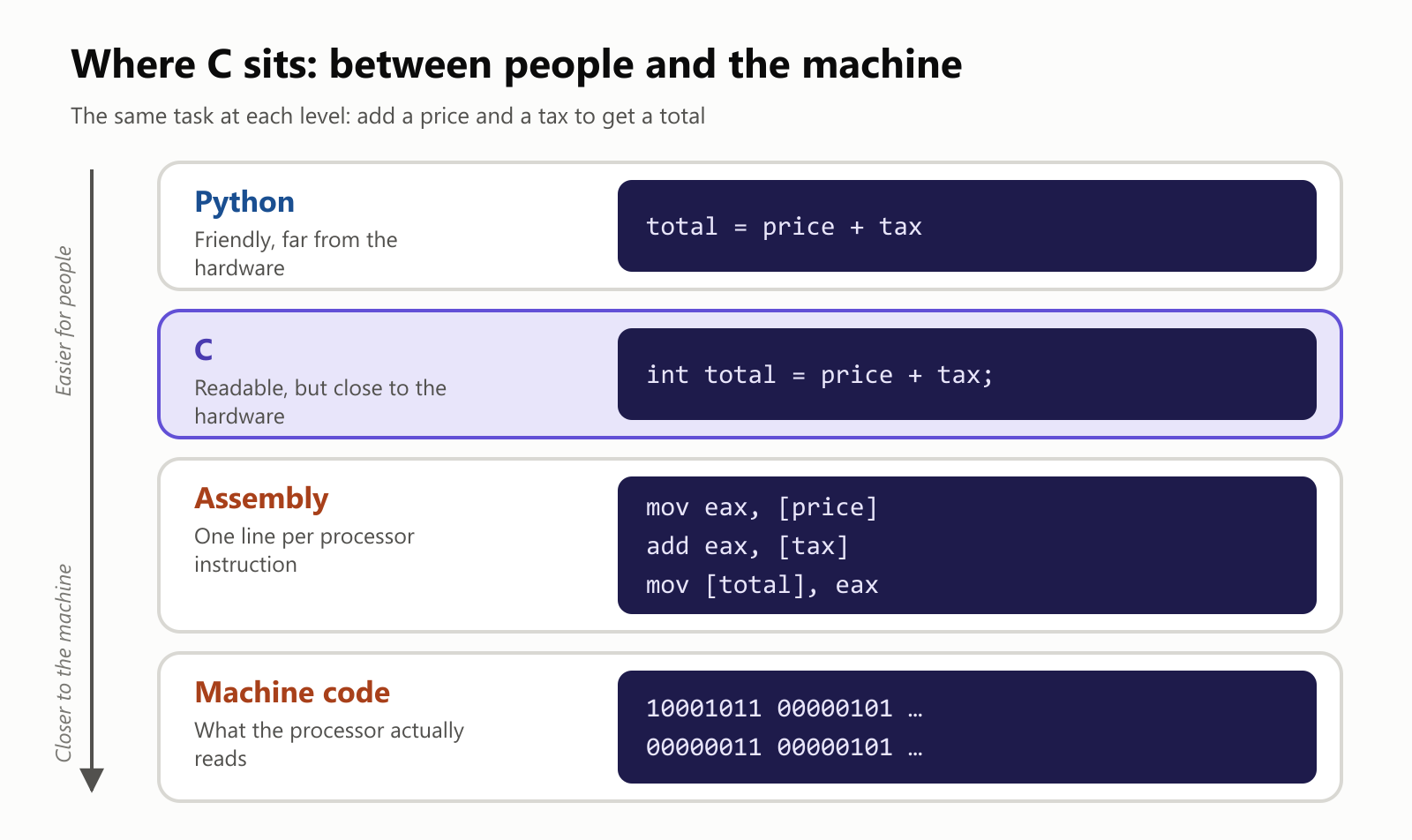
That middle position is C's superpower. It's readable enough for humans to write big programs, but close enough to the hardware that those programs run fast and can control the machine precisely. People sometimes call C "portable assembly" for exactly this reason.
What C looks like
Here's the classic first program in C. All it does is print a greeting:
1#include <stdio.h>
2
3int main(void) {
4    printf("hello, world\n");
5    return 0;
6}
It may look cryptic, but each line has a simple job:
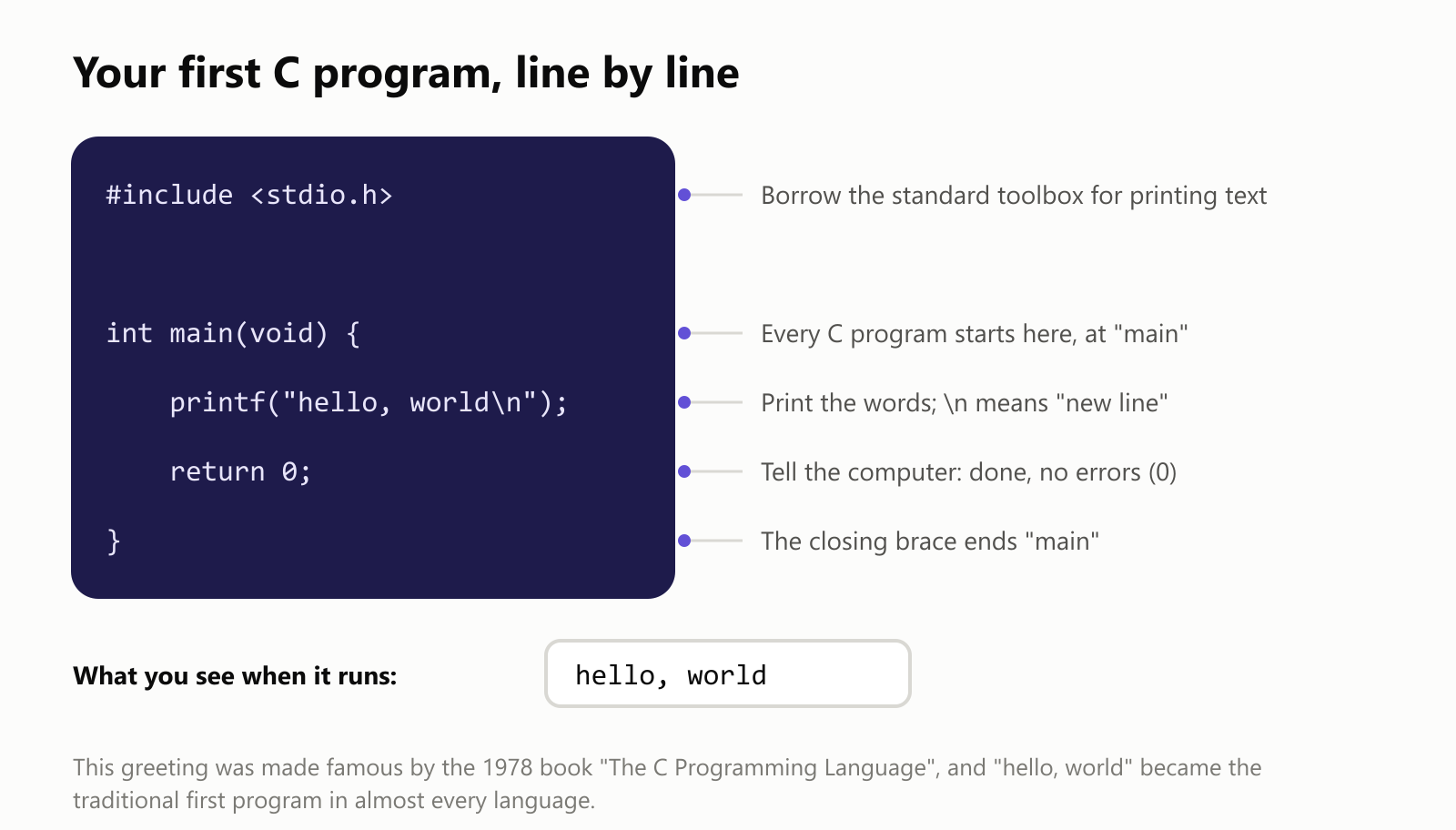
This little "hello, world" program was made famous by the 1978 book The C Programming Language, by Brian Kernighan and Dennis Ritchie. Since then, "hello, world" has become the traditional first program for beginners in almost every language.
Notice the curly braces { } and the semicolon ; at the end of a line. If you've ever glimpsed code in JavaScript, Java or C#, those will look familiar. They're C's fingerprints.
From code to a running program
The computer can't run that text directly. First, a program called a compiler translates the whole thing into machine code, ahead of time:
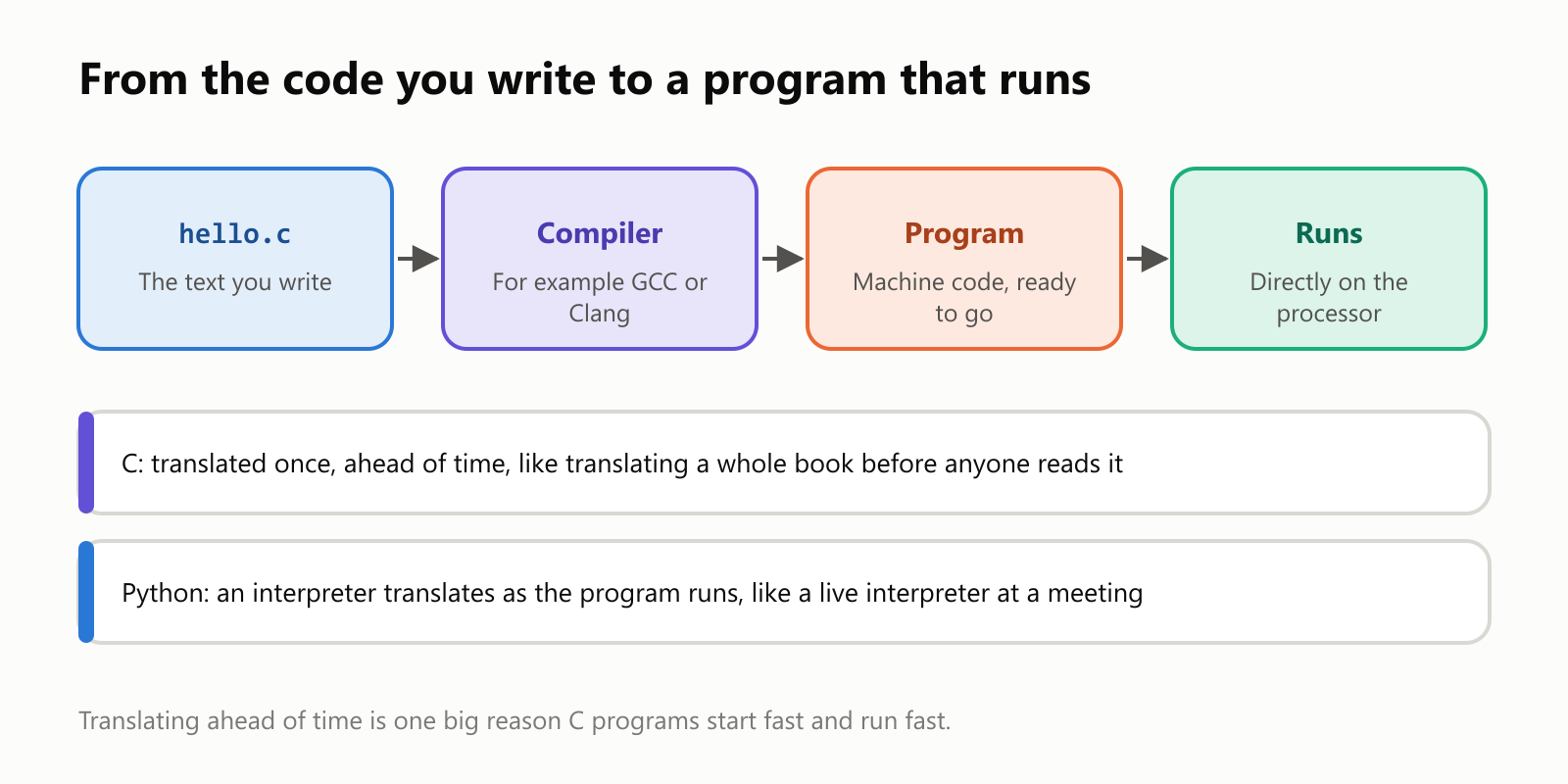
Think of it like translating a book. C translates the whole book before anyone reads it, so reading it later is quick. Languages like Python use an interpreter, which is more like a live interpreter at a meeting, translating while the conversation happens. That's more flexible, but slower.
Why C changed everything
C was created by Dennis Ritchie at Bell Labs (the research lab of the US phone company AT&T), and its name is simply the next letter after an earlier language called B.
Ritchie and his colleague Ken Thompson were building an operating system called Unix. Back then, operating systems were usually written in assembly language, which is tied to one specific kind of computer. Moving to a new computer meant rewriting almost everything from scratch.
In 1973, they did something bold: they rewrote most of Unix in C. Suddenly, moving Unix to a new computer mostly meant writing a C compiler for it, then recompiling. This idea, called portability, was revolutionary, and it helped both Unix and C spread across the world.
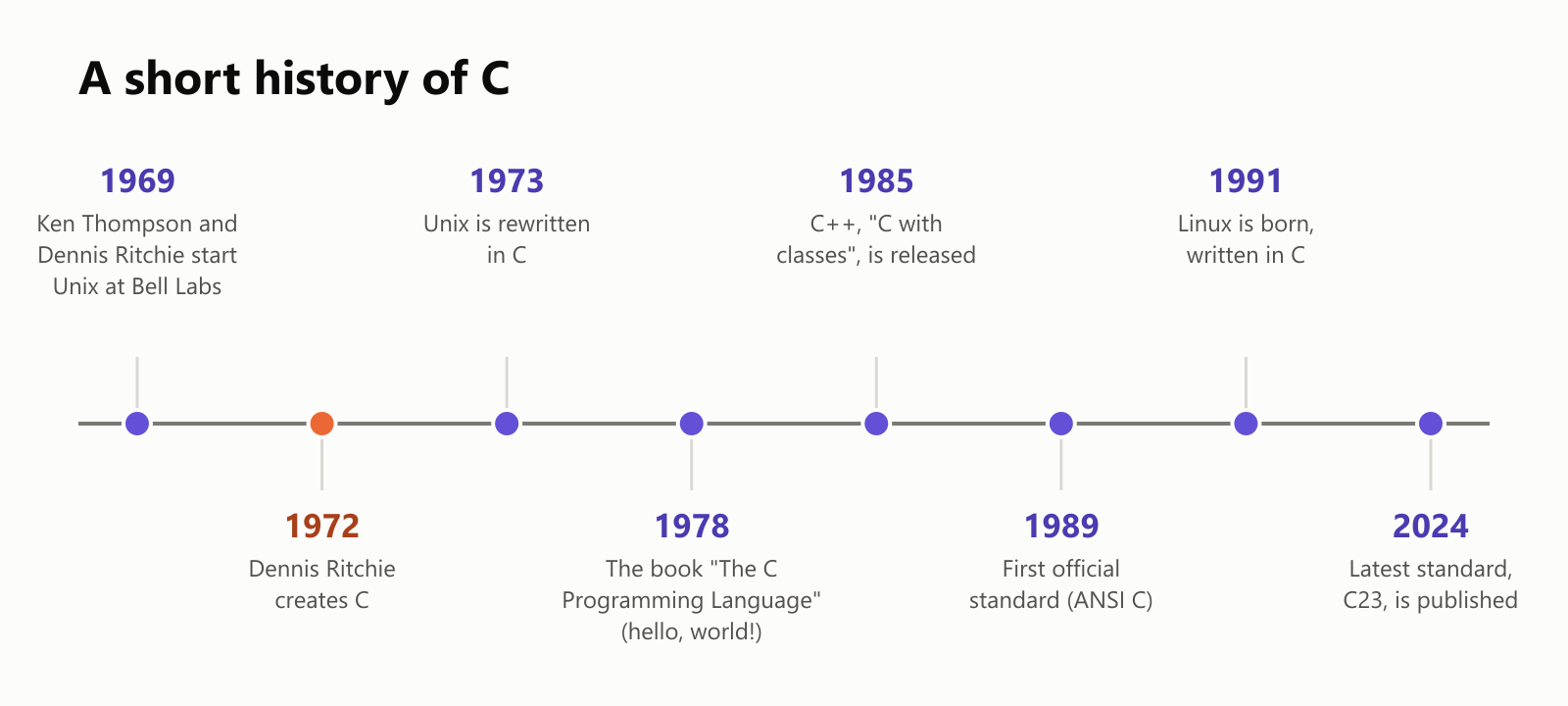
Today's Linux, macOS, iPhone, Android and much of Windows all trace part of their family tree back to those ideas, and their cores are still largely written in C.
Why C is so fast
C has a reputation for speed, and it's well earned. There are three main reasons:
- It's translated ahead of time into machine code, so there's no translation work while the program runs.
- It adds almost nothing extra. There's no hidden helper running in the background to tidy up memory or check your work.
- The programmer is in control. You decide exactly how data is laid out and when memory is used and released.
To see what that means in practice, here's the same simple program, counting all the prime numbers below 2 million, written in three languages and timed on the same laptop:
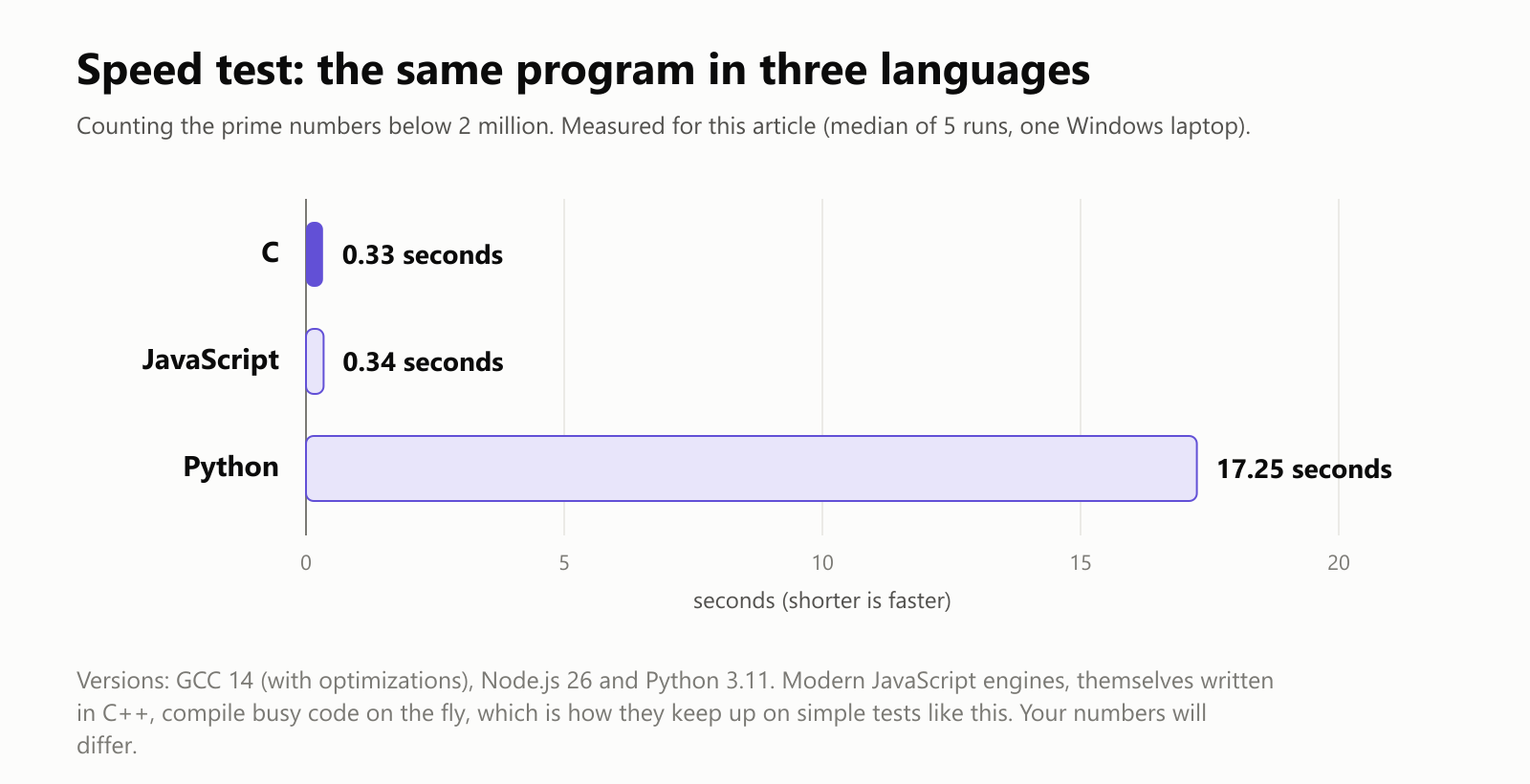
C finished in a third of a second. Python, which is wonderful for many things but isn't built for raw speed, took about 50 times longer. JavaScript kept up with C on this simple test, because modern JavaScript engines (which are themselves written in C++, C's close relative) translate busy code into machine code on the fly. On bigger, messier real-world programs, C usually keeps an edge, especially in how little memory it needs.
That's why C is the go-to choice when every bit of speed and memory counts: operating systems, databases, game engines, and the tiny computers inside appliances, cars and medical devices.
Working directly with memory
Here's the part that makes C both powerful and tricky. A computer's memory is like a very long row of numbered mailboxes. Each mailbox has an address and can hold a value. C lets you work with those mailboxes directly:
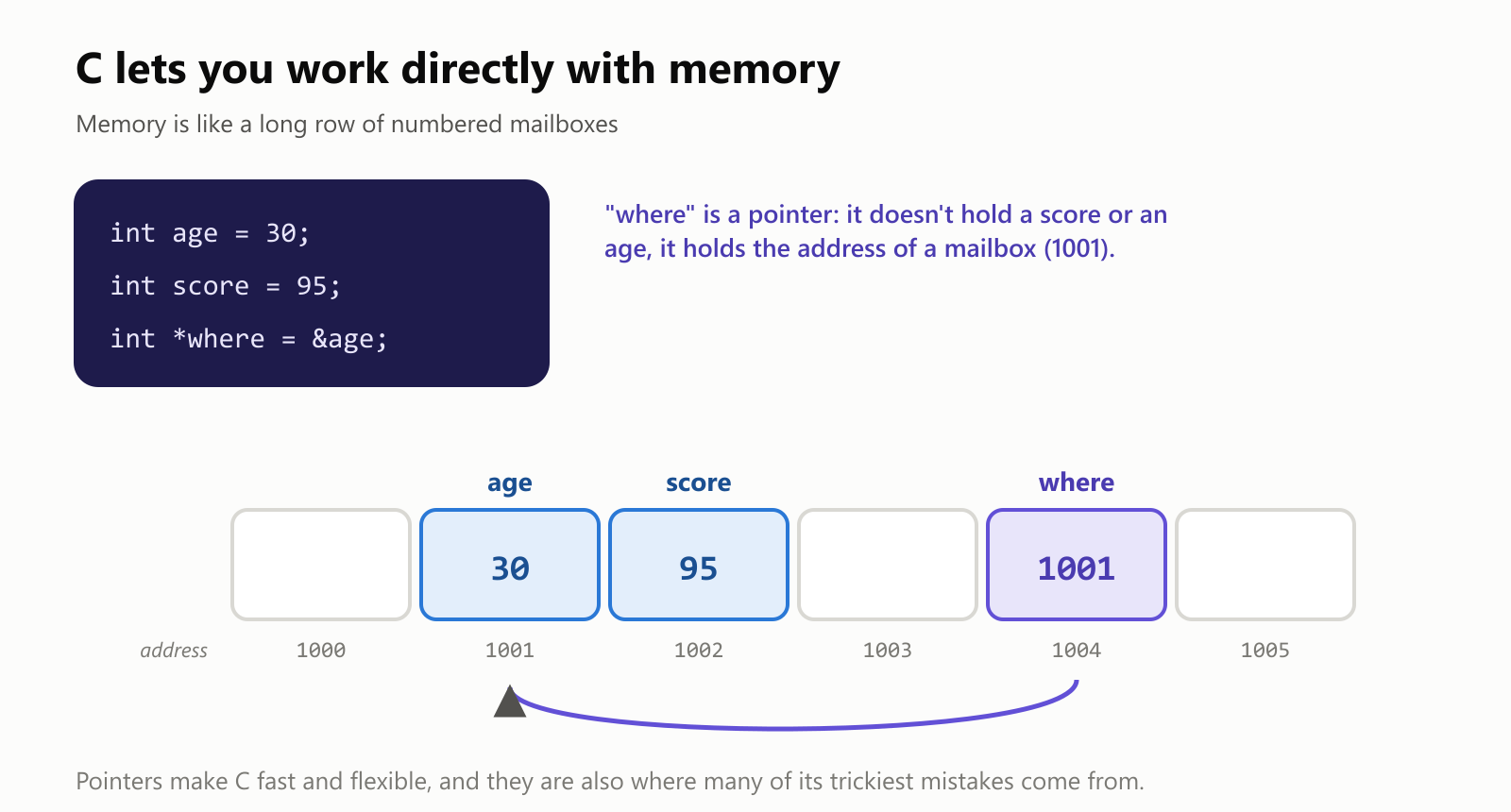
The variable where is a pointer. It doesn't hold a normal value like an age or a score; it holds the address of another mailbox. It's like writing someone's home address on a sticky note instead of carrying their house around.
Pointers let C programs move data around efficiently and talk directly to hardware. They're a big reason C is so fast and flexible, and they're also where many of its trickiest mistakes come from.
The catch: C has no safety net
Most modern languages check your work. If you try to put 4 things in a space meant for 3, they stop you with an error. C trusts you completely, and doesn't check:
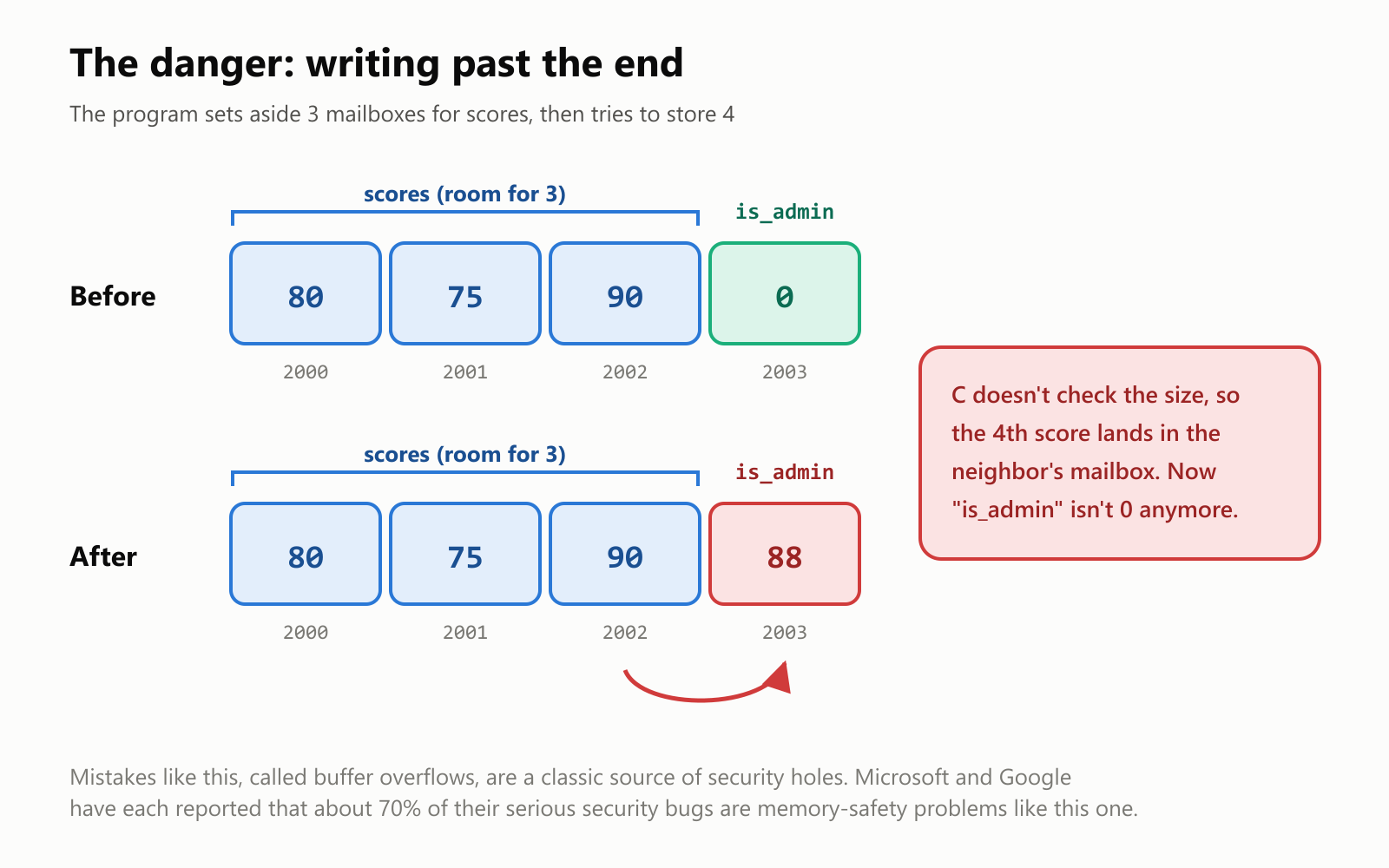
In this example, the 4th score spills into the neighbor's mailbox, which happens to hold a setting called is_admin. Now the program thinks the user is an administrator. This kind of mistake is called a buffer overflow, and attackers have exploited it for decades.
This isn't just theory:
- Microsoft has said that about 70% of the security problems it fixes each year are memory-safety issues, and the team behind Google Chrome reported a similar figure. Much of that code is written in C and its relative C++.
- Heartbleed, a famous 2014 bug that exposed private data on a huge number of websites, was a memory mistake in OpenSSL, a widely used security library written in C.
- In 2024, the White House Office of the National Cyber Director published a report urging the software industry to move toward memory-safe languages wherever possible.
C also asks you to manage memory by hand: you request mailboxes when you need them and must give them back when you're done. Forget to give them back, and a program slowly eats up memory (a memory leak). Give them back too early and keep using them, and strange, hard-to-find bugs appear.
C's big family
Even if C itself disappeared tomorrow, its influence would be everywhere:
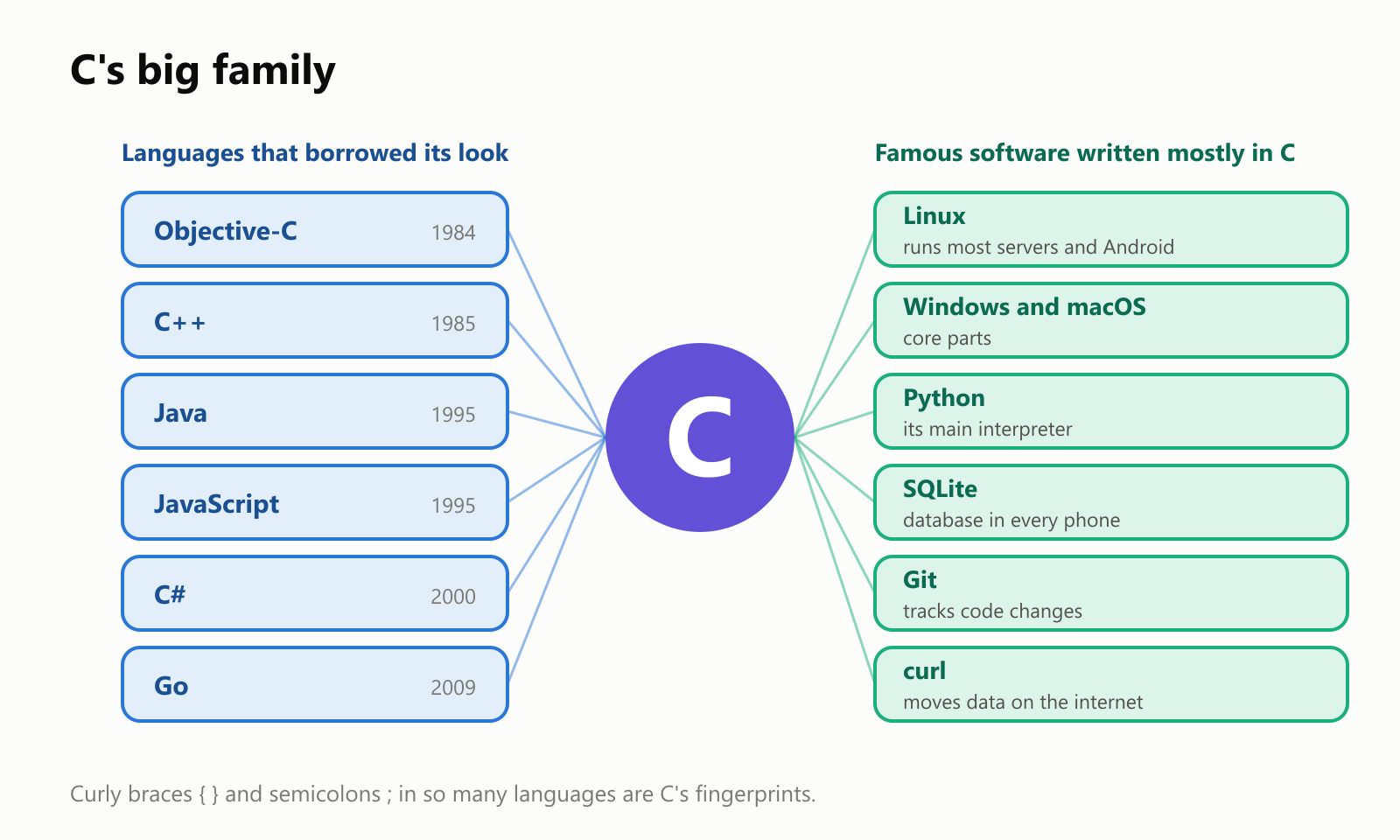
- Languages it inspired: C++, Objective-C, Java, JavaScript, C# and Go all borrowed C's look and many of its ideas. If you learn C, a lot of other languages will feel familiar.
- Software built with it: the Linux kernel (which runs most of the world's servers, supercomputers and every Android phone), the cores of Windows and macOS, the SQLite database (found in practically every smartphone and web browser), Git (which programmers use to track their code), and many more.
- Tiny devices: microwaves, washing machines, thermostats, car engine controllers, pacemakers. The small chips inside these devices are very often programmed in C, because it runs well with very little memory.
For decades, C has consistently ranked among the most popular programming languages in industry rankings, a remarkable run for a language born in the early 1970s.
C vs. C++ (and other confusing names)
The names can be confusing, so here's a quick guide:
- C++ started in the early 1980s as "C with classes", adding new ways to organize big programs. It's mostly a superset of C: a lot of C code works in C++ too. It's widely used for video games, web browsers and other large, performance-hungry software.
- C# (pronounced "C sharp") is a different language from Microsoft, released in 2000. It borrows C's look but works very differently, including automatic memory management.
- Objective-C added new features to C and was Apple's main language for many years, before Swift arrived.
If you're curious about C++, start with Writing your First Program in the C++ Programming Language.
Should you learn C?
It depends on what you want to do:
- Good reasons to learn C: you'll understand how computers really work under the hood (memory, the processor, how programs run), and you'll be ready for work on operating systems, devices, robots, games or anything where speed matters.
- Reasons you might start elsewhere: C makes you handle a lot of details yourself, and its mistakes can be confusing for beginners. Many people start with a friendlier language like Python or JavaScript, and learn C later.
Either way, C is never a waste of time. Many programmers say that learning C was the moment computers finally "clicked" for them.
A small glossary
- C: a programming language created in 1972 at Bell Labs, known for speed and control.
- Programming language: a way of writing instructions for a computer in text people can read.
- Machine code: the 0s and 1s a processor actually understands.
- Assembly language: a human-readable version of machine code, one line per processor instruction.
- Compiler: a program that translates code into machine code ahead of time.
- Interpreter: a program that translates and runs code as it goes.
- Portability: the ability to move a program to a different kind of computer with little change.
- Memory address: the number of a "mailbox" in the computer's memory.
- Pointer: a value that holds a memory address, like a sticky note with a home address.
- Buffer overflow: writing past the end of a reserved space in memory, into someone else's data.
- Memory leak: memory a program forgets to give back, slowly using up more and more.
- Memory-safe language: a language that automatically prevents most memory mistakes, such as Python, Java, Go or Rust.
- Unix: an influential operating system rewritten in C in 1973, ancestor of macOS and inspiration for Linux.
Wrapping up
C is a programming language from 1972 that sits between people and the machine: readable enough to write big programs, close enough to the hardware to run them fast. Its ability to move between different computers helped Unix, and later Linux, spread across the world, and its look lives on in many of today's most popular languages.
That closeness to the machine comes with a price: C gives programmers complete control over memory, and with it, the chance to make costly mistakes. Still, more than 50 years later, a huge share of the technology you use every day, from your phone's operating system to the tiny chip in your microwave, is quietly running on C.
Read next

What Is the C++ Programming Language? A Simple Guide to the Language Behind Games and Browsers
A friendly, jargon-free guide to C++, the programming language behind video games, web browsers and much of the software you use every day. Learn what it adds to C, how classes and automatic cleanup work, and why it's both fast and famously complex.
 nbkhope
How to Create a Variable in the C++ Programming Language
We can create variables in C++ using the following syntax: We declare the variable first with the data type, followed by the desired name. For example, if you want to store a person's age, you could…
nbkhopeWriting your First Program in the C++ Programming Language
A C++ program starts in the main function. That is where execution begins: In the construct above, the name of the function is main. The return type of the function is int, an integer. There are no…
nbkhope
Comments
Be kind and specific. Comments with links from new accounts appear after a moderator reviews them.