A Brief History of Programming Languages: From Machine Code to Modern Tools
From machine code and FORTRAN to Python, JavaScript, and Rust, explore how programming languages evolved and why there are so many.

On this page
When you tap a button in an app, your computer follows instructions written by people. Programming languages are the tools people use to express those instructions. They have changed over time to make different kinds of work easier: calculations, business records, websites, scientific research, and much more.
This history is not a parade where every new language replaces the one before it. It is more like a growing toolbox. Older languages often remain useful, while new ones appear to solve new problems or make familiar work safer and clearer.
First, what is a programming language?
A programming language is a structured way to describe instructions a computer can carry out. It has rules for words, symbols, and order—much like a spoken language has grammar, but with far less room for ambiguity.
Computers ultimately operate on very simple electrical states represented as bits. People could write instructions close to those bits, but that was difficult and tied to a specific machine. A compiler or interpreter helps translate a more readable language into steps a computer can execute.
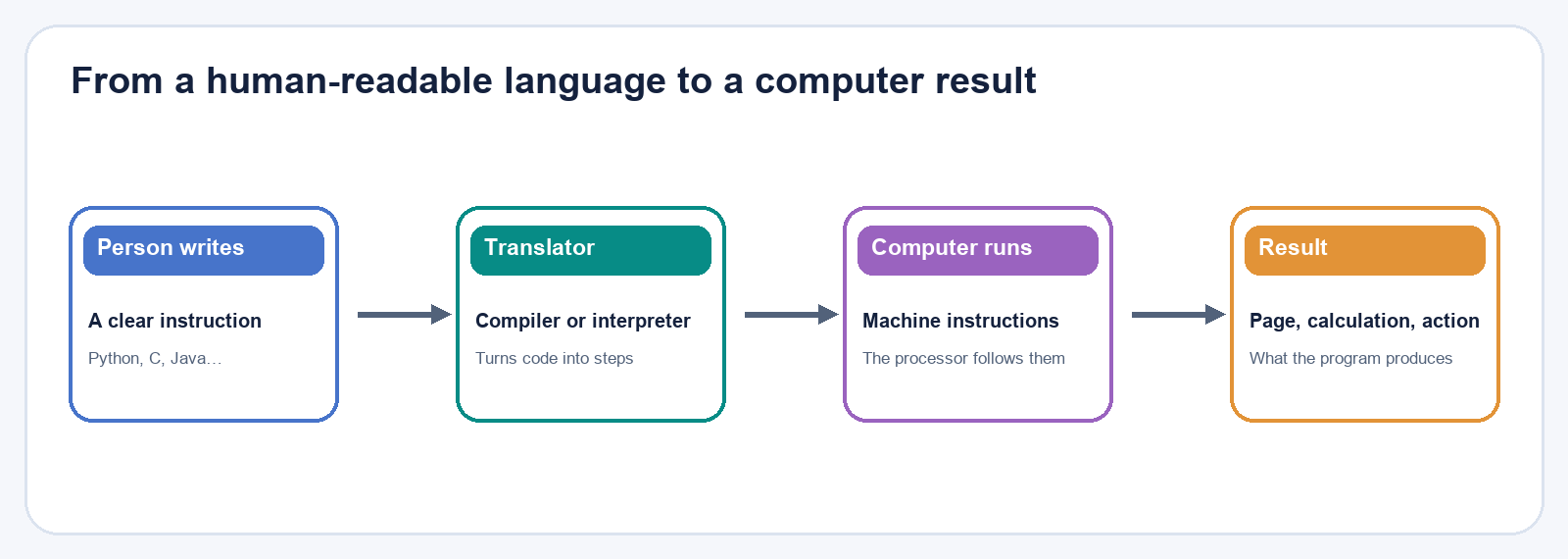
A compiler usually prepares a program before it runs. An interpreter can carry out instructions as the program is running. Real systems can combine both approaches, but the basic idea is the same: people describe a task, software translates it, and the computer follows the resulting instructions.
Before modern languages: instructions close to the machine
Early computers had to be told exactly which small operations to perform. Machine code represents those operations in numbers the processor understands. Assembly language gives short names to many of those operations, making them a little easier for people to read.
That was still demanding work. A program written for one computer might not work on another, and even a small change could mean checking many low-level details. As computers began to serve scientists, businesses, and universities, people wanted languages that described the problem more directly.
The 1950s: languages for science, business, and symbolic ideas
FORTRAN, whose name comes from “Formula Translation,” was designed for scientific and engineering calculations. IBM’s team created it in the 1950s, and its first commercial release came in 1957. It helped programmers write mathematical expressions in a form that could be translated into efficient machine instructions.
COBOL was designed for business data such as accounts, payroll, and records. LISP, introduced in 1958, focused on lists and symbolic expressions, making it useful in early artificial intelligence research. ALGOL helped researchers describe algorithms in a more systematic way and influenced the design of later languages.
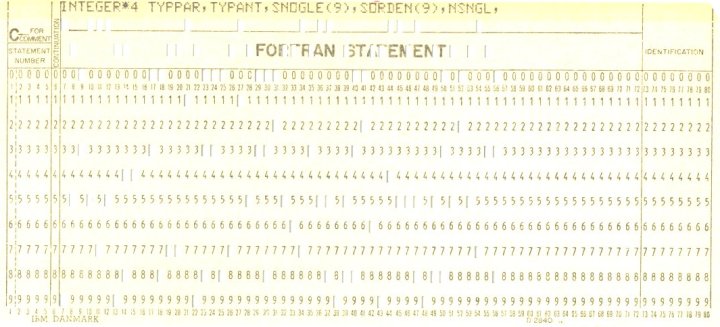
This card held part of a FORTRAN IV program used at the regional computer center at the University of Copenhagen. Image released to the public domain by Hansjorn; source and details.
These languages were built for different jobs. The important shift was that people could express formulas, records, or symbolic rules without spelling out every tiny operation the computer needed to perform.
The 1960s and 1970s: programming becomes a broader craft
BASIC was created at Dartmouth in 1964 to make computing accessible to students and other beginners. People could use it through shared computers and terminals, instead of needing exclusive access to a machine.
Other languages explored new ways to organize programs. Pascal encouraged clear structure and became popular in education. Smalltalk developed the idea that a program could be built from objects that combine information and actions. C, created at Bell Labs in the early 1970s, gave programmers a compact way to build operating systems and other software that needed close control of the computer. In 1974, IBM researchers Donald Chamberlin and Raymond Boyce described SEQUEL, which later became SQL, a language for asking questions about information stored in tables.
The first edition of The C Programming Language, published in 1978 by Brian Kernighan and Dennis Ritchie, became a widely used guide to the language. C also influenced many languages that followed, including C++ and Java.
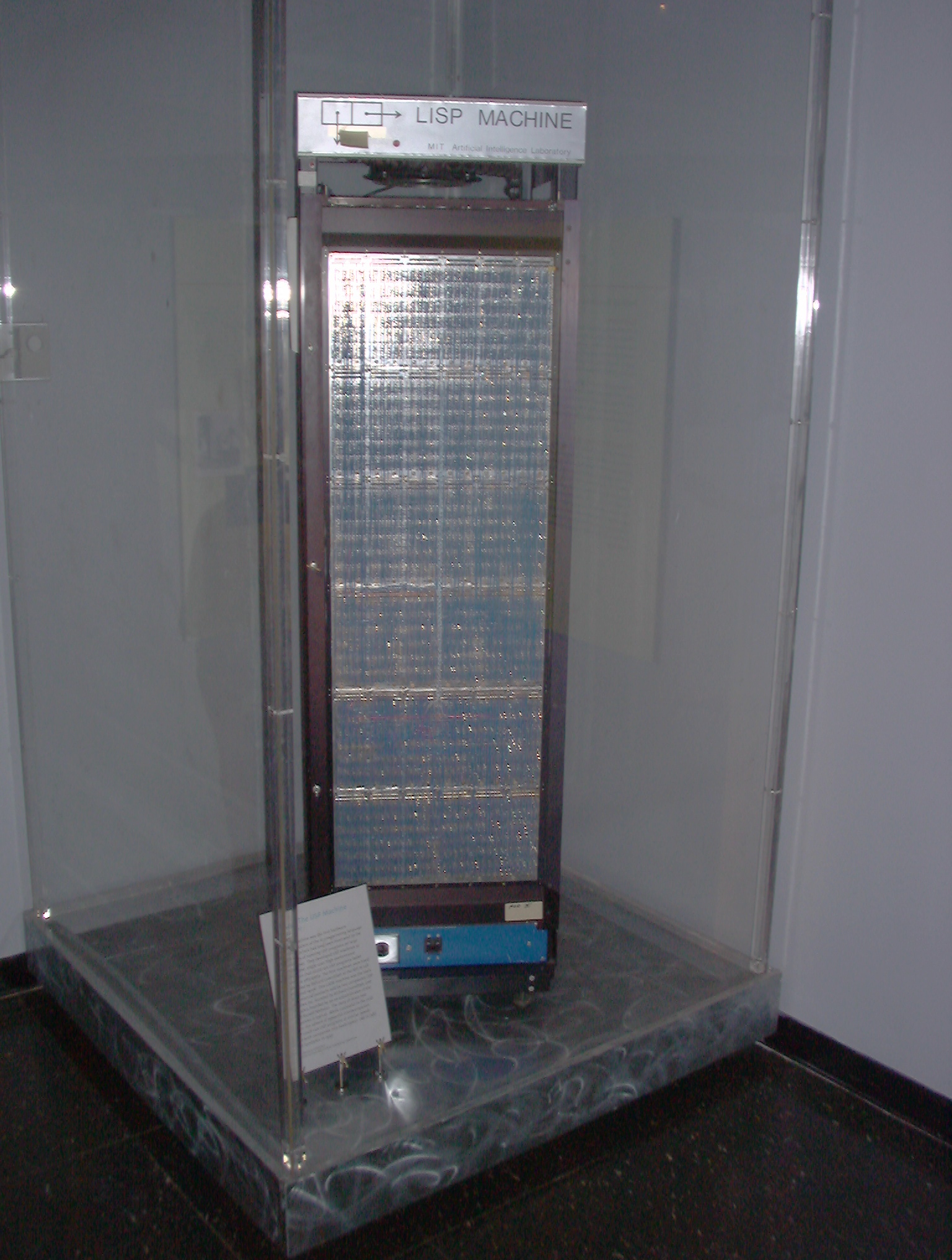
The machine is identified as a likely Knight machine manufactured by MIT. Photo by Jszigetvari, CC BY-SA 3.0; source and details.
The 1980s and 1990s: personal computers and the web
As personal computers spread, programmers created languages and tools for a widening range of users and projects. C++ added features for organizing larger programs. Perl became useful for text processing and system administration.
Python began in the early 1990s with an emphasis on readable code. Java was designed to run on different kinds of computers through a shared runtime. JavaScript arrived in web browsers in 1995, letting web pages respond to clicks and other actions.
These languages did not all do the same thing. A browser, a bank system, and a science program have different needs, so their developers often choose different tools.
The 2000s to today: a bigger toolbox
Languages continue to evolve alongside phones, web services, games, data science, and connected devices. C# and Java support many kinds of business and application software. Go is used for network services and infrastructure. Rust focuses on performance and preventing certain classes of memory errors. Swift and Kotlin are common choices for Apple and Android applications, while TypeScript adds helpful checks to JavaScript projects.
There is no single “best” language for every task. A language that is convenient for a website may not be the best fit for controlling a tiny device or performing a large scientific calculation.
Different languages can organize the same task in different ways
Languages also differ in how they encourage people to think about a problem. These approaches are often called programming styles or paradigms. They can overlap: many modern languages support more than one.
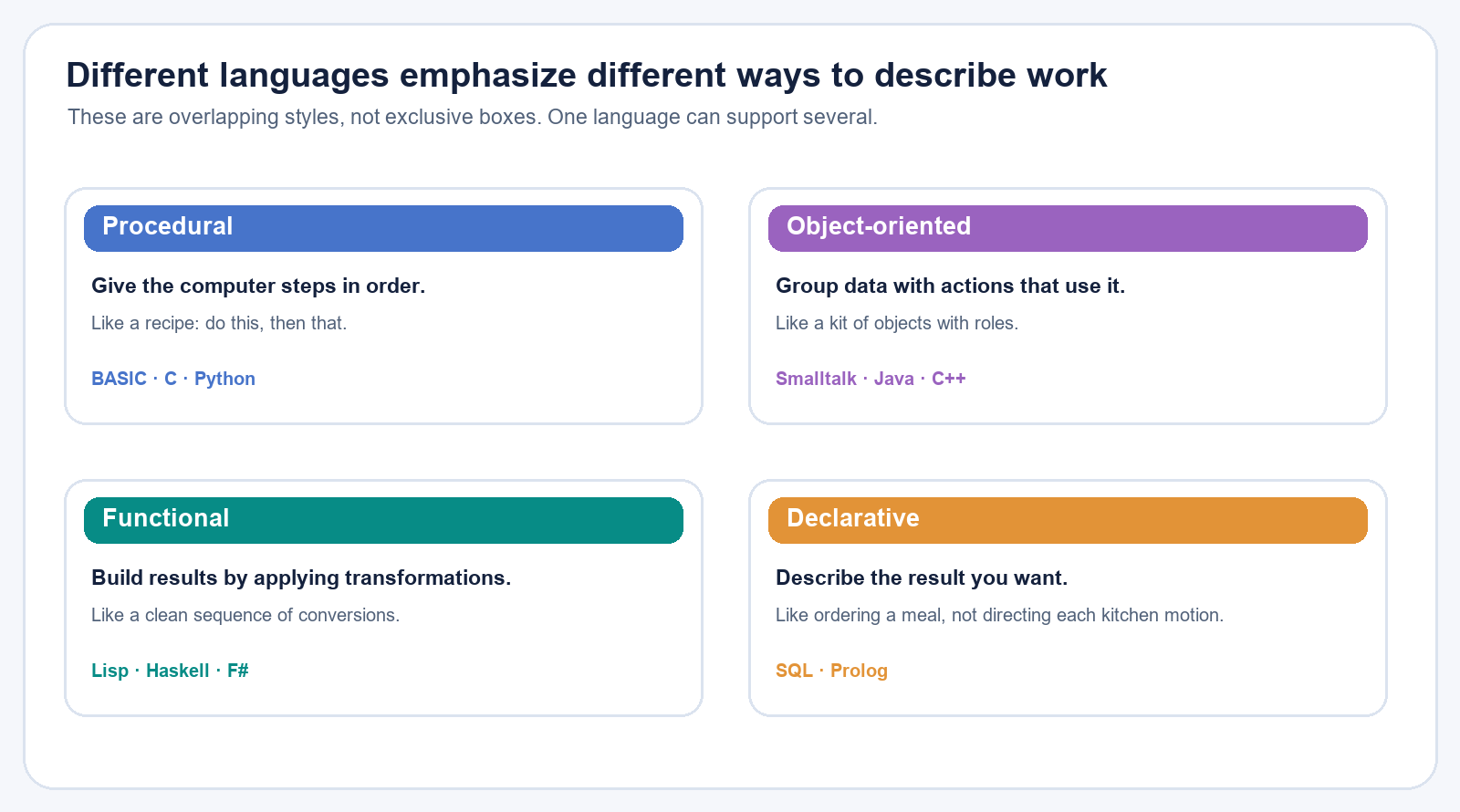
A simple analogy is planning a meal:
- Procedural: write each step in order—wash, chop, heat, and serve.
- Object-oriented: organize the work around things with roles, such as an oven, recipe, and ingredients.
- Functional: transform ingredients through a sequence of operations, aiming for predictable results.
- Declarative: describe what you want, such as a list of ingredients or a database search, and let a tool figure out the steps.
These are broad ideas, not rigid categories. Knowing them can help explain why two languages may look very different while solving a similar problem.
A timeline of influential languages
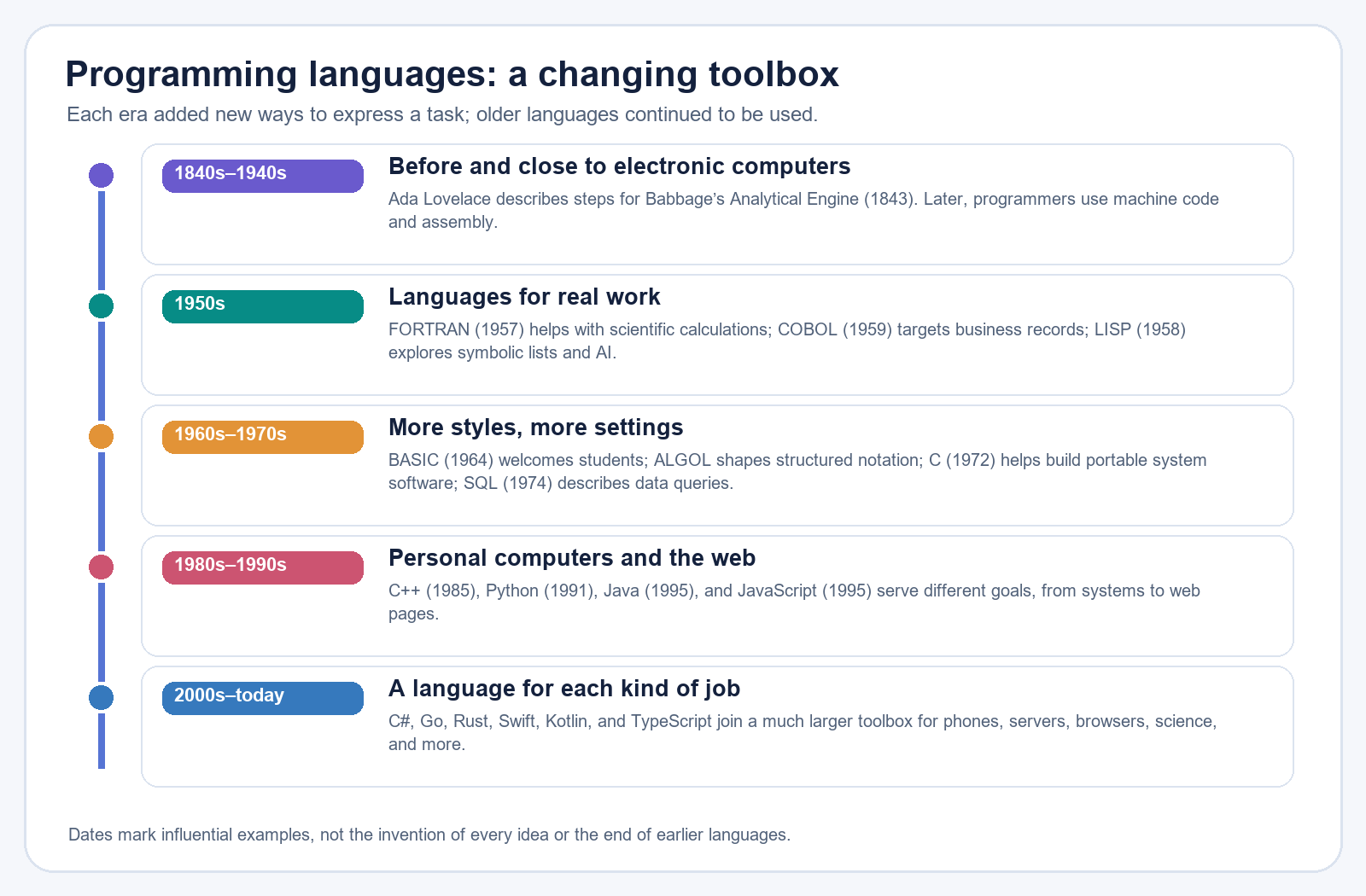
The dates mark influential milestones, not the moment every idea first appeared or the point when an older language stopped being used. Many languages have long lives, and they borrow ideas from one another.
Why are there so many languages?
Different tasks create different trade-offs. A language may make it easier to write mathematical formulas, handle business records, build a web page, manage memory, or prevent common mistakes. Some prioritize quick experimentation; others prioritize speed, compatibility, or strict checking.
Languages also reflect the people and communities that use them. Students, researchers, businesses, hobbyists, and open-source contributors all shape which tools grow and how they change. New languages often combine ideas that worked well elsewhere.
The big idea
Programming languages are layers of communication between people and computers. Over time, they have let people describe goals with less attention to the details of each machine. They did not eliminate complexity; they gave us better ways to organize it.
If you would like to see how programming itself changed—from cables and switches to apps—read A Brief History of Computer Programming. For an accessible look at the field that inspired early Lisp machines, see A Brief History of Artificial Intelligence.
Sources and further reading
- FORTRAN history — IBM
- Timeline of software and programming languages — Computer History Museum
- Thomas E. Kurtz and the creation of BASIC — Computer History Museum
- LISP and early artificial intelligence — Computer History Museum
- Early history of programming languages — Computer History Museum Software Preservation Group
- SEQUEL: A structured query language — IBM Research (1974)
- Python history — Python documentation
- JavaScript history — MDN Web Docs
- Rust language — official project site
Read next
A Brief History of Computer Programming: From Wires to Apps
From Ada Lovelace’s 1843 notes to today’s apps and AI coding assistants, see how programming changed—and what a program really is—in plain language.
 nbkhope
Getting Started with GraphQL and Express
You can employ GraphQL in your Express server using a middleware. If you get a request that goes to the endpoint POST /graphql, it will pass through the GraphQL Express middleware and handle the…
nbkhopeJavaScript: Stop Using var with ES6
With the advent of ES6, two new keywords for the definition of variables have come forth: const and let. Now, whenever you need to define a variable, don't use var -- start off with const. Once you…
nbkhope
Comments
Be kind and specific. Comments with links from new accounts appear after a moderator reviews them.