The History of Artificial Intelligence: A Simple Timeline
From Alan Turing’s early question to today’s chatbots, explore the people, pauses, and breakthroughs that shaped artificial intelligence—in plain language.

On this page
Artificial intelligence can feel like a brand-new invention. Chatbots, image makers, and voice assistants have appeared in everyday life very quickly. But the questions behind them are much older: Could a machine learn? Could it solve a problem? Could it use language?
Artificial intelligence (AI) is the broad effort to make computers perform tasks that usually call for human abilities, such as recognizing images, understanding words, or choosing a move in a game. It does not mean a machine is conscious or thinks exactly as a person does. The history of AI is a story of changing ideas about how to build useful machines—and repeated cycles of excitement, setbacks, and progress.
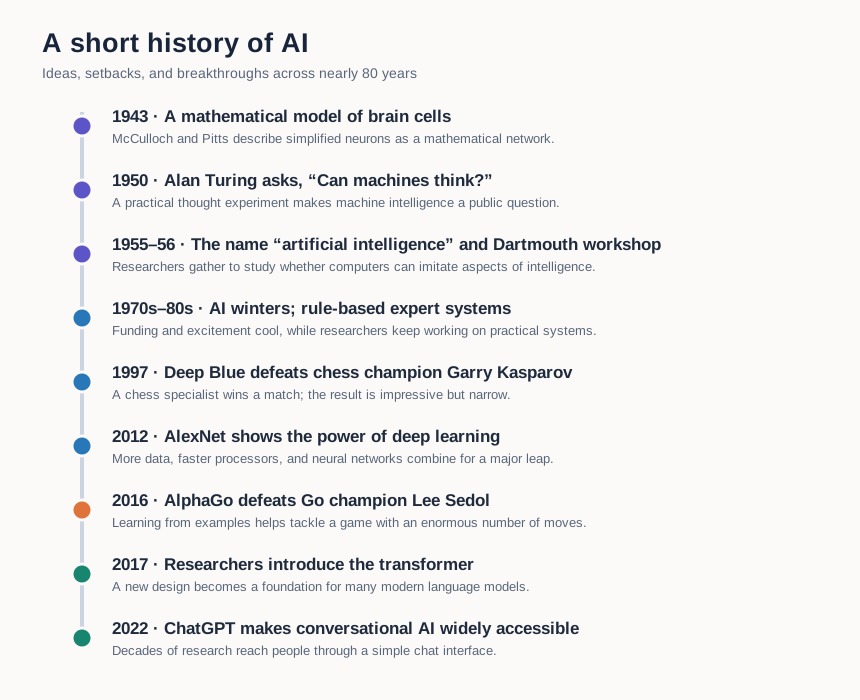
The timeline at a glance
Before the name: ideas about thinking machines
Long before computers could run today’s software, researchers were asking how to describe thought in a way a machine might follow. In 1943, neurophysiologist Warren McCulloch and mathematician Walter Pitts published a mathematical description of simplified brain cells. Their model was not a working brain, but it helped establish the idea that networks of simple units could perform logical tasks.
In 1950, British mathematician Alan Turing published “Computing Machinery and Intelligence.” Rather than get stuck on the hard-to-define question “Can machines think?”, he suggested a practical question: Could a machine use conversation well enough that a person could not reliably tell it from another person? The idea became known as the Turing test, and the paper helped make machine intelligence a serious subject of discussion.
1956: AI becomes a named research field
The phrase artificial intelligence appeared in a 1955 proposal for a summer research project at Dartmouth College in the United States. The workshop took place in 1956 and brought researchers together to explore whether parts of learning and intelligence could be described precisely enough for computers to imitate them.
The gathering did not create modern AI overnight. It gave a name and a shared research agenda to work already under way. Early researchers built programs that could prove simple theorems, solve puzzles, and play games. Their demonstrations were exciting, but they often worked only in small, carefully controlled situations.
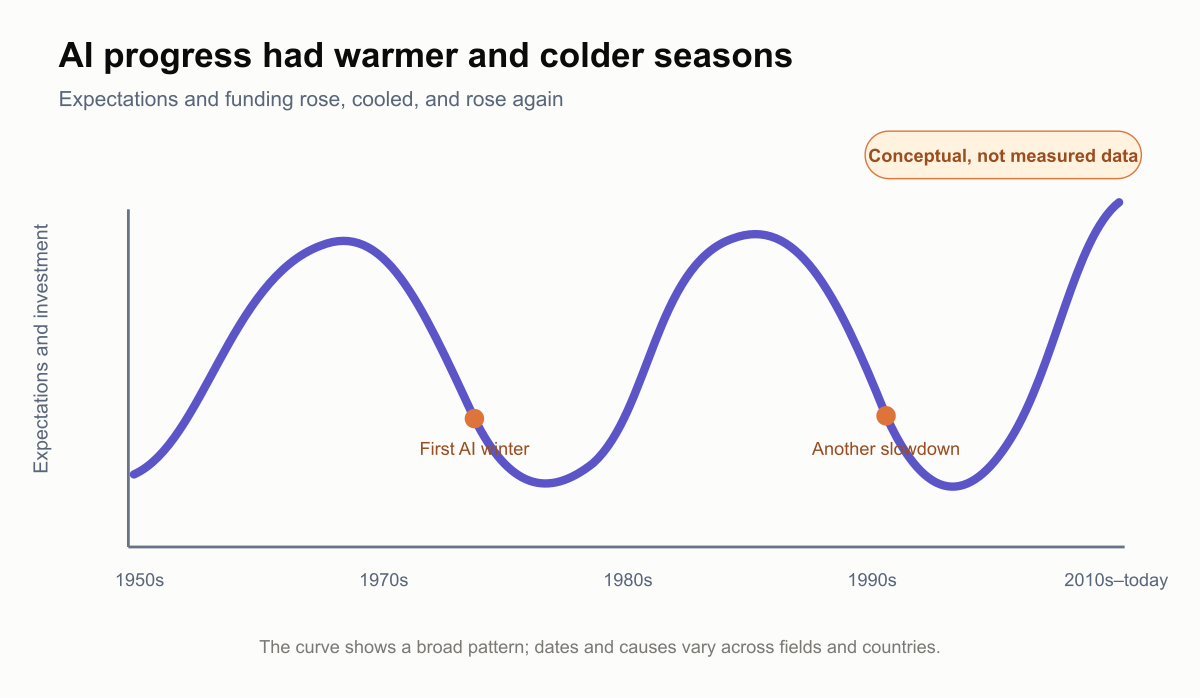
Early optimism, followed by “AI winters”
In the 1950s and 1960s, some researchers made ambitious predictions about how quickly computers would match human abilities. Real progress proved harder. Computers had little memory and processing power, and early programs struggled when a problem grew beyond the examples their creators had anticipated.
When promised results did not arrive, governments and other funders reduced support. These slowdowns are often called AI winters. The name can make it sound as if research stopped; it did not. Researchers kept working, but public excitement and funding cooled. AI has had more than one such cycle, and the exact dates depend on which country or part of the field you mean.
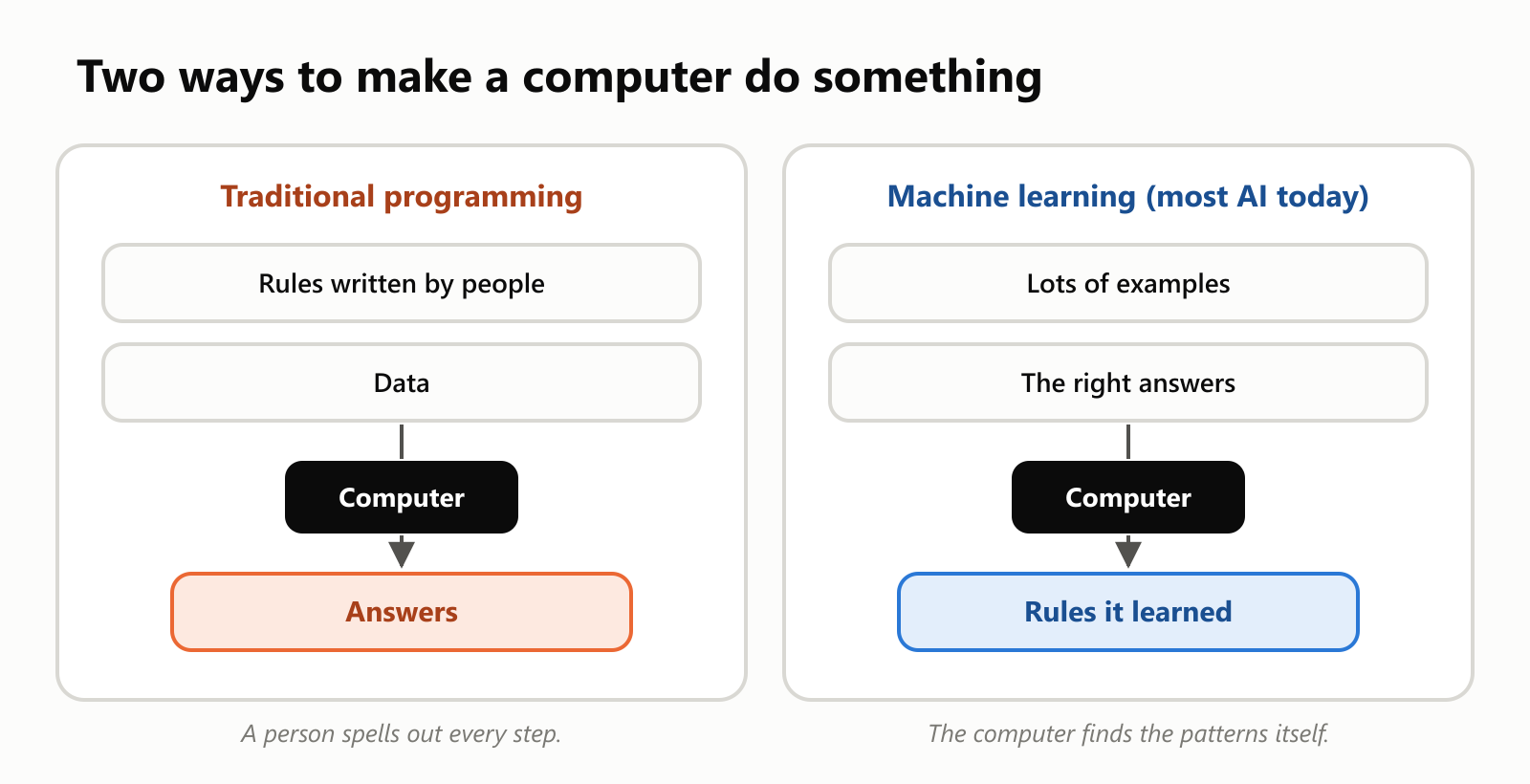
One popular approach in the 1970s and 1980s was the expert system. People wrote down rules from specialists—if a certain set of symptoms is present, consider a particular diagnosis, for example—and a computer applied those rules. Expert systems found useful jobs in businesses and laboratories, but gathering and maintaining all the rules was expensive. A system could also fail when it met a situation its rulebook did not cover.
1997: Deep Blue wins at chess
In 1997, IBM’s Deep Blue defeated reigning world chess champion Garry Kasparov in a six-game match. This was a remarkable milestone, but it did not mean the computer could think about anything a person could. Deep Blue was built for chess and used specialized hardware and search techniques to examine many possible moves quickly.
That distinction matters throughout AI history: a machine can outperform people at a particular task without having general human understanding. Chess was a visible test of computer skill, not proof that machines had become people.
2012: computers learn from examples at a new scale
For years, computer vision researchers tried to help computers recognize objects in photographs. A breakthrough came in 2012, when AlexNet—a deep neural network trained on many labeled images—won the ImageNet image-recognition competition by a wide margin.
A neural network is a computer system made of connected mathematical units. During training, the system adjusts those connections so its answers improve on examples. “Deep” means the network has many layers that can learn increasingly complex patterns. AlexNet’s success reflected more than one clever idea: large collections of data, faster graphics processors, and better training methods had all become available.
2016–2022: AI moves into games, language, and everyday tools
In 2016, Google DeepMind’s AlphaGo defeated Go champion Lee Sedol four games to one. Go has an enormous number of possible moves, making it difficult to handle by simply checking every option. AlphaGo combined learned patterns with search to choose moves. Its win showed how systems that learn from examples could tackle problems once thought far beyond computers.
In 2017, researchers introduced the transformer, a design that helps AI process relationships between words across a stretch of text. Transformers later became an important foundation for many language systems.
On November 30, 2022, OpenAI released ChatGPT as a research preview. Its chat format made it easy for people to ask questions and get answers in ordinary language. ChatGPT did not mark the beginning of AI; it brought decades of research—especially advances in deep learning, data, and computing—into a tool the public could try directly.
Why did AI progress take so long?
There was no single missing invention. AI advances when several pieces come together:
- Ideas: a method that can learn, search, or represent a problem well.
- Data: enough examples for the system to find useful patterns.
- Computing power: enough processing speed and memory to train and run the system.
- A clear task: a way to tell whether the system’s answer is useful.
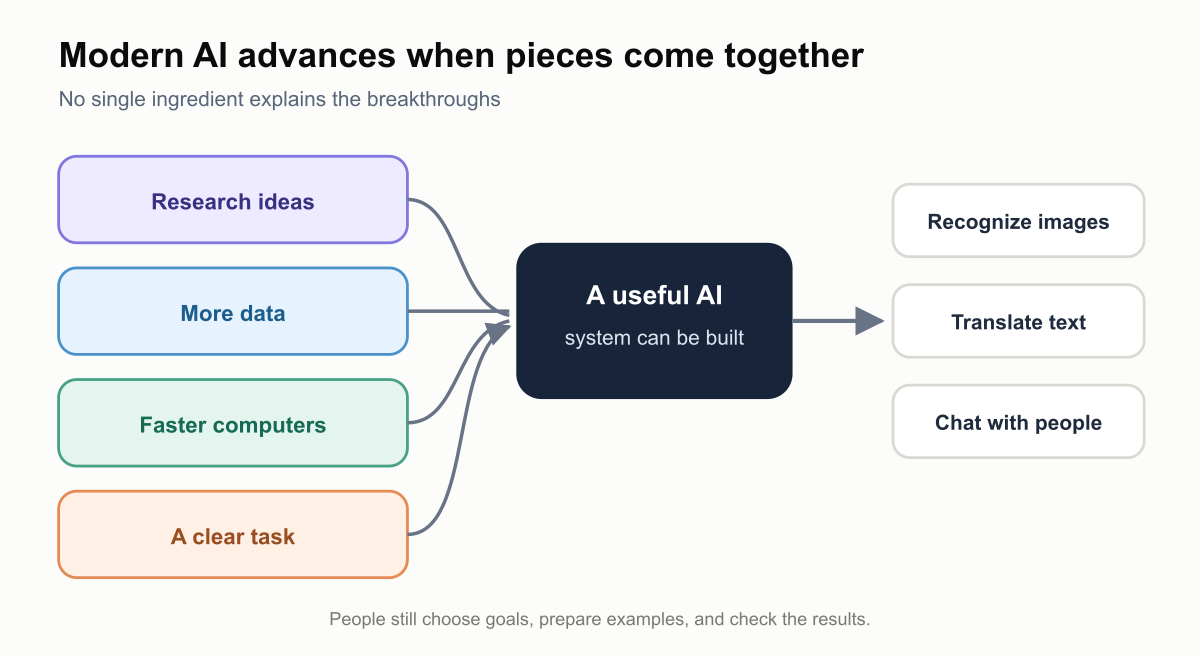
Early researchers often had promising ideas but not enough computing power or data to make them work at a large scale. Later, the internet made huge collections of text and images available, while specialized processors made complex calculations much faster. Progress still depends on people choosing goals, preparing data, building systems, and checking their results.
What the history teaches us
AI is not one machine that suddenly woke up. It is a broad field built over many decades by researchers who tried different approaches: writing rules, searching possible answers, and learning patterns from examples. Some approaches became useful; others exposed how much computers still could not do.
The most visible breakthroughs usually combine older ideas with better tools and more data. And each success has limits: a system that excels at one task may not understand the world the way a person does. Knowing that history makes today’s AI easier to place: powerful technology with a long past, real capabilities, and plenty of open questions.
Sources for further reading
- McCulloch and Pitts, “A Logical Calculus of the Ideas Immanent in Nervous Activity” (1943)
- Alan Turing’s 1950 paper in the Turing Digital Archive
- Dartmouth’s account of the 1956 AI workshop
- Computer History Museum: early chatbots, neural networks, and AI
- IBM: Deep Blue and the 1997 match
- The AlexNet paper, “ImageNet Classification with Deep Convolutional Neural Networks”
- Google DeepMind: AlphaGo
- The transformer paper, “Attention Is All You Need”
- OpenAI: Introducing ChatGPT
Read next

What Is Graph Engineering? How Today's AI Teams Up to Get Real Work Done
A friendly, jargon-free guide to graph engineering, the 2026 idea of building AI as a map of connected steps instead of one big loop. See how today's AI agents work, why small mistakes add up, and how checkers, branches and teamwork fix it.
 nbkhope
What Is Loop Engineering? How AI Agents Keep Working Until the Job Is Done
A friendly, jargon-free guide to loop engineering, the 2026 idea of designing the loop that lets an AI agent keep working until a job is done, with clear goals, real feedback, smart stop rules and knowing when to ask a person.
nbkhope
What Is Prompt Engineering? How to Ask AI for Exactly What You Need
A friendly, jargon-free guide to prompt engineering, the skill of asking AI chatbots like ChatGPT, Claude and Gemini for exactly what you need. Learn what a prompt is, what makes a good one, and simple techniques anyone can use.
nbkhope
Comments
Be kind and specific. Comments with links from new accounts appear after a moderator reviews them.