What Is Scale AI? A Simple Guide to the Company That Teaches AI with Human Help
A friendly, jargon-free guide to Scale AI, the company that prepares the examples AI learns from. Learn what data labeling is, see a real experiment on why good labels matter, and find out why Meta paid over $14 billion for almost half of the company.

On this page
When people talk about AI, they usually mention chatbots like ChatGPT or Claude, or the chips that run them. But there is a quieter part of the story: before an AI can learn anything, someone has to prepare millions of examples for it to learn from. A lot of that work is done by people, and one of the best-known companies organizing it is Scale AI.
This article explains, in plain language, what Scale AI does, why AI needs so much human help and why the company ended up at the center of one of the biggest deals in AI.
What is Scale AI?
Scale AI is an American company based in San Francisco. It was founded in 2016 by Alexandr Wang, who was 19 and had just left the Massachusetts Institute of Technology (MIT), and Lucy Guo, who left the company in 2018. It started in Y Combinator, a famous program that helps young startups.
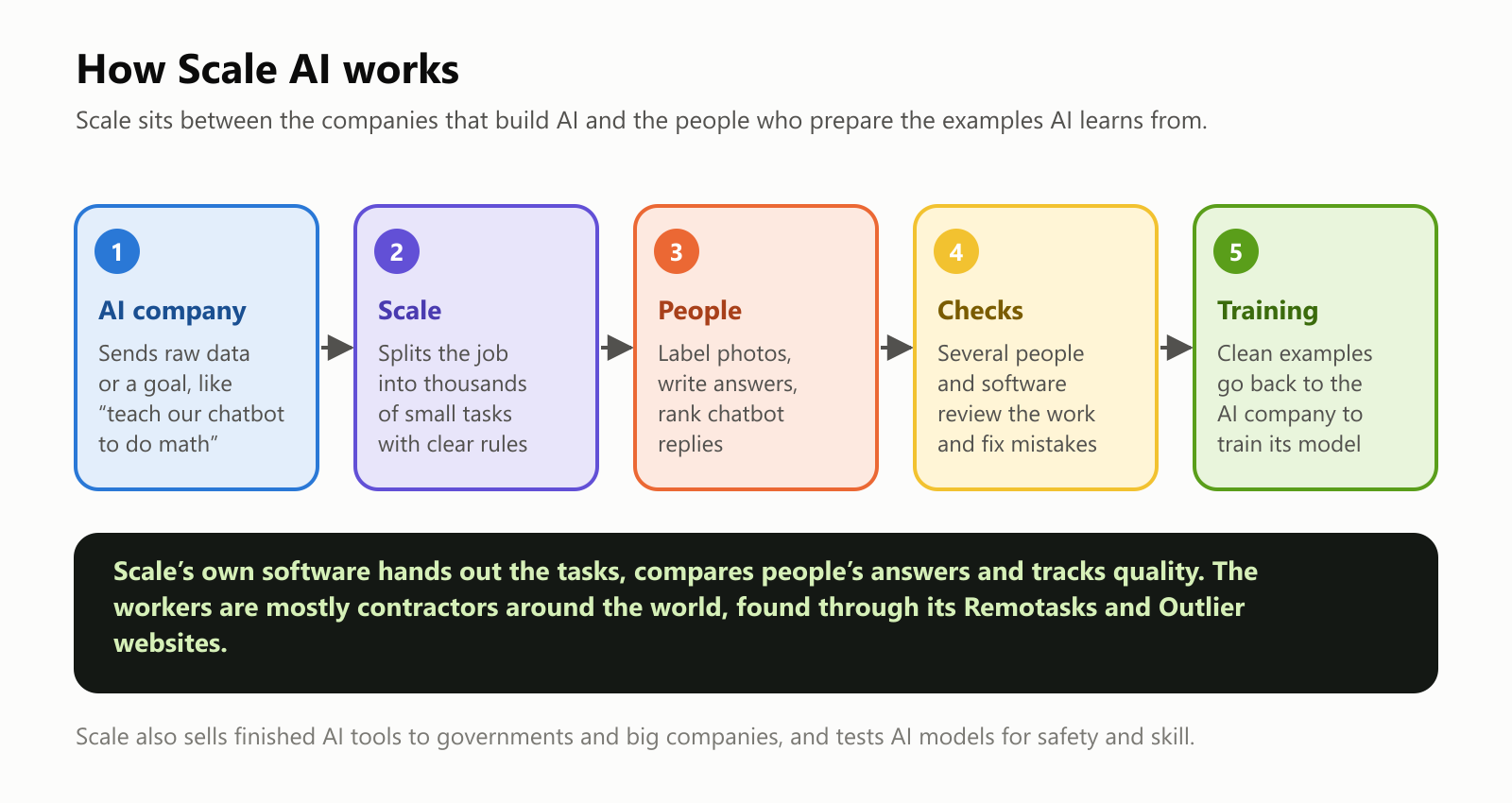
Scale's main business is data for AI. AI systems learn from examples, and those examples are only useful if they come with the right answers attached. Scale organizes large numbers of people around the world to create those answers, and builds software to check that the work is correct. Its customers have included OpenAI, Google, Meta, Microsoft, carmakers and the US government.
Why does AI need human help?
Most AI learns from examples, a bit like a student learning from a textbook full of solved problems. To teach an AI to recognize cats, you show it many photos that a person has marked "cat" or "not cat." Those marks are called labels, and adding them is called data labeling.
The AI can't learn from photos alone, because it doesn't know what's in them. A person has to tell it, at least at first, and doing that for millions of examples is a huge job. Scale's idea was to turn that job into a service: an AI company sends its data, and Scale sends back clean, labeled examples.
What kind of work is it?
The work changed as AI changed.
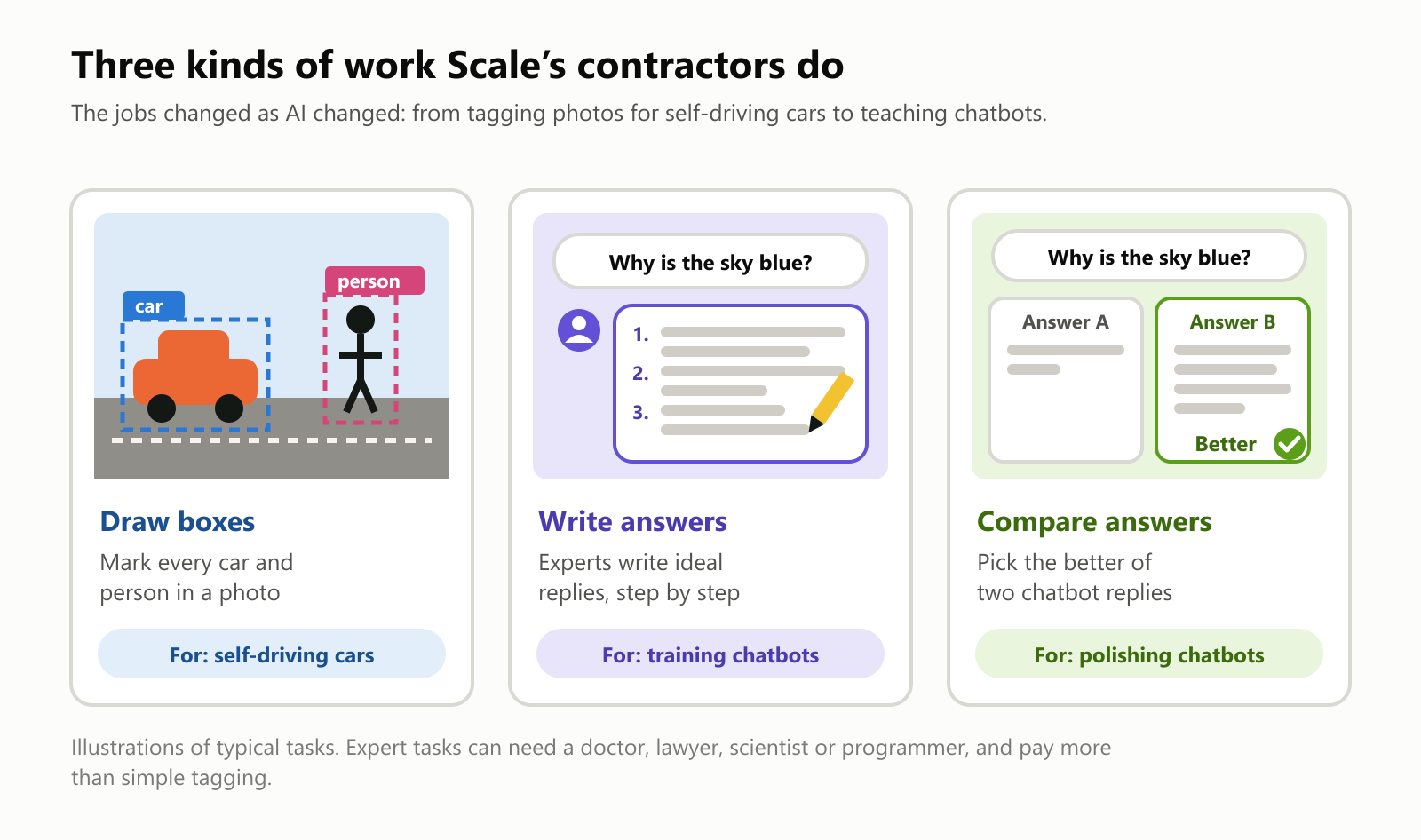
- Drawing boxes (the early years). Scale's first big customers were self-driving car companies. Their cars record endless video of streets, and someone has to draw boxes around every car, person, bike and traffic light so the car's AI can learn to spot them.
- Writing answers. Today's chatbots learn to be helpful by studying good examples of answers. Scale hires people, often experts like doctors, lawyers, scientists or programmers, to write ideal answers to hard questions.
- Comparing answers. A chatbot gives two replies to the same question, and a person picks the better one. Thousands of these choices teach the AI what people prefer. This is a key step called reinforcement learning from human feedback (RLHF). (See What Is Reinforcement Learning?)
Most of these workers aren't Scale employees. They are contractors who sign up on Scale's websites, Remotasks (started in 2017) and Outlier (started in 2023), and are paid per task or per hour.
A real experiment: why good labels matter
To show why AI companies pay for this, we ran a small experiment ourselves. We used a well-known public collection of 50,000 movie reviews from the IMDB website, where people have already labeled each review as positive or negative. Then we trained a simple AI to read a review and guess whether it's positive or negative, and tested it on 25,000 reviews it had never seen.
First, we changed how many labeled reviews the AI could learn from:
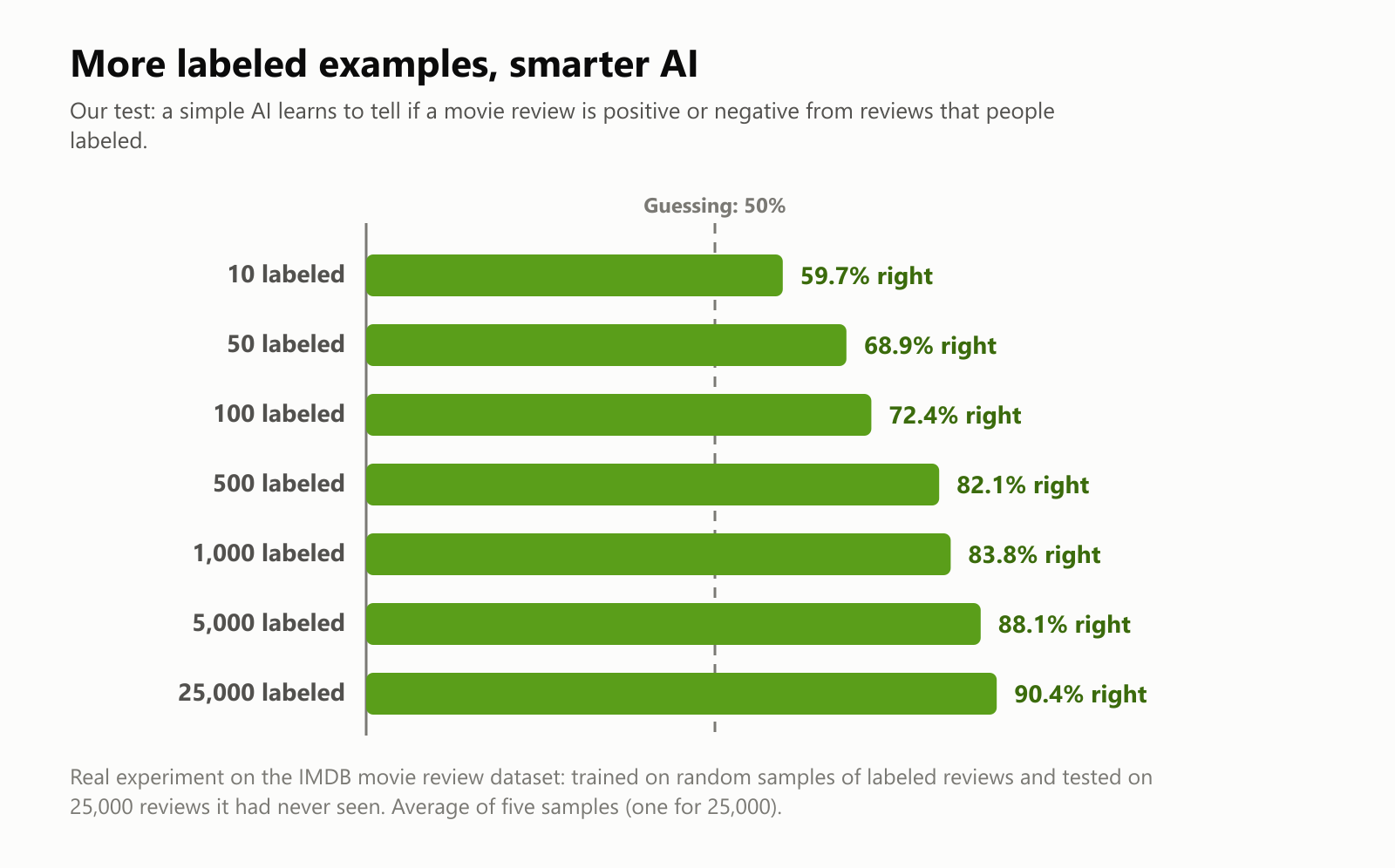
With only 10 labeled reviews, the AI was barely better than flipping a coin. With 25,000, it was right more than 90% of the time. More labeled examples make a smarter AI, which is why AI companies want millions of them.
Then we kept 2,000 labeled reviews but switched some labels on purpose, as if careless labelers had called good reviews bad and bad reviews good:
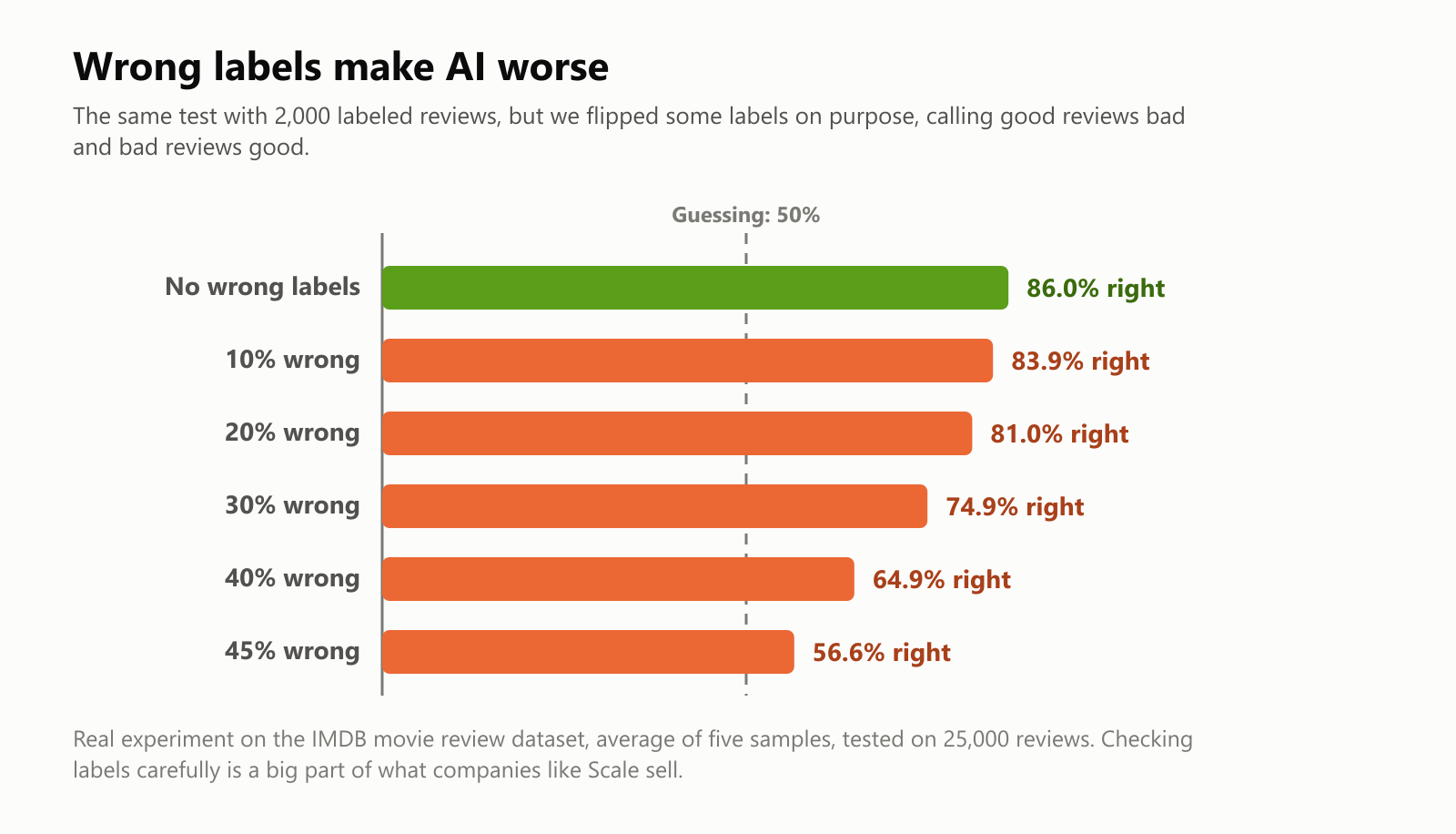
A few mistakes didn't hurt much, but as wrong labels piled up, the AI got steadily worse, until it was almost guessing. Quality matters as much as quantity. That's why companies like Scale don't just sell labels; they sell checked labels, using several people per task, test questions with known answers and software that spots careless work.
More than labels
Over time, Scale added other businesses:
- AI for governments and big companies. Scale builds and sells finished AI tools. Its customers include the US military and companies like BP and Mayo Clinic. In 2025 the Pentagon picked Scale for Thunderforge, a project to use AI agents in military planning, and in May 2026 a Pentagon agreement with Scale was expanded so it can be worth up to $500 million.
- Testing AI. Scale runs public rankings that compare AI models on hard tasks. With the Center for AI Safety, it created Humanity's Last Exam, a test of 2,500 very hard questions written by about 1,000 experts. When it came out in January 2025, the best AI models answered fewer than 10% correctly; by mid-2026 the best scored above 40%.
The Meta deal
In June 2025, Scale made headlines around the world.
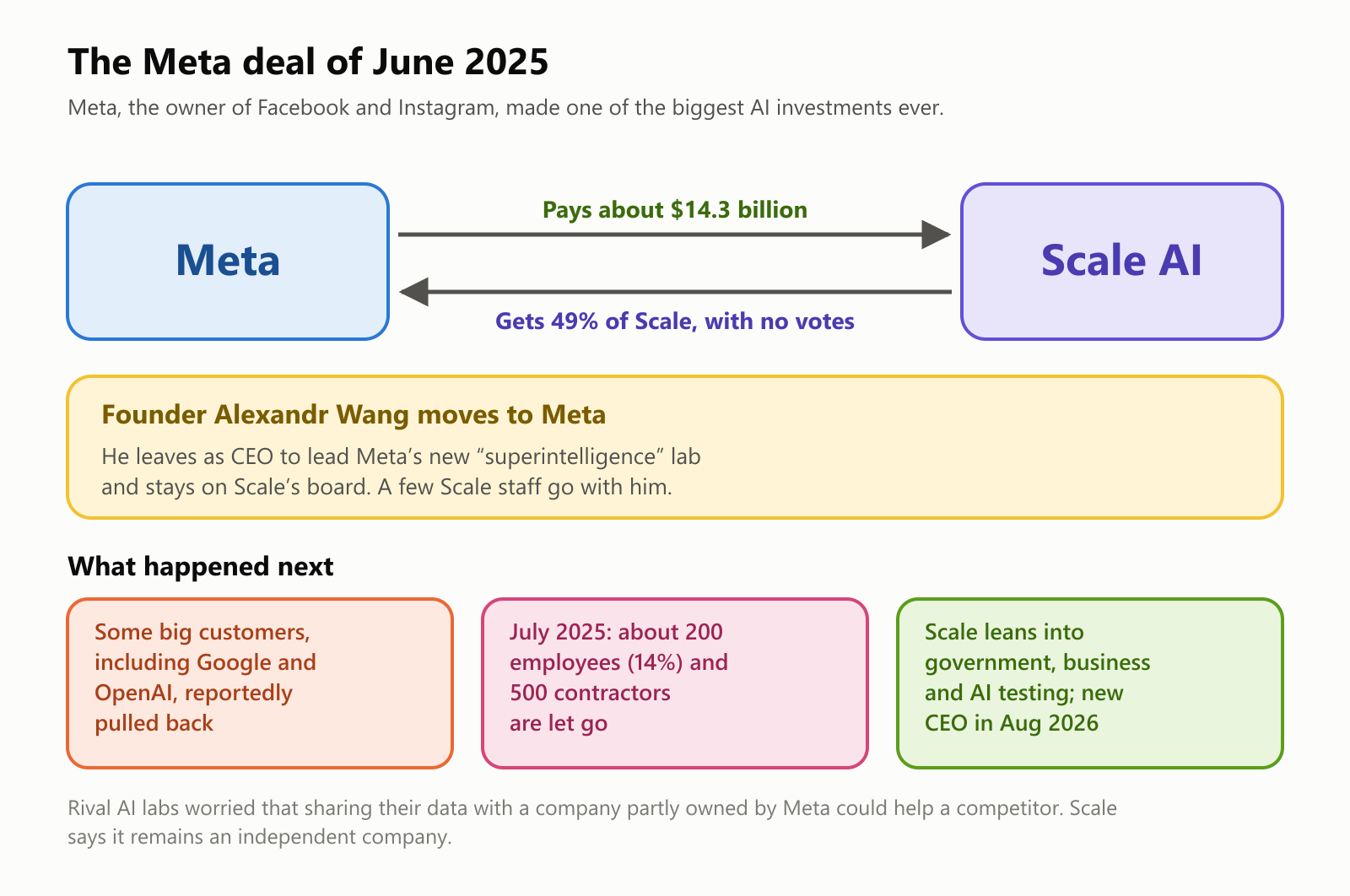
Meta, the owner of Facebook and Instagram, invested about $14.3 billion for 49% of Scale, valuing the company at about $29 billion. Meta's shares came with no voting power, so it doesn't control the company. But the real prize for Meta was Alexandr Wang himself: he left Scale to lead Meta's new AI lab, whose goal is to build "superintelligence," AI smarter than people.
The deal had side effects. Rival AI companies worried that sharing their data and plans with a company partly owned by Meta could help a competitor. Google and OpenAI were reported to wind down their work with Scale. A month later, Scale laid off about 200 employees, about 14% of its staff, and stopped working with 500 contractors. Its interim leader, Jason Droege, said the company had grown its chatbot-data business too fast.
Scale says it is still an independent company. It leaned harder into selling AI to governments and businesses, and in July 2026 it named Francis deSouza, a former top executive at Google Cloud and former CEO of the biotech company Illumina, as its new CEO, starting August 10, 2026.
How much is it worth?
Like many startups, Scale isn't on the stock market, so its value is only set when investors buy a piece of it.
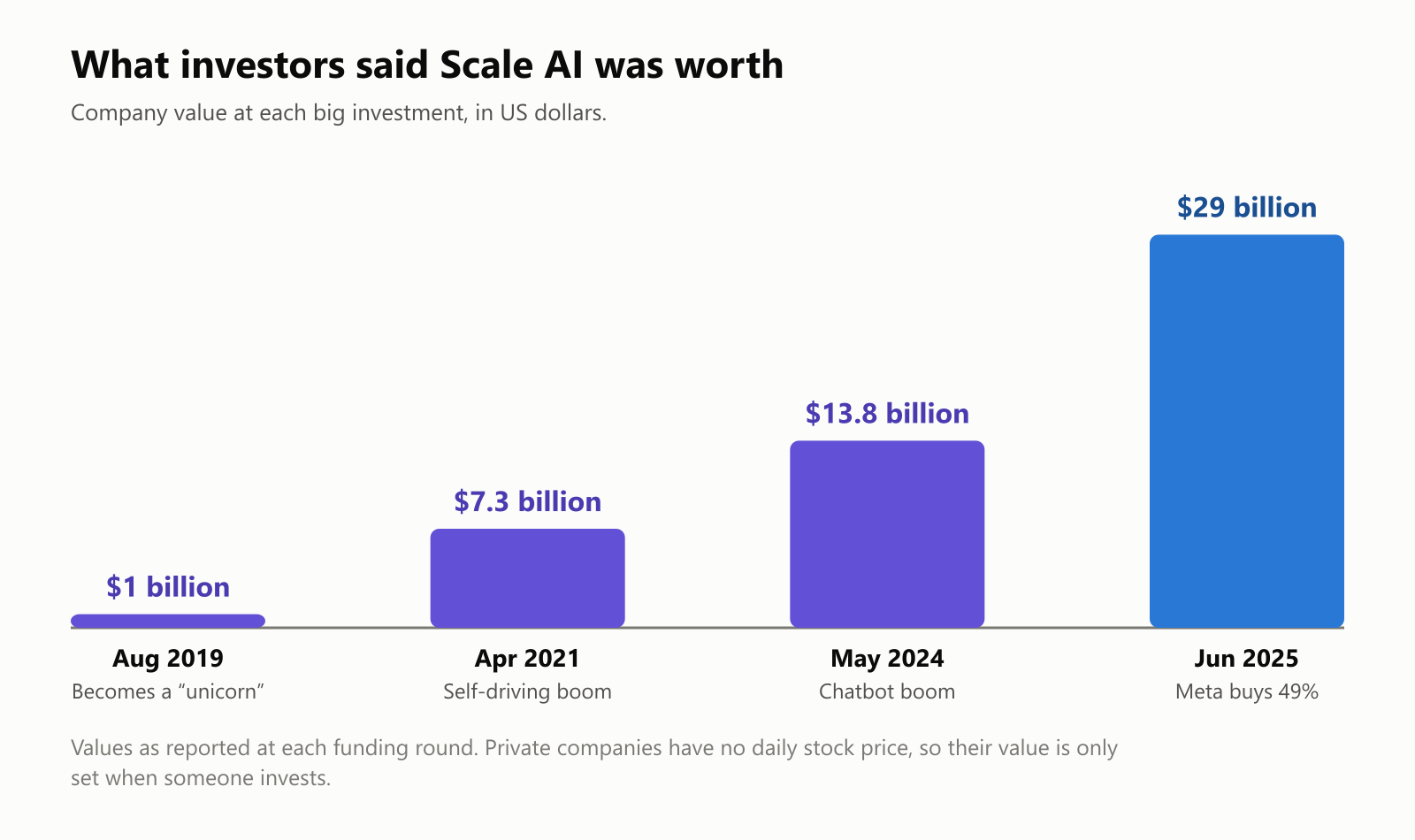
Scale reported about $870 million in revenue in 2024. In May 2026, Droege said he expected revenue to pass $1 billion in 2026, with the business of selling AI to companies and governments growing fastest.
Challenges and debates
- Pay and working conditions. News reports and studies have described Remotasks workers in countries like the Philippines and Kenya receiving very low or late pay. A 2022 Oxford University study found that Remotasks met only one of its ten standards for fair work. Scale has said it is committed to paying its contributors fairly and on time.
- Lawsuits. In late 2024 and early 2025, workers sued Scale in the US, saying they were wrongly treated as contractors instead of employees and, in one case, that they were harmed by having to read disturbing content to test AI safety. Scale disputes these claims.
- Customers and competition. Rivals such as Surge AI, Mercor and Turing offer similar services, and they grew quickly after the Meta deal, partly by winning work that used to go to Scale.
- Military work. Some people welcome AI that helps the military plan; others worry about AI being used in war. Scale's leaders have argued that the US needs the most advanced AI to keep up with rivals like China.
- Will AI still need people? AI can now label some data itself. Scale's bet is that the hardest, most valuable examples, like expert answers and careful comparisons, will still need humans for a long time.
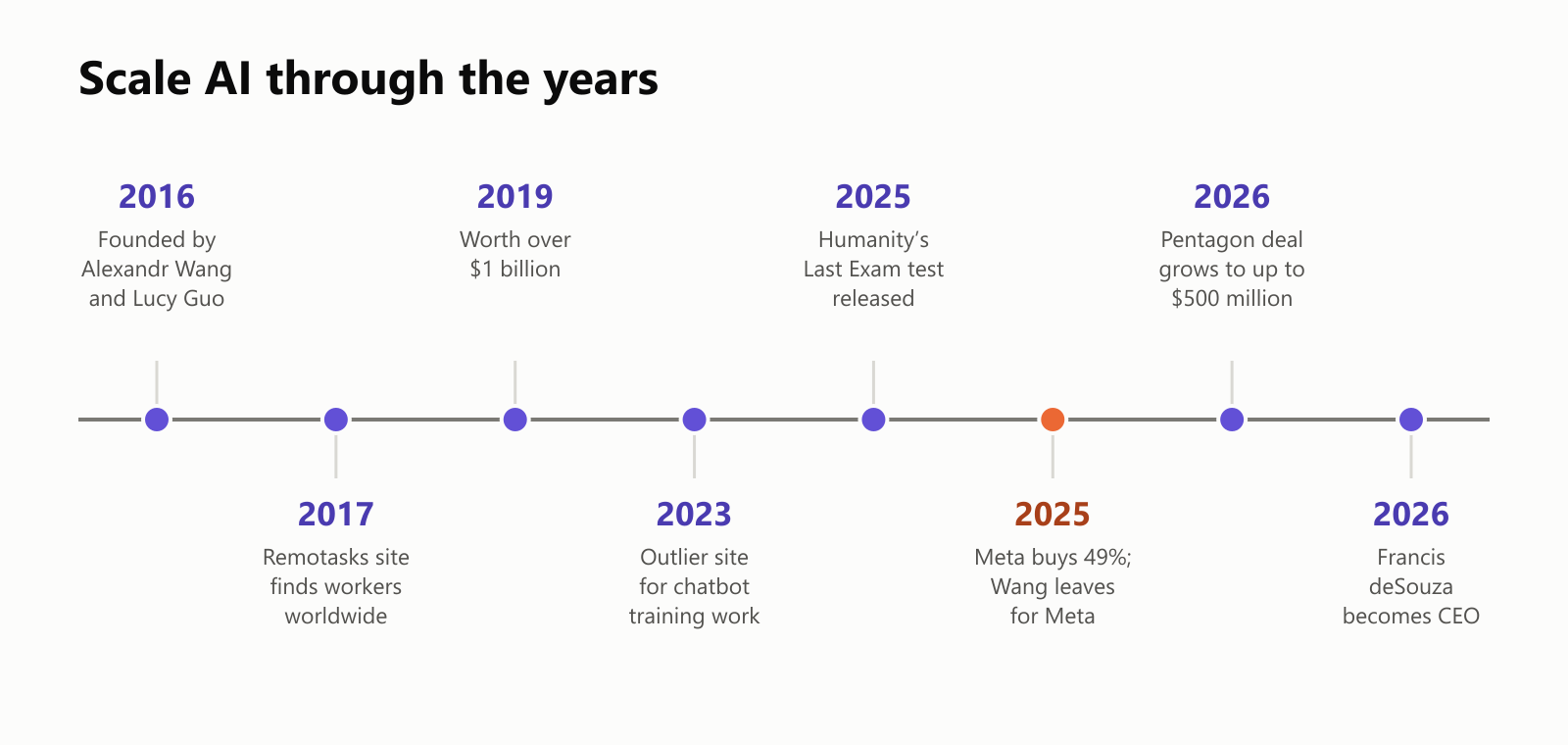
A short history
Try it yourself
- You've probably labeled data already. When a website asks you to "select all squares with traffic lights," you are helping to label images.
- Be the human feedback. Some chatbots occasionally show two answers and ask which one you prefer, or offer thumbs-up and thumbs-down buttons. Your choice is the same kind of signal that RLHF uses.
- Look at a labeled dataset. Search for the "IMDB" dataset on Hugging Face to see the movie reviews and labels we used in our experiment.
Common questions
Does Scale AI make a chatbot? Not one for the public. It helps other companies build and improve theirs, and builds custom AI tools for governments and businesses.
Is Scale AI owned by Meta? No. Meta owns 49%, but its shares have no votes, so Scale is still an independent company.
Who does the labeling? Mostly contractors around the world who sign up online, from students and gig workers doing simple tasks to experts with advanced degrees doing harder ones.
Can I work for Scale? Scale's Outlier and Remotasks websites recruit contractors. As with any gig work, read the pay rates and reviews carefully before signing up.
Why can't AI just teach itself? Increasingly it can, for some tasks. But to learn what is correct, helpful or safe, AI still needs examples from people, especially for new or difficult skills.
Glossary
- Data labeling: adding the correct answers (labels) to examples so an AI can learn from them.
- Dataset: a large collection of examples used to train or test AI.
- Label: the answer attached to an example, like "cat" on a photo or "positive" on a review.
- Contractor: a worker paid per task or per hour who isn't an employee of the company.
- RLHF: reinforcement learning from human feedback, teaching an AI using people's choices between its answers.
- Valuation: how much a company is worth, based on what investors pay for a share of it.
- Benchmark: a standard test used to compare AI models.
Wrapping up
Scale AI shows that behind every impressive AI system there are huge numbers of examples, and many of them were made, checked or chosen by people. Scale turned that work into a business, grew with the self-driving car and chatbot booms, and became important enough that Meta paid over $14 billion for a large share of it and hired its founder.
Next time an AI gives you a good answer, remember that somewhere, people taught it what a good answer looks like.
Read next
What Is a Transformer in AI? The Idea Behind ChatGPT, Explained Simply
A friendly, jargon-free guide to transformers, the AI design behind ChatGPT, Claude and Gemini. Learn how "attention" lets AI understand words in context, what happens inside a transformer, and why it changed AI so quickly.
 nbkhope
What Is Reinforcement Learning? How AI Learns by Trial, Error and Reward
A friendly, jargon-free introduction to reinforcement learning, how AI learns by trial, error and reward, like training a dog with treats. Watch a real robot learn a maze, see why exploring matters, and learn how it shapes chatbots.
nbkhope
What Is Graph Engineering? How Today's AI Teams Up to Get Real Work Done
A friendly, jargon-free guide to graph engineering, the 2026 idea of building AI as a map of connected steps instead of one big loop. See how today's AI agents work, why small mistakes add up, and how checkers, branches and teamwork fix it.
nbkhope
Comments
Be kind and specific. Comments with links from new accounts appear after a moderator reviews them.