
What Is Multimodal AI? One Task Across Text, Images, Audio, and Video
Follow a plant photo and spoken question through a multimodal assistant. Learn what images, audio, text, and video contribute—and what the model still cannot know.

On this page
What Is Multimodal AI? One Task Across Text, Images, Audio, and Video
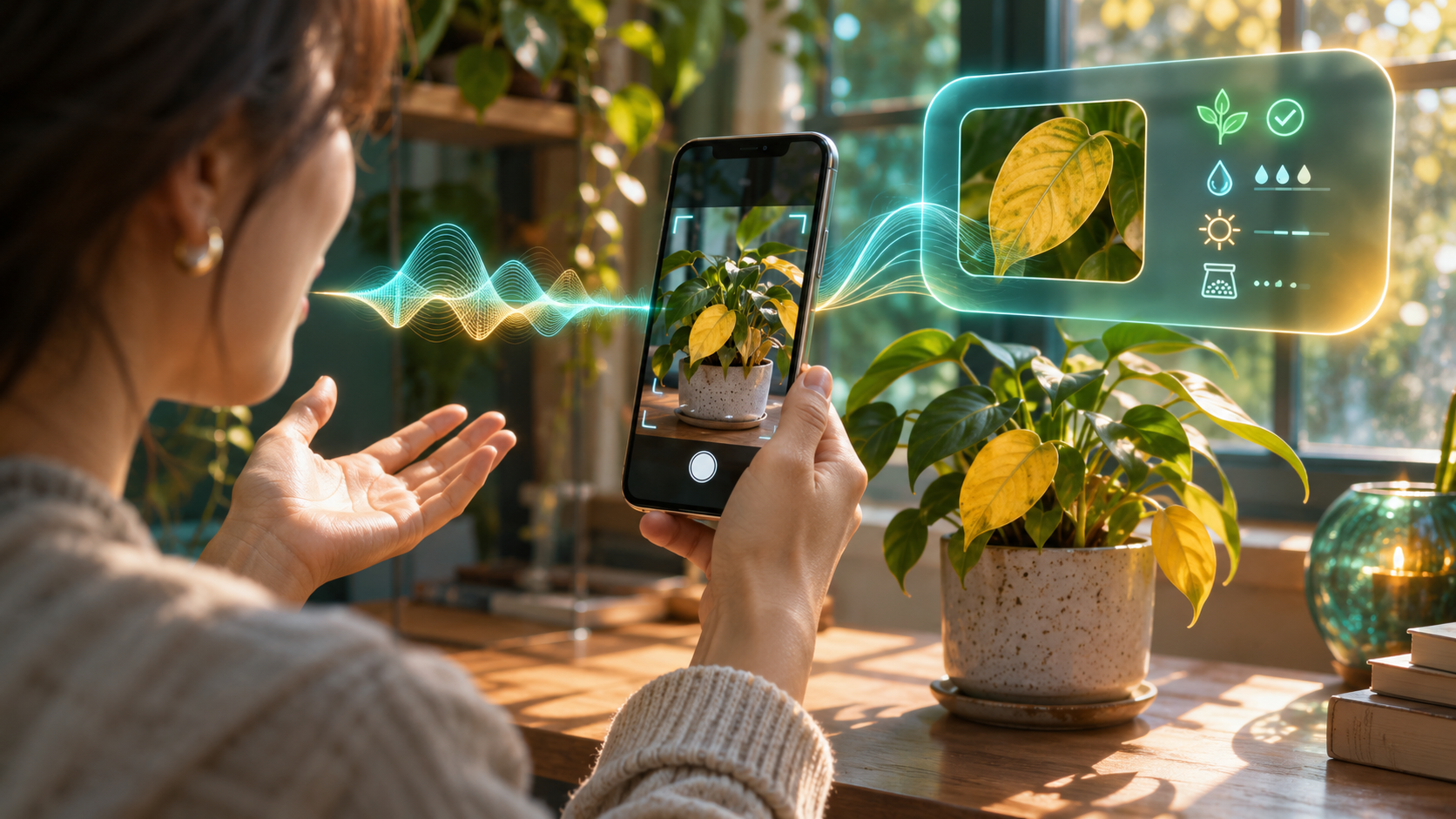
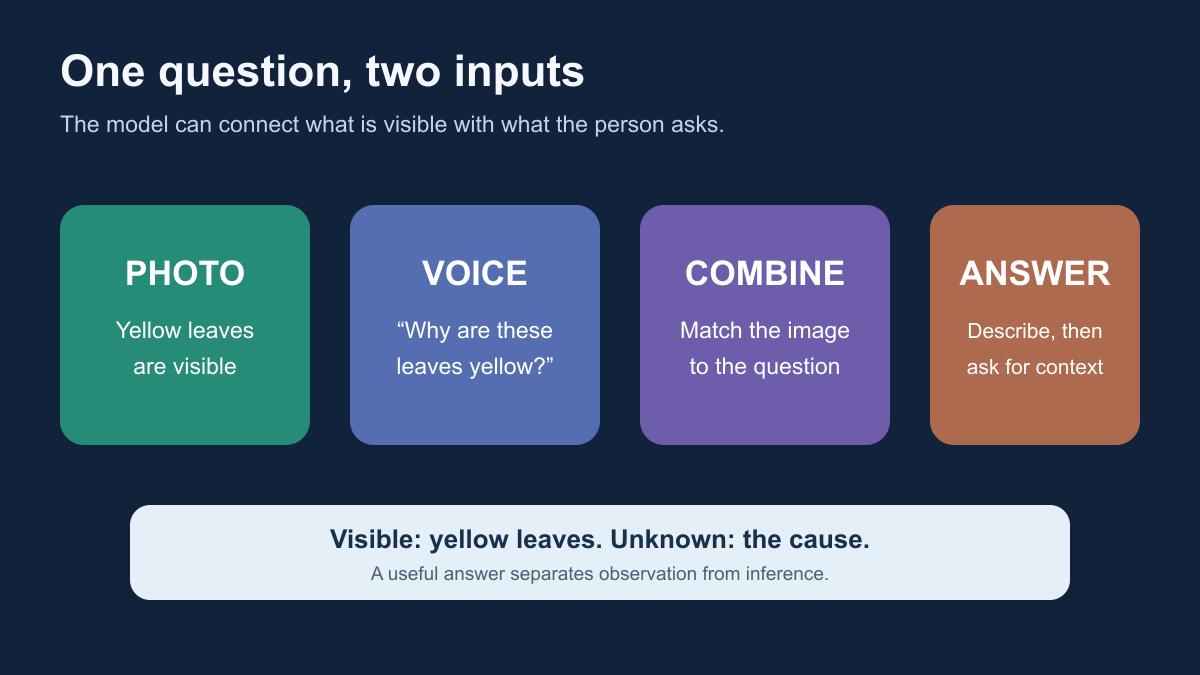
You point a phone at a houseplant and ask aloud, “Why are these leaves yellow?” The assistant may use the picture to locate the yellow leaves, the audio to understand your question, and text to answer. That is a multimodal task: information arrives in more than one form, and the system connects the pieces.

This plant photo was generated for the article. It is a visual exercise, not a diagnosis of a real plant. Try the question with the image in an image-capable assistant; if voice input is unavailable, type the same words. Compare what the assistant actually observed with what it inferred.
One question, several kinds of input
“Multimodal” describes systems that can work across modalities such as text, image, audio, and video. It does not mean every product accepts every format or processes them in the same way. Google's image, audio, and video guides show examples of combining media with text prompts. Check the tool you are using for its supported inputs and limits.
| Part of the task | What it contributes | What it cannot establish alone |
|---|---|---|
| Photo | Visible yellow leaves, pot, and light near a window | Soil moisture, watering history, hidden roots, or a definite cause |
| Spoken question | What the person wants to know and which leaves they mean | Whether speech recognition captured every word correctly |
| Typed context | Details such as “I watered it yesterday” | Whether the detail is accurate or sufficient |
| Text answer | A summary and useful follow-up questions | Proof that the explanation is correct |
Some apps first transcribe speech into text; others process audio more directly. Some send the image and question together to one model, while others use several components. The useful mental model is combined evidence, not one universal internal pipeline.
What a careful answer sounds like
For the pictured plant, a grounded response would begin: “I can see several yellow leaves. The image alone does not show why they turned yellow. How often do you water it, and does the pot drain?” It might suggest checking light and soil before changing care. It should distinguish what is visible from what is a possible explanation.
A weak answer says, “This is definitely overwatering,” because the photo cannot establish that. A model can also miss a small leaf, mistake background light for discoloration, or misunderstand the spoken word “older” as “all.” These are examples of failure modes, not a claim that any particular product will make each error. Google's image-understanding guidance cautions that model outputs can be inaccurate; use follow-up evidence when the distinction matters.
Try an adversarial change: crop the picture so the pot is hidden, then ask the same question. If the answer becomes more certain despite having less evidence, that is a reason to slow down. Also inspect the speech transcript, if the app shows one. Correct a misheard question before judging the visual answer.
Understanding media is different from making media
| Request | Input | Output | What to review |
|---|---|---|---|
| “Which leaves look yellow?” | Photo + text or voice | Description | Did it point to details that are actually visible? |
| “Summarize this short clip” | Video + question | Text summary | Did it preserve the order of events? |
| “Make an illustration of this plant” | Prompt, perhaps a reference photo | New image | Is it an illustration rather than evidence of the original plant? |
| “Read this reply aloud” | Text | Generated speech | Does the spoken output match the intended words? |
An assistant may support both analysis and generation, but those are different jobs. A generated image can look like a photograph; it does not document a real event. For more on visual analysis, see What Is Computer Vision?. For generated speech, see How to Generate Audio from Text with TTS.
Video adds time. A single frame may show a person next to a bicycle; a clip may show whether they approached it, repaired it, or walked away. A video-capable system needs enough of the sequence and, where relevant, its sound. A short summary can still miss a brief event, so replay the source when order or timing matters. Google's video-understanding guide documents video prompting and notes that model outputs can be wrong.
A five-minute experiment
- Save the plant photo above and use a tool that accepts image plus text or speech. Do not upload a private photo for this exercise.
- Ask: “What can you see, and what information would you need before explaining the yellow leaves?”
- Repeat by voice if supported. Check whether the transcript matches your words.
- Ask again with the photo omitted. Notice which claims now lack visual support.
- Score the answers: did they identify visible facts, label guesses, and request the missing context?
The point is not to get a perfect plant-care answer. It is to see how one modality changes the evidence available to the model. When you share your own photos, audio, or video, review the app's current privacy settings and avoid sending more personal detail than the task needs.
Sources and further reading
Read next

What Are Content Credentials? A Guide to Digital Provenance
Follow a photo from capture through editing and export to see what signed Content Credentials reveal, what can be lost, and what they cannot prove.
 nbkhope
How to Verify a Suspicious Image or Video
A striking image or video can be real, generated, edited, or simply mislabeled. Follow a practical source-checking workflow before sharing it.
nbkhope
AI Agents for Weekly Work Reports: From Scattered Updates to a Trustworthy Draft
Build a weekly report from Slack or Teams, GitHub, Jira and documents without inventing progress. Follow a source-linked agent workflow and copy a ready-to-use prompt.
nbkhope
Comments
Be kind and specific. Comments with links from new accounts appear after a moderator reviews them.