
Video Games and AI: From Enemy Patrols to Talking NPCs
What does AI actually do in a video game? Follow one guard from patrol to pursuit, meet talking NPCs, and see what game workers say about generative AI.

On this page
Video Games and AI: From Enemy Patrols to Talking NPCs
You sneak past a guard in a game. A bottle rolls across the floor. The guard turns, walks over, then spots you and gives chase. Is that “AI”? Yes—but probably not the kind that writes essays or answers questions. The guard may be following a handful of carefully designed rules.
Now imagine asking the same guard, “Did you see who stole the key?” and getting a new spoken reply that fits the quest. That might use a language model. Both are called game AI, but they solve different problems. Let's follow the guard and see what each layer adds.
The guard who thinks in branches
Many game characters work with a behavior tree or another rule-based decision system. The designer decides which facts matter and what the character should do. Our fictional guard might follow this priority:
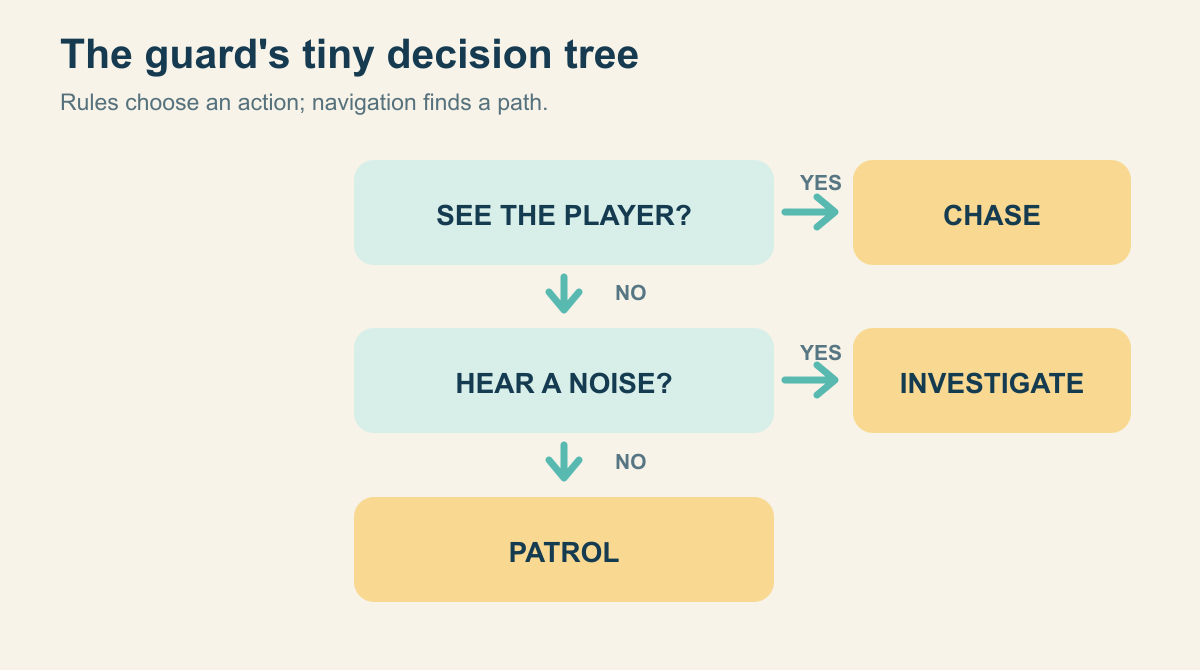
See the player?  → Chase
Otherwise, hear a noise? → Investigate
Otherwise → Patrol
That can already feel intelligent because the response fits the situation. But the guard is not inventing its own goals. The game author set the conditions and actions. Epic's Unreal Engine documentation uses behavior trees and a “blackboard” of game facts for non-player characters (NPCs).
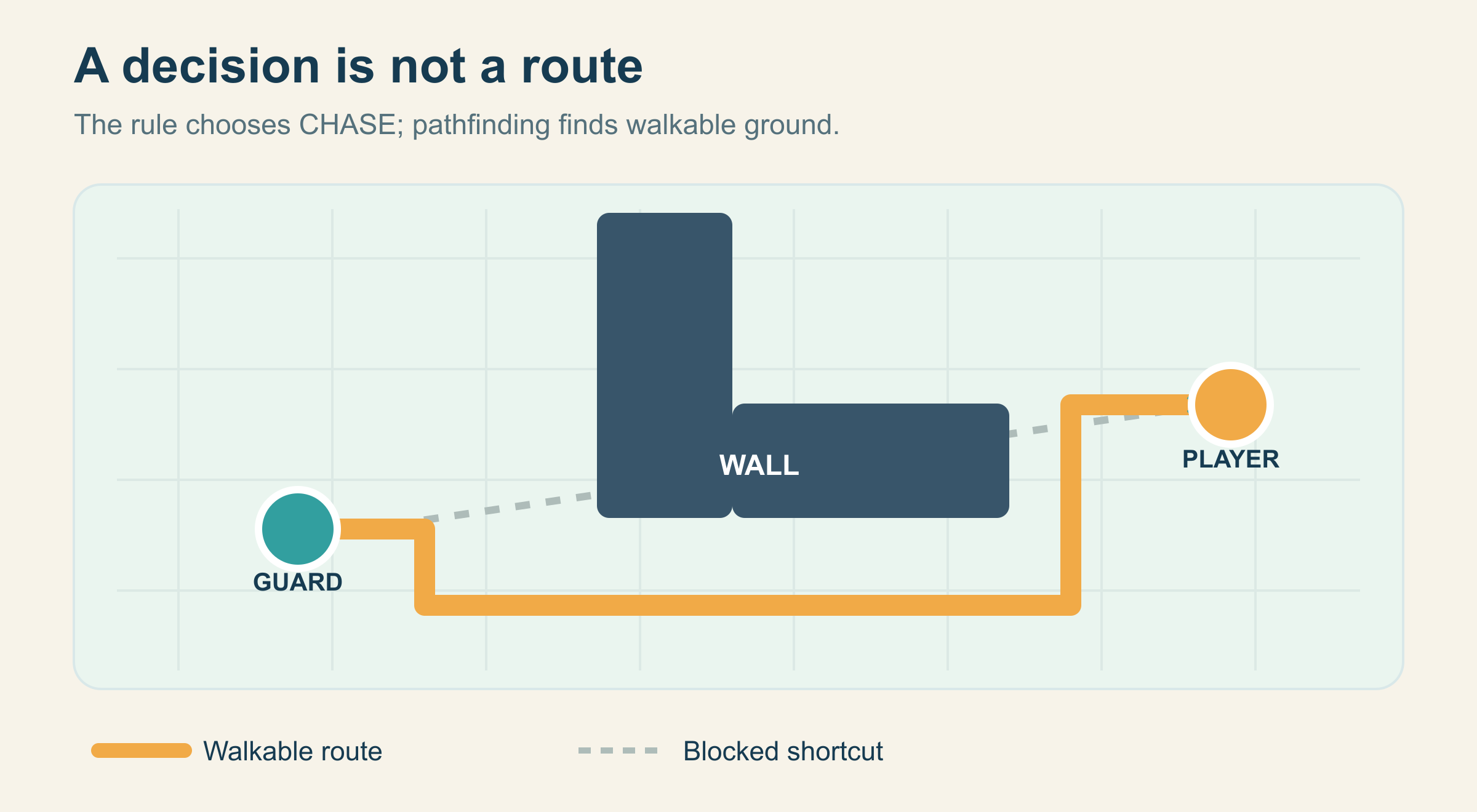
Once the guard chooses “chase,” it still needs a route. A navigation mesh marks where it can walk; pathfinding picks a route through those areas. Unreal's navigation system describes this as a graph with travel costs. In our example, the decision tree chooses the goal; navigation finds the way there.
Four things people call “AI” in games
| Use | What it does | Does it need a language model? |
|---|---|---|
| Character behavior | Patrols, reacts, takes cover, or changes tactics | Usually no |
| Pathfinding | Finds a route around walls and obstacles | No |
| Generative characters and tools | Drafts dialogue, answers player speech, or helps make content | Often yes for language tasks |
| Neural graphics | Reconstructs or enhances images using trained models | Uses ML, but not necessarily language models |
One easy mix-up: procedural generation is not automatically generative AI. A designer can use rules and a random seed to place trees or assemble a dungeon without training a model. Unreal's procedural content tools are an example of rule-driven world-building tools. Also, better graphics do not imply that the enemies are smarter: the systems can be completely separate. NVIDIA describes both neural rendering and AI characters as distinct game technologies.
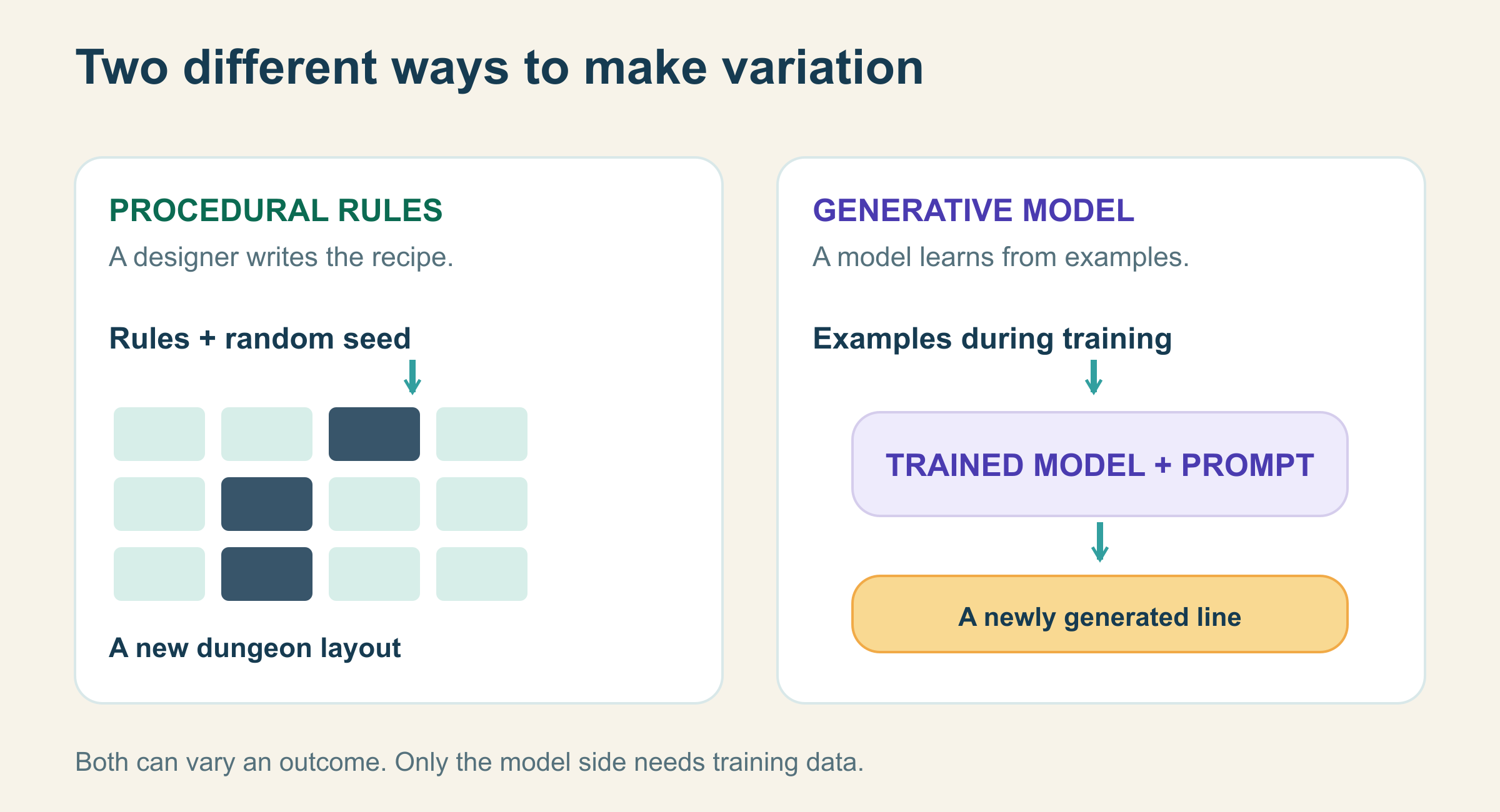
What changes when the guard can talk?
A conversational NPC needs more than a chat box. If you speak, the game may transcribe your voice, send the words and relevant game state to a language model, check its proposed response or action against game rules, then show or speak the result. Some steps may happen on your device; others may use a server. This is a possible design, not a claim that every game uses the same pipeline.
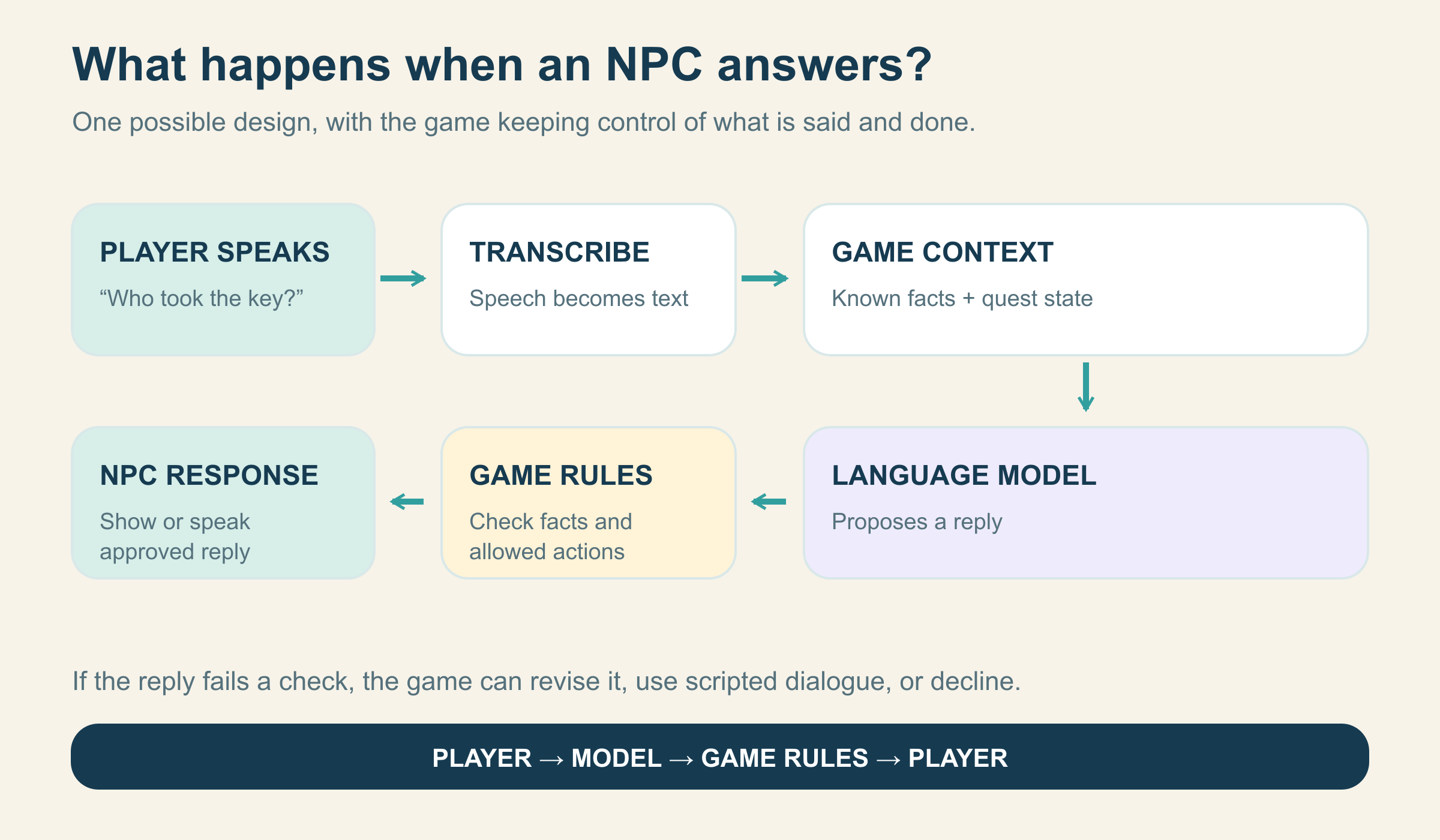
Why include game state? Without it, the guard might reveal a quest secret before you earn it, claim to know an event that never happened, or promise to open a door the game cannot open. The game must decide which facts the character may know and which actions it is permitted to take. KRAFTON's PUBG Ally playtest announcement describes one real effort to connect voice interaction and game knowledge to an AI teammate; it is an example, not evidence that talking NPCs are standard across games.
For the player, the trade-off is easy to feel. Unscripted conversation can be surprising and personal, but it must respond quickly, stay in character, respect the story, and avoid nonsense. Designers still have to decide what counts as a good performance.
Behind the scenes: enthusiasm and concern coexist
Generative AI also appears outside gameplay, in brainstorming, code assistance, prototyping, marketing, and other work. A 2026 Game Developers Conference survey of more than 2,300 game-industry professionals reported these figures:
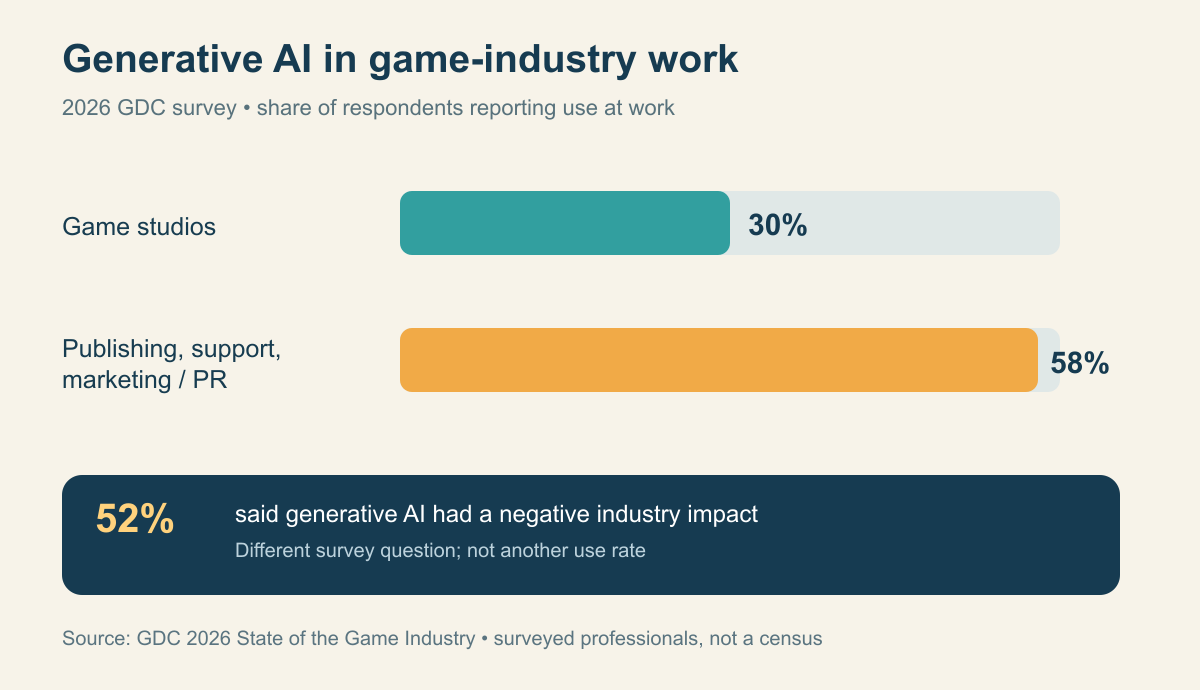
- 30% of respondents at game studios said they used generative-AI tools at work.
- 58% of respondents in publishing, support, and marketing or PR said they used them.
- In a separate question, 52% of surveyed industry professionals said generative AI was having a negative impact on the industry.
These are survey responses, not a count of games with AI NPCs. The groups and questions differ, so do not subtract or combine the percentages. The survey shows why “the industry loves AI” and “the industry rejects AI” are both too simple. Its results are a snapshot of respondents, not a random census of every game worker. Concerns include creative control, the quality and provenance of training material, jobs, and whether the technology improves the player's experience.
A player's three-question test
Next time a game advertises “AI,” ask:
- What is changing? Enemy decisions, dialogue, world generation, graphics, or the team's workflow?
- When does it happen? During development, on your device while playing, or on a remote server?
- Who keeps control? Can designers constrain what the system says and does, and can players understand the result?
The most interesting future is not simply “more AI.” It is games where the technology makes a choice, character, or world feel better to play—and where people can tell what is actually happening. For the hardware side, see Inside an AI Answer: What an NVIDIA GPU Actually Does. For a broader learning loop, see What Is Reinforcement Learning?.
Sources and further reading
Read next

Can You Trust an AI Summary? Look for What It Leaves Out
An AI summary can get the total right and still mislead you. Use a small, visual experiment to spot missing groups, unsupported claims, and lost context.
 nbkhope

Inside an AI Answer: What an NVIDIA GPU Actually Does
Follow one AI question through an NVIDIA GPU: prompt processing, token-by-token generation, memory, and batching. See a calculated chart of why long chats cost memory.
nbkhope
The Top 5 AI Coding Agents in 2026: Which One Belongs in Your Workflow?
Five AI coding agents, five different ways to build. Compare Claude Code, Codex, Cursor, GitHub Copilot and Google Antigravity with real workflows and a quick chooser.
nbkhope
Comments
Be kind and specific. Comments with links from new accounts appear after a moderator reviews them.