
Can You Trust an AI Summary? Look for What It Leaves Out
An AI summary can get the total right and still mislead you. Use a small, visual experiment to spot missing groups, unsupported claims, and lost context.

On this page
Can You Trust an AI Summary? Look for What It Leaves Out
“The sign-up rate was 56% on the old page and 68% on the new page.” That sentence could be perfectly true—and still be a poor basis for a decision. If an AI assistant adds “it worked better for everyone,” the problem is no longer just arithmetic. It has turned an incomplete summary into an unsupported conclusion.
Let's investigate with a tiny, fictional experiment. This article focuses on a subtle trust problem: correct totals can hide important context. For a general five-step method to check an AI answer, see How to Check an AI Answer Before You Use It.
The source: a small fictional test
Imagine a team comparing an old sign-up page with a new one. Each version was shown to 100 visitors. Here are the complete made-up counts:
| Visitor group | Old page | New page |
|---|---|---|
| Desktop | 40 sign-ups / 80 visitors = 50% | 60 / 80 = 75% |
| Mobile | 16 / 20 = 80% | 8 / 20 = 40% |
| All visitors | 56 / 100 = 56% | 68 / 100 = 68% |
The overall rate was 12 percentage points higher for the new page: 68% minus 56%. But the mobile rate was 40 percentage points lower: 40% minus 80%. A single total conceals that reversal.
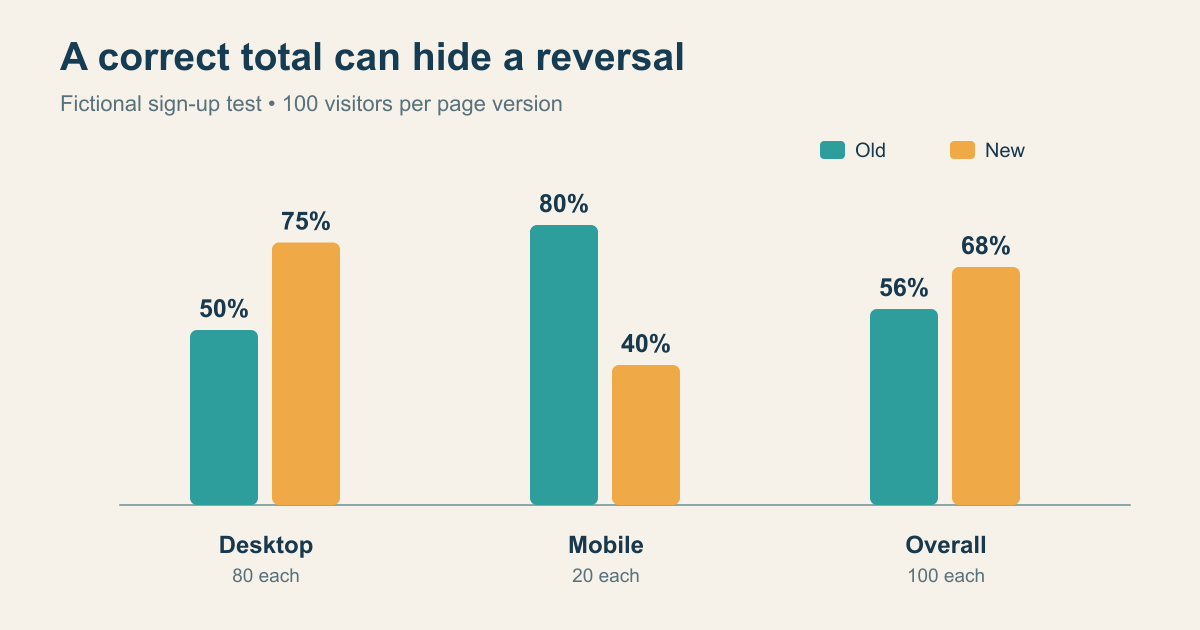
This chart is calculated from the table, not a real study or an AI benchmark. The groups are small, especially mobile. The figures alone do not tell us whether the new design caused the changes or whether a difference would persist in a larger test. They do tell us that “better for everyone” is unsupported.
The AI summary—and the missing sentence
Suppose an assistant writes:
The sign-up rate was 56% on the old page and 68% on the new page, a 12-point difference. The redesign performed better for everyone, so the team should launch it.
Separate its sentences into claims:
| Claim | What the source says | Verdict |
|---|---|---|
| Overall rate was 56% versus 68% | 56 of 100 versus 68 of 100 | Supported |
| Difference was 12 percentage points | 68 − 56 = 12 | Supported |
| Better for everyone | Mobile fell from 80% to 40% | Contradicted |
| Launch now | The table alone lacks a decision rule, uncertainty analysis, and information about the test setup | Not established |
The most important omission is not a fabricated number. It is the mobile decline, hidden by an accurate overall result. A useful corrected summary might say:
In this fictional sample, the overall sign-up rate was 56% for the old page and 68% for the new page, while the mobile rate was 80% versus 40%. The mobile group included 20 visitors per version. Investigate the mobile experience and how the test was run before making a launch decision.
A source-to-claim workflow
For any AI-generated summary you might repeat or act on, trace the conclusion back to the source:
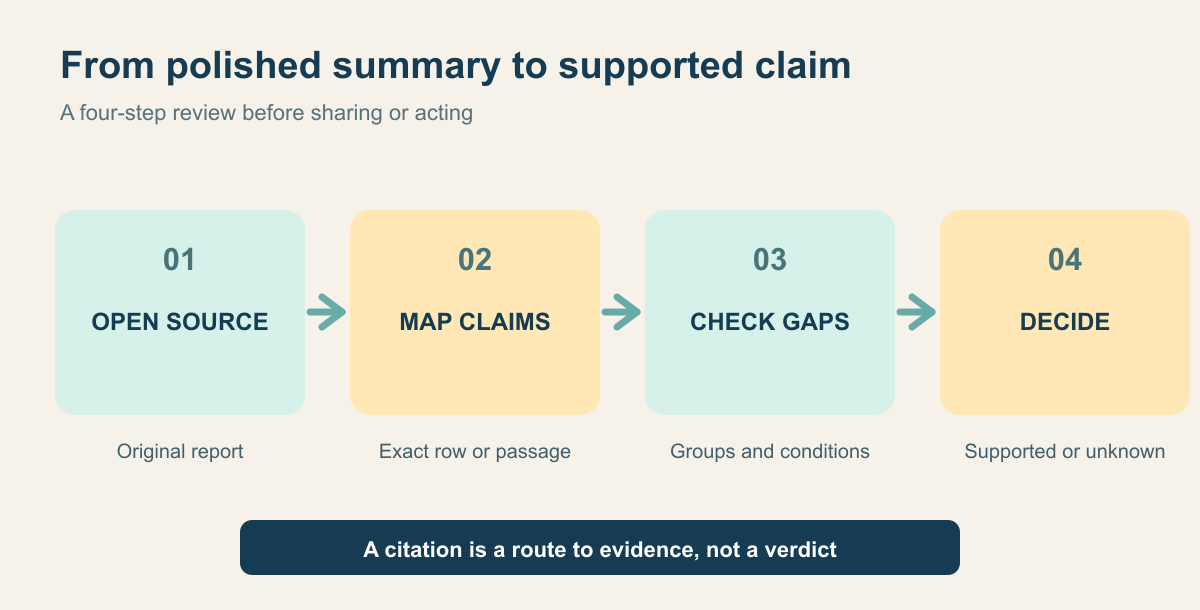
- Open the original. Ask for the report, dataset, study, or notice. A link to a related page is not enough.
- Map each consequential claim. Find the exact row or passage behind it. Mark claims that have no supporting source.
- Inspect what was compressed away. Look for subgroups, denominators, dates, conditions, uncertainty, and exceptions. Check whether the summary changes “some” into “all,” or a correlation into a cause.
- Set a trust level. You can use a well-supported claim as a working fact, hold an uncertain claim as a question, and reject a contradicted claim. For high-stakes decisions, involve the appropriate expert or required review process.
You can ask an assistant to make a claim-to-source table, but treat that table as another output to verify. The NIST generative-AI profile notes that systems can produce confident errors and even misleading supporting logic or citations. Research on summary faithfulness has also found that fluent summaries can misrepresent source material. Those findings do not provide an error rate for your particular tool or document; they explain why an evidence check is useful.
Try this on your next summary
Copy the prompt below, then independently inspect the original material:
Summarize this source in five bullets. For each bullet, show the exact supporting row or passage. Include results that point in the opposite direction, group sizes, and important limitations. Label any recommendation as your inference rather than a source fact.
The goal is not to distrust every sentence. It is to know which part of an answer has earned your trust. In the example, the overall rate earned it; “for everyone” did not.
Sources and further reading
Read next

Inside an AI Answer: What an NVIDIA GPU Actually Does
Follow one AI question through an NVIDIA GPU: prompt processing, token-by-token generation, memory, and batching. See a calculated chart of why long chats cost memory.
 nbkhope

The Top 5 AI Coding Agents in 2026: Which One Belongs in Your Workflow?
Five AI coding agents, five different ways to build. Compare Claude Code, Codex, Cursor, GitHub Copilot and Google Antigravity with real workflows and a quick chooser.
nbkhope
How to Protect Your Privacy When Using AI Tools
Protect your privacy when using AI tools with a practical workflow for removing personal details, checking data controls, handling files, and reviewing shared links.
nbkhope
Comments
Be kind and specific. Comments with links from new accounts appear after a moderator reviews them.