
A Brief History of Video Games: From Lab Screens to Everywhere
From an oscilloscope tennis match to pocket-sized worlds, follow the inventions, surprises, setbacks, and new places to play that shaped video game history.

On this page
A Brief History of Video Games: From Lab Screens to Everywhere
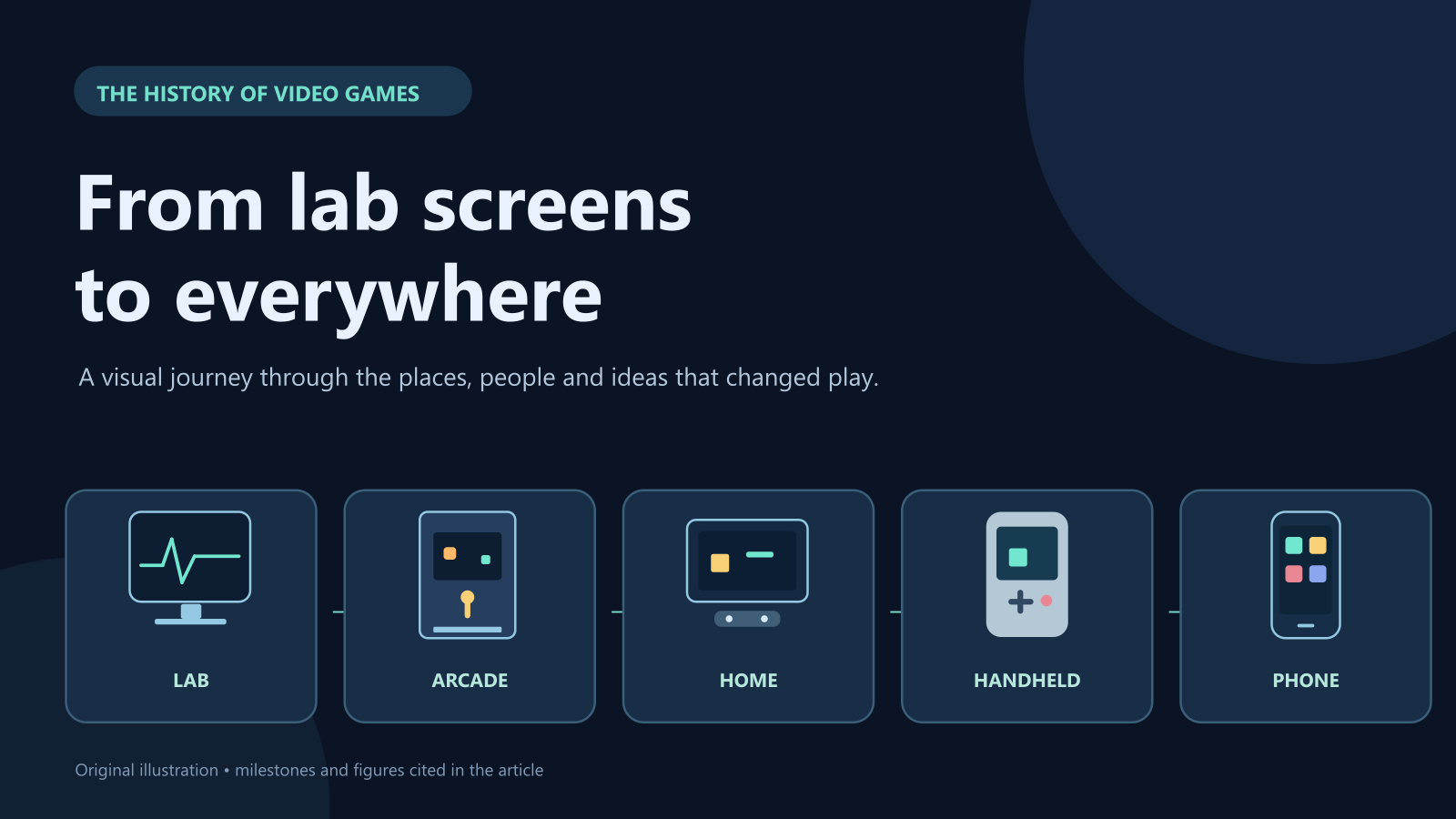
Imagine paying a quarter to steer a glowing dot. Now imagine carrying a whole library of games in your pocket. Between those two moments lies a history of clever experiments, crowded arcades, hard lessons, and a recurring question: where can play go next?
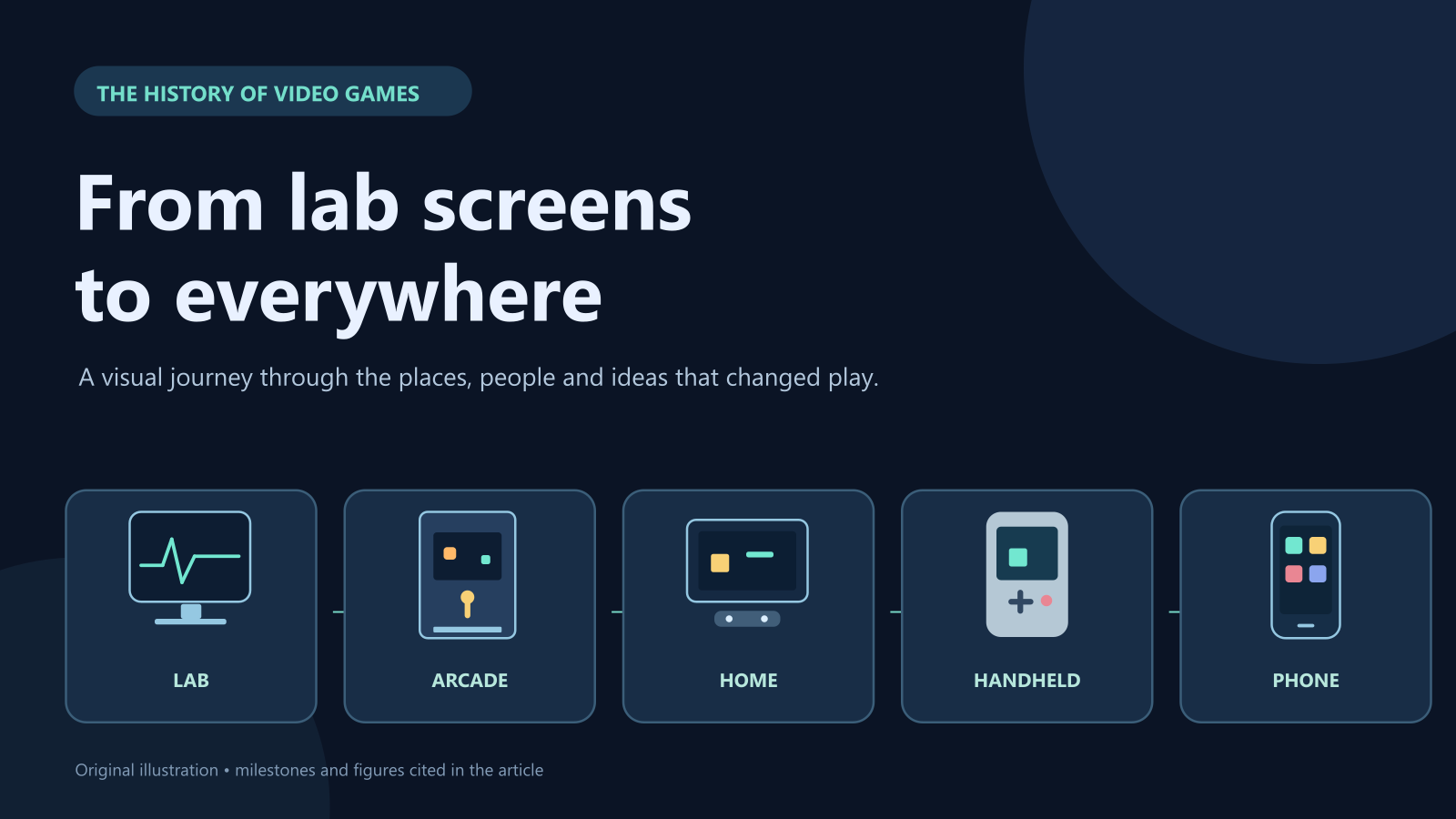
There is no single “first video game” that everyone agrees on. It depends on whether you mean a computer program, an electronic display, a commercial product, or a home console. A more useful story follows the doors each invention opened.
1958–1972: A screen becomes something you can play
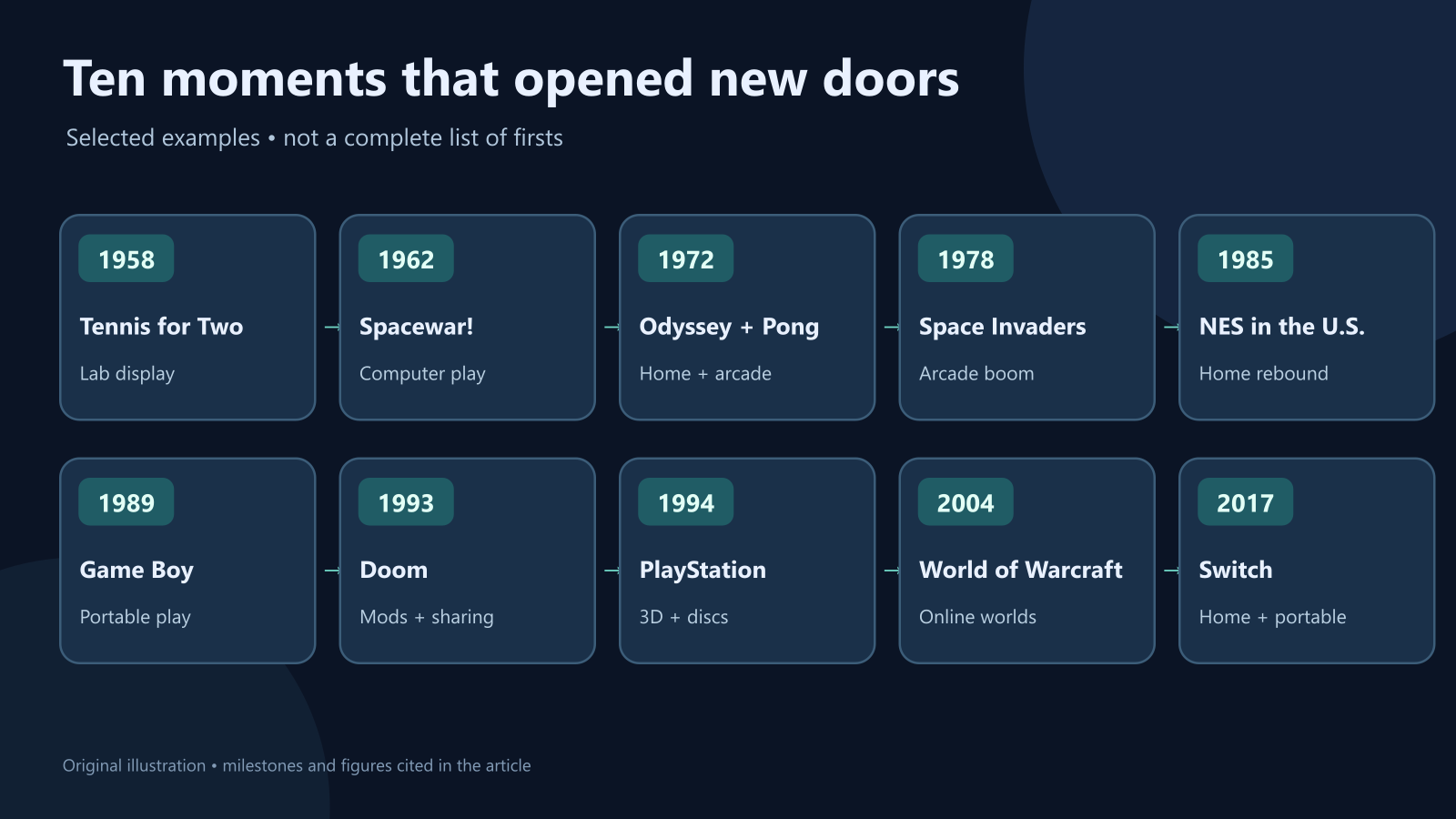
At Brookhaven National Laboratory in 1958, William Higinbotham and David Potter built Tennis for Two for visitors. Two people could bat a spot of light across an oscilloscope. In 1962, Spacewar! let players pilot ships around a star on MIT's PDP-1 computer. These were striking demonstrations, but neither meant you could walk into a shop and take the experience home. The Computer History Museum's timeline documents both.

Game image: Spacewar! authors / Wikimedia Commons, public domain.
Ralph Baer approached the screen from the living room. His team developed the “Brown Box,” a prototype with multiple games and controllers. Magnavox turned it into the Odyssey, released in 1972. The machine drew simple shapes; transparent overlays and physical accessories supplied some of the scenery and rules. It appeared months before Atari's arcade Pong. That does not make Pong unimportant: its simple, coin-operated table tennis made strangers stop, watch, and play. The Smithsonian's Odyssey collection and video game history tell the fuller story.
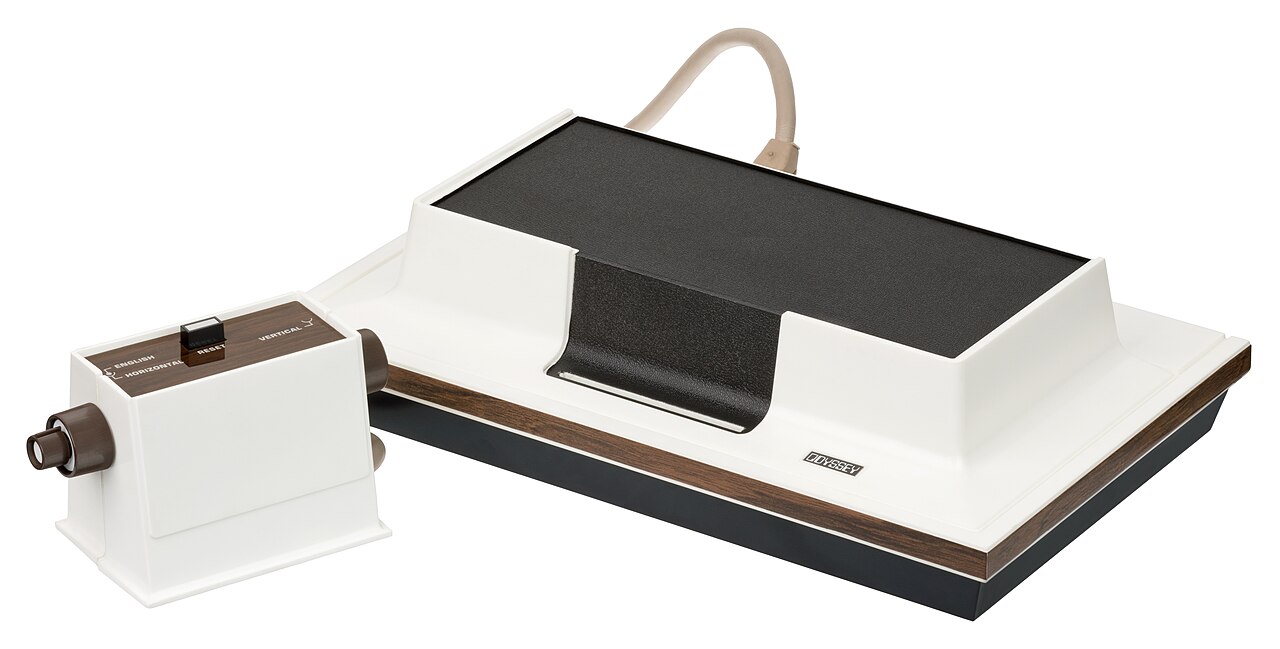
Photo: Evan-Amos / Wikimedia Commons, public domain.
The arcade becomes a social place
Before a video arcade was a destination, a game could be a cabinet in a bar, bowling alley, or restaurant. Atari, founded by Nolan Bushnell and Ted Dabney in 1972, sent Al Alcorn's two-player Pong into that world. Its simple controls made the action legible even to someone standing behind the players. The Computer History Museum describes its early bar tests and the way Pong helped launch a new arcade business.
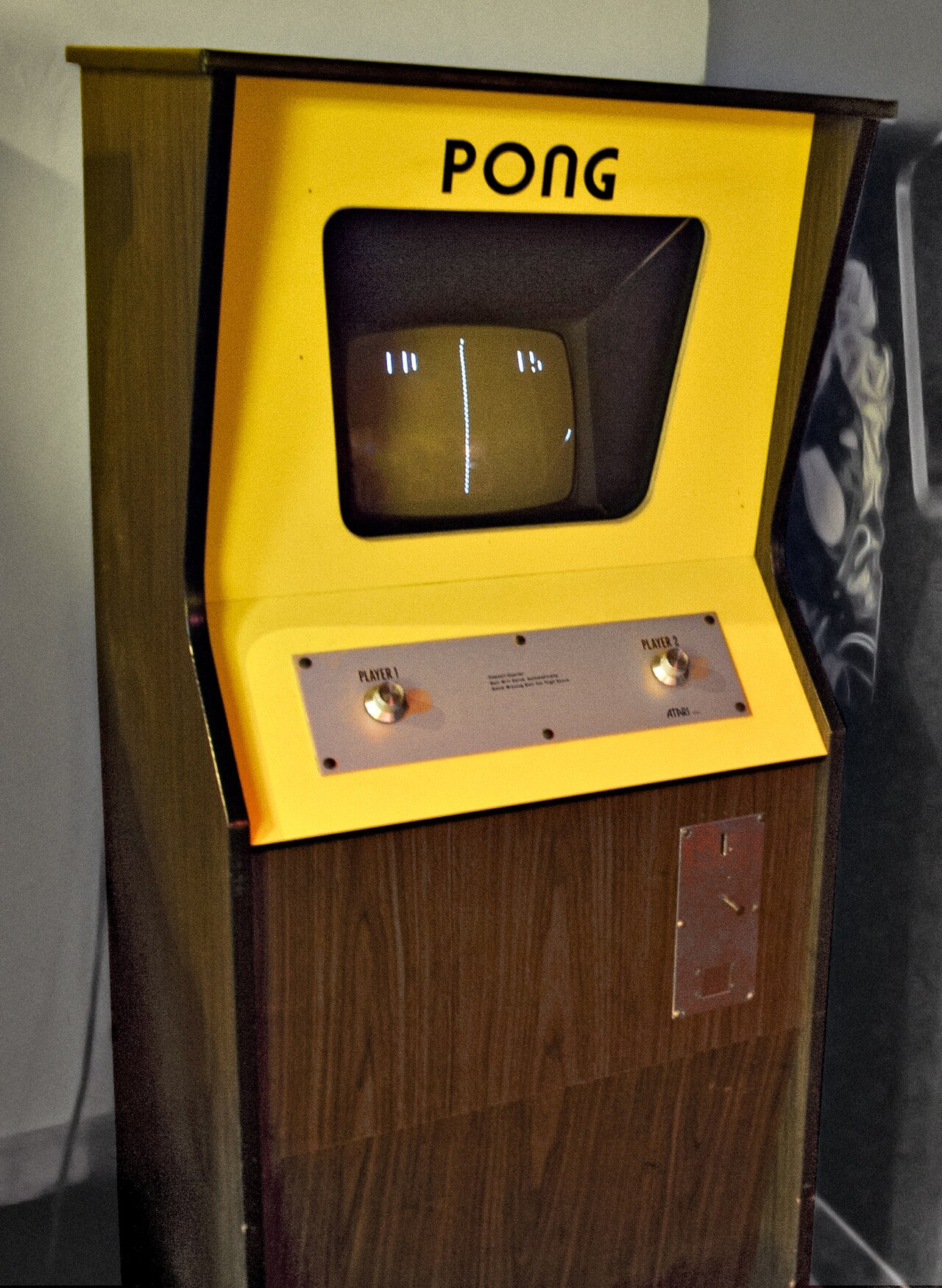
Photo: Rob Boudon; edited by Ubcule / Wikimedia Commons, CC BY 2.0; displayed at reduced size.
Then the cabinets became destinations in their own right. Japan's Taito developed Space Invaders (1978), which Midway brought to the U.S. market. Atari followed with Asteroids (1979) and Centipede (1981). Namco created Pac-Man (1980), distributed by Midway in the U.S.; its maze and characters stood apart from the space shooters. Nintendo turned Donkey Kong (1981) into a little rescue story with a jumping hero later known as Mario. Williams, already a pinball maker, made the demanding, scrolling Defender (1981). These were different companies, and “made” and “distributed” were not always the same job. The Computer History Museum, Atari, Bandai Namco, and the Strong museum's Donkey Kong and Defender histories trace the games and their makers.
The room was part of the design. A player spent a coin for a short attempt, tried to beat a score, and learned by watching someone better. Friends waited, strangers offered advice, and a good run could draw an audience. Machines also spread beyond dedicated arcades into malls, convenience stores, and other public places. The Denver Public Library's period photographs and reporting show how varied those settings were. At the 1983 Omaha Powwow, an arcade booth brought the machines into a community gathering, as the Library of Congress documents.
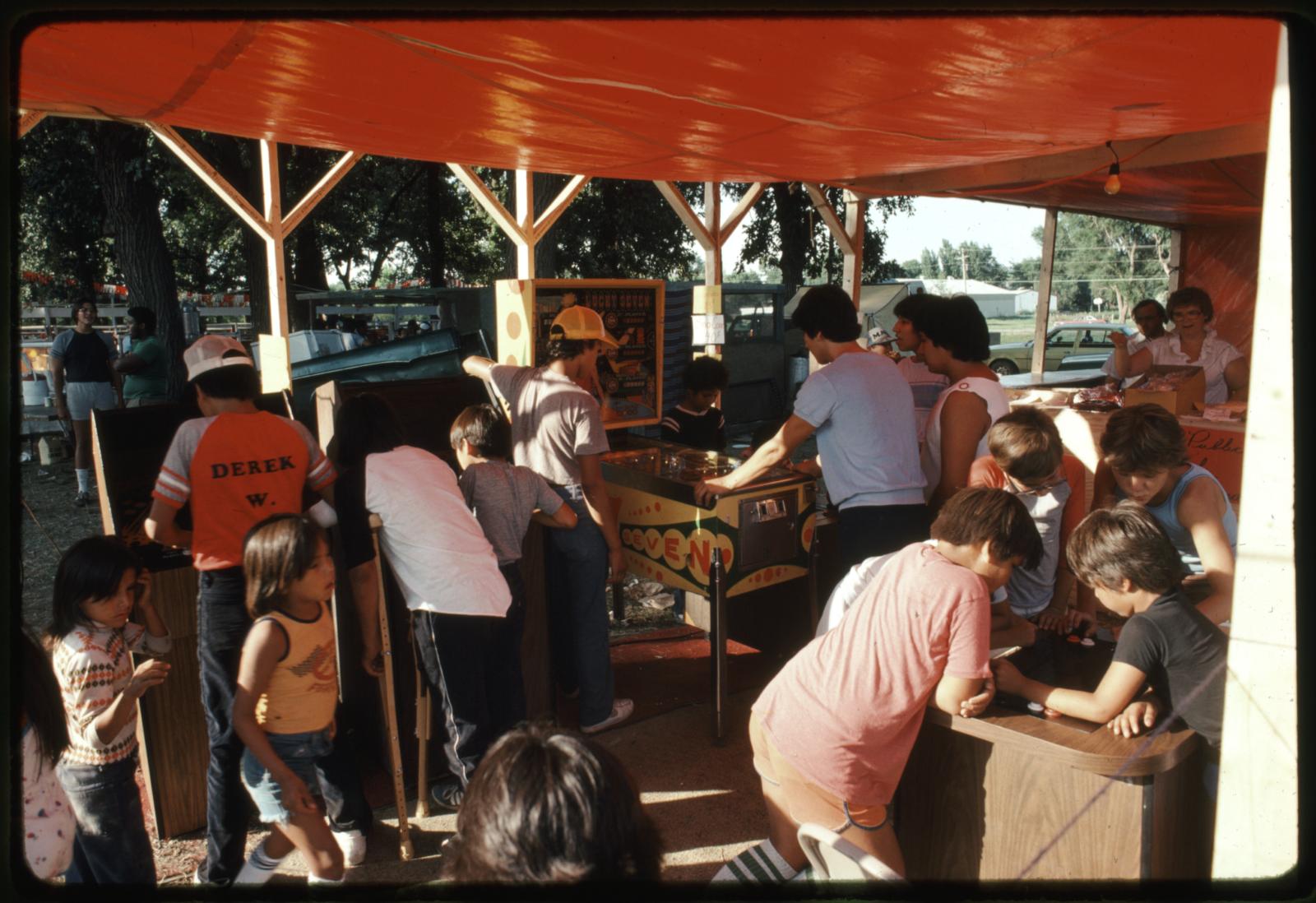
Photo: Carl Fleischhauer, August 12, 1983; Omaha Powwow Project Collection (AFC 1986/038), American Folklife Center, Library of Congress. The Library lists no known U.S. copyright restrictions; displayed at reduced size.
Sega was an arcade maker long before its console rivalry with Nintendo. In the mid-1980s it asked a question a living-room TV could not easily answer: what if the cabinet itself moved? Hang-On (1985) put players on a motorcycle-shaped machine, and Out Run (1986) offered a driving seat, steering wheel, branching roads, and a choice of music. Arcade hardware could make the outing feel physically different from playing at home. Sega's arcade history documents that run of large “experience” cabinets.
The social contest changed again in the 1990s. Capcom's Street Fighter II (1991) made a human opponent the main event; Midway's Mortal Kombat (1992) followed with a very different style, and Sega's Virtua Fighter (1993) brought polygonal fighters into the face-off. A crowd could gather around two players, watch their tactics, then step up to challenge the winner. Arcades were still places where games were learned in public. See the Strong museum on fighting games and Sega's timeline.
Back in the early 1980s, home machines made play repeatable without another coin. The Atari 2600 helped establish removable game cartridges, and its version of Space Invaders helped sell the console. A game could travel from an arcade to a living room, but the experience changed: at home, you could practice all evening. The Computer History Museum's Atari exhibit traces that connection.
The 1983 crash was an American market story
The early home market in the United States did not rise in a straight line. Too many consoles and games competed for shelf space, and poor-quality releases damaged confidence. The U.S. video game market contracted sharply in 1983. Games did not disappear worldwide. Nintendo's Famicom launched in Japan in 1983, while the Nintendo Entertainment System (NES) arrived in the U.S. in 1985 and helped rebuild the American home market. See the Computer History Museum's account of Atari and its NES exhibit.
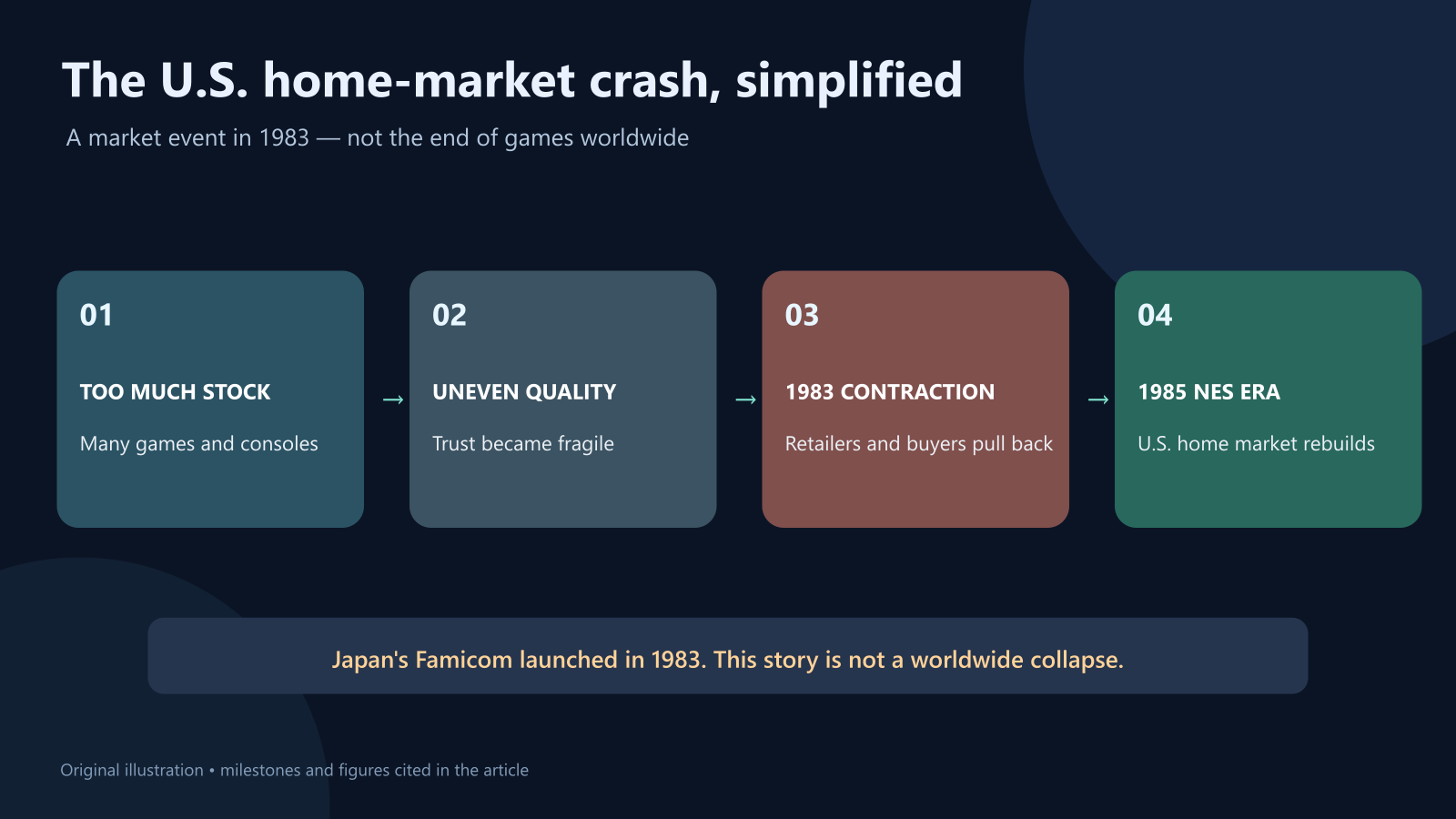
This is a useful lesson in distribution. A game needs more than a clever idea: people must be able to find it, trust it, and play it on a machine they own. The 1983 crash changed how the American industry thought about those steps.
NES and Master System: two routes back to the television
Nintendo's Famicom arrived in Japan in 1983. Its redesigned North American counterpart, the Nintendo Entertainment System, reached the U.S. in 1985. Super Mario Bros. made side-scrolling movement feel like a journey, while The Legend of Zelda rewarded exploration and saved progress. The NES became a center of the American home market's recovery, but it was one chapter in a worldwide story, not the machine that single-handedly “saved video games.” Nintendo's company history and the Computer History Museum's NES exhibit provide the dates and context.
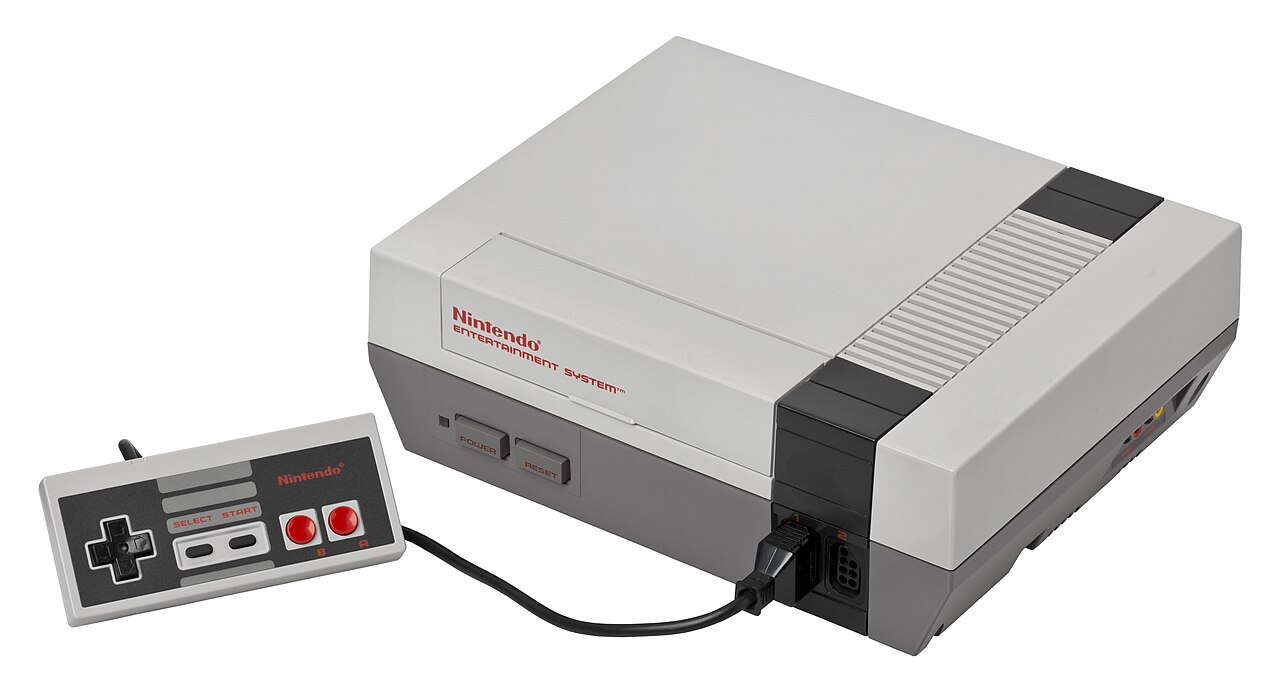
Photo: Evan-Amos / Wikimedia Commons, public domain.
Sega had a different path. Its Mark III appeared in Japan in 1985; the redesigned Master System followed in North America in 1986. Arcade-style action was part of its appeal, and Alex Kidd in Miracle World gave Sega a recognizable home-console hero before Sonic. The NES led in North America, but the Master System found stronger audiences in parts of Europe and in Brazil. That regional difference is a good reminder that a console's “winner” depends on where you lived. See Sega's hardware history and the Powerhouse museum's Master System collection.
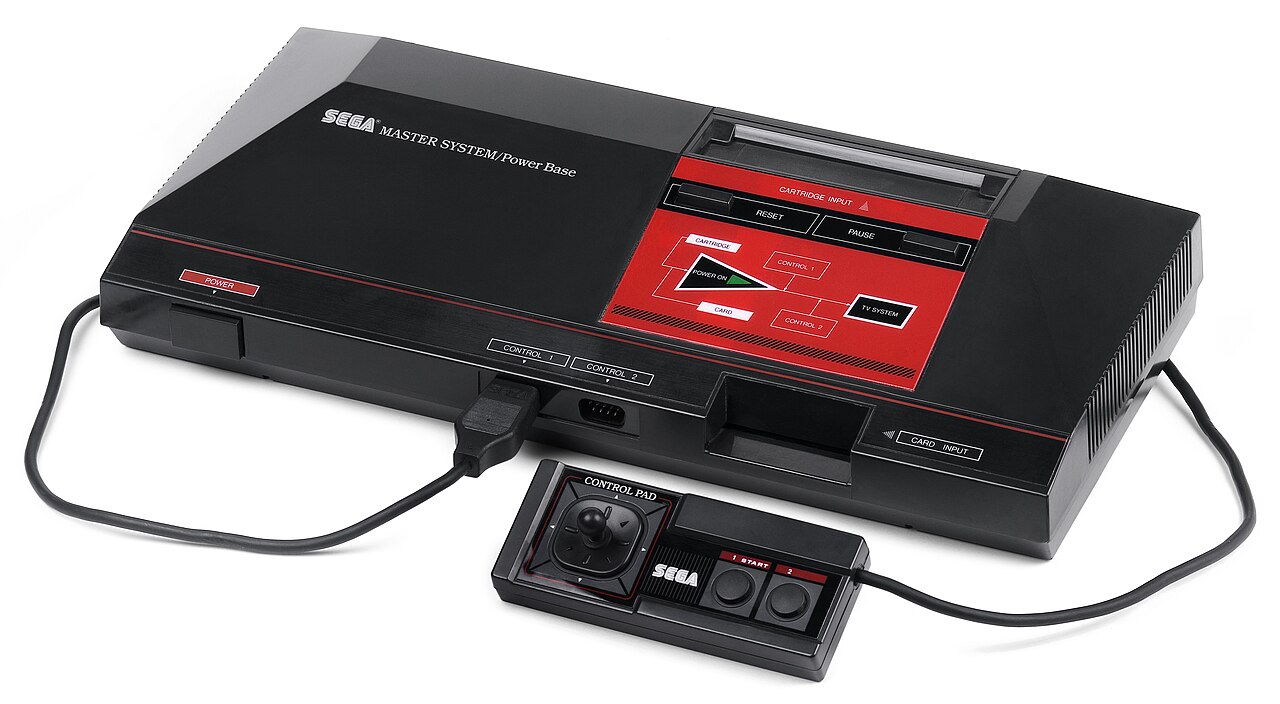
Photo: Evan-Amos / Wikimedia Commons, public domain.
Genesis and Super NES: the 16-bit rivalry
Sega's Mega Drive launched in Japan in 1988 and became the Genesis in North America in 1989. Its fast arcade conversions and Sonic the Hedgehog (1991) gave it a distinct personality. Nintendo answered with the Super Famicom in Japan in 1990 and the Super Nintendo Entertainment System (SNES) in North America in 1991. Super Mario World and The Legend of Zelda: A Link to the Past showed how familiar series could become bigger and more expressive. The machines competed through games, controllers, price, and marketing as much as hardware. “16-bit” names the era; it is not a score for how fun a game is. Sega's timeline and Nintendo's history establish the regional launches.
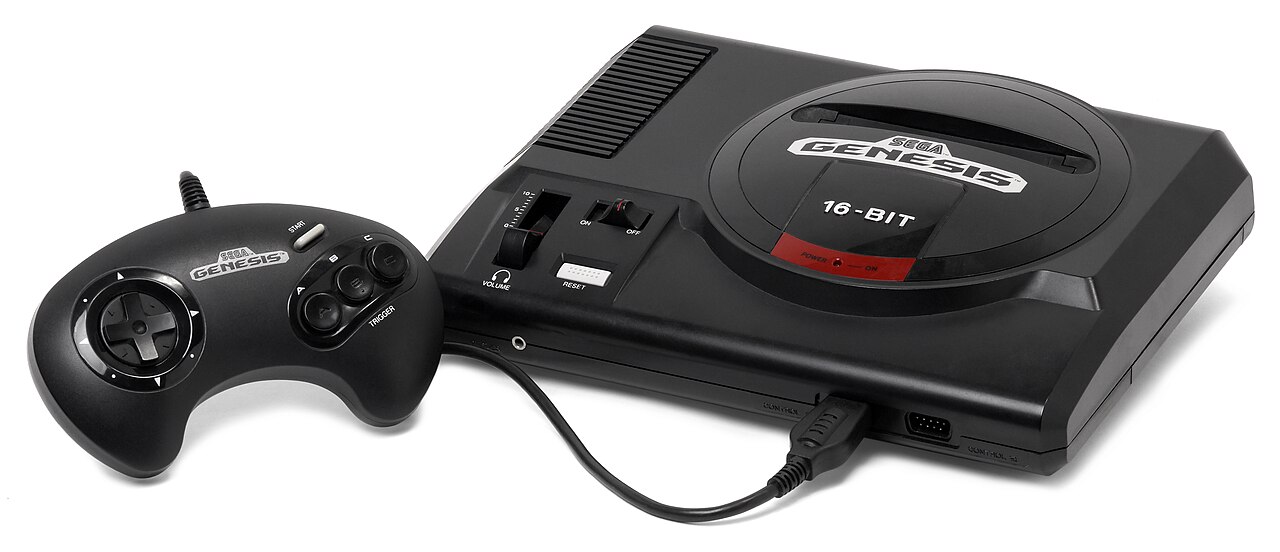
Photo: Evan-Amos / Wikimedia Commons, public domain.
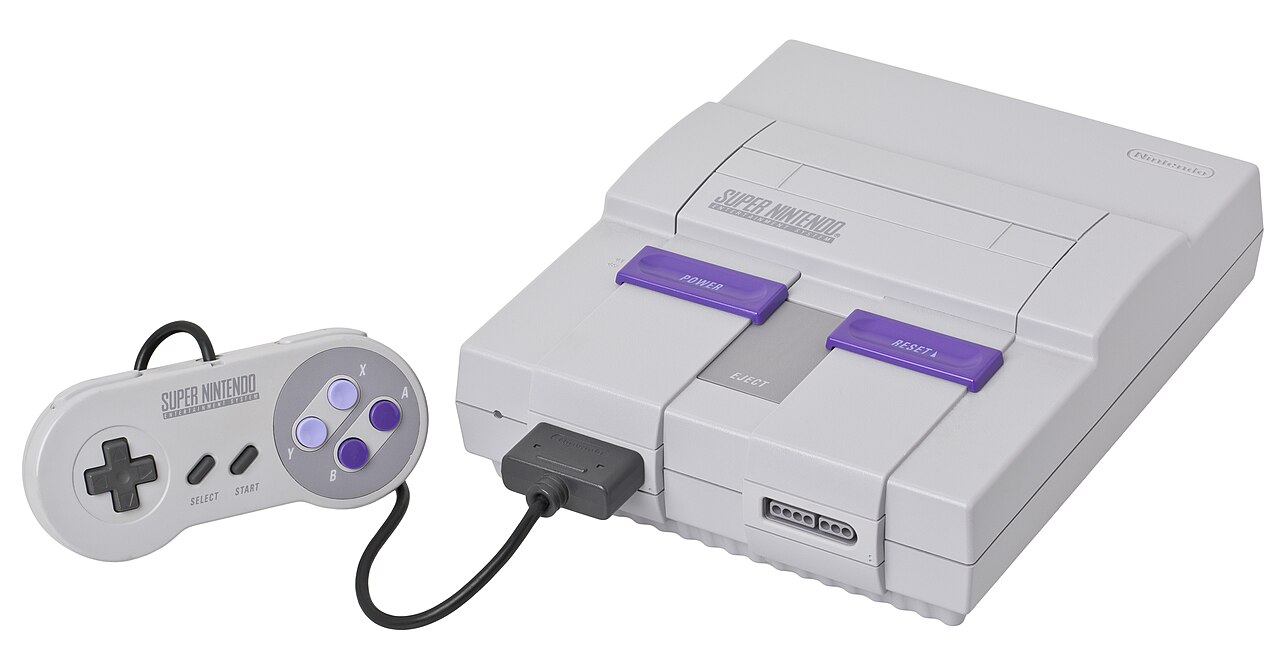
Photo: Evan-Amos / Wikimedia Commons, public domain.
The rivalry did not prevent experimentation. Nintendo's Star Fox (1993) used an extra chip in its cartridge to draw polygonal spaces on the SNES. Sega offered a CD add-on for the Genesis/Mega Drive. Neither idea instantly replaced ordinary cartridges, but both foreshadowed the next argument: what should a home game look and feel like? Nintendo and Sega document those experiments.
| Console | Selected regional launch years | What it helped bring home |
|---|---|---|
| Famicom / NES | Japan 1983; U.S. 1985 | A broad cartridge library after the U.S. crash |
| Mark III / Master System | Japan 1985; North America 1986 | Sega's arcade-inspired alternative |
| Mega Drive / Genesis | Japan 1988; North America 1989 | Fast 16-bit play and a new mascot rivalry |
| Super Famicom / SNES | Japan 1990; North America 1991 | Richer 2D worlds and cartridge experiments |
| PlayStation | Japan 1994; North America 1995 | CD games and a wider audience for 3D |
| Nintendo 64 | Japan and North America 1996 | Analog control and 3D movement in Super Mario 64 |
| Xbox | North America 2001 | Built-in Ethernet and console online services |
These are selected regional launch years, not simultaneous worldwide release dates. Sources: Nintendo, Sega, PlayStation, and Xbox.
Handhelds and PCs follow their own paths
The next leap was not simply sharper graphics. It was more places to play. Alexey Pajitnov created Tetris in 1984; its rules fit almost any screen. Nintendo's Game Boy brought interchangeable cartridges to a popular portable system in 1989, with Tetris helping show why a game did not need a television to be absorbing. The Strong museum's Hall of Fame and Nintendo's company history document those milestones. Game Boy was a landmark, not the first handheld game.
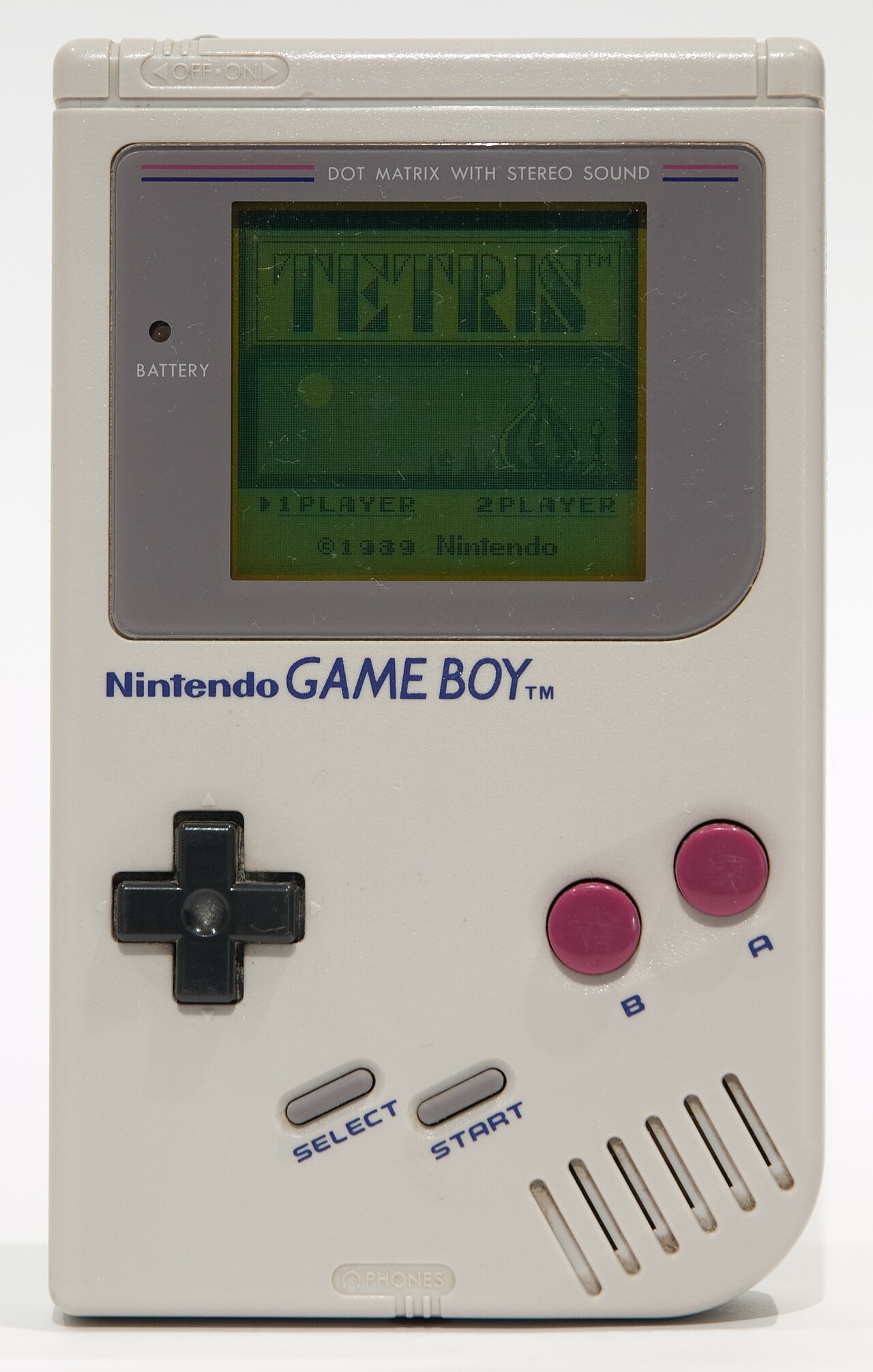
Photo: William Warby / Wikimedia Commons, CC BY 2.0; cropped on Commons and displayed at reduced size.
On PCs, Doom (1993) showed how first-person action, shareware distribution, and player-made modifications could build a community around a game. Consoles did not own innovation; computer and handheld players were making their own history at the same time. The Computer History Museum timeline follows these overlapping paths.
PlayStation, Saturn, and Nintendo 64: learning to move in 3D
Sony's PlayStation launched in Japan in 1994 and North America in 1995. CD-ROMs gave developers room for larger soundtracks, video, and game worlds; polygon graphics helped make 3D a familiar home-console language. Ridge Racer, Final Fantasy VII, and Metal Gear Solid illustrate how differently creators used the same machine. A disc held more data than a typical cartridge of the period, but a spinning disc also introduced loading time. The tradeoff shaped design, not just advertising. PlayStation's official history recounts its launch and games.
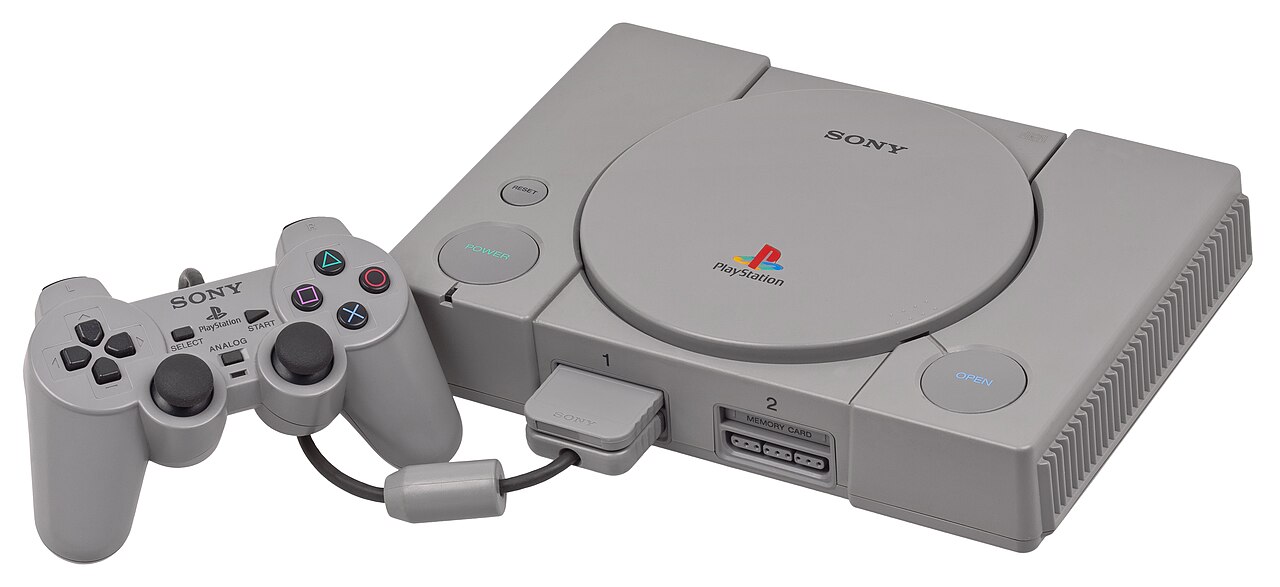
Photo: Evan-Amos / Wikimedia Commons, public domain.
Sega's Saturn also launched in Japan in 1994, with both 2D and 3D games. Nintendo's Nintendo 64 followed in Japan and North America in 1996. Its controller's analog stick made gradual movement feel natural in Super Mario 64: players could walk, run, turn, and explore a castle rather than simply move left and right. Nintendo kept cartridges, favoring quick access while accepting tighter storage limits than CDs. The Sega timeline and Nintendo history supply the launch context. The move to 3D was not a clean break: great 2D games continued alongside it.
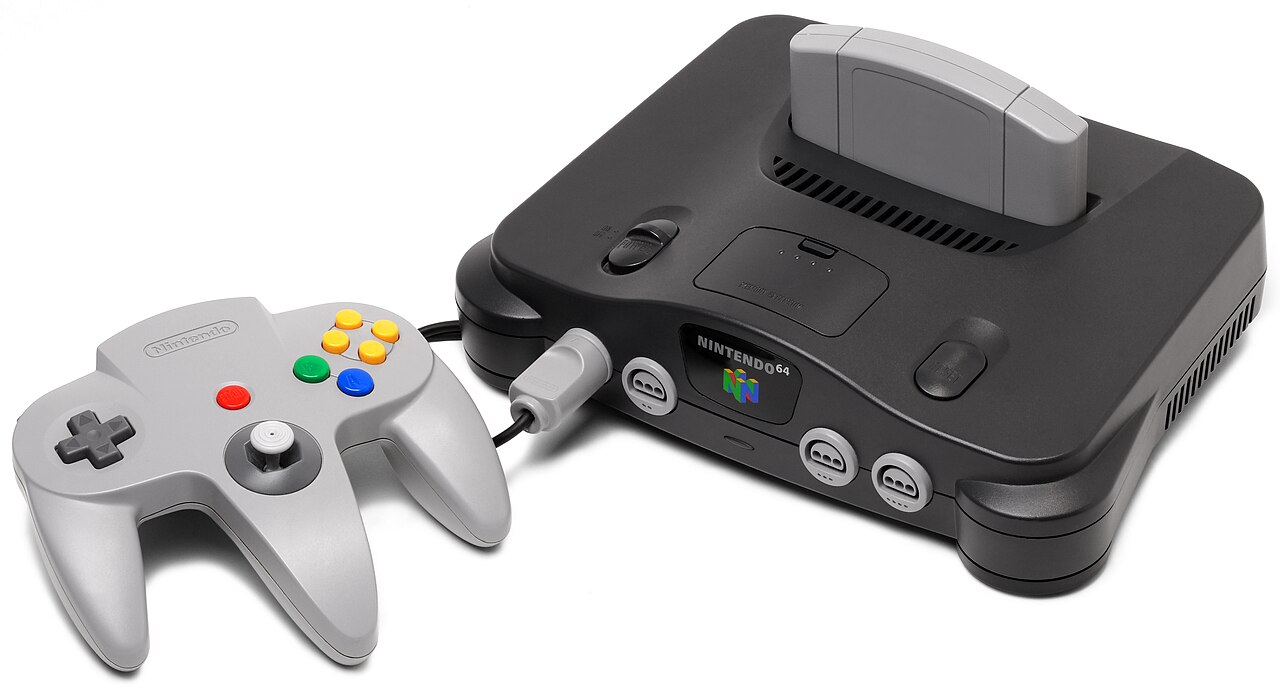
Photo: Evan-Amos / Wikimedia Commons, public domain.
Dreamcast, PlayStation 2, and Xbox: discs meet networks
Sega's Dreamcast reached Japan in 1998 with built-in communication hardware, bringing online play closer to a standard console feature. Sony's PlayStation 2 arrived in Japan in 2000; its DVD player and support for original PlayStation games made the box useful beyond its new releases. Microsoft entered with the Xbox in North America in 2001. Halo: Combat Evolved gave it a defining launch game, and built-in Ethernet prepared it for Xbox Live, launched in 2002. These companies did not invent networked games; they made new ways of connecting practical for more console households. See Sega's history, PlayStation's PS2 history, Xbox's launch retrospective, and Xbox Live's history.
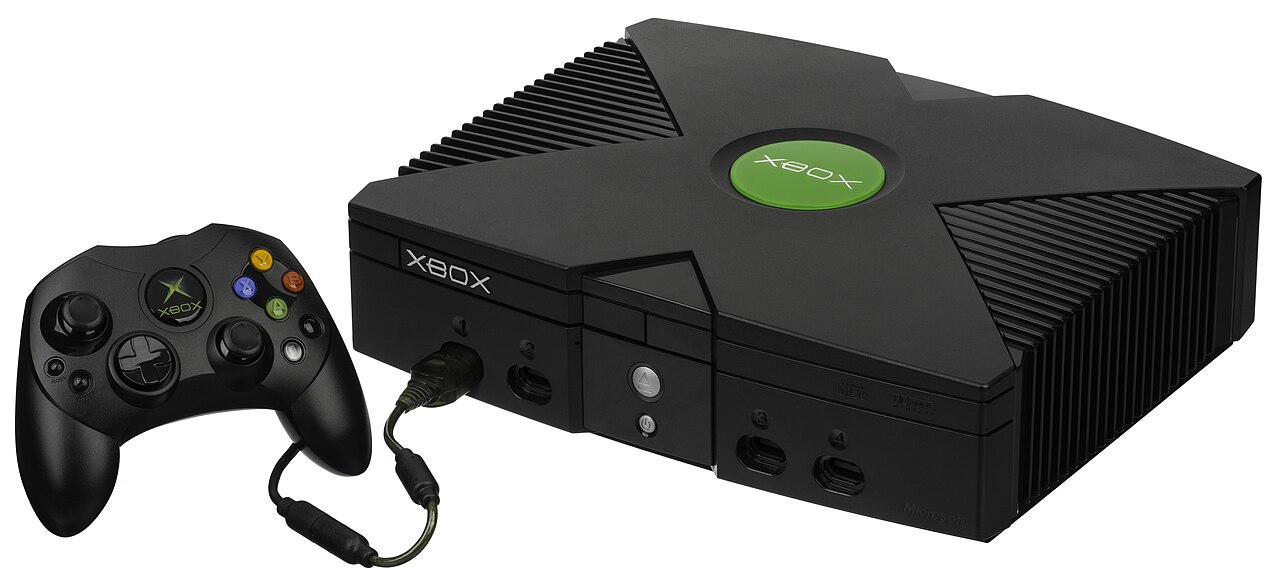
Photo: Evan-Amos / Wikimedia Commons, public domain.
The next console generation pushed different ideas at once. The Xbox 360 (2005) put profiles, online play, and downloadable games into its everyday interface. The PlayStation 3 (2006) combined Blu-ray games with the PlayStation Network. Nintendo's Wii (2006) made motion controls the invitation: Wii Sports could draw someone into a room who had never memorized a controller's buttons. The Nintendo DS (2004) had already shown that a touch screen could change portable play. The lesson of this period is not that one feature “won”; the audience and the ways to reach it expanded. Xbox, PlayStation, and Nintendo document these launches.
Connected play grew into persistent online worlds. World of Warcraft launched in 2004 and made guilds, shared quests, and chat central to many players' routines. It was an influential example of online gaming, not its beginning. The Computer History Museum also records earlier networked game milestones.
Then software stores made the phone a game platform for far more people. Apple's App Store opened in 2008 with games among its launch categories, allowing downloads directly to a pocket device. In 2017, Nintendo's Switch deliberately blurred the home/portable boundary. These were changes in access and context, not a single march toward one “best” device. See Apple's launch announcement and Nintendo's history.
What a 2026 snapshot tells us
The history of games is also a history of who gets counted as a player. The Entertainment Software Association's 2026 U.S. survey, conducted with YouGov, estimates 212.3 million Americans ages 5–90 play video games for at least one hour per week. That is 67% of Americans in that age range; the reported average player age is 37. These are U.S. survey estimates with a weekly-play threshold, not global totals or a count of everyone who has ever tried a game.

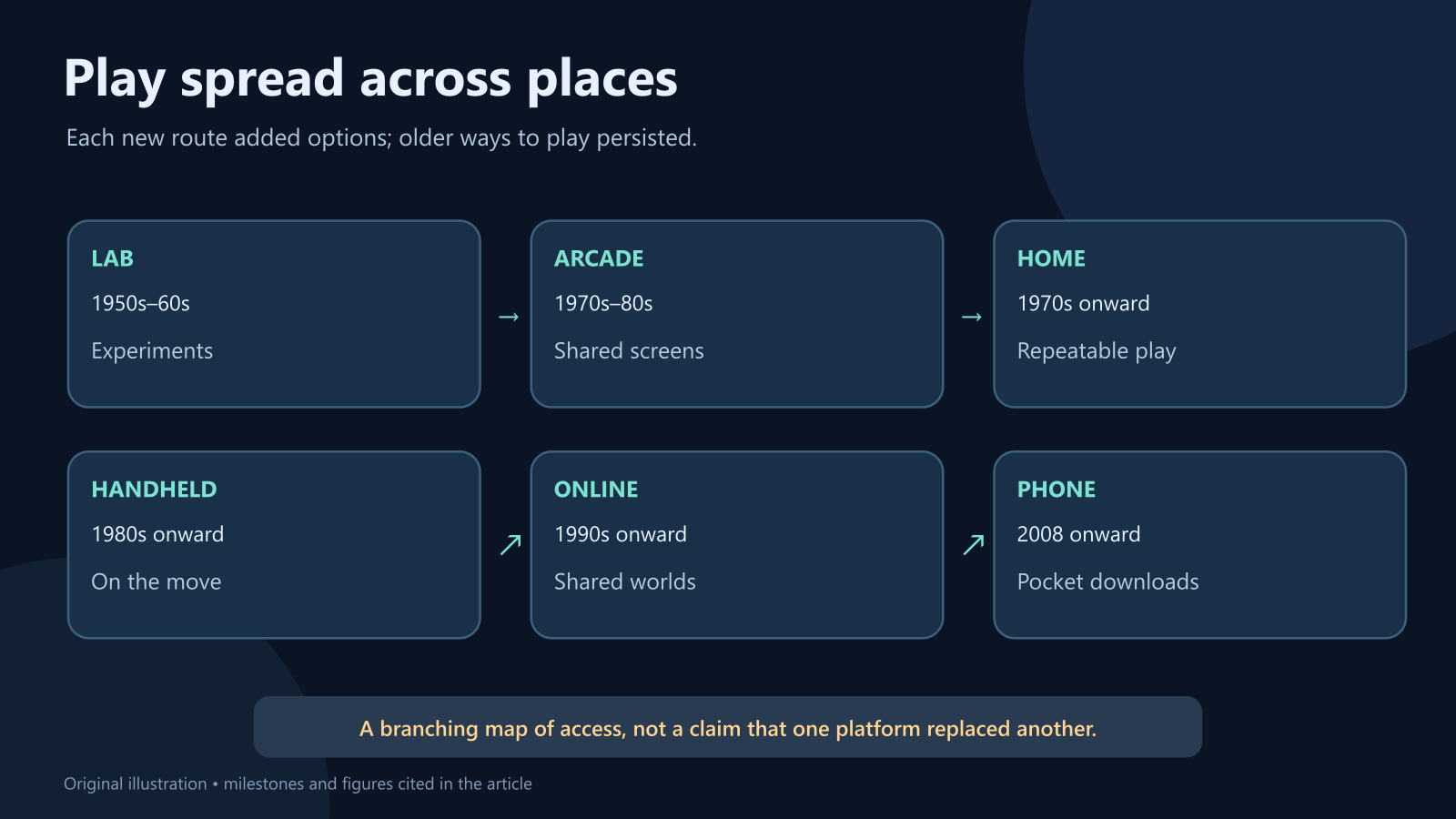
The insight is not that arcades “turned into” phones. Different forms of play accumulated. A person might play a puzzle on a commute, a cooperative game with distant friends, and a decades-old cartridge at home. The platform changes; the reasons to play—challenge, curiosity, company, and delight—keep finding new shapes.
The next level
Today's games sit on decades of earlier choices: controllers, cartridges, modding tools, online communities, digital stores, motion input, and portable screens. New tools such as AI may change parts of game creation and character behavior, but they enter a history already full of experimentation. If that intersection interests you, read Video Games and AI: From Enemy Patrols to Talking NPCs.
For a fun test of any “first video game” claim, ask first in what sense, where, and for whom? That question makes the history more interesting—and usually more accurate.
Sources and further reading
- Computer History Museum: Graphics & Games timeline
- Smithsonian: Ralph Baer and early video game history
- The Strong National Museum of Play: World Video Game Hall of Fame
- Denver Public Library: Video game arcades in the early 1980s
- The Strong National Museum of Play: Street Fighter II and arcade competition
- Nintendo of America: Company History
- Sega: Company and hardware history
- PlayStation: Console history
- Xbox Wire: Xbox and Xbox Live history
- Apple: App Store launch, 2008
- Entertainment Software Association: 2026 Essential Facts
Read next

The History of Artificial Intelligence: A Simple Timeline
From Alan Turing’s early question to today’s chatbots, explore the people, pauses, and breakthroughs that shaped artificial intelligence—in plain language.
 nbkhope

A Brief History of Computer Programming: From Wires to Apps
From Ada Lovelace’s 1843 notes to today’s apps and AI coding assistants, see how programming changed—and what a program really is—in plain language.
nbkhope
A Brief History of Programming Languages: From Machine Code to Modern Tools
From machine code and FORTRAN to Python, JavaScript, and Rust, explore how programming languages evolved and why there are so many.
nbkhope
Comments
Be kind and specific. Comments with links from new accounts appear after a moderator reviews them.