What Is Apple? A Guide to the Company, Its Products, and Its Ecosystem
Meet Apple, the company behind the iPhone, Mac, Apple Watch, and a connected world of software and services. Learn how its ecosystem, custom chips, business model, and leadership fit together.

On this page
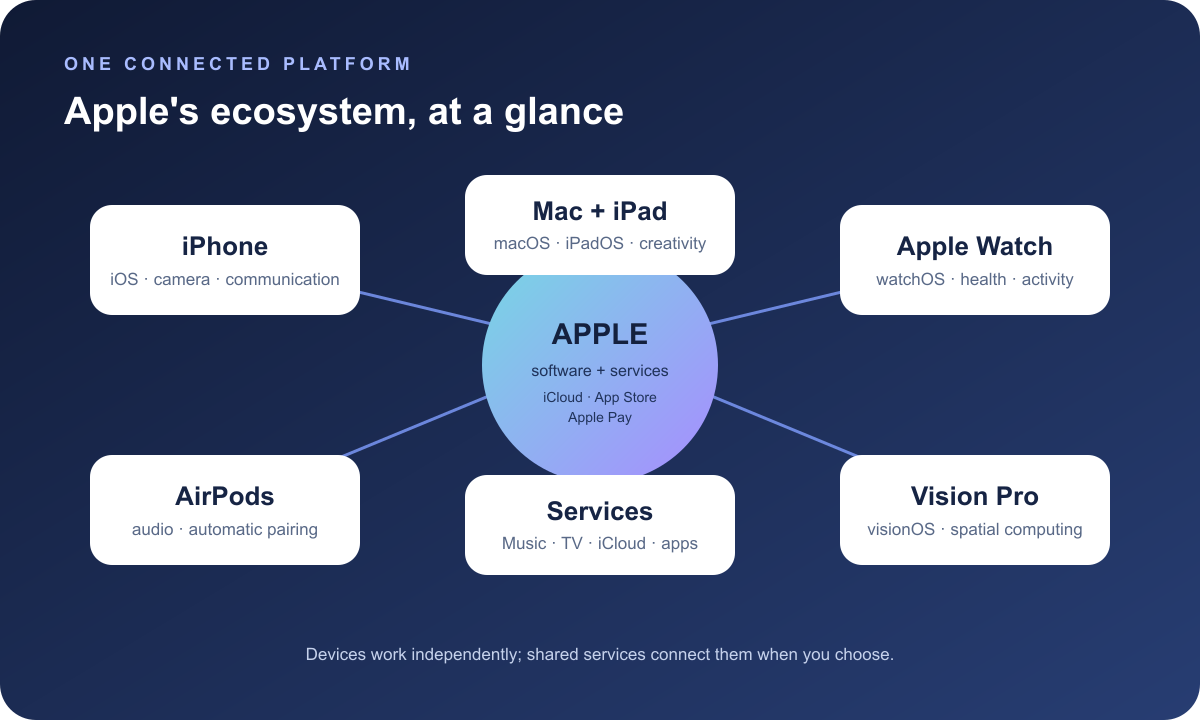
Apple is a technology company that designs devices, operating systems, apps, and online services that work together. You probably know the iPhone, but Apple also makes Mac computers, iPad tablets, Apple Watch, AirPods, and Apple Vision Pro. Services such as the App Store, iCloud, Apple Music, Apple Pay, and Apple TV extend those products beyond the hardware.
This guide was prepared on October 18, 2026. Product names and availability can change. Apple announced its 50th anniversary in 2026, marking its founding on April 1, 1976. Apple's anniversary note traces a line from Apple II and Macintosh to iPhone, iPad, Apple Watch, and Vision Pro.
What does Apple make?
Apple's products are easier to understand in three layers: devices, software, and services. A Mac is a computer; macOS is its operating system. An iPhone is a phone; iOS is its operating system. Apple's other devices have their own software too, such as iPadOS, watchOS, tvOS, and visionOS.
| Layer | Examples | What it does |
|---|---|---|
| Devices | iPhone, Mac, iPad, Apple Watch, AirPods, Vision Pro | Provide the screen, sensors, speakers, cameras, and compute power |
| Software | iOS, macOS, iPadOS, watchOS, visionOS | Runs apps and coordinates the device's hardware |
| Services | iCloud, App Store, Apple Music, Apple Pay, Apple TV | Syncs, distributes, protects, or delivers content and features |
Apple's official product lineup includes these categories and accessories. It also sells subscriptions and digital services, and operates retail stores and support programs. A device can work on its own, but features such as Handoff, AirDrop, iCloud Photos, and Apple Watch pairing are designed to be especially convenient when you use several Apple products together.
Why do Apple products feel connected?
Apple controls several important parts of the product stack: it designs devices, develops the operating systems, makes many of its own chips, and runs services such as iCloud and the App Store. That gives Apple room to tune hardware and software for one another. For example, Apple silicon can combine a CPU, graphics, media engines, memory, and a Neural Engine in one system-on-a-chip, while macOS and apps are optimized for that platform.
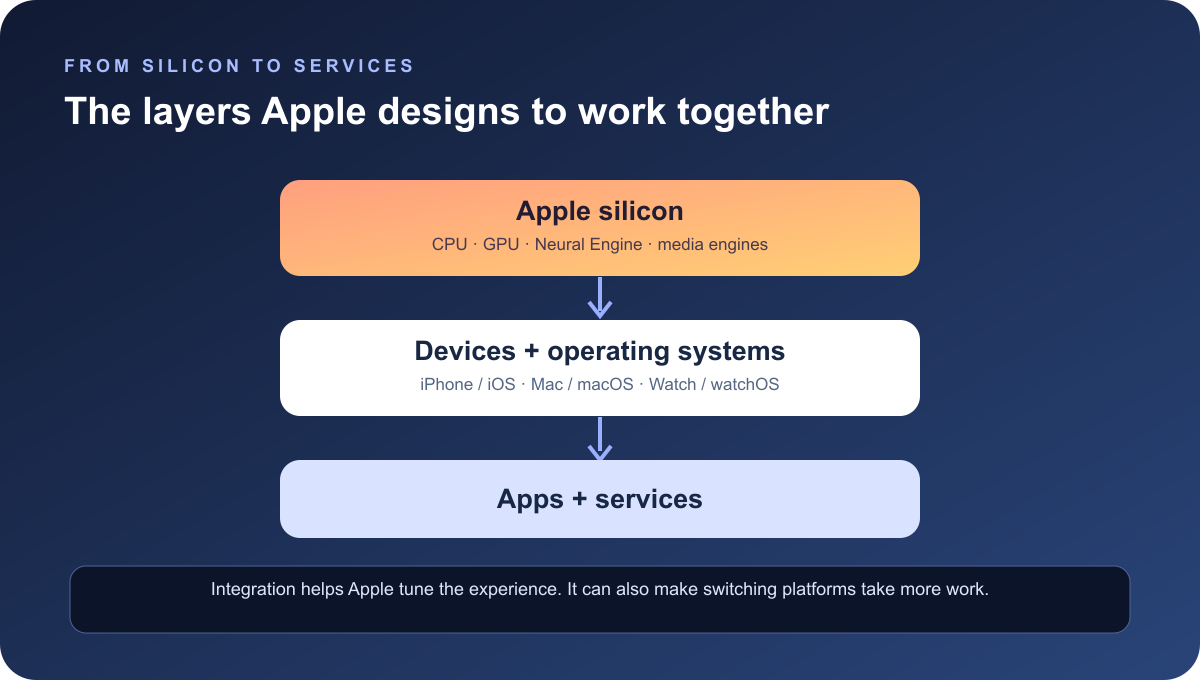
The benefit is a more consistent experience across devices: your messages can appear on an iPhone and Mac, photos can sync through iCloud, and AirPods can switch among devices signed in to the same account. The trade-off is that the most seamless path often depends on staying inside Apple's ecosystem. Moving to another platform can require replacing apps, accessories, or cloud services, and some capabilities differ across operating systems.
How did Apple get here?
Apple was founded in 1976 and first became known for personal computers, including Apple II and Macintosh. Over time it expanded from computers into portable music with iPod, phones with iPhone, tablets with iPad, wearables with Apple Watch and AirPods, and spatial computing with Apple Vision Pro. Each product line connects to Apple's software and developer ecosystem.
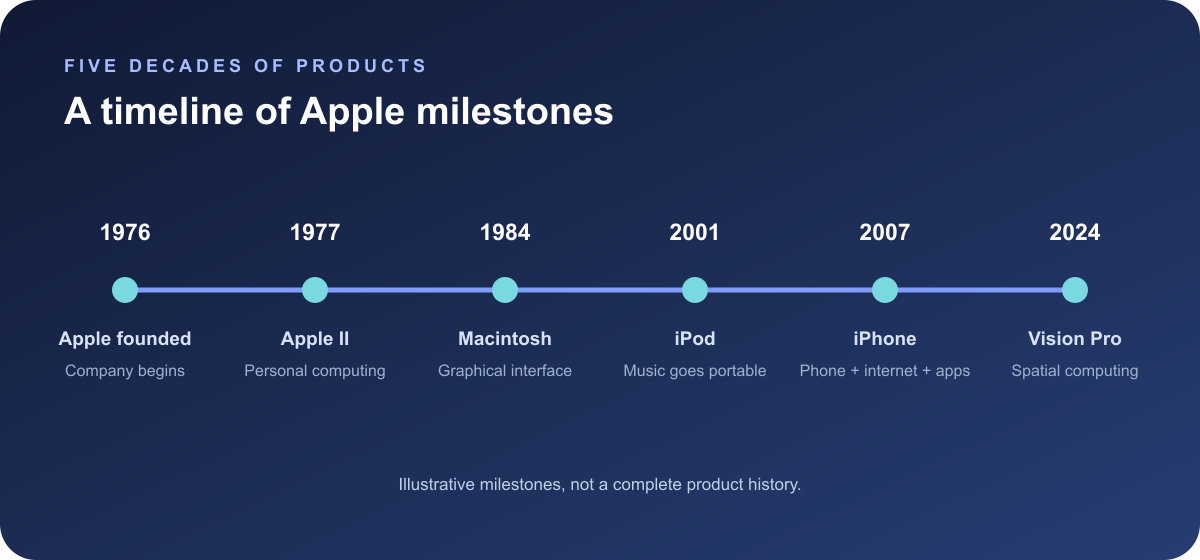
Apple's growth was not a straight line: products such as the iPhone changed the scale and shape of the business, while some categories mattered more than others at different times. The company's ability to combine industrial design, operating systems, custom silicon, retail, and services is a central part of its strategy.
How large is Apple's business?
Apple sells products around the world and earns revenue both when customers buy devices and when they use services. In its fiscal 2026 third quarter, which ended June 27, 2026, Apple reported $109.4 billion in quarterly revenue, up 16% from the same quarter a year earlier. The company said iPhone, Mac, and Services each set June-quarter revenue records. This is a snapshot of one quarter, not a forecast or a guarantee of future performance. Apple's Q3 2026 results
Services matter because they can generate recurring revenue after a device sale. Examples include subscriptions, cloud storage, payment features, and commissions or fees tied to distributing apps and content. Services also help make Apple devices more useful, while the installed base of devices gives Apple's services a large audience.
Who leads Apple?
As of this guide's preparation date, John Ternus is Apple's CEO. Apple announced that he would succeed Tim Cook effective September 1, 2026. Cook became executive chairman after serving as CEO from 2011 to 2026. Ternus previously led Hardware Engineering at Apple. Apple's leadership transition announcement
What is Apple's approach to AI and privacy?
Apple's AI features are branded Apple Intelligence and are integrated into Apple operating systems and apps. Apple says many requests are processed on the device. For more complex requests, its Private Cloud Compute service is designed to process only the data needed to answer, without storing it or making it accessible to Apple. These are Apple's stated design commitments; they are not a guarantee that every feature works the same way in every country, language, or device. Check Apple's privacy overview for current details.
Apple's approach relies on its own silicon and tight integration between hardware, operating systems, and services. Some features may also use outside AI services. Availability depends on the device, software version, language, region, and feature rollout. It is useful to distinguish Apple Intelligence, Apple's feature set, from a general claim that every AI task happens locally.
What are Apple's strengths and trade-offs?
Apple's strengths include a recognizable product range, long-running software platforms, custom chips, global retail and support, and services that work across devices. Tight integration can reduce setup friction and make everyday tasks feel predictable.
The same integration creates trade-offs. Apple devices and repairs can be expensive; some services or accessories work best with Apple hardware; and customers have less control over certain system-level choices than on more open platforms. App distribution, repair rules, privacy claims, and competition policy are also subjects of public debate and regulation. The best choice depends on what you value: ease of use and device coordination, flexibility, price, or control.
The short version
Apple is more than a phone maker. It is a company that combines consumer hardware, operating systems, custom silicon, software distribution, and services. The ecosystem can make its products work especially well together, while also making the decision to switch platforms more consequential. That combination—product design plus a connected platform—is the key to understanding Apple.
Sources and further reading
Read next
What Is NVIDIA? A Simple Guide to the Chip Company Powering AI
A friendly, jargon-free guide to NVIDIA, the company whose chips power video games and almost all of today's AI. Learn what a GPU is, see a real speed test of CPU vs GPU, find out why AI needs these chips and how NVIDIA became worth over $5 trillion.
 nbkhope
What Is Grok? Elon Musk’s AI Assistant, xAI, and SpaceX Explained
Grok is the AI assistant and model family first developed by xAI. Learn how it works, how it uses X and the web, where Tesla fits, and why current materials mention SpaceXAI and SpaceXSI.
nbkhope
MCP Server Authentication Explained: OAuth, Tokens, and Trust
MCP authentication is more than a password on a server. Learn how OAuth, token audiences, scopes, and per-tool checks fit together for remote MCP—and what local stdio servers should do instead.
nbkhope
Comments
Be kind and specific. Comments with links from new accounts appear after a moderator reviews them.