The History of Mobile Smartphones, From the Brick to the Pocket Computer
A friendly, jargon-free history of the smartphone, from a 1973 call on a phone the size of a brick to the pocket computers billions of people carry today. Meet the IBM Simon, Nokia, BlackBerry, the iPhone and Android, and learn how phones overtook computers.

On this page
Look around a bus, a café or a waiting room, and you'll probably see most people looking down at a small glass rectangle. The smartphone is now so ordinary that it's easy to forget how new it is: the iPhone came out in 2007, and the first Android phone in 2008. Yet in less than 20 years, these devices replaced cameras, maps, music players, alarm clocks and, for many people, the computer itself.
This article tells the story of how we got here, in plain language: from the first handheld phone call in 1973, through the "brick" phones, Nokia and BlackBerry, to the touchscreen devices in our pockets today.
Before the smartphone: phones that moved
Phones you could take with you existed long before smartphones. In the late 1940s, some cars in the United States had radio telephones, but they were huge, expensive, and only a few calls could happen at once in a whole city.
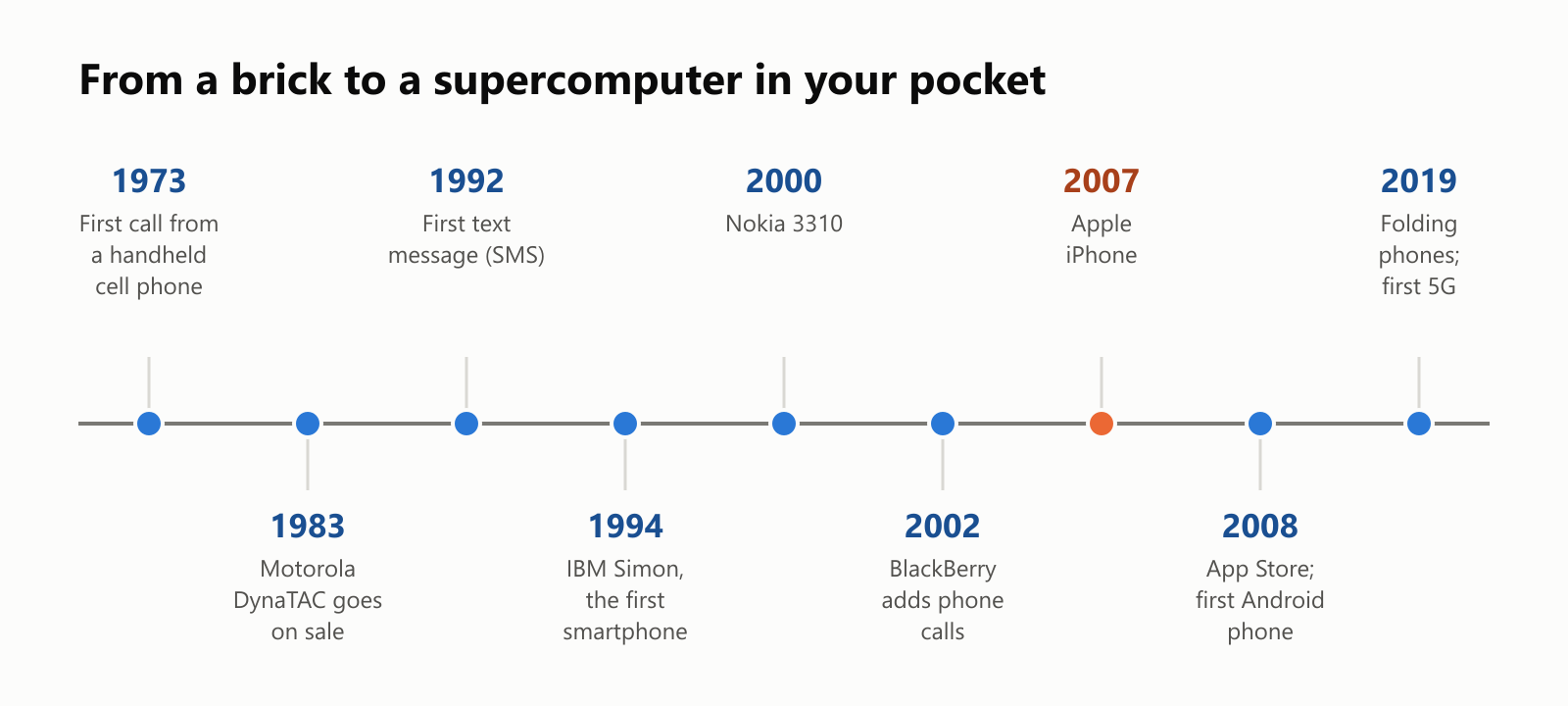
On April 3, 1973, a Motorola engineer named Martin Cooper stood on a street in New York City and made the first call from a handheld cell phone. He called a rival engineer at Bell Labs, the competing company, to tell him about it.
It took ten more years for that phone to reach stores. The Motorola DynaTAC 8000X went on sale in 1983:
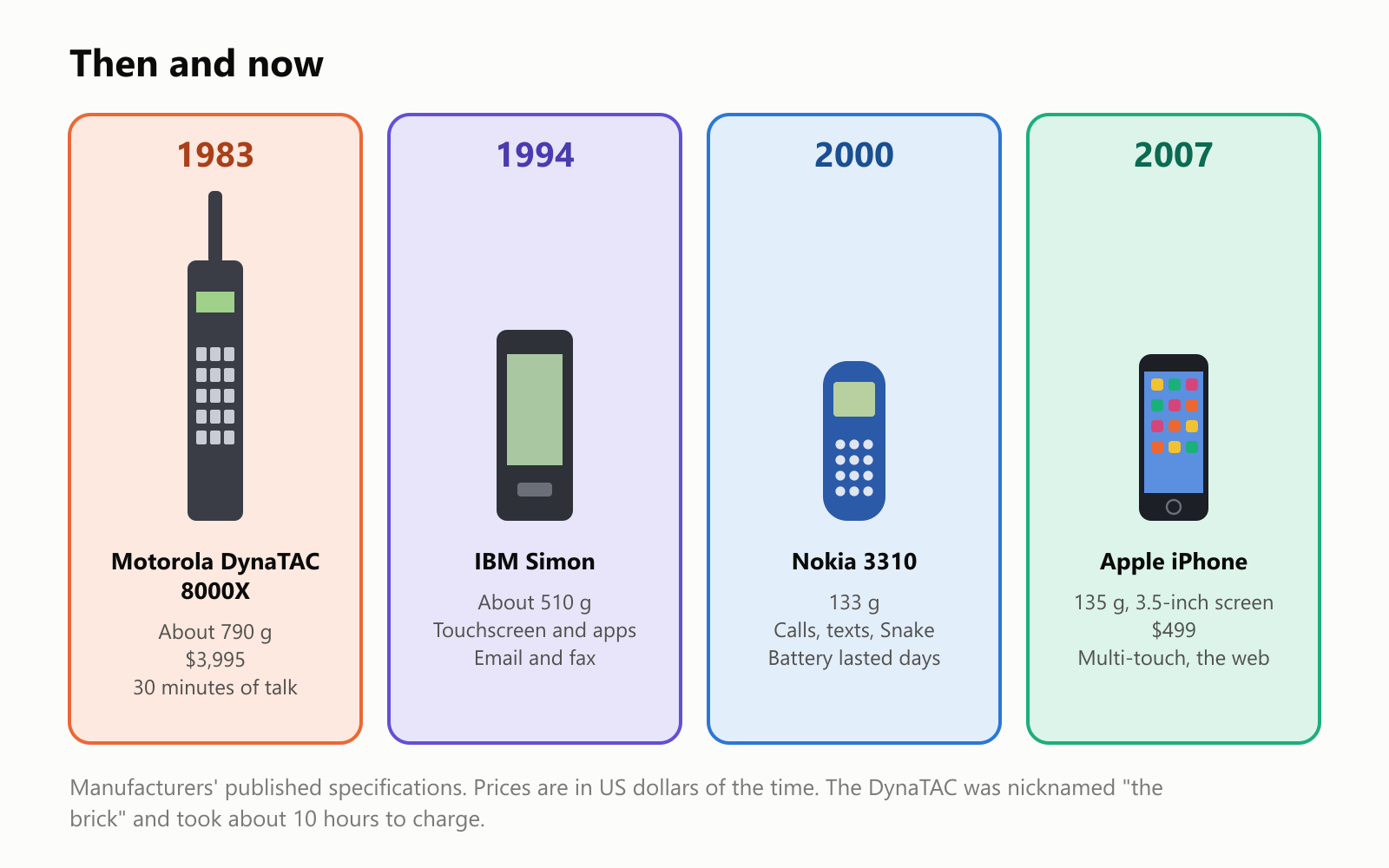
The DynaTAC weighed about 790 grams, cost $3,995 (well over $10,000 in today's money), and its battery lasted about 30 minutes of talking after charging for about 10 hours. People called it "the brick". It could only make calls.
Why "cell" phone?
The word "cell" doesn't describe the phone. It describes the network:
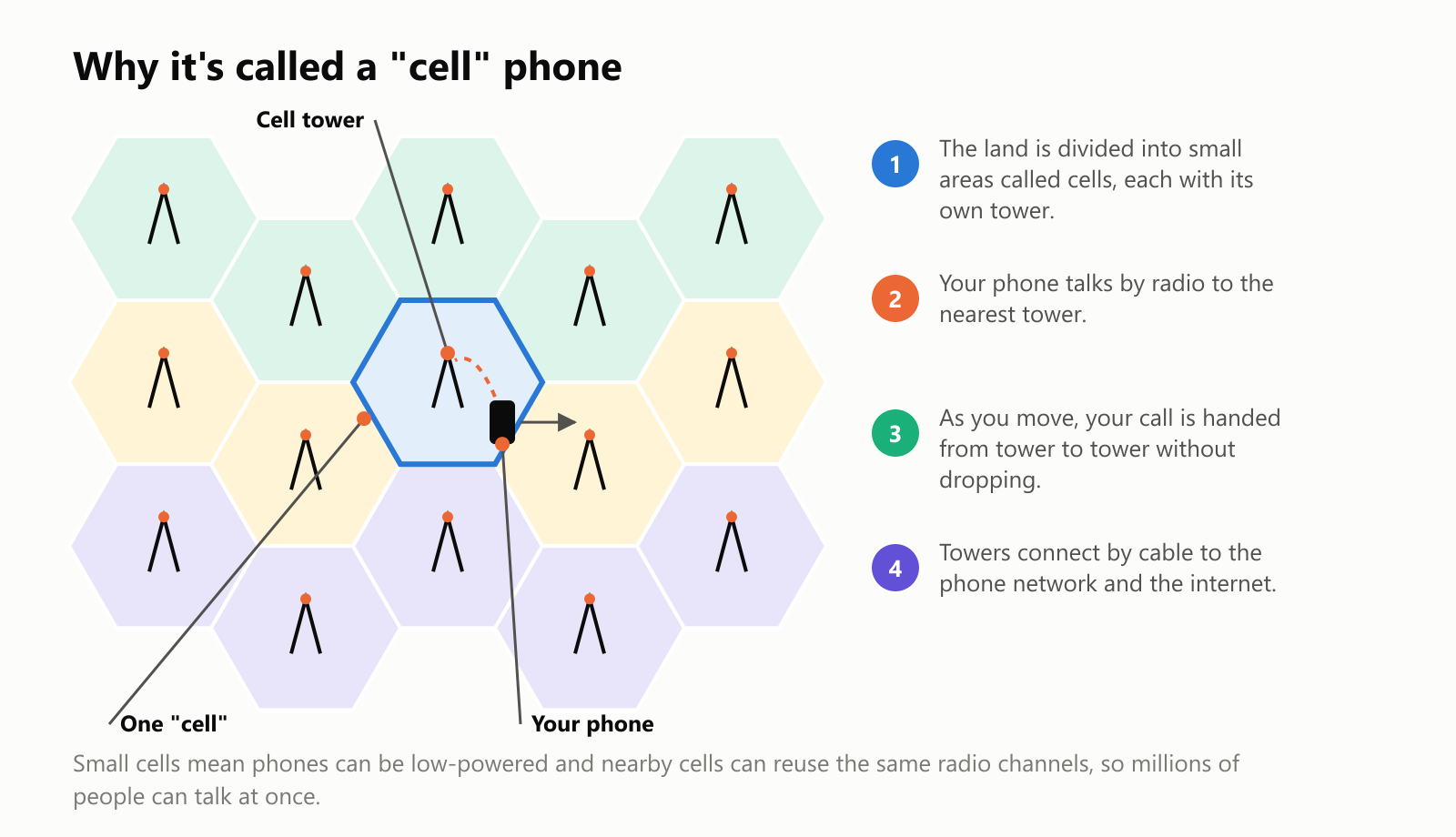
Instead of one giant antenna for a whole city, the land is divided into many small areas called cells, each with its own tower. Your phone only has to reach the nearest tower, so it can use a small battery. As you drive or walk, your call is quietly handed from one tower to the next. And because each cell is small, cells far enough apart can reuse the same radio channels, which lets millions of people use their phones at once.
The "G"s: generations of mobile networks
You've probably seen "4G" or "5G" at the top of your phone screen. The G stands for generation, and each one changed what phones could do:
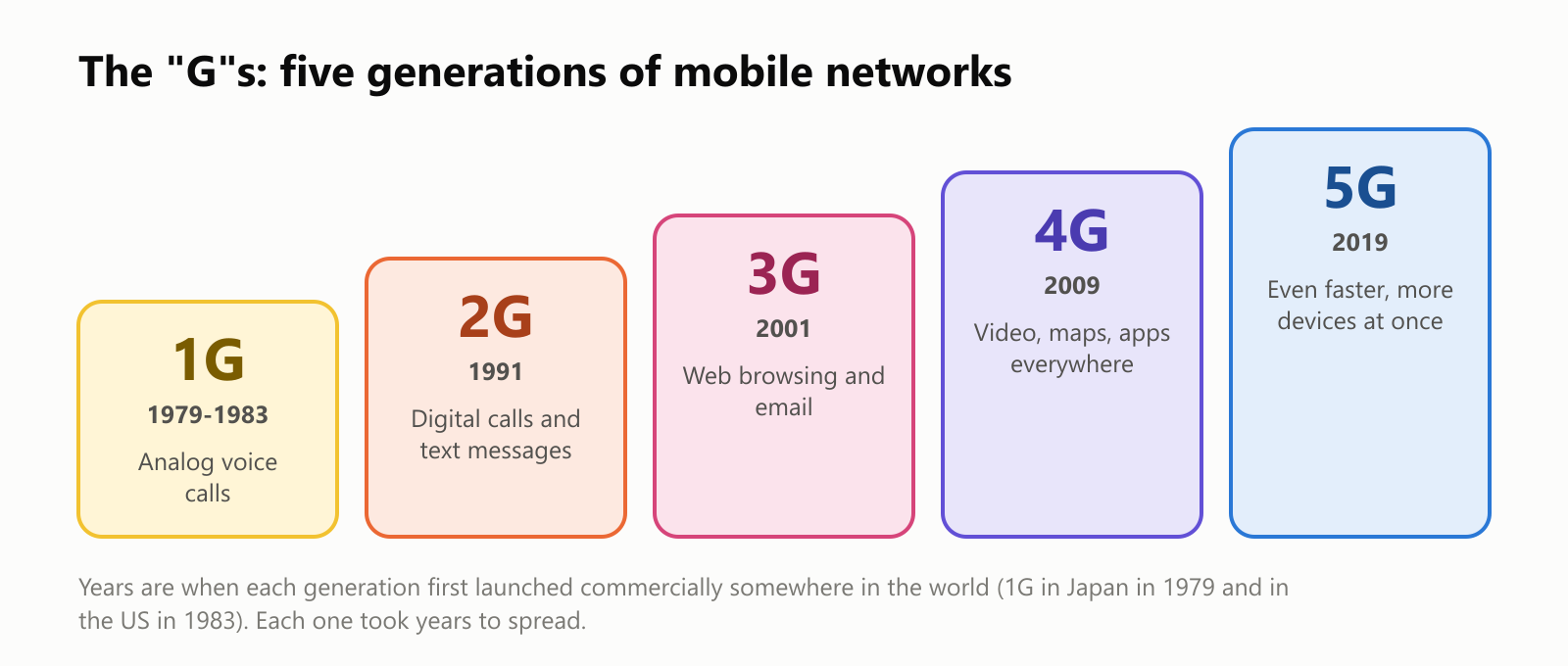
- 1G (Japan in 1979, the US in 1983) carried voice only, as an analog radio signal, a bit like FM radio. Anyone with the right radio could listen in.
- 2G (Finland, 1991) made calls digital, which was clearer and more private, and brought text messages. The first text message, "Merry Christmas", was sent on December 3, 1992.
- 3G (Japan, 2001) made the mobile internet practical: email and simple websites on the go.
- 4G (Sweden and Norway, 2009) was fast enough for video, maps, music streaming and video calls, the things that make smartphones so useful.
- 5G (South Korea and the US, 2019) is faster still, and can handle many more devices at once.
The first smartphone: IBM Simon (1994)
Many historians call the IBM Simon, sold in 1994, the first smartphone, even though the word didn't exist yet. It had a touchscreen (used with a stylus or a finger), and besides calls it could send email and faxes, keep a calendar and an address book, and take notes.
It was ahead of its time. It weighed about half a kilo, the battery lasted roughly an hour of use, and it cost about $899 with a contract. Only around 50,000 were sold.
The Nokia years
By the late 1990s, mobile phones were becoming small, cheap and popular, and the Finnish company Nokia became the world's biggest phone maker. Its Nokia 3310 (2000) is still remembered for being almost indestructible, for its battery that lasted for days, and for the game Snake.
Nokia also made early smartphones running an operating system called Symbian, which was the most common smartphone system in the world for much of the 2000s. Meanwhile, Japan was racing ahead: by 2000, Japanese phones were browsing a mobile internet service called i-mode and taking photos with built-in cameras.
BlackBerry: email in your pocket
In the early 2000s, the Canadian company Research In Motion made the BlackBerry. Its tiny physical keyboard and instant email made it the must-have device for business people and politicians. It was so addictive that people nicknamed it the "CrackBerry". Other "smart" devices of the era included the Palm Treo and phones running Microsoft's Windows Mobile.
These phones were useful, but they were complicated, the screens were small, and browsing the real web on them was painful.
2007: the iPhone changes everything
On January 9, 2007, Steve Jobs introduced the iPhone as three devices in one: an iPod music player, a phone and an internet communicator. It went on sale on June 29, 2007.
The iPhone had no physical keyboard. Instead, almost the whole front was a screen you controlled with your fingers, using gestures like swiping and pinching to zoom (multi-touch). It also had a real web browser that showed full websites, not simplified "mobile" pages. Under the hood, it ran a version of the same system as the Mac (see What Is macOS?).
A year later, in July 2008, Apple opened the App Store, which let anyone create apps and sell them to iPhone owners. This turned the phone into a platform: suddenly there were apps for games, banking, maps, music, photos and, eventually, almost everything.
Android: the smartphone for everyone
Google had bought a small company called Android in 2005, and in October 2008 the first Android phone, the HTC Dream (sold as the T-Mobile G1), went on sale. Android is built on the Linux kernel (see What Is the Linux Operating System?), and Google lets phone makers use it for free.
That decision made Android spread everywhere. Samsung, Motorola, LG, Huawei, Xiaomi and dozens of other companies built Android phones at every price, from expensive flagships to very cheap models. Today, most of the world's smartphones run Android.
The rise and fall of phone systems
We collected StatCounter's records of which operating systems people used to browse the web on their phones, every month since 2009:
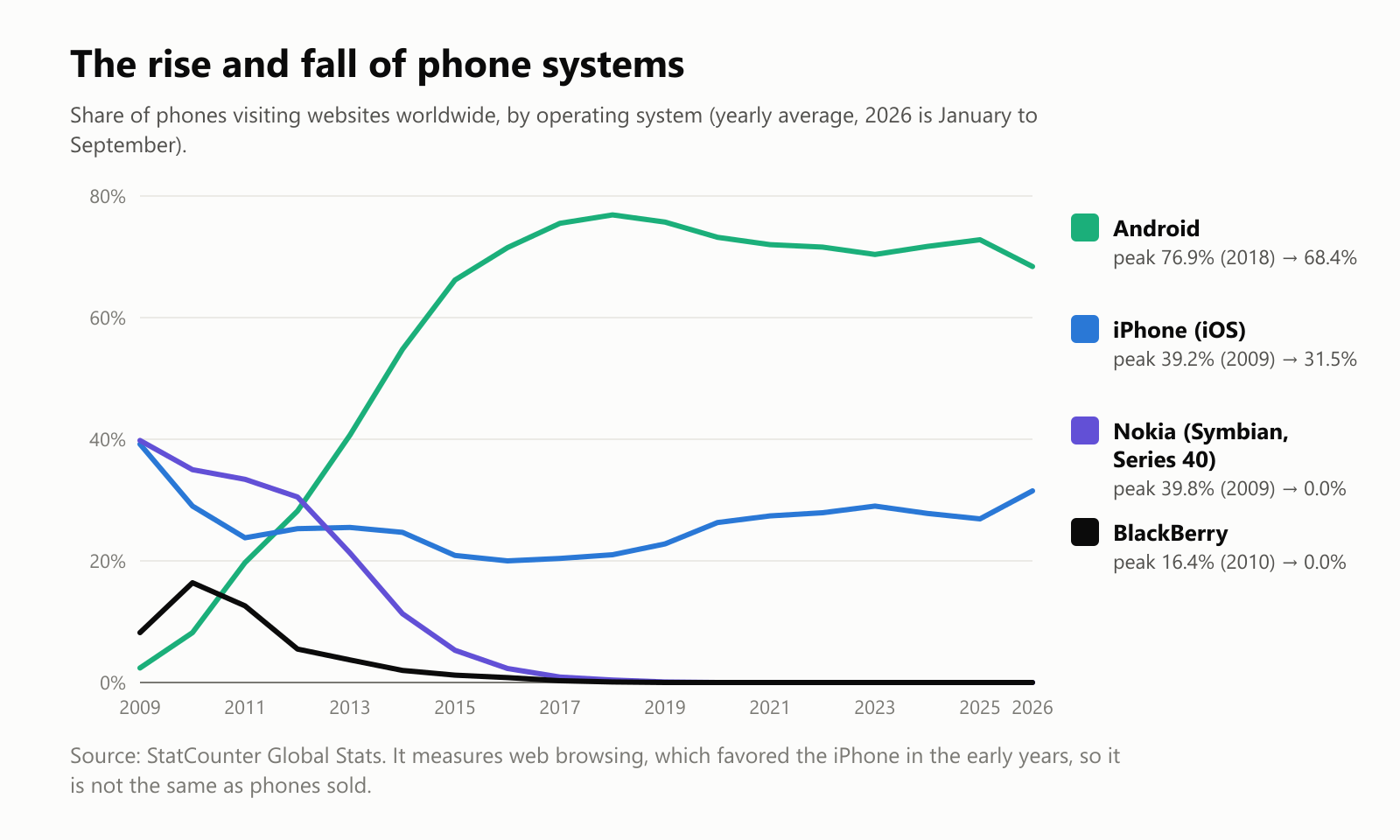
The chart shows one of the fastest shake-ups in business history:
- In 2009, Nokia phones made about 40% of phone visits to websites. By 2016, it was about 2%. Nokia sold its phone business to Microsoft in 2014.
- BlackBerry peaked in 2010 at about 16%, then faded. The company stopped designing its own phones in 2016.
- Android shot from about 2% to over 70% in less than a decade.
- Since 2011, the iPhone has stayed between about a fifth and a third of the total. It varies a lot by country: in September 2026, iPhones made about 54% of phone visits in the United States and 60% in Japan, but about 21% in Brazil.
- Microsoft's Windows Phone never got above about 2.5% and was discontinued.
Keep in mind that StatCounter measures web browsing, not phones sold. iPhone owners were especially heavy web users in the early years, which is why the iPhone looks so strong in 2009.
Phones overtook computers
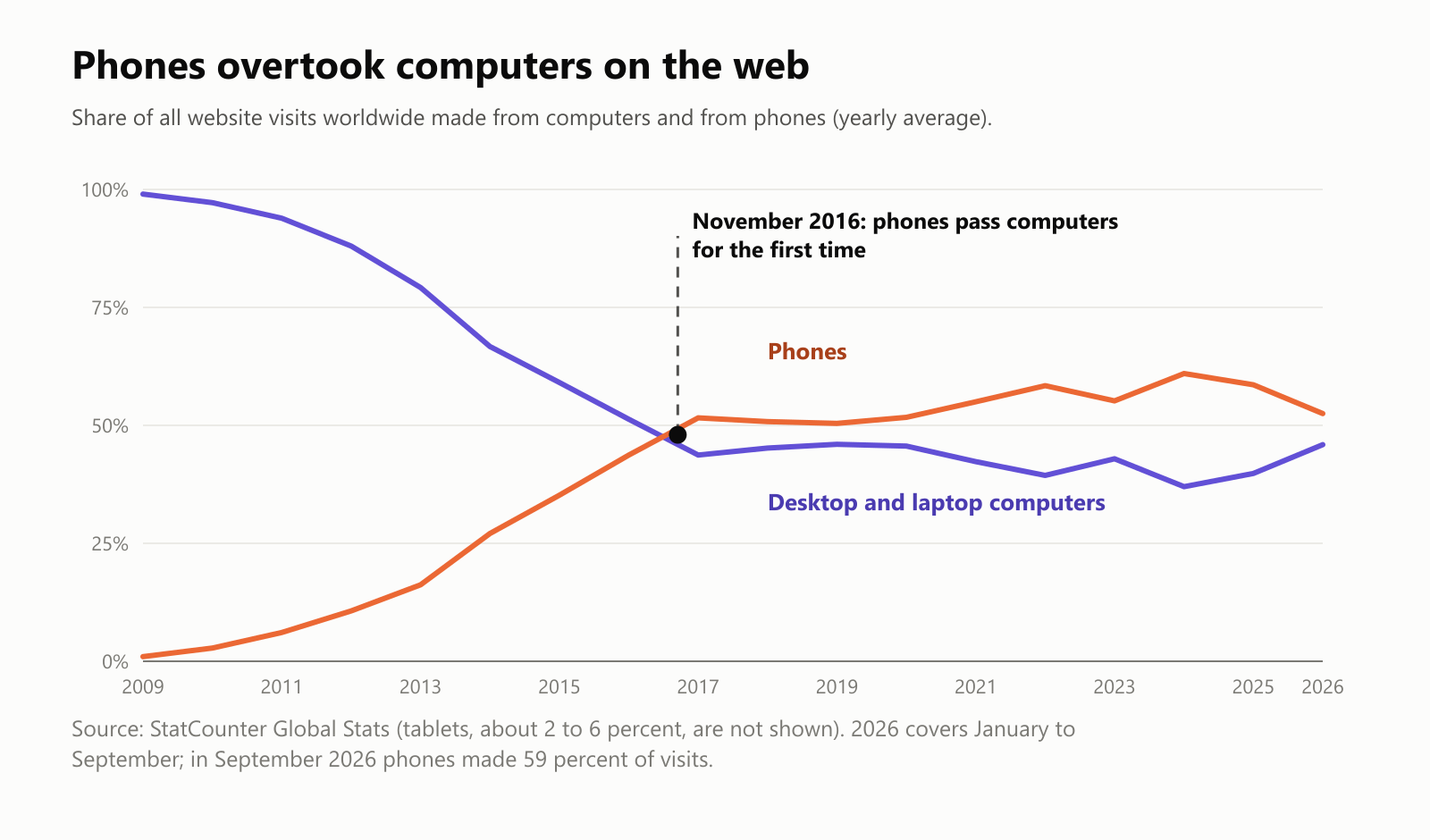
In 2009, about 99% of visits to websites came from desktop and laptop computers. In November 2016, for the first time, more visits came from phones than from computers, and phones have stayed ahead since. For billions of people, especially in countries where computers were always rare and expensive, a smartphone is their first and only computer.
Screens kept growing
The first iPhone's 3.5-inch screen seemed big in 2007. It didn't stay big for long:
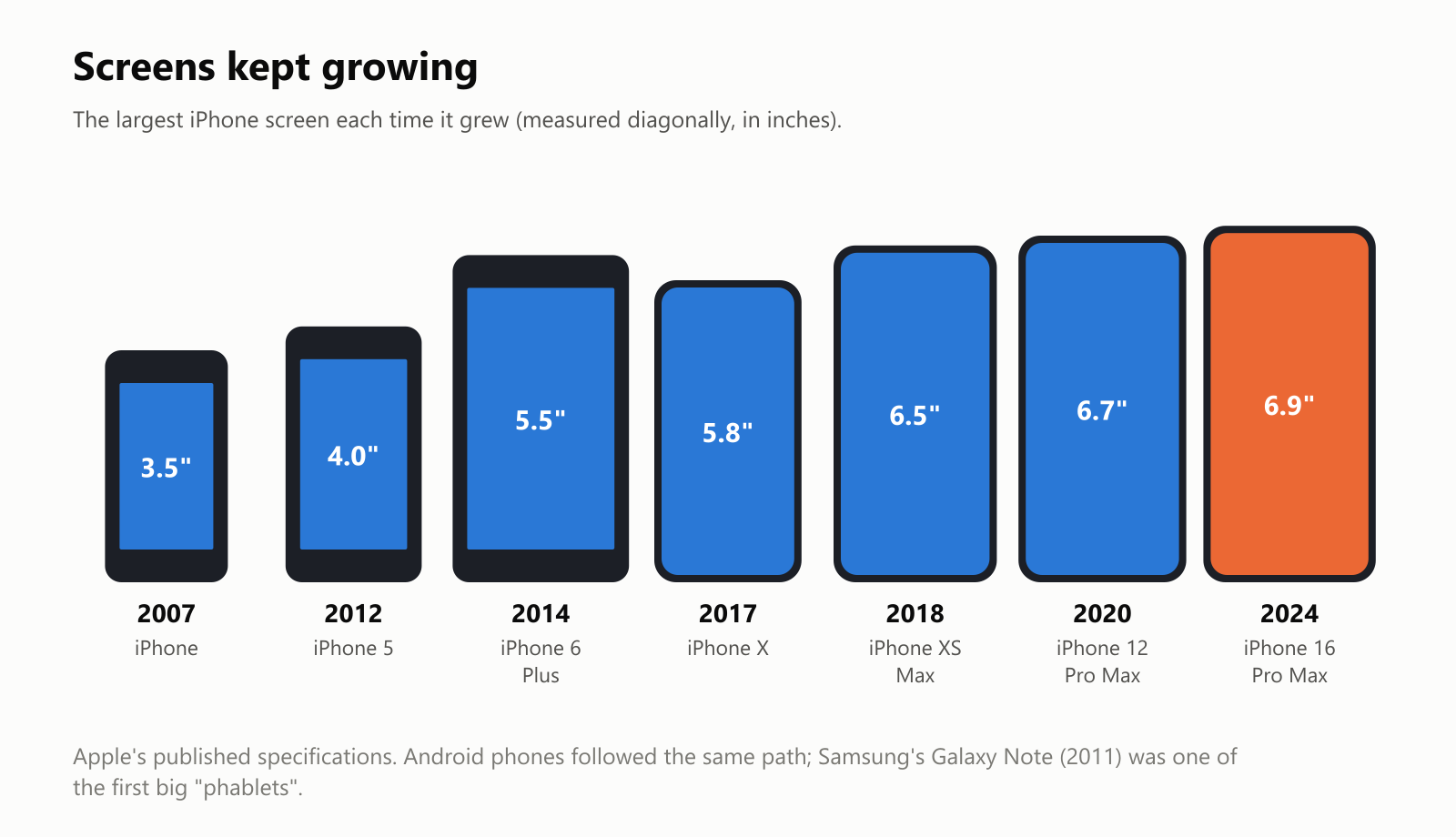
As people used phones more for videos, games and reading, screens grew from 3.5 inches to almost 7. To fit bigger screens into hands and pockets, phone makers shrank the borders around them and, in 2017, removed the iPhone's home button. In 2019, Samsung's Galaxy Fold introduced a phone with a screen that folds in half, opening up into a small tablet.
One device, many gadgets
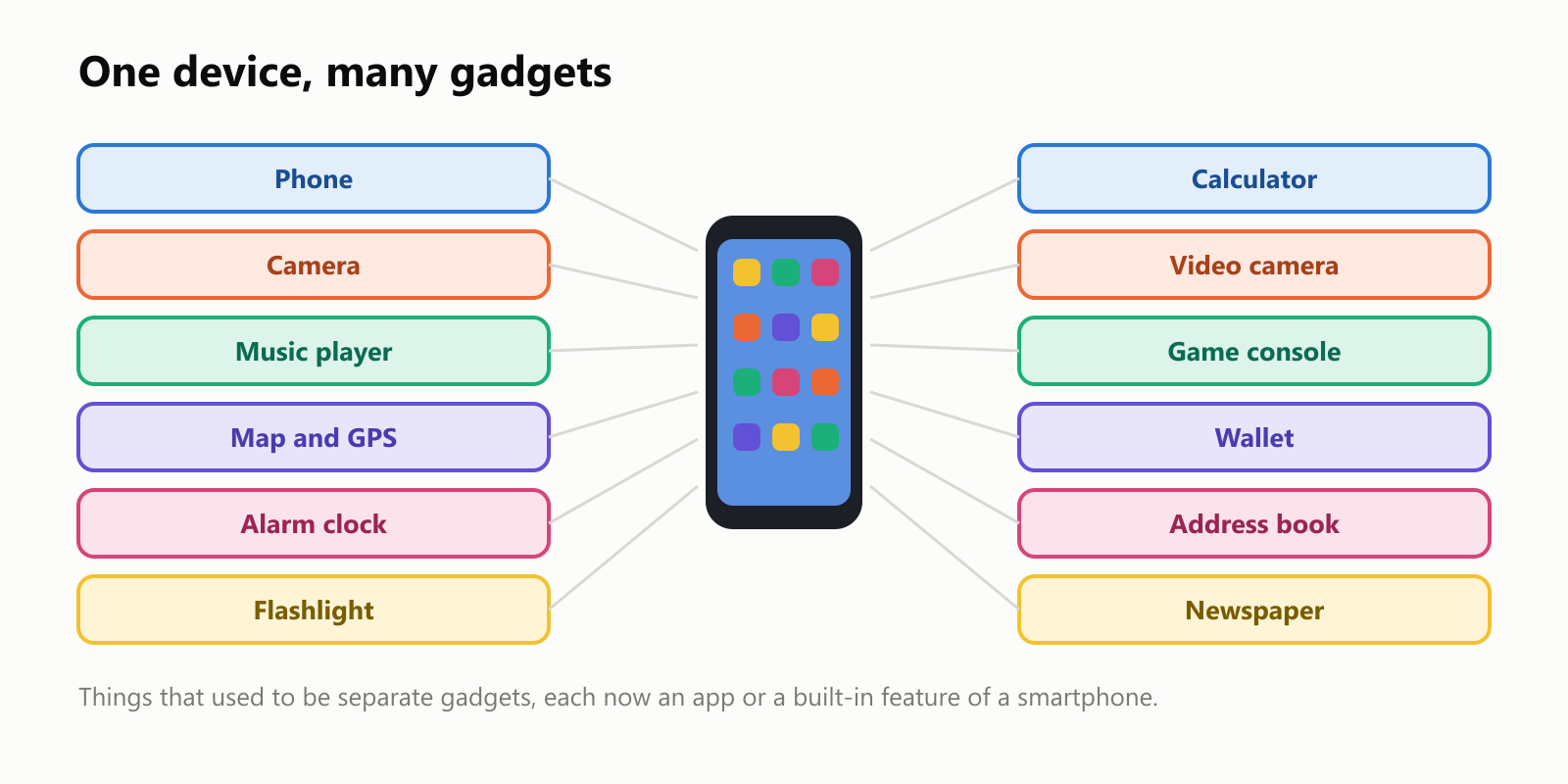
Perhaps the biggest change is how many separate things a smartphone replaced. Cameras, music players, GPS units, alarm clocks, flashlights and paper maps used to be separate purchases. Now they are apps or built-in features of one device, along with your bank, your boarding pass and, increasingly, your wallet.
A short history
The not-so-good side
Smartphones have also brought real challenges:
- Distraction and screen time. Many people find it hard to put their phones down, and apps are often designed to keep you scrolling.
- Privacy. Phones know where you go, who you talk to and what you search for, and some apps collect and sell that information.
- Cost and waste. Phones are replaced every few years, and old ones become electronic waste.
- Dependence. Losing your phone can mean losing access to your messages, bank, photos and tickets all at once.
A small glossary
- Cell phone (mobile phone): a phone that connects by radio to a network of towers.
- Smartphone: a mobile phone that is also a computer, with apps and internet access.
- Feature phone: a simpler phone mainly for calls and texts.
- Cell: the small area served by one tower in a mobile network.
- 1G to 5G: the generations of mobile networks, each faster and more capable.
- SMS: a text message.
- Operating system: the master program of a device, like Android or iOS.
- iOS: Apple's operating system for the iPhone.
- Android: Google's operating system, used by most of the world's smartphones.
- App store: an online shop for installing apps on a phone.
- Multi-touch: a touchscreen that understands several fingers at once, for gestures like pinch-to-zoom.
Wrapping up
In about 50 years, the mobile phone went from a 790-gram brick that could only make calls to a slim glass computer that fits in a pocket and does almost everything. The biggest leap happened in just a few years around 2007 and 2008, when the iPhone, the App Store and Android turned phones into computers and changed which companies ruled the industry.
The next time you pull out your phone, remember: you're holding the descendant of the brick, the Simon, the Nokia and the BlackBerry, and one of the most powerful tools people have ever carried.
Read next
What Is a Transformer in AI? The Idea Behind ChatGPT, Explained Simply
A friendly, jargon-free guide to transformers, the AI design behind ChatGPT, Claude and Gemini. Learn how "attention" lets AI understand words in context, what happens inside a transformer, and why it changed AI so quickly.
 nbkhope
What Is Reinforcement Learning? How AI Learns by Trial, Error and Reward
A friendly, jargon-free introduction to reinforcement learning, how AI learns by trial, error and reward, like training a dog with treats. Watch a real robot learn a maze, see why exploring matters, and learn how it shapes chatbots.
nbkhope
What Is Graph Engineering? How Today's AI Teams Up to Get Real Work Done
A friendly, jargon-free guide to graph engineering, the 2026 idea of building AI as a map of connected steps instead of one big loop. See how today's AI agents work, why small mistakes add up, and how checkers, branches and teamwork fix it.
nbkhope
Comments
Be kind and specific. Comments with links from new accounts appear after a moderator reviews them.