
What Is Entire.io? Version Control for AI Agents
Entire is a Git-compatible forge for agent-human development, founded by ex-GitHub CEO Thomas Dohmke. Learn why it exists, how Checkpoints and Trails work, how it compares with GitHub, and what its $60M bet says about coding with AI agents.

On this page
What Is Entire.io? Version Control for AI Agents
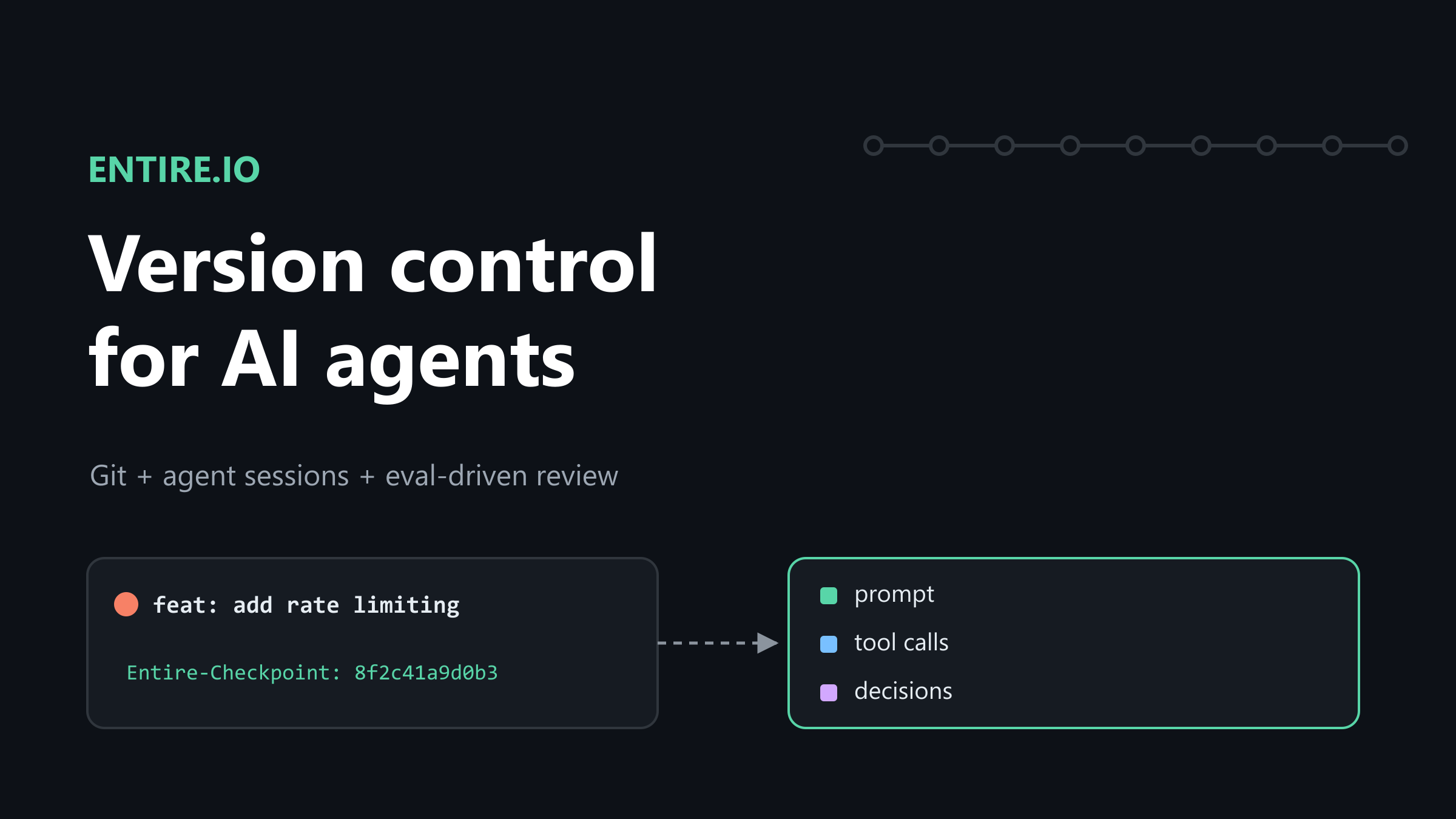
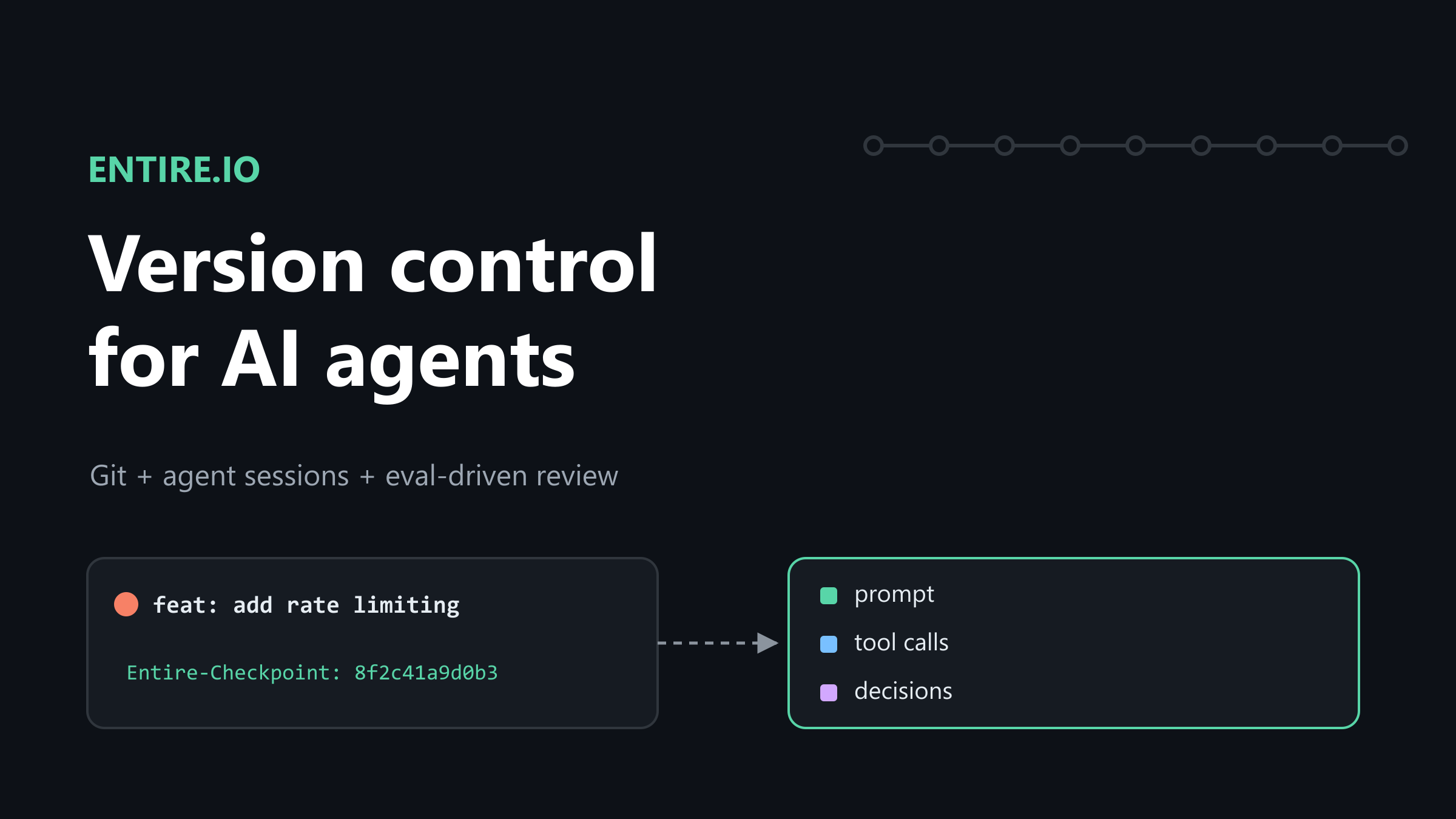
If Git solved distributed version control for humans and GitHub scaled pull-request collaboration, Entire is trying to solve the next bottleneck: software written by AI agents faster than people can review it. It doesn't replace Git. It adds a Git-compatible forge (a place to host and collaborate on repositories, like GitHub or GitLab) that also stores the why behind each change: the prompts, agent transcripts and review results that a plain commit throws away.
The company was started by Thomas Dohmke, who ran GitHub for nearly four years, and it launched with the largest seed round ever raised by a developer tools startup. This article covers who built Entire and why, what it ships today, how it fits with Git and GitHub, and where its claims still need independent proof.
Note: the company's site moved from entire.io to entire.com; old entire.io links redirect there. The open-source code lives under github.com/entireio.
Entire at a glance
| Founded by | Thomas Dohmke, GitHub CEO from November 2021 to the end of 2025 |
| Announced | February 10, 2026 |
| Funding | $60 million seed at a $300 million valuation, led by Felicis |
| Team | 15 people at launch, about 50 by October 2026; remote-first |
| First product | Checkpoints, an open-source CLI that saves agent sessions next to commits |
| Full platform | Launched October 26, 2026: Git hosting, Trails (review), Continuous Memory |
| Works with | Claude Code, Codex, Cursor, Copilot CLI, OpenCode, Antigravity, Factory AI Droid, Pi and more |
| License (CLI) | MIT, written in Go |
Who founded Entire, and why
Thomas Dohmke: from app testing to running GitHub
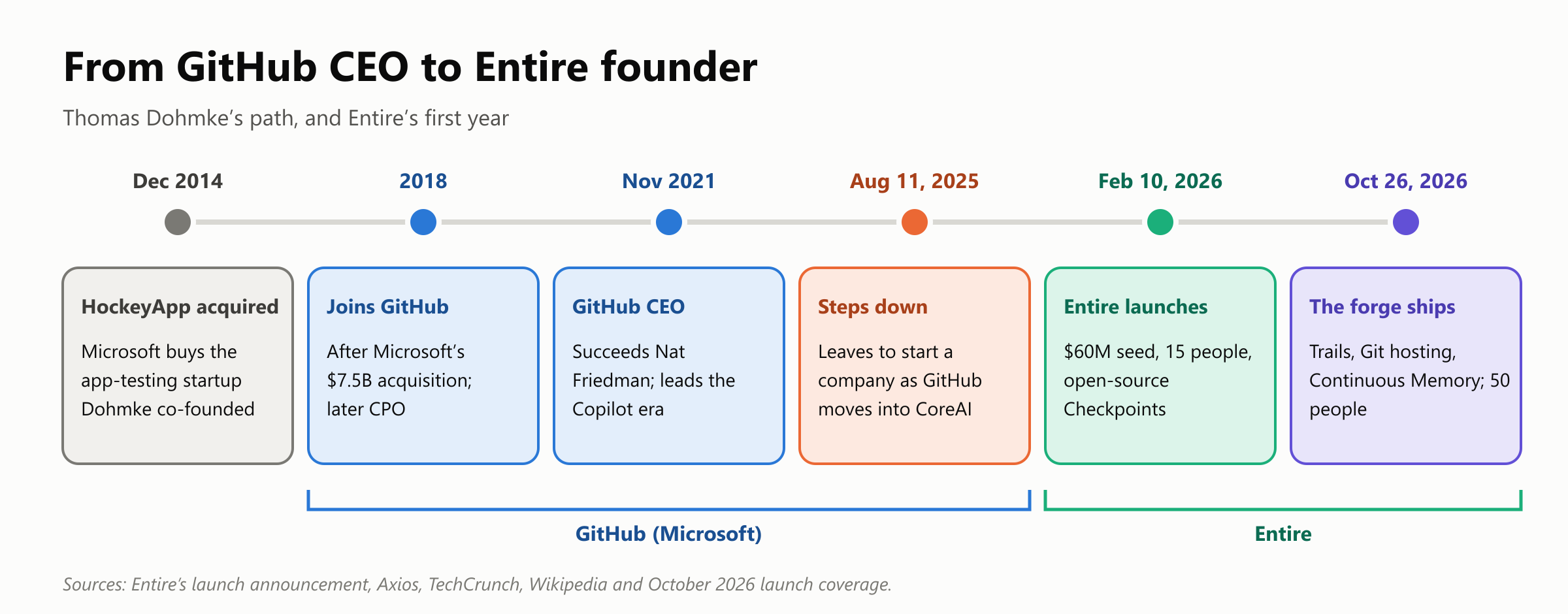
Thomas Dohmke was born in East Berlin in 1978. He studied computer engineering at the Technical University of Berlin and later earned a PhD in mechanical engineering at the University of Glasgow. In the early 2010s he co-founded HockeyApp, a service for distributing beta builds of mobile apps and collecting crash reports, a rival to Apple's TestFlight. Microsoft bought HockeyApp in December 2014, and Dohmke moved to Microsoft with it.
When Microsoft bought GitHub for $7.5 billion in 2018, Dohmke joined GitHub, first leading strategic programs and then becoming Chief Product Officer. In November 2021 he succeeded Nat Friedman as CEO. His tenure lined up with the rise of GitHub Copilot, the AI pair programmer that first previewed in mid-2021 and turned AI coding from a novelty into a daily tool for millions of developers.
Why he left
On August 11, 2025, Dohmke announced that he would leave GitHub at the end of the year to start a company again. At the same time, Microsoft said GitHub would no longer have its own CEO and would be folded more tightly into its CoreAI organization. In other words, GitHub was becoming part of a bigger Microsoft AI platform, and its former leader wanted to build something independent.
The thesis: the software "factory" was built for humans
Dohmke's argument is simple. The tools we use to produce software (issues, Git repositories, pull requests, CI pipelines) were designed for people typing code. AI agents changed how code gets written, but the rest of the system didn't change with them. In Entire's launch announcement, he said that the traditional system "was never designed for the era of AI in the first place," at a time when "massive volumes of code are being generated faster than any human could reasonably understand."
At the October launch he put it another way: agents "reinvented how we produce code. It changed our tools and half of our workflow. It's time for the other half to catch up." Entire is his bet on that "other half": how code is stored, reviewed and remembered.
The early team came from GitHub, Microsoft and Atlassian, people who had built the current generation of developer tools and were now trying to replace parts of it.
The record $60 million seed round
Entire announced its first round on February 10, 2026. Seed rounds for developer tools are usually a few million dollars; Felicis, which led this one, called it the largest seed investment ever for a developer tools startup.
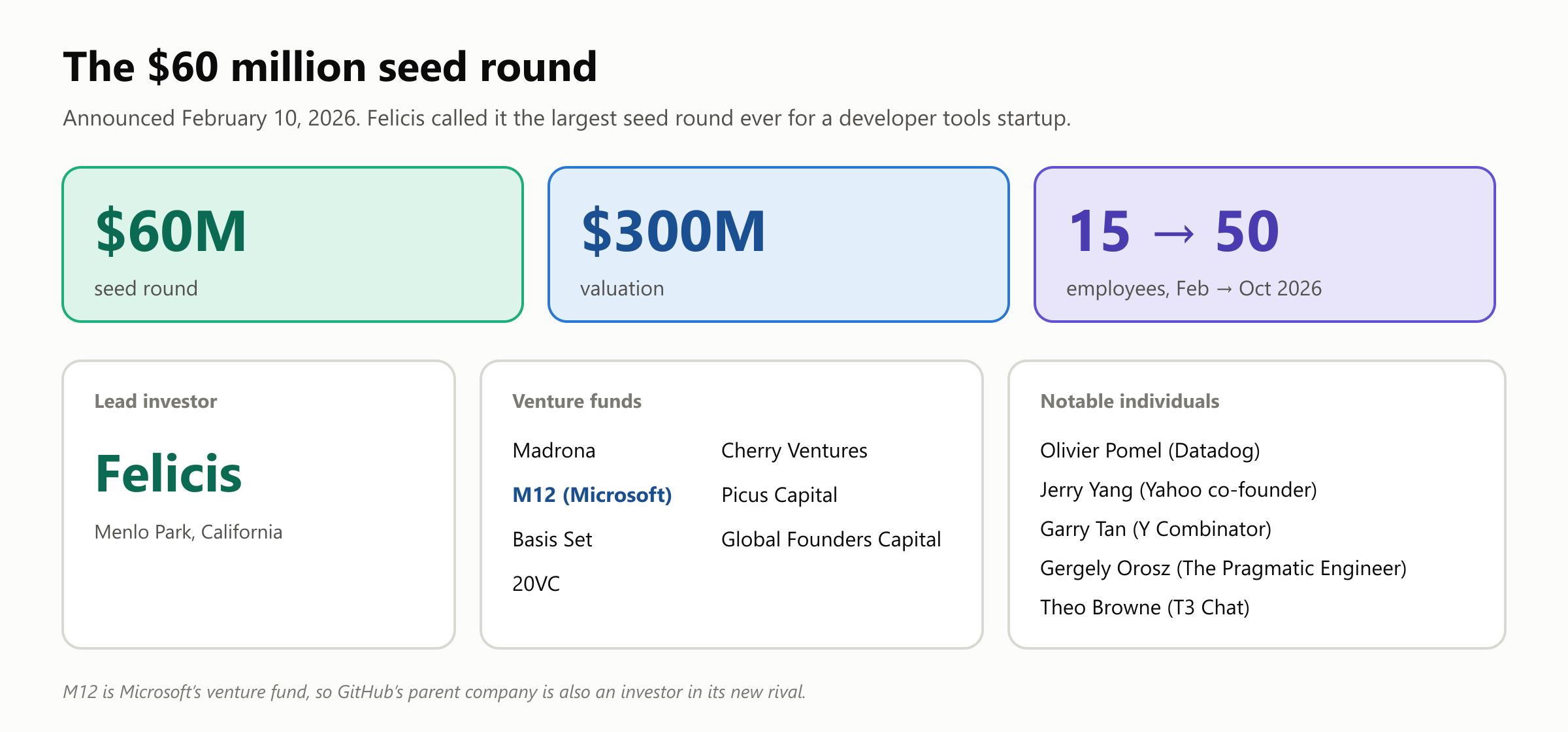
A few details stand out:
- Microsoft is on both sides. M12 is Microsoft's venture fund, so GitHub's parent company also owns a piece of a would-be GitHub rival. It's a cheap hedge for Microsoft and a credibility signal for Entire.
- The angel list is aimed at developers. Gergely Orosz (The Pragmatic Engineer newsletter) and Theo Browne (a popular developer YouTuber and the founder of T3 Chat) have large developer audiences. Olivier Pomel built Datadog, a developer-facing platform company.
- The valuation reflects the founder. A $300 million valuation before a full product existed is a bet on Dohmke's track record and on the size of the market GitHub created.
Five decades of version control
Version control has been reinvented every time collaboration changed shape. Entire argues that AI agents are the next such change.
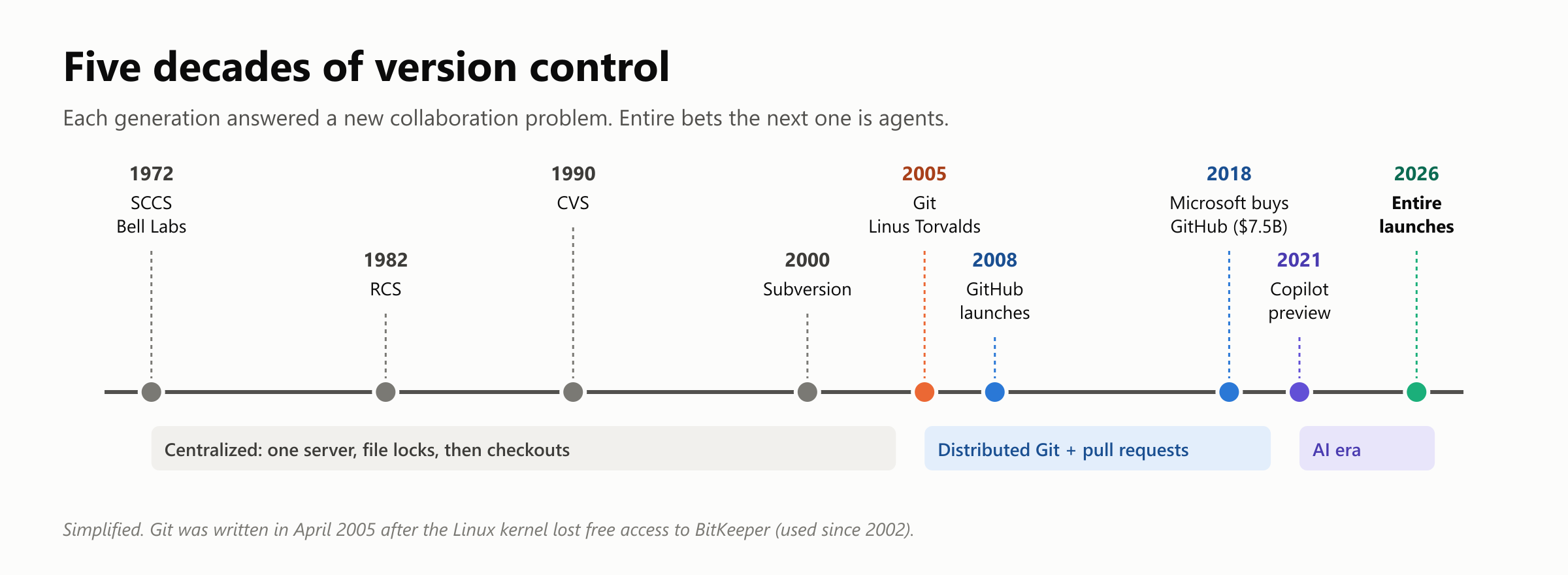
- Centralized systems (1972 to 2000s): SCCS, RCS, CVS and Subversion kept one central copy of the history. They solved "who changed this file?" for teams sharing a server.
- Git (2005): The Linux kernel had used the proprietary BitKeeper since 2002. When that free license was withdrawn in April 2005, Linus Torvalds wrote Git in a few weeks. It was built for speed, cheap branching and fully distributed copies of history.
- GitHub (2008): GitHub put a social layer on Git. Pull requests, code review and forks made open source collaboration mainstream, and it grew to over 100 million developers.
- AI-authored code (2021 onward): Copilot, then agents such as Claude Code and Codex, moved from suggesting lines to writing whole features, and the number of changes per developer jumped.
Git's data model has held up remarkably well for 20 years. What's under strain is everything around it.
Where Git workflows strain with AI agents
When one developer can run several coding agents in parallel, a team can produce far more branches, commits and proposed changes than humans can review.
| Git-era assumption | AI-agent reality | Resulting pain |
|---|---|---|
| The commit message explains the intent | An agent makes hundreds of small decisions per task, and the session is thrown away | Reviewers see what changed but not why |
| Review keeps pace with writing | Agents produce changes far faster than review queues clear | Long review queues; rubber-stamp approvals |
| Context lives in people's heads, docs and issues | Each new agent session starts from zero | Agents re-discover the codebase and burn tokens doing it |
| Git hosting is sized for human push rates | Many agents push continuously, from many places | Rate limits, slow clones and CI backlogs |
| The PR timeline is a conversation between people | Bots and agents flood it with comments | In Entire's words, the PR becomes "an audit log that only the agent reads" |
None of this is a flaw in Git itself. It's pressure from a new way of working, and it's the gap Entire is built for.
What Entire ships
Entire has launched in two stages:
- February 2026: Checkpoints. An open-source CLI that captures agent sessions and links them to commits. It worked in any Git repository, with no account needed, and initially supported Claude Code and Gemini CLI.
- October 26, 2026: the forge. Git hosting on Entire's own distributed infrastructure, Trails (a replacement for pull requests), and Continuous Memory (searchable project memory built from past sessions).
The pieces stack on top of Git rather than replacing it:
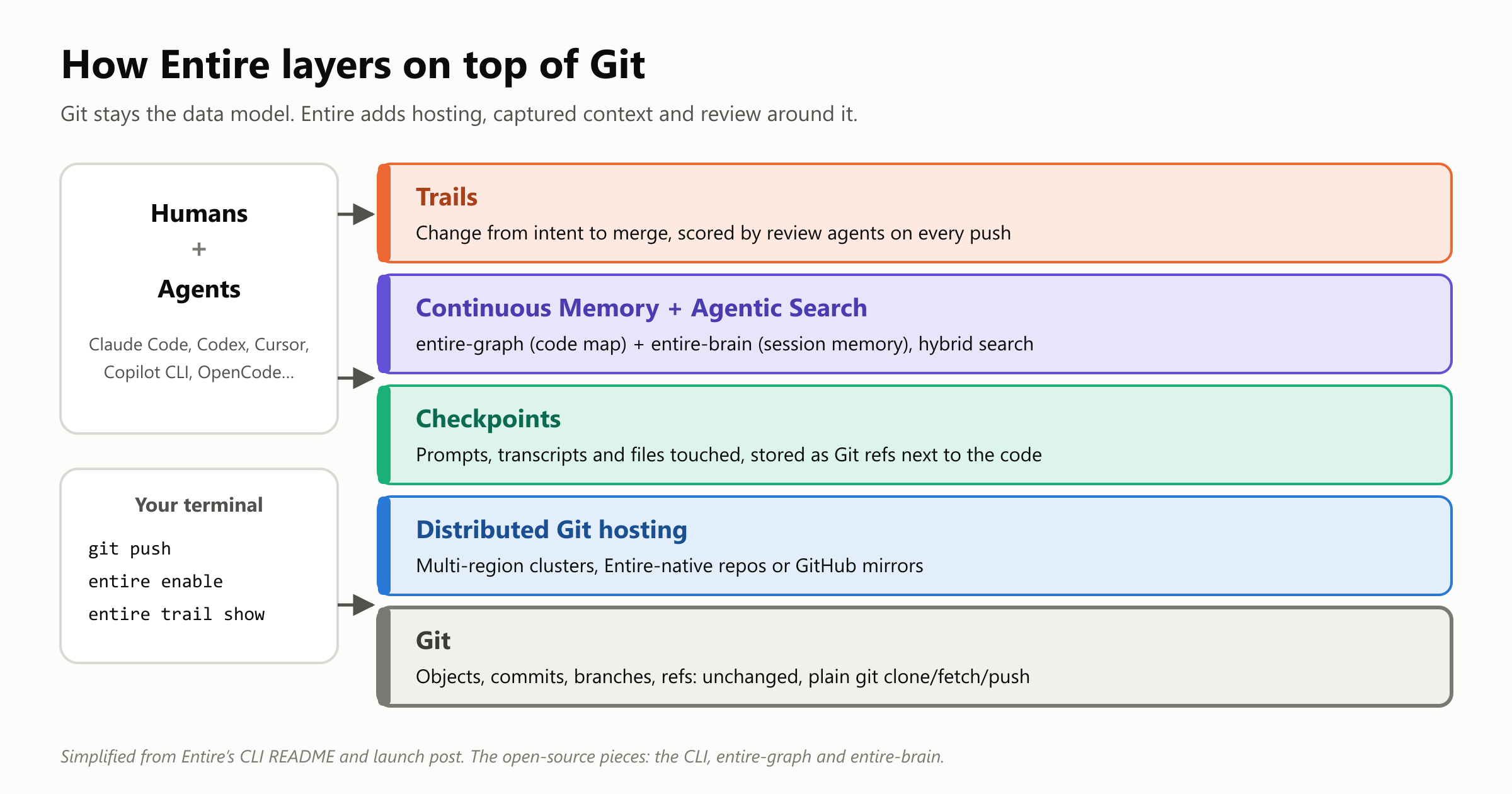
The key design choice: everything is still Git underneath. You clone, commit, branch and push with normal Git commands. Entire adds hooks, extra refs and a web interface around that.
Checkpoints: saving the "why" next to the code
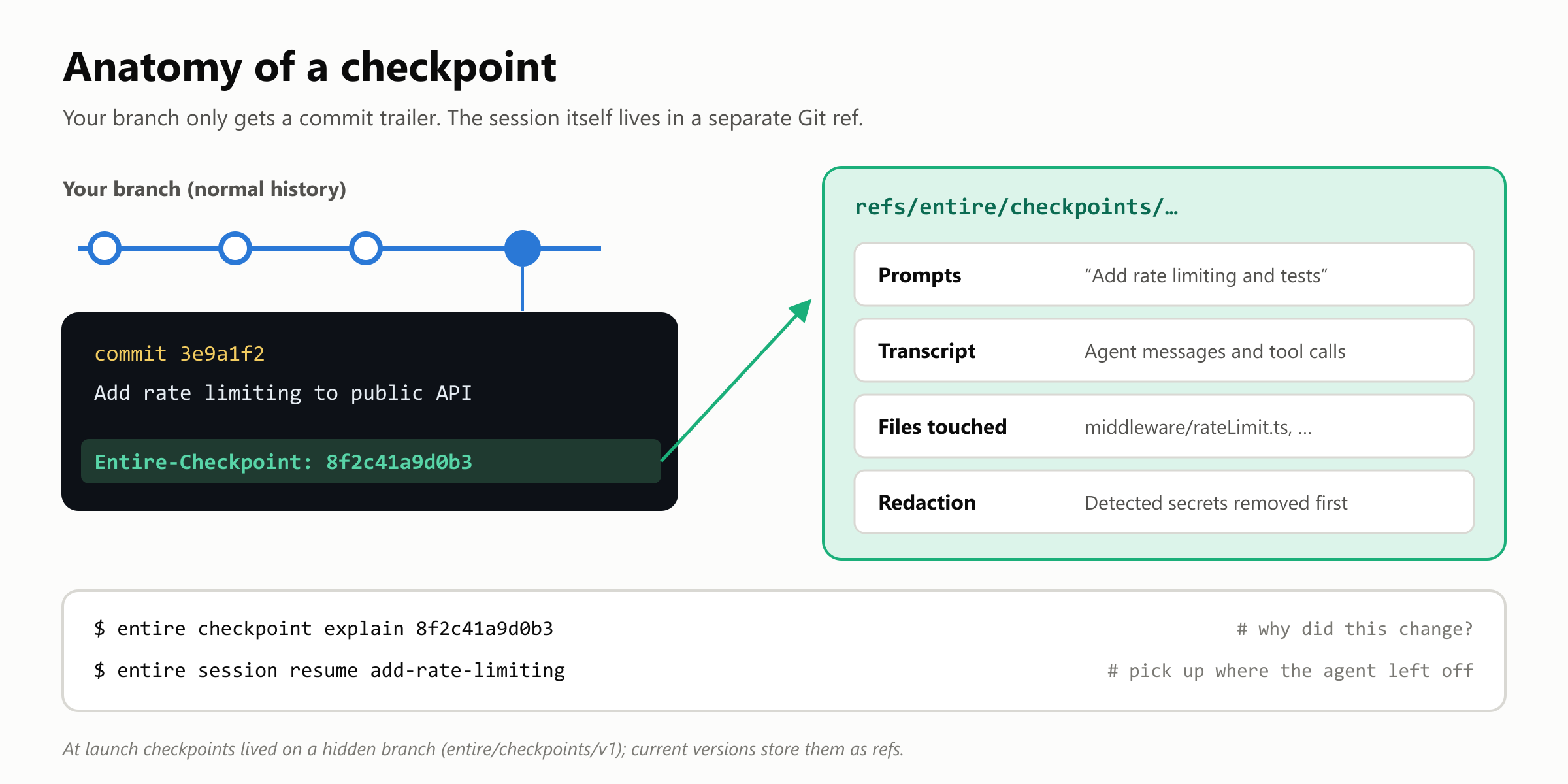
Run entire enable in a repository, pick your agents, and Entire installs hooks for both the agent and Git. From then on, every commit that includes agent work gets a checkpoint: the prompts, the transcript and the list of files touched.
How it works:
- Your branch gets no extra commits. The commit message gains one trailer line,
Entire-Checkpoint: <id>. - The session itself is stored in its own Git refs (
refs/entire/checkpoints/…) and pushed along with your code. Early versions used a hidden branch namedentire/checkpoints/v1instead. - Because it's all Git data, checkpoints travel with the repository. They work with GitHub, GitLab or any other remote, not only Entire.
A few everyday commands:
1entire enable                          # pick agents; install agent hooks and git hooks
2entire checkpoint list                 # checkpoints on this branch
3entire checkpoint explain <id>         # the prompt, transcript and files behind a commit
4entire session resume <branch>         # restore a branch's sessions and continue in your agent
entire session resume is the underrated part. A new agent, or a teammate, can pick up where the last session stopped instead of starting cold.
Privacy warning: transcripts are pushed to your Git remote. If the repository is public, anyone can read them. Entire redacts detected secrets before saving, but its own docs say redaction is "best effort." For public repos, send checkpoints to a separate private repository (entire configure --local --checkpoint-remote github:<owner>/<repo>) or turn off session uploads (--skip-push-sessions).
Trails: reviewing intent, not just diffs
A Trail follows a change from the original idea to the merge. It plays the role of a pull request, but the review is done first by review agents (Entire calls them evals) that score every push.
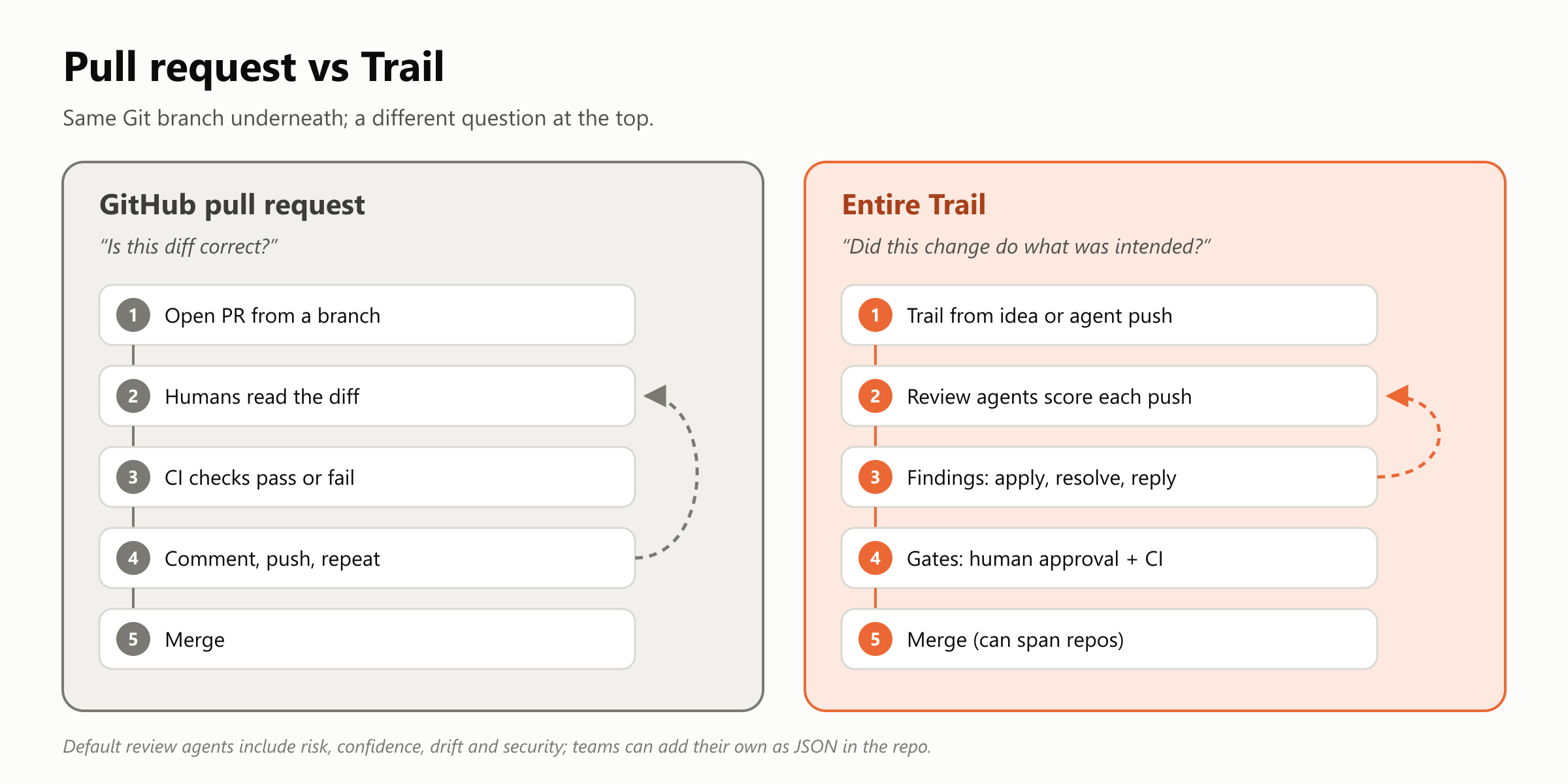
What's different from a pull request:
- Agents review first. Preset review agents (such as risk, confidence, drift and security) run Claude Code and Codex in isolated sandboxes and score each push with a rationale. Teams can define their own evals in the web interface or as JSON files in the repository.
- Findings are actionable.
entire trail finding apply <id>applies a suggested fix; you can also resolve or reply to a finding. - Gates protect merges. Each repository can require human approval and passing CI before a Trail merges.
- One Trail can span several repositories, which helps when a feature touches a backend and a frontend.
- Trails link back to sessions, so a reviewer can open the agent conversation that produced a change.
1git switch -c add-rate-limiting
2entire trail create --title "Add rate limiting"
3entire trail watch      # stream reviews and findings live
4entire trail merge
Preset review agents run on free credit; custom agents need billing set up for the project.
Hosting, mirrors and regions
Entire hosts Git repositories on clusters in several regions (Entire lists Ohio, Frankfurt, Mumbai, Singapore and São Paulo, with Australia added at launch), so agents can clone and push close to where they run. You can create an Entire-native repository or keep GitHub and add a mirror.
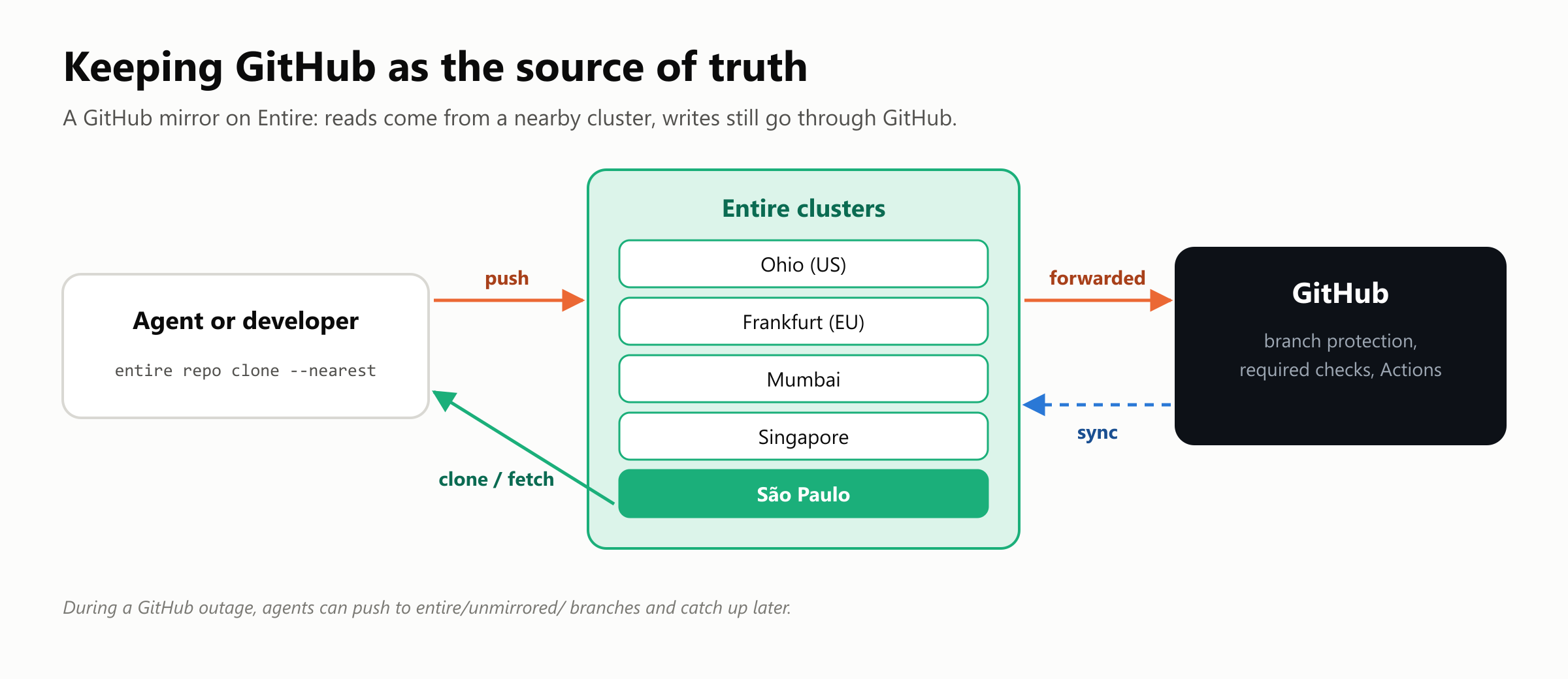
With a GitHub mirror, GitHub stays the source of truth. Clones and fetches come from the nearest Entire cluster; pushes are forwarded to GitHub, where your permissions, branch protection and Actions still apply. If GitHub is down, agents can push to entire/unmirrored/ branches and catch up later.
entire repo mirror add /gh/acme/web --cluster aws-us-east-2.entire.io,aws-eu-central-1.entire.io
entire repo clone /gh/acme/web --nearest     # time each cluster, use the fastest
For continuous integration, Entire integrates with Buildkite and Depot, and Depot offers a tool to convert GitHub Actions workflows.
Continuous Memory and search
Agents waste a lot of time (and tokens) re-learning a codebase. Entire's answer is Continuous Memory, built from two open-source, local-first plugins:
- entire-graph builds a map of the code with tree-sitter, so agents can find the right files without reading everything.
- entire-brain turns past checkpoints into memories agents can retrieve: "we tried that approach in March and reverted it because…"
On top of this, entire search runs hybrid (keyword plus semantic) search across code, commits and sessions, with a compact JSON mode designed for agents to call.
The performance claims, with a grain of salt
Entire publishes several benchmark results. All are vendor-reported; there are no independent measurements yet.
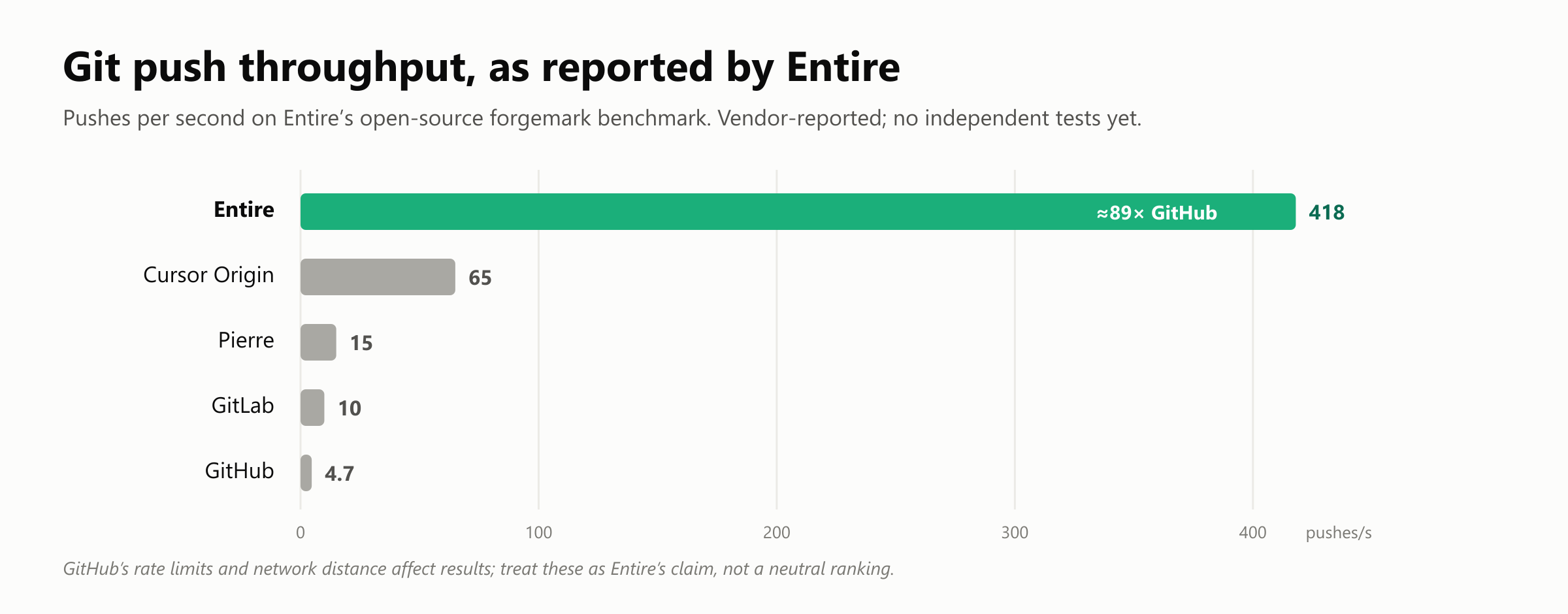
| Claim | Entire's number | What to keep in mind |
|---|---|---|
| Git push throughput | 418 pushes/s vs 4.7 for GitHub (about 89×) | GitHub's rate limits and network distance affect the result; the benchmark (forgemark) is open source, so it can be checked |
| Token savings from entire-graph | Up to 71% fewer tokens than Graphify | "Up to" is the best case, not the average |
| Agentic Search on history questions | 81 of 90 answered, vs 70 without it, using under half the tokens and steps | A benchmark Entire designed |
Push throughput matters if you run dozens of agents pushing all day; for a small human team, GitHub's speed is rarely the bottleneck. The context and review features are the more meaningful part for most teams.
Open source and shipping speed
The Entire CLI is MIT-licensed and developed in public. By November 10, 2026 it had 5,332 GitHub stars, about 500 forks, 69 contributors and 62 stable releases in just over 10 months, plus nightly builds almost every day.
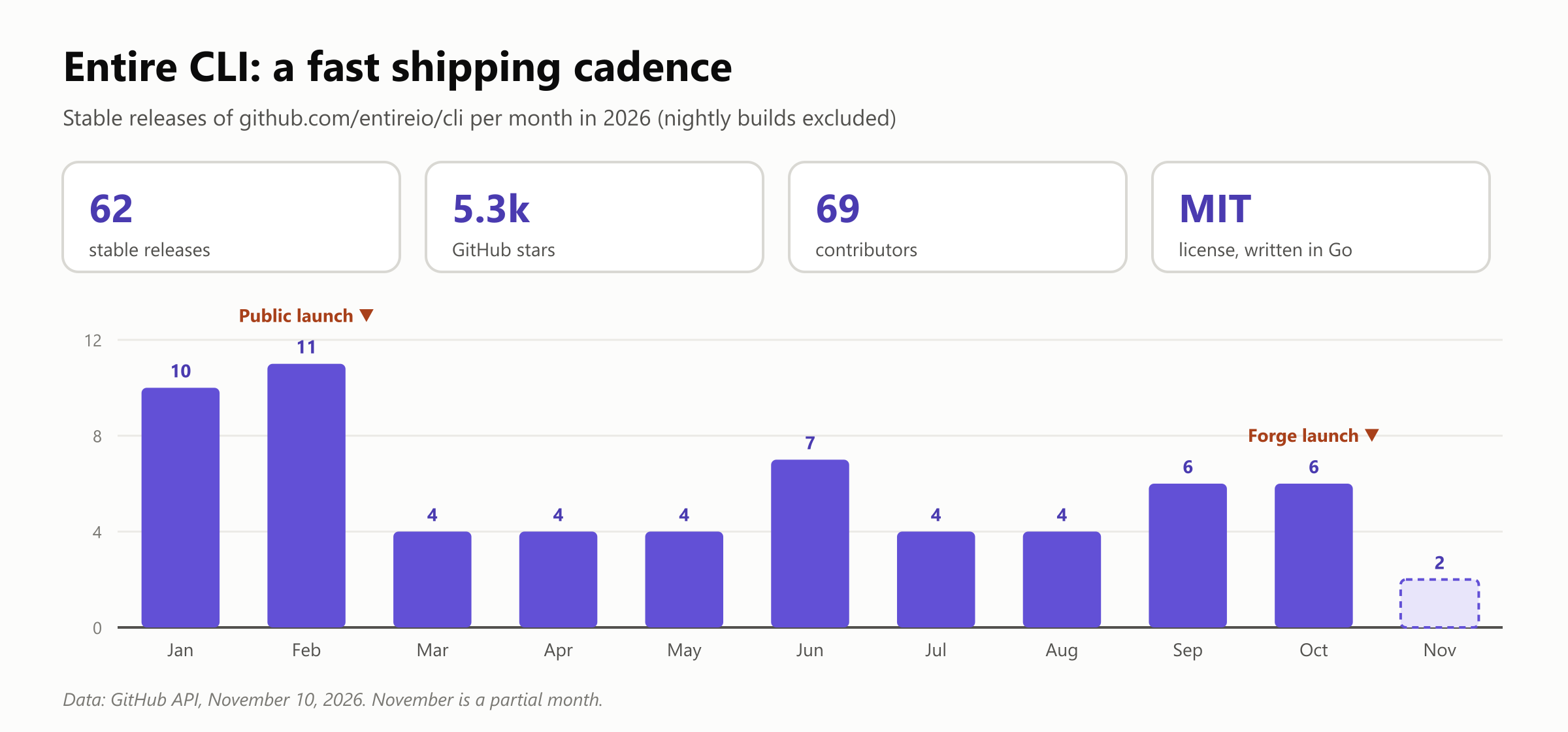
The busiest months were January and February, leading up to and right after the public launch, when the CLI went from v0.3.0 to a usable tool. The pace then settled at roughly one stable release a week.
Entire vs GitHub
| Dimension | GitHub | Entire |
|---|---|---|
| Review unit | Pull request: diff + comments + checks | Trail: intent + agent evals on every push + gates |
| Agent context | Lost unless a third-party tool saves it | Checkpoints linked to each commit, stored in Git |
| Hosting | Github.com and GitHub Enterprise | Multi-region clusters; native repos or GitHub mirrors |
| CI | GitHub Actions, huge marketplace | Partners: Buildkite and Depot |
| Ecosystem | Apps, Marketplace, Copilot, security tooling, 100M+ developers | New, small, agent-focused |
| Public repositories and self-hosting | Yes | On the roadmap |
| Ownership | Microsoft (CoreAI) | Independent startup (Microsoft's M12 is a minority investor) |
The practical takeaway: GitHub is still the safe default for mostly human teams. Entire is aiming at teams where agents already write most of the code and review, not writing, is the bottleneck.
You don't have to choose
Entire is designed to be adopted step by step:
- Checkpoints only. Run
entire enablein any existing repository, GitHub or not. No account, no migration. - Add a mirror. Keep GitHub as the source of truth, and let agents clone and fetch from Entire's clusters.
- Try Trails on one project, with GitHub's branch protection still in place.
- Move fully with the
entire-migrateplugin if it proves itself.
Installing the CLI:
brew install --cask entireio/tap/entire          # macOS and Linux
curl -fsSL https://entire.com/install.sh | bash  # macOS and Linux, without Homebrew
irm https://entire.com/install.ps1 | iex         # Windows PowerShell
Open questions
- Will agent sessions become standard Git metadata? If checkpoints catch on, GitHub could build its own version, which is the biggest risk to Entire.
- Is saving every transcript a liability? Sessions can contain internal details, customer data or secrets that slip past redaction. Teams will need policies for what gets stored and for how long.
- Can review agents be trusted? Evals reduce human workload, but an agent grading another agent's code still needs human checks for anything important.
- Pricing and maturity. Public repositories, self-hosted Git nodes and live-streamed sessions were still on the roadmap at launch, and long-term pricing for Trails is still taking shape.
The short version
Entire is a Git-compatible forge built for teams of humans and AI agents. Founded by former GitHub CEO Thomas Dohmke and backed by a record $60 million seed round, it keeps Git as the foundation and adds three things Git never had: saved agent context (Checkpoints), agent-first review (Trails) and project memory (Continuous Memory), on hosting built for high push volume.
If Git answered "How do humans share code safely?", Entire is asking: "How do humans and many AI agents share code, intent and verification at production speed?" Whether Entire or an updated GitHub ends up answering it, that question is likely to shape the next generation of developer tools.
Sources and further reading
- Entire home page
- Entire launch announcement: $60 million seed round (Feb 10, 2026)
- Entire CLI repository and README
- Entire documentation
- TechCrunch: Former GitHub CEO raises record $60M dev tool seed round at $300M valuation
- Axios: Former GitHub CEO launches AI coding startup
- Axios: GitHub CEO to step down (Aug 11, 2025)
- The New Stack: Ex-GitHub CEO launches a GitHub rival that reinvents the pull request
- iTWire: Former GitHub chief launches Entire forge to rethink AI code review
- Thomas Dohmke on Wikipedia
- Git: A Short History of Git (git-scm.com)
Read next
Making Music with AI: A Visual, Hands-On Guide
How to make music with AI and keep the song yours. The tools from stem separation to full-song generators, what listeners and producers think, who owns the result, a human-led workflow, prompts that work, a listening checklist and a release check, with charts and diagrams.
 nbkhope

AI and Your Inbox: A Visual, Hands-On Guide
Let AI help with your email without handing it the keys. What it does well, how hidden text can steer it, which permissions to grant, and what happened when real models sorted and acted on a 30-email test inbox. With working Python, charts and a checklist.
nbkhope
Why Does an AI Task Cost More Than One Prompt?
A single AI task can contain several model calls, tool results, repeated context, and retries. Follow a fictional token ledger and try an interactive call-by-call exercise.
nbkhope
Comments
Be kind and specific. Comments with links from new accounts appear after a moderator reviews them.