The History of Dell: From PC’s Limited to Global Infrastructure
From a college-room PC startup to a global technology company, discover how Dell’s direct-sales model and business pivots shaped four decades of computing.


On this page
The History of Dell: From PC’s Limited to Global Infrastructure
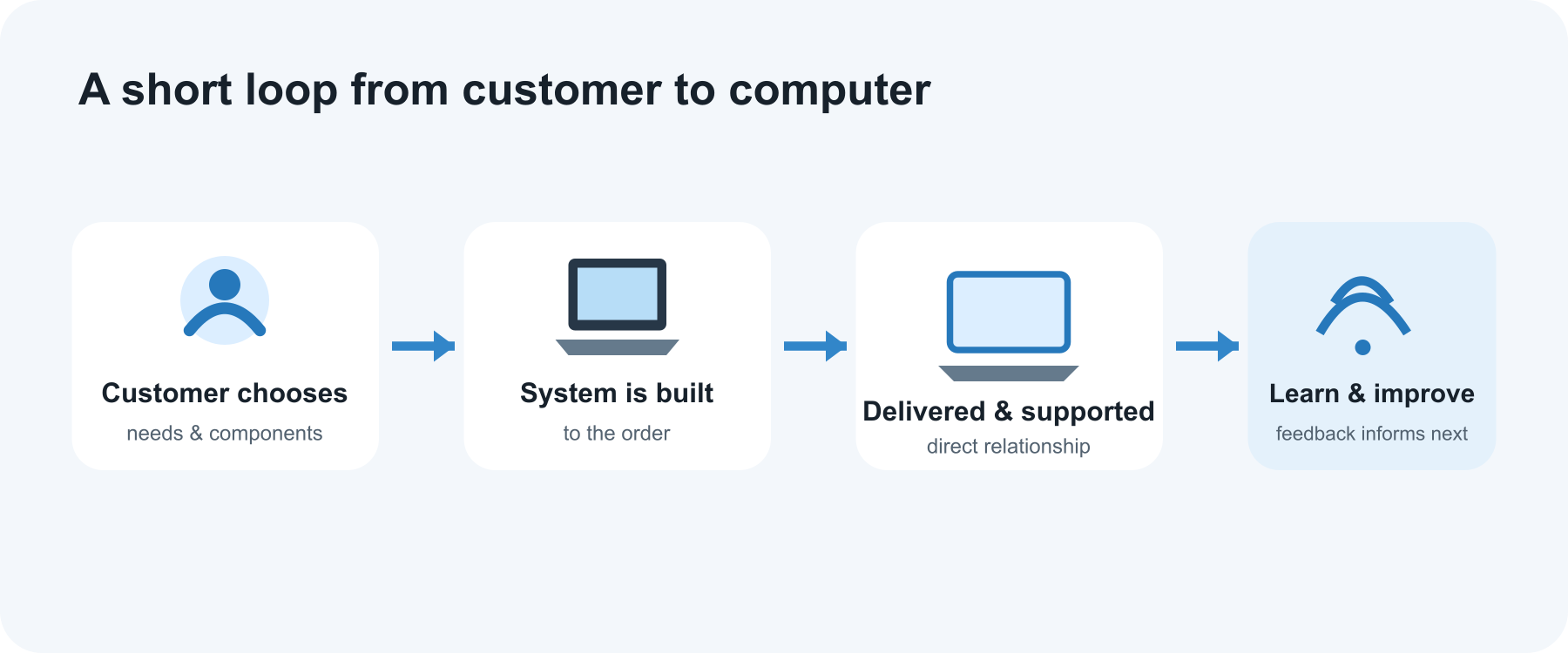
In 1984, a University of Texas student named Michael Dell started a company with $1,000 and an unusual idea: build computers around what customers actually wanted, then sell them directly. That customer-first loop helped a small PC business grow into a global technology company. Dell’s history is a story of listening, assembling, shipping, and then repeatedly asking: what else do organizations need from their technology?

1984–1990s: a direct connection to the customer
Michael Dell founded PC’s Limited in 1984. Rather than begin as a conventional brand selling only preconfigured boxes through stores, the company focused on customizing systems and selling directly. The model could reduce steps between buyer and maker, provide a clearer read on demand, and let customers choose components for their needs.
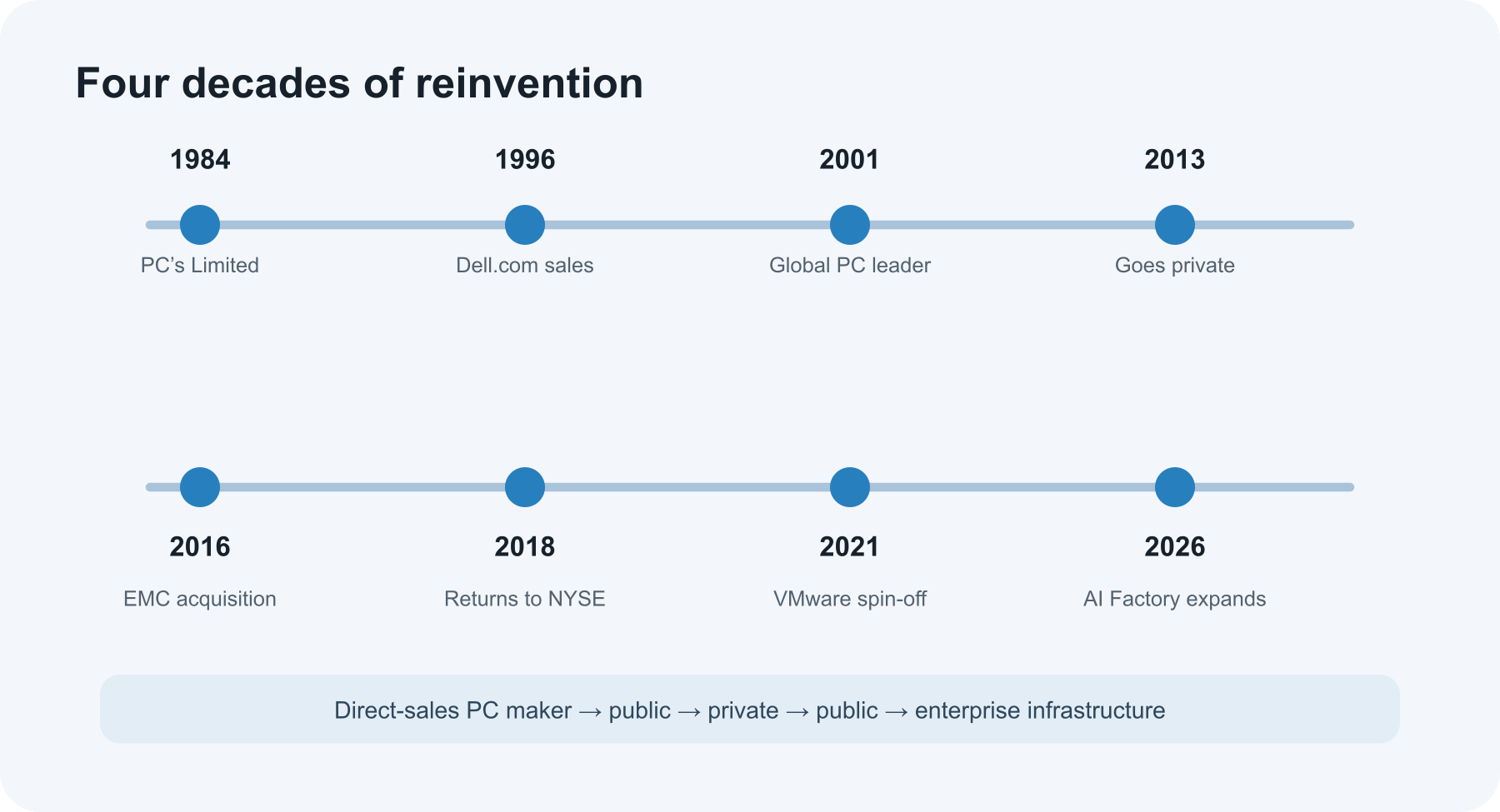
The company incorporated as Dell Computer Corporation and went public in 1988. As personal computers spread into homes and offices, Dell expanded internationally and built its business around direct customer relationships. In 1996, Dell.com began selling online. E-commerce extended the same basic idea: customers could configure a system, place an order, and connect to support through the web.
1990s–2000s: from PCs to a broader computer company
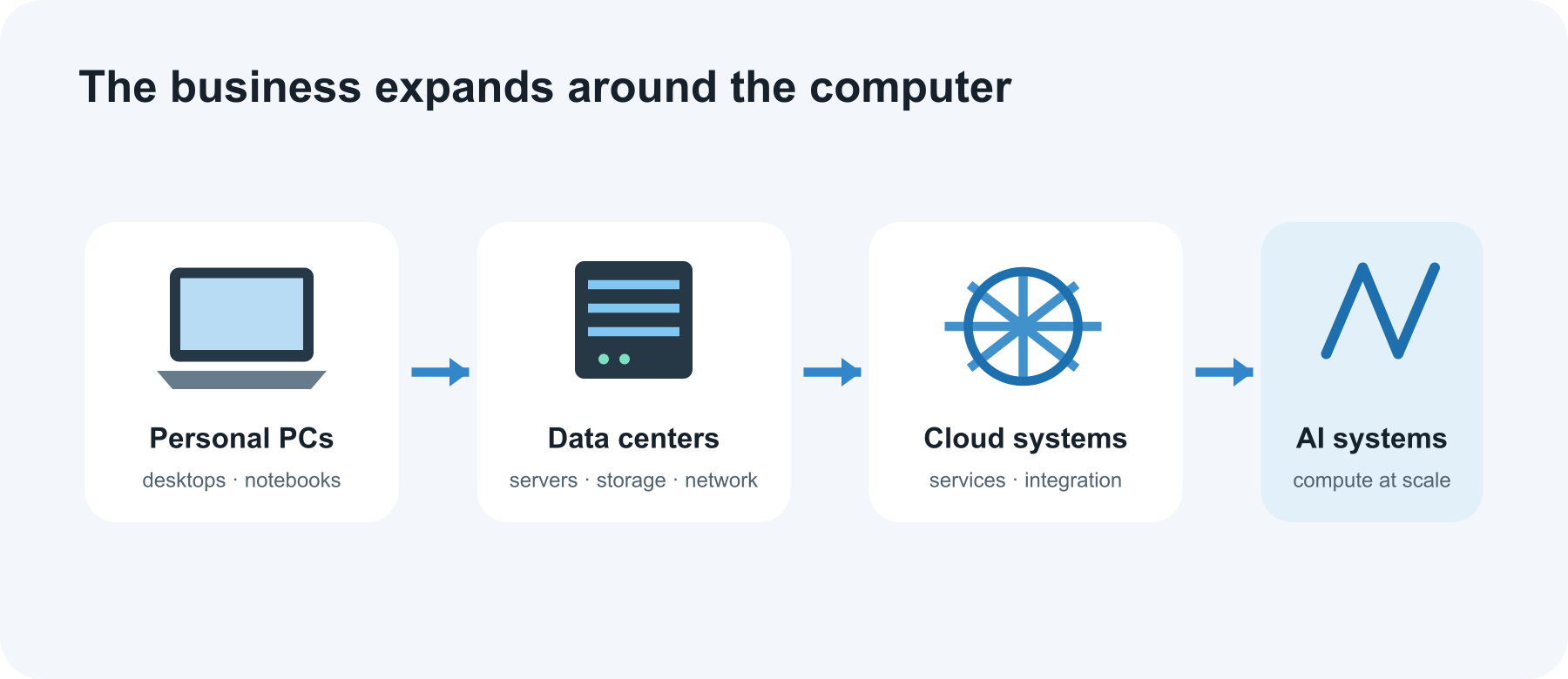
Dell’s growth was not only about desktop PCs. It entered notebook computing, built a server business, and expanded into storage and services. By the early 2000s, the company had become a major global computer-systems supplier. Internet sales and a build-to-order approach helped it scale, while enterprise customers increasingly wanted whole systems—from client computers to the equipment running their data centers.
This shift mattered because the computer industry was changing. Hardware became more connected, businesses relied on larger server fleets, and customers began buying integrated technology services alongside machines. Dell’s later acquisitions were part of a long effort to serve those bigger infrastructure needs.
2013: Dell leaves the public market
After decades as a public company, Dell completed a $24.9 billion leveraged buyout led by Michael Dell and Silver Lake in October 2013. The company argued that private ownership would give it room to invest and transform without the same short-term pressure of public-market reporting. Going private was a major strategic choice during a period when the PC business faced rapid change and the company was expanding beyond PCs.
2016–2021: Dell Technologies and the infrastructure era
In September 2016, Dell completed its acquisition of EMC, a major enterprise storage and infrastructure company. The combined company began operating as Dell Technologies. EMC’s portfolio included VMware, which became part of the group at that time; Dell Technologies later spun VMware off as a separate company in 2021. The merger dramatically broadened Dell’s presence in servers, storage, virtualization, and enterprise systems.
Dell returned to the public markets in 2018, when its Class C shares began trading on the New York Stock Exchange. Taken together, the 2013 buyout and 2018 return make for a rare corporate loop: public, private, then public again, while reshaping the business around a much larger technology portfolio.
From computer maker to technology platform
Dell still sells personal computers, but the company’s history no longer fits inside a PC case. Servers, storage, networking, services, and infrastructure for cloud and AI workloads now sit alongside consumer and business computers. In 2024, Dell announced its AI Factory with NVIDIA. By March 2026, it was marking two years of the program with expanded infrastructure, data-platform, and service offerings aimed at helping organizations move AI from experiments into production.
One thread runs through these changes: the original direct model tried to understand customer requirements and shape a system around them. The products changed from configurable PCs to large-scale infrastructure, but the underlying business question stayed familiar: how can a technology supplier make complex computing easier to buy, deploy, and support?
What Dell’s story tells us
Dell’s trajectory shows that a company can outgrow its first product without abandoning the habits that made it successful. Direct sales helped the business learn from customers; later acquisitions and organizational shifts helped it move into new markets. Those moves also brought complexity, integration challenges, and exposure to cycles in the PC and enterprise markets.
The history is not a straight climb from startup to success. It includes reinvention, a high-stakes leveraged buyout, a major merger, and another return to public ownership. That makes Dell a useful case study in how technology companies adapt when the definition of “the computer business” keeps expanding.
Sources and further reading
- Dell: How we got here (company timeline)
- Dell’s 1984 founding and original direct-sales concept
- Dell history: the company’s 2013 going-private transaction (SEC filing)
- Dell and EMC transaction to close in 2016
- Dell Technologies timeline, including its 2018 return to public markets
- Dell announces AI Factory with NVIDIA (2024)
- Dell AI Factory advances (2026)
Read next
The History of Artificial Intelligence: A Simple Timeline
From Alan Turing’s early question to today’s chatbots, explore the people, pauses, and breakthroughs that shaped artificial intelligence—in plain language.
 nbkhope
A Brief History of Computer Programming: From Wires to Apps
From Ada Lovelace’s 1843 notes to today’s apps and AI coding assistants, see how programming changed—and what a program really is—in plain language.
nbkhope
A Brief History of Programming Languages: From Machine Code to Modern Tools
From machine code and FORTRAN to Python, JavaScript, and Rust, explore how programming languages evolved and why there are so many.
nbkhope
Comments
Be kind and specific. Comments with links from new accounts appear after a moderator reviews them.