The History of the iPad: From Big-Screen iPhone to Creative Studio
Follow the iPad from its 2010 debut as a big-screen companion to a family of tablets for reading, drawing, learning, and professional work.

On this page
The History of the iPad: From Big-Screen iPhone to Creative Studio
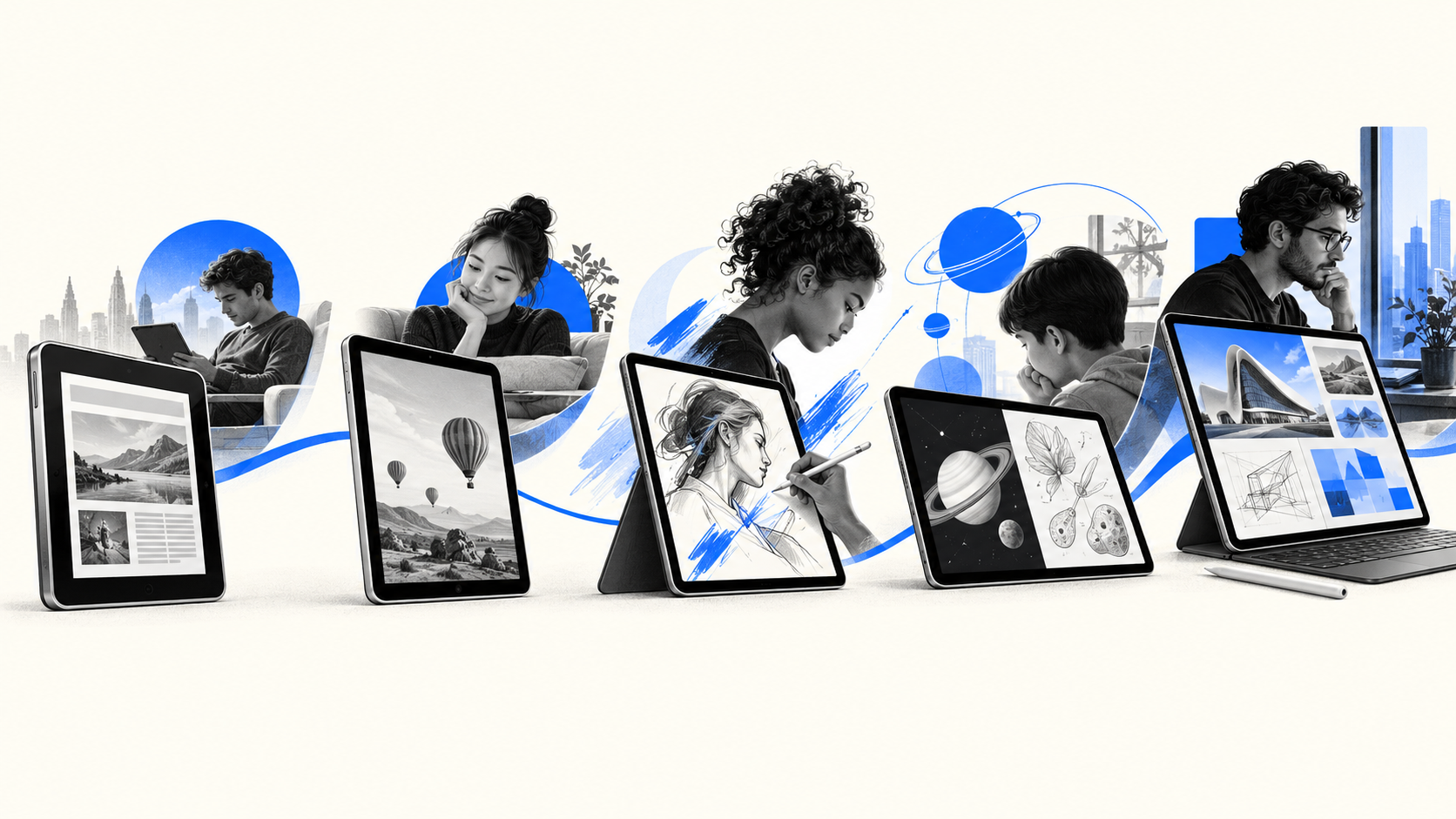
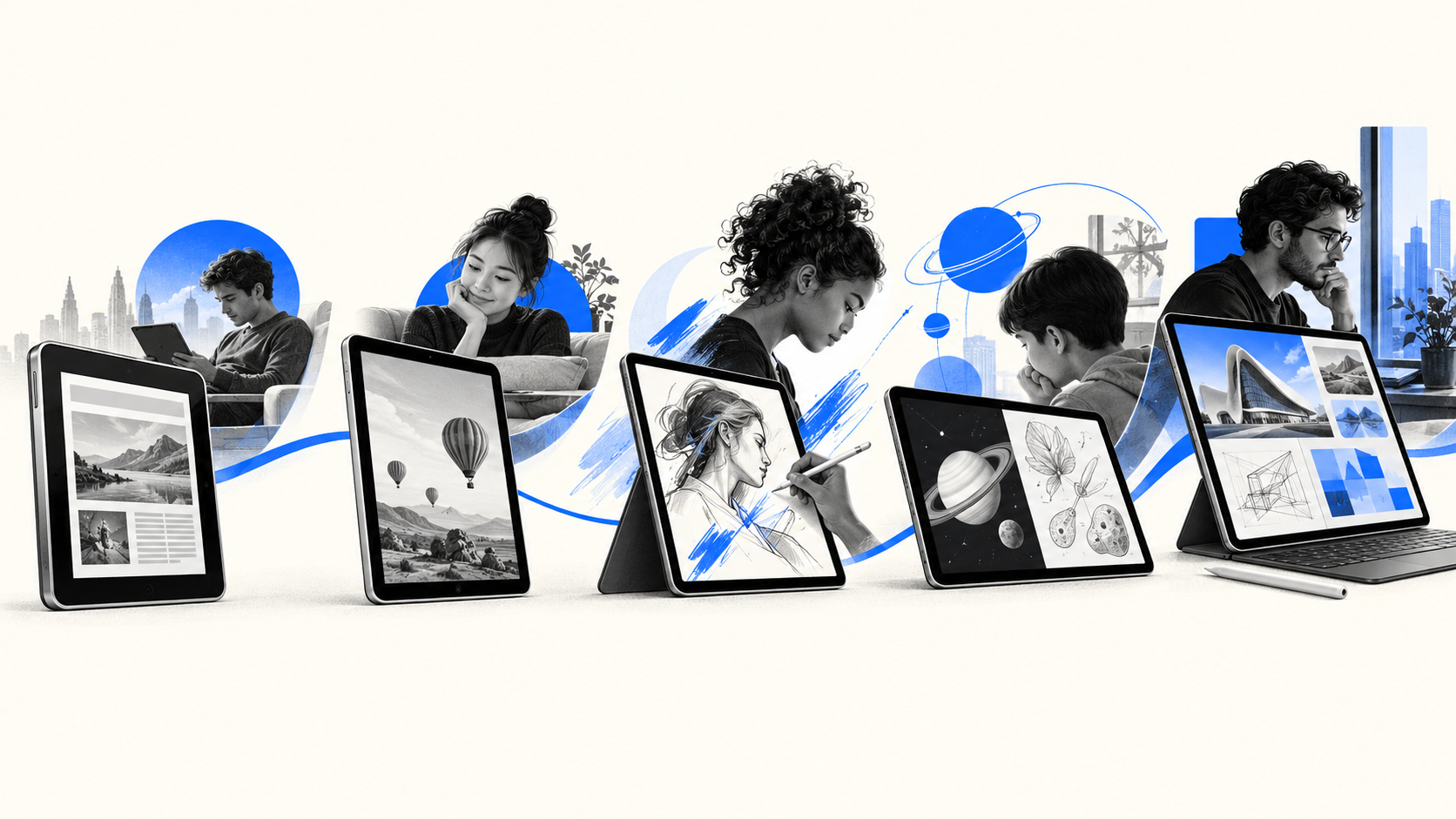
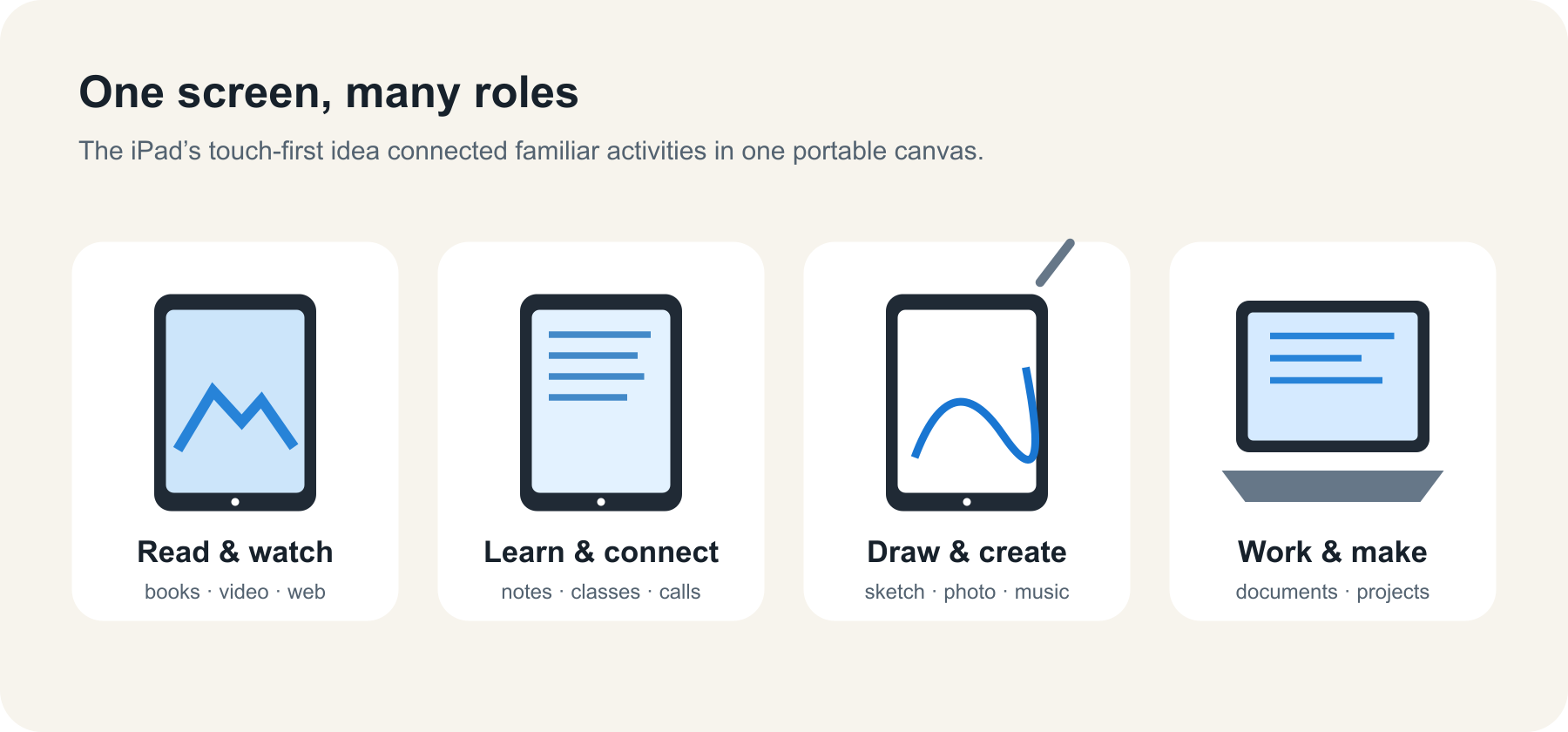
When Apple unveiled the iPad in January 2010, the pitch was simple: a screen you could touch, large enough to make the web, books, photos, games, and video feel inviting from the couch. Fifteen years later, “iPad” describes a whole family: tiny travel companions, everyday tablets, and powerful Pro models with a pencil, keyboard, and desktop-class software.
The fun part of the story is how the iPad kept changing its answer to one question: what is a computer when the screen is also the keyboard, sketchbook, book, and window to the world?
2010: a new space between phone and laptop
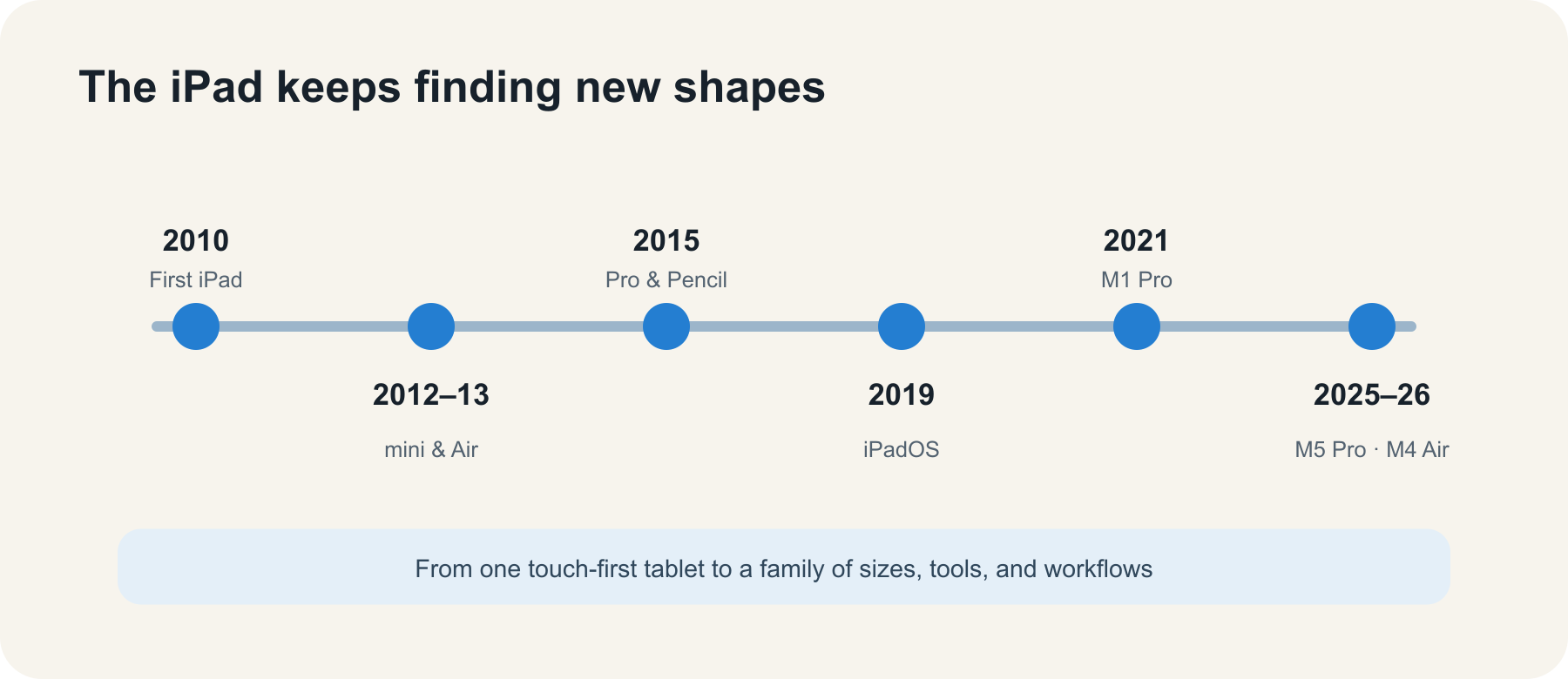
Apple introduced the first iPad on January 27, 2010, and began selling it that April. It had a 9.7-inch multi-touch display, Apple-designed A4 chip, and a starting price of $499 in the United States. Apple pitched it for browsing, email, photos, video, games, and ebooks. It could run most existing iPhone apps, while developers could also make experiences for the larger screen.
The tablet was not born in a vacuum: pen computers and tablet PCs already existed. Apple’s particular bet was to make a slate computer feel immediate and approachable, and to pair it with a ready-made app and media ecosystem. The first iPad sold more than a million units in its first month, an early signal that the category had found a broad audience.
2011–2014: a family begins to form
The iPad 2 arrived in 2011 with a thinner body, cameras, and a faster chip. In 2012, Apple added two different directions: the fourth-generation iPad brought a Retina display to the main model, while the iPad mini made the experience smaller and lighter with a 7.9-inch screen. The message was clear: there was no single ideal tablet size.
In 2013, the iPad Air made the full-size model dramatically lighter and thinner. The iPad line was becoming a design exercise in trade-offs: a bigger canvas for movies and documents, or a lighter device you could carry one-handed. During this period, tablet software also grew more capable, though the iPad still shared much of its software foundation with the iPhone.
2015–2018: Pencil, keyboard, and the Pro idea
The 12.9-inch iPad Pro, introduced in 2015, pushed the tablet toward creative and professional work. Apple Pencil offered precise input for drawing and handwriting, and a Smart Keyboard added physical keys. These accessories did not turn every tablet into a laptop; they gave people more ways to work directly on the screen.
Apple Pencil support reached a more affordable iPad in 2018. That widened the tablet’s role in classrooms and everyday note-taking, where a digital notebook could hold a semester’s notes without the pile of paper. Meanwhile, the mini and Air families continued to serve people who valued portability and balance over maximum screen size or power.
2019 onward: iPadOS gives the tablet its own voice
In 2019, Apple introduced iPadOS as a name for capabilities designed around the iPad’s larger display and multitasking needs. The split also made a useful point: a tablet could share foundations with a phone while still needing its own interface choices. Later updates brought more windowing, file handling, external-display support, and creator tools.
Apple silicon changed the hardware story too. The 2021 iPad Pro moved to the M1 chip, and the 2024 Pro generation brought the M4 chip and tandem OLED display. In October 2025, the Pro advanced to M5; the following March, the Air adopted M4. By 2026, the iPad family paired its most advanced chip in Pro with a powerful Air for students and creators, while mini remained the compact option. The line spans reading and travel, schoolwork and video calls, illustration, music production, and demanding creative apps.
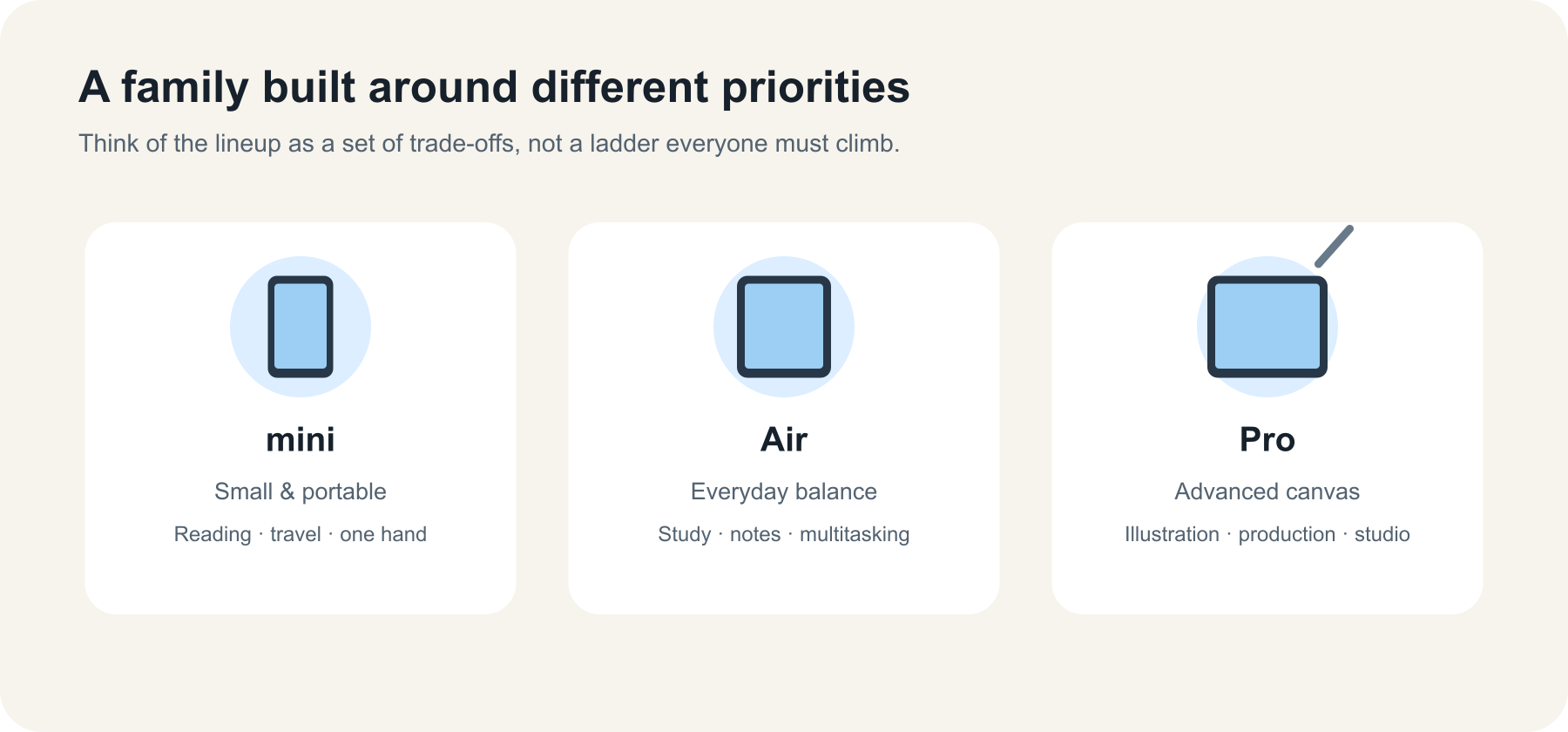
The iPad’s real legacy
The iPad’s biggest contribution may be its range. It helped make the tablet a familiar category and showed that touch-first computing could be useful for consumption and creation. Its evolution also challenged the idea that every computer must begin with a hinge and a keyboard. On an iPad, the accessory can be a pencil, a keyboard, a case, or nothing at all.
It is still not the right tool for every task. Some people prefer a laptop’s precise pointer, windowing, and keyboard-first workflow. The iPad’s history is more interesting than a “laptop replacement” contest: it is a continuing attempt to make computing adapt to the task and the person holding it.
Sources and further reading
- Apple introduces iPad (2010)
- Apple reports one million iPads sold (2010)
- Apple introduces iPad 2 (2011)
- Apple introduces iPad mini (2012)
- Apple introduces iPad Pro and Apple Pencil (2015)
- Apple introduces iPadOS (2019)
- Apple unveils iPad Pro with M4 (2024)
- Apple introduces iPad Pro with M5 (2025)
- Apple introduces iPad Air with M4 (2026)
Read next

The History of Artificial Intelligence: A Simple Timeline
From Alan Turing’s early question to today’s chatbots, explore the people, pauses, and breakthroughs that shaped artificial intelligence—in plain language.
 nbkhope

A Brief History of Computer Programming: From Wires to Apps
From Ada Lovelace’s 1843 notes to today’s apps and AI coding assistants, see how programming changed—and what a program really is—in plain language.
nbkhope
A Brief History of Programming Languages: From Machine Code to Modern Tools
From machine code and FORTRAN to Python, JavaScript, and Rust, explore how programming languages evolved and why there are so many.
nbkhope
Comments
Be kind and specific. Comments with links from new accounts appear after a moderator reviews them.