The History of HP: From a Palo Alto Garage to Personal Technology
Explore HP’s journey from a Palo Alto garage and a precision audio oscillator to scientific calculators, LaserJet printers, PCs, and AI-ready devices.

On this page
The History of HP: From a Palo Alto Garage to Personal Technology
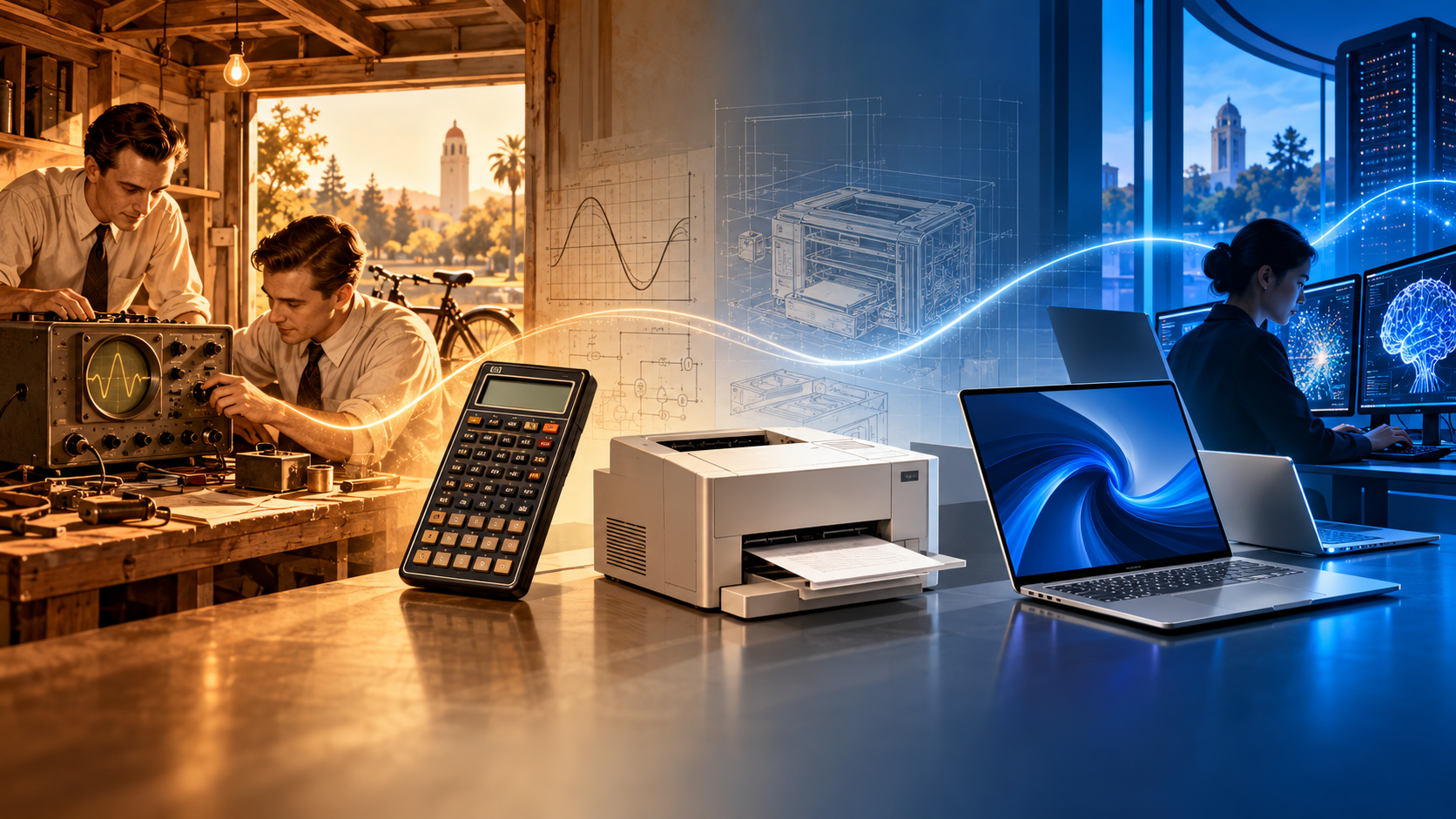
HP’s origin story starts in a garage, but its first famous product was not a computer. In 1939, Stanford classmates Bill Hewlett and Dave Packard formalized a company built around precision electronics. Over the decades, Hewlett-Packard became known for test equipment, computers, calculators, printers, and personal devices. Its history is also a lesson in reinvention: the company that once served engineers and laboratories helped put printing and computing on everyday desks.
1939: an oscillator, a garage, and a coin toss
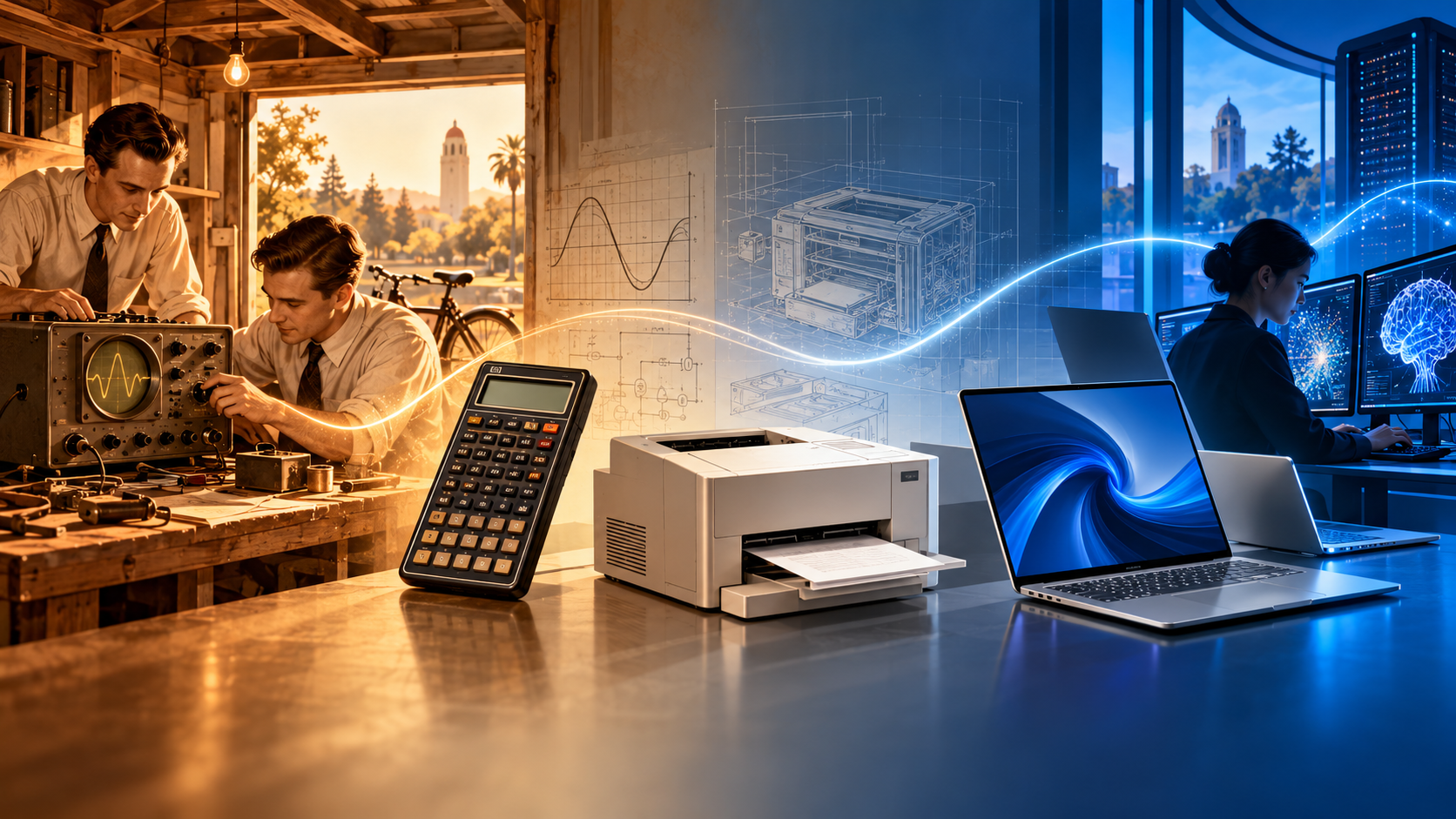
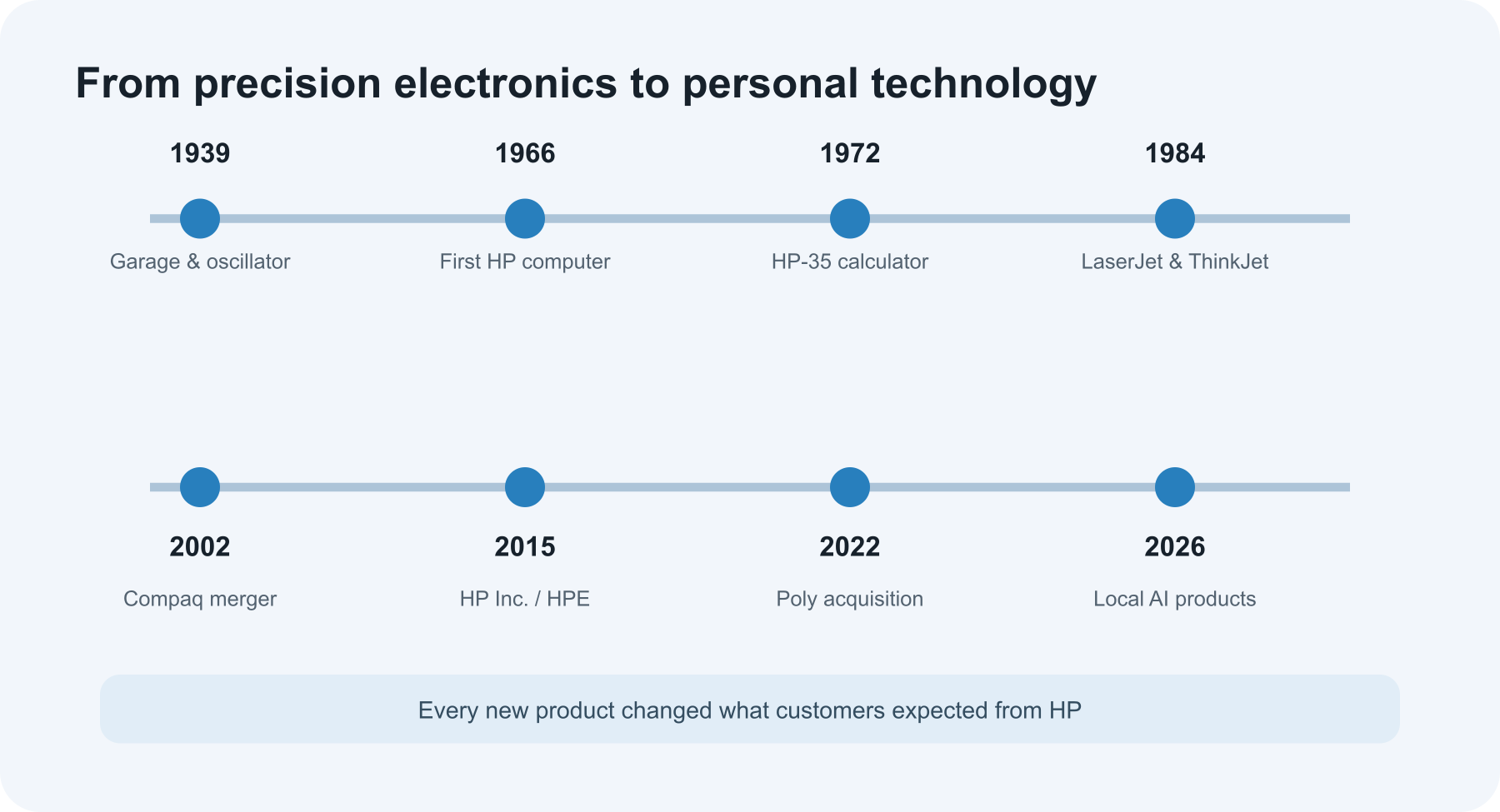
Bill Hewlett and Dave Packard founded Hewlett-Packard in Palo Alto in 1939, beginning with $538 in working capital. They chose the order of their surnames by flipping a coin. Their first product was the Model 200A audio oscillator, an electronic instrument that generated audio frequencies for testing. Walt Disney Studios bought eight oscillators to help develop the sound system for Fantasia, giving the young company an early boost.
The garage was more than a quaint backdrop. HP grew by building reliable instruments for engineers, researchers, and industrial customers. That discipline—solve a specific technical problem, make the instrument dependable, and listen closely to customers—would reappear as the company expanded into new products.
1960s–1970s: computers and a calculator that fit in a pocket
HP entered computing in 1966 with the 2116A, a rugged computer designed to control measurement instruments. It was built to operate in demanding environments, including aboard a research vessel. In 1972, HP introduced the HP-35, the first handheld scientific calculator. Engineers could carry out complex calculations without a slide rule or desk-sized machine. Its success helped make computing more personal and portable.
The HP-35 was a compact device, but it represented a major shift in who could use computing and where. HP continued with programmable calculators and computers for business and engineering, building a reputation at the intersection of electronics and computation.
1980s: computers and printers move onto the desk
HP’s products became more visible in offices and homes during the 1980s. The company introduced personal computers and, in 1984, the LaserJet desktop laser printer. The first LaserJet was expensive by household standards, but it made clear, quiet, high-quality printing practical for offices. HP’s ThinkJet inkjet printer also appeared in 1984, offering a quieter and lower-cost alternative for personal computers.
Printers made HP a familiar name well beyond laboratories and engineering departments. The company connected printers to computers and software, helping people produce documents, reports, and graphics where they worked. It became a bridge between technical innovation and everyday office life.
1990s–2000s: growth, PCs, and the Compaq merger
HP expanded through the personal-computer era, adding desktops, notebooks, printers, and services. In 2002, it completed a merger with Compaq Computer Corporation, combining HP’s businesses with one of the largest PC makers of the time. The enlarged company served consumers, businesses, and governments with personal systems, printing, servers, and services.
Like many technology companies, HP faced the challenge of managing a broad portfolio as markets changed. Its product range stretched from small personal devices to large enterprise systems, from printers to software and services. The next major turning point would redefine what the HP name meant.
2015 onward: two companies and a changing definition of HP
On November 1, 2015, Hewlett-Packard separated into two independent public companies. HP Inc. retained personal systems and printing. Hewlett Packard Enterprise (HPE) took the enterprise technology infrastructure, software, services, and financing businesses. Hewlett-Packard Company changed its name to HP Inc. at the end of October 2015.
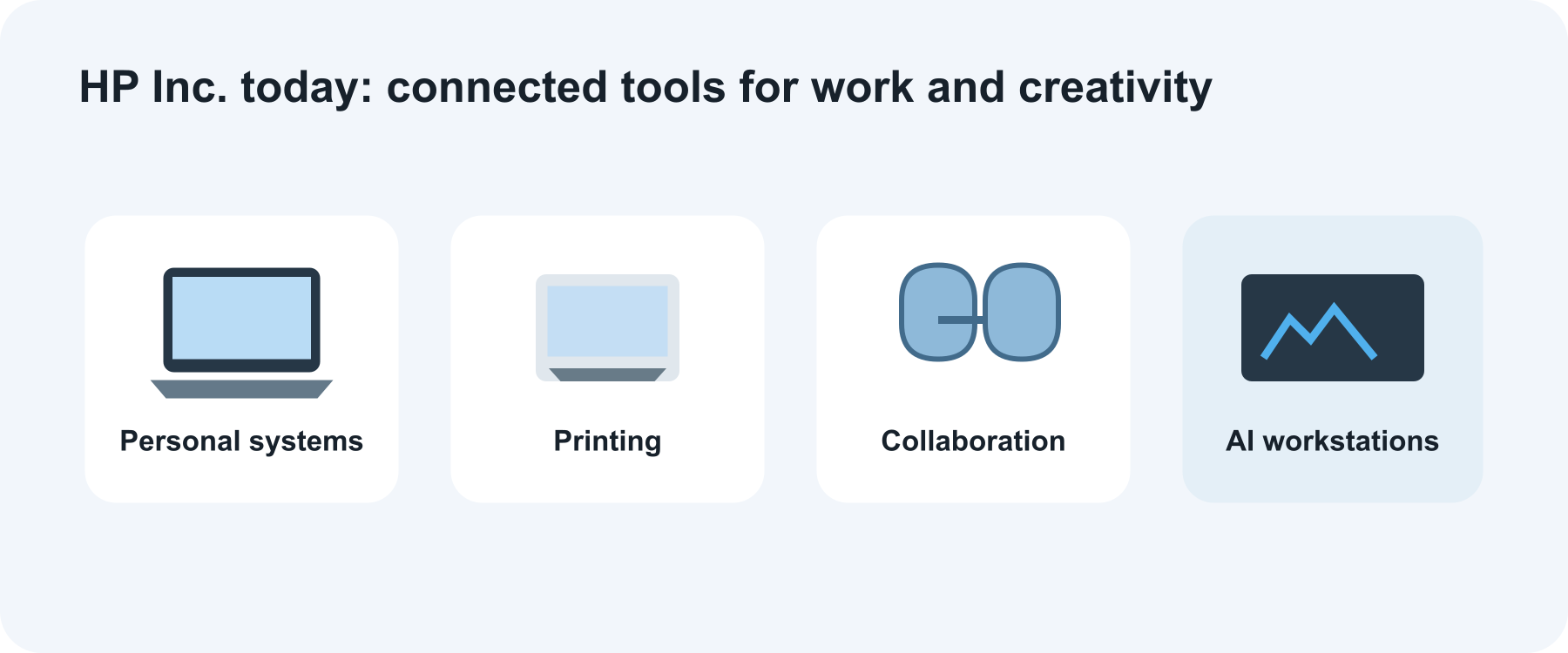
This distinction still matters: HP Inc. and HPE are separate companies with different product portfolios. HP Inc. continues to build PCs, printers, peripherals, and workplace solutions. Its 2022 acquisition of Poly expanded its presence in headsets, cameras, and collaboration tools for hybrid work.
By 2026, HP was presenting local AI as another expansion of the personal-computing story, from AI PCs to Z workstations and intelligent workplace devices. In September, it announced the ZBook Ultra G3a, a mobile workstation designed to run large AI models and agent workflows locally. The products are different from the 1939 oscillator, but the theme is familiar: package complex technology into tools that help people do practical work.
What HP’s history reveals
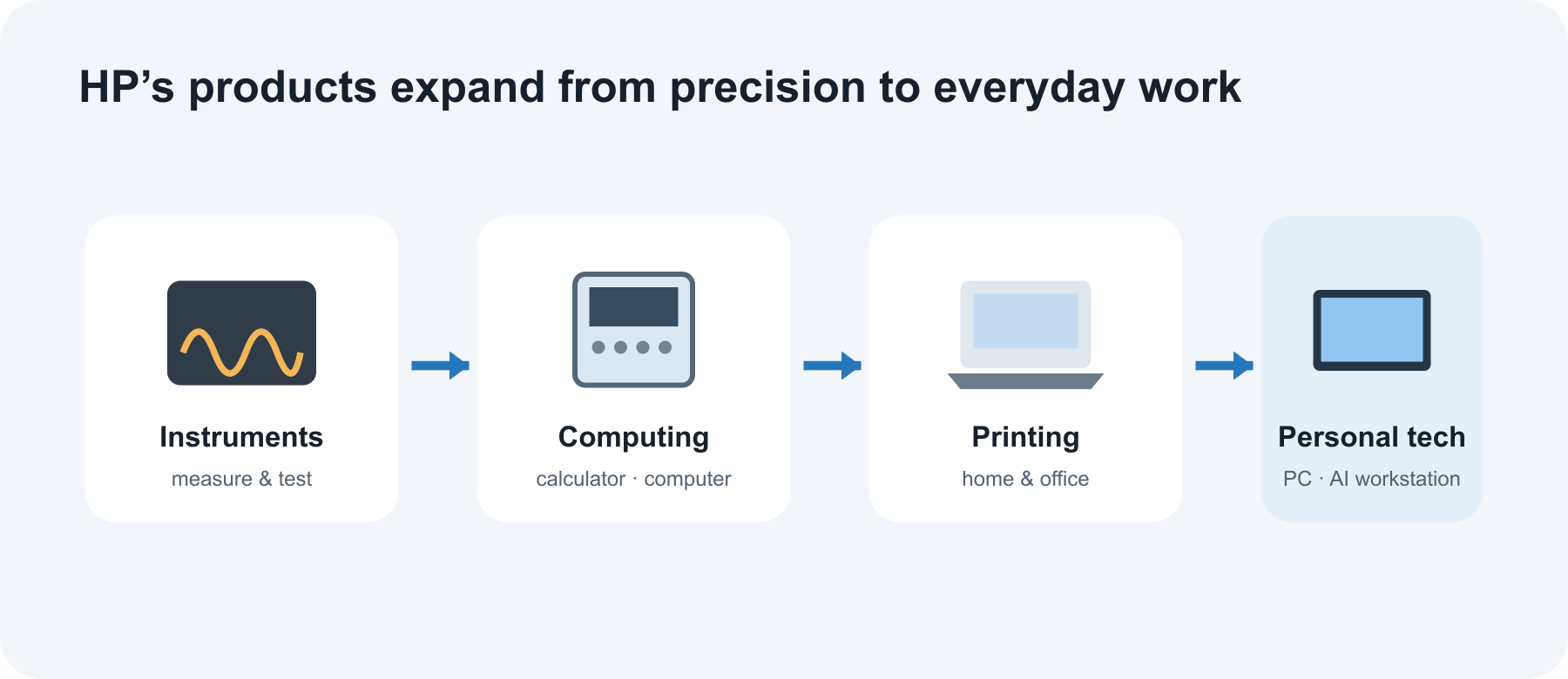
HP’s story is not one straight line from garage to laptop. It is a series of shifts: precision instruments to computers, desktop calculators to personal computing, printing to broad office systems, and a single company to two specialized businesses. Each step changed what customers expected HP to do.
The lasting connection is the focus on useful tools. An oscillator helped engineers test sound equipment; a pocket calculator helped professionals work away from a desk; a printer brought digital documents onto paper. HP’s history shows how a technology company can grow by repeatedly finding a new everyday problem its engineering can solve.
Sources and further reading
- HP’s 1930s timeline and founding story
- HP history: the 2116A, HP’s first computer
- HP history: the HP-35 scientific calculator
- HP timeline: LaserJet and the 1980s
- HP timeline: Compaq merger (2002)
- HP Inc. and HPE separation (2015)
- HP completes acquisition of Poly (2022)
- HP’s 2026 local AI and future-of-work announcements
- HP announces a mobile workstation for local agentic AI (September 2026)
Read next
The History of Artificial Intelligence: A Simple Timeline
From Alan Turing’s early question to today’s chatbots, explore the people, pauses, and breakthroughs that shaped artificial intelligence—in plain language.
 nbkhope
A Brief History of Computer Programming: From Wires to Apps
From Ada Lovelace’s 1843 notes to today’s apps and AI coding assistants, see how programming changed—and what a program really is—in plain language.
nbkhope
A Brief History of Programming Languages: From Machine Code to Modern Tools
From machine code and FORTRAN to Python, JavaScript, and Rust, explore how programming languages evolved and why there are so many.
nbkhope
Comments
Be kind and specific. Comments with links from new accounts appear after a moderator reviews them.