What Is a Neural Network? A Friendly Guide to How AI Learns
Neural networks learn patterns by adjusting connected, layered computations. Follow a cat-photo example to see neurons, weights, training, and what these models can and can’t do.

On this page
What Is a Neural Network? A Friendly Guide to How AI Learns
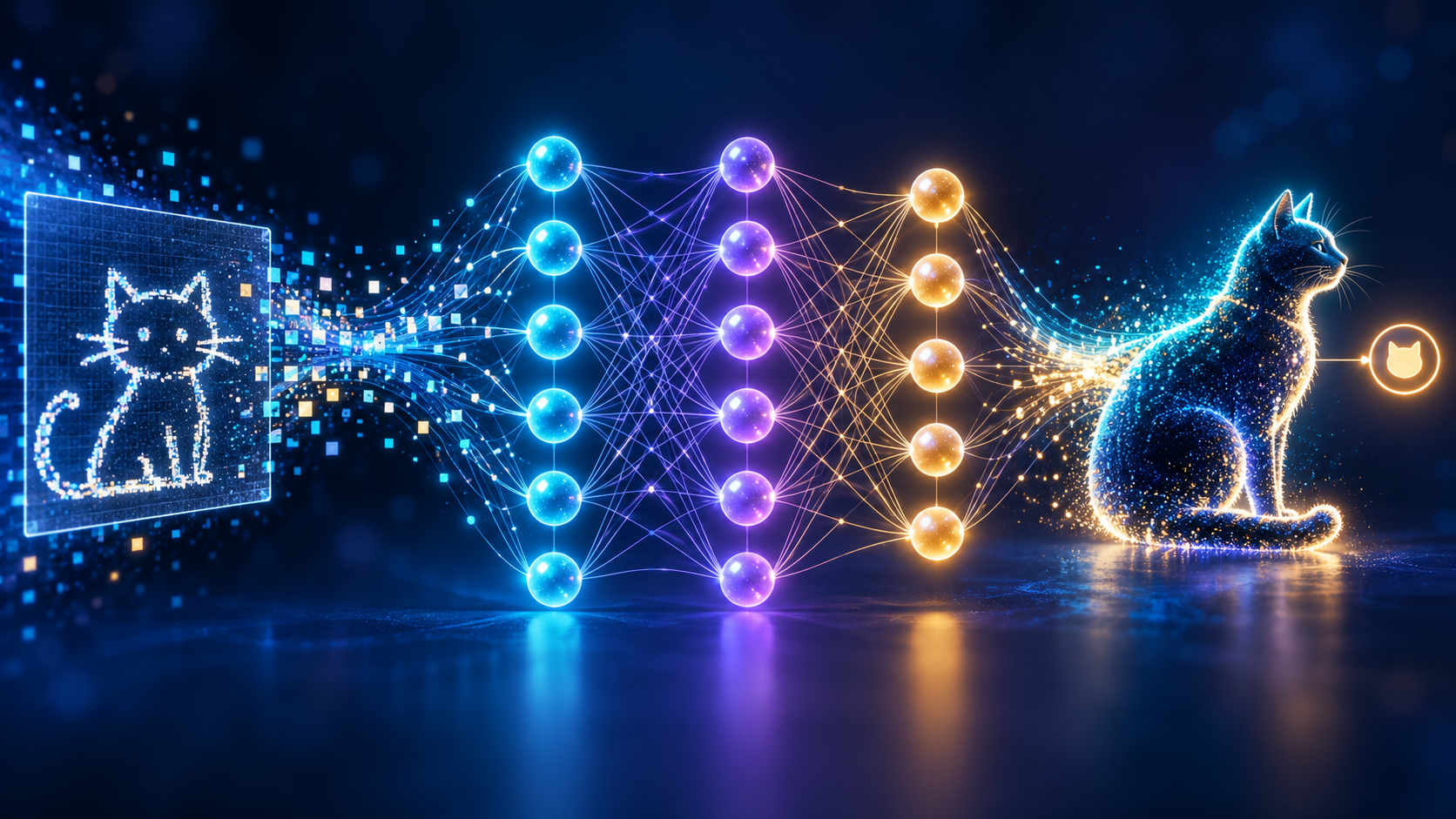
Show a computer thousands of cat photos and ask it to recognize the next one. How could it learn that pointy ears, whiskers, and a certain arrangement of pixels often mean “cat”?
One answer is a neural network: a machine-learning model made from layers of small calculations that learn useful patterns from examples. The name nods to biology, but these are mathematical functions running on computers—not tiny digital brains. Let’s follow one photo through the network and watch how learning happens.
The network, in one picture
A neural network takes numbers as input, transforms them through one or more hidden layers, then produces an output. The lines between nodes carry learned weights; each node combines its incoming values, adds a bias, and usually applies an activation function.
1pixels / measurements       hidden layers                 prediction
2  x₁  ───────┐             ○───○───○
3  x₂  ───────┼────────────▶ ○───○───○ ────────────────▶  cat: 0.91
4  x₃  ───────┘             ○───○───○                    dog: 0.06
5                            learned features              bird: 0.03
In this sketch, the circles are neurons (or units), and the lines are connections. A real image model may start with hundreds of thousands of pixel values and contain many more units and connections than fit in this drawing.
What does one neuron actually do?
You can think of a neuron as a tiny scoring machine. It multiplies each input by a weight, adds those results together with a bias, and passes the score through an activation function:
score = (input₁ × weight₁) + (input₂ × weight₂) + bias
output = activation(score)
Suppose two made-up image measurements are “pointy-ear signal” (0.8) and “round-ear signal” (0.2). With weights 0.6 and -0.4 and a bias of 0.1, the score is:
score = (0.8 × 0.6) + (0.2 × -0.4) + 0.1 = 0.5With a ReLU activation, negative scores become zero and positive ones pass through. This unit sends 0.5 to the next layer. It has not “understood ears”; it has performed a useful learned calculation.
| Part | Plain-language job |
|---|---|
| Input | The numbers describing an example, such as pixel values |
| Weight | How strongly a connection influences the next calculation |
| Bias | An adjustable offset that shifts a neuron’s score |
| Activation | A function that lets the network model more than one big linear rule |
| Output | The prediction, score, or other result the task asks for |
The example is intentionally tiny. Real neural networks can have millions or billions of adjustable parameters and many different layer designs.
How does a network learn?
Training is a repeated try, measure, adjust loop. The network makes a prediction, compares it with a known answer, measures the error with a loss function, then adjusts its weights to reduce that loss.
1training example + correct label
2              │
3              ▼
4       network prediction ──▶ loss: how far off?
5                                  │
6                           backpropagation
7                                  │
8                       update weights and biases
9                                  │
10                                  └──▶ try the next example
For a cat-photo classifier:
- Feed in a labeled photo: “cat.”
- The network predicts scores for cat, dog, and bird.
- The loss is larger when the cat score is too low or another class is too high.
- Backpropagation calculates how each weight contributed to that loss.
- An optimizer nudges the weights in a direction expected to reduce the loss.
- Repeat with many examples; evaluate on photos the model did not train on.
The calculus is handled automatically by modern libraries such as PyTorch. The important idea is that the network’s internal weights are adjusted from feedback. It does not store a hand-written rule that says “if whiskers, then cat.”
Why stack layers?
Each layer can turn its inputs into a more useful representation. In an image model, early computations may respond to simple edges or color changes; later layers can combine signals into shapes and parts; still later layers can support the task’s final prediction. This is an intuition, not a guarantee that every neuron has a neat human-readable meaning.
A network with multiple hidden layers is called deep. Deep learning is the part of machine learning that uses these deeper neural networks. Different architectures suit different data and tasks:
| Architecture | Common use | A helpful picture |
|---|---|---|
| Feed-forward network | Tables and basic classification | Signals move layer by layer toward an output |
| Convolutional network (CNN) | Images and spatial patterns | Filters scan for local visual patterns |
| Transformer | Text, code, images, audio, and more | Attention helps relate parts of the input |
| Recurrent network (RNN) | Ordered sequences, especially in older systems | A state carries information from earlier steps |
This is a map, not a rulebook. Modern systems can combine architectures and use specialized components for particular jobs.
Where do we meet neural networks?
They help power speech recognition, language translation, image classification, recommendation systems, scientific modeling, and generative AI. A large language model, for example, is built with a neural-network architecture—most current LLMs use Transformers—but “neural network” is a much bigger family than chatbots.
The same basic idea supports very different tasks. A network might classify a photo, estimate a number, rank search results, or generate the next token in a sequence. The inputs, outputs, training data, objective, and architecture all matter.
What neural networks are good at—and what can go wrong
Neural networks can learn complicated patterns that would be difficult to write as a list of fixed rules. That flexibility is powerful, but it also means they depend on examples and training choices.
- They can overfit. A model may memorize quirks in training data and perform poorly on new examples. Keep a separate test set and check performance on data it has never seen.
- Data quality matters. Missing, noisy, or unrepresentative examples can produce unreliable predictions or uneven performance across groups.
- They can be hard to interpret. A correct prediction does not automatically explain why the network made it.
- They can require significant compute. Training large models can take substantial time, specialized hardware, and energy.
- A score is not certainty. A high model score does not guarantee a prediction is correct, fair, or calibrated for the real-world decision.
A neural network is a pattern-learning tool, not a truth detector. For consequential decisions, evaluate it carefully and keep people accountable for how it is used.
Try the idea yourself
Google’s Machine Learning Crash Course has interactive neural-network lessons on nodes, hidden layers, activation functions, and training. If you want to see the learning loop in code, PyTorch’s beginner material walks through a complete model workflow, including automatic differentiation and optimization.
As you explore, keep this little checklist:
- What are the input numbers?
- What should the model predict?
- What examples teach it?
- How will you check it on examples it has not seen?
- What mistakes would matter most?
Once you can answer those, “neural network” stops sounding like a mysterious brain in a box. It becomes a layered calculator that learns which patterns help solve a particular task.
Sources and further learning
- Google for Developers: Neural networks — nodes, hidden layers, activation functions, and training.
- Google for Developers: Backpropagation — how error gradients guide weight updates and common training pitfalls.
- PyTorch: Learn the Basics — a complete beginner machine-learning workflow, recently updated in 2026.
- PyTorch: Neural Networks — defining a model and the typical training procedure.
- Goodfellow, Bengio, and Courville: Deep Learning — a free, detailed textbook on the mathematics and architectures behind deep learning.
Read next

What Is Meta Muse? A Guide to Meta’s AI Models and Tools
Meta Muse is a family of AI models and products from Meta, spanning its Meta AI assistant, multimodal reasoning, creative tools, and developer-focused agents. Here is what the name covers and what to know about its newest models.
 nbkhope
What Is a Transformer in AI? The Idea Behind ChatGPT, Explained Simply
A friendly, jargon-free guide to transformers, the AI design behind ChatGPT, Claude and Gemini. Learn how "attention" lets AI understand words in context, what happens inside a transformer, and why it changed AI so quickly.
nbkhope
What Is Reinforcement Learning? How AI Learns by Trial, Error and Reward
A friendly, jargon-free introduction to reinforcement learning, how AI learns by trial, error and reward, like training a dog with treats. Watch a real robot learn a maze, see why exploring matters, and learn how it shapes chatbots.
nbkhope
Comments
Be kind and specific. Comments with links from new accounts appear after a moderator reviews them.