How to Use AI to Make Money: A Realistic Guide
Explore realistic ways to use AI to support paid work or a small business, validate demand, protect customer data, and avoid get-rich-quick claims.


On this page
How to Use AI to Make Money: A Realistic Guide
Can AI help you make money? It can help you do parts of useful work faster—research a customer problem, draft a proposal, organize a workflow, or polish a first version. But the customer, skill, judgment, quality, and follow-through are still the business. A chatbot does not print cash; it prints words, pictures, plans, and occasionally a very confident mistake.
The most promising question is not “How do I make money from AI?” It is “Who has a problem I can solve, and where could AI help me solve it better?”

Three practical routes
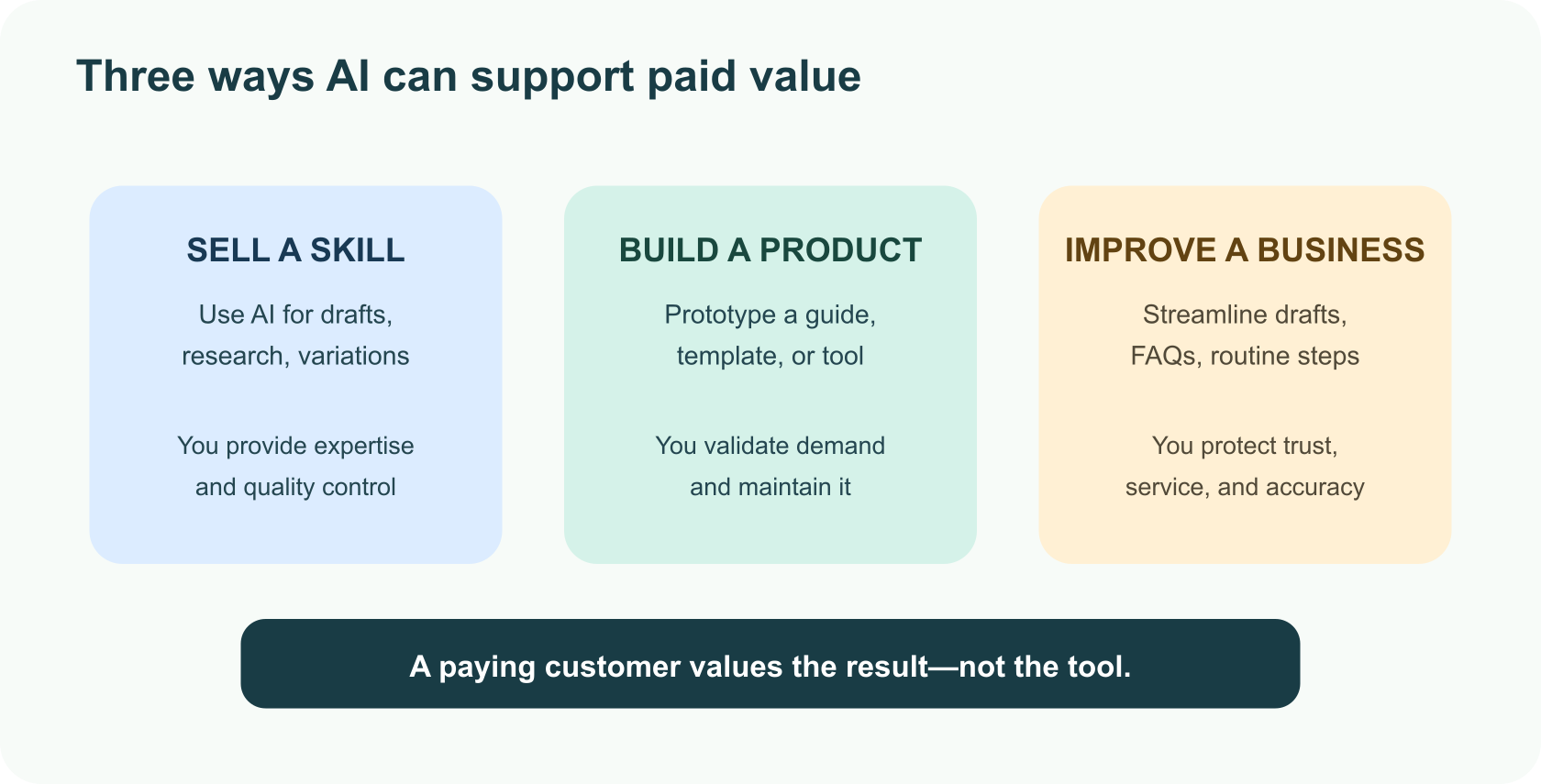
1. Add AI to a skill people already pay for
If you already write, design, translate, teach, code, edit video, analyze data, or support customers, AI may help with research, outlines, drafts, variations, or routine steps. Sell the outcome and your expertise—not “AI output.” Check the facts, edit for the client, and be clear about how you handle AI-assisted work.
2. Build a small product around a real need
AI can help you prototype a workbook, lesson plan, spreadsheet template, niche reference guide, or small software tool. First talk to likely users. Find out what they do now, what is frustrating, and whether they would pay for a better result. A product nobody needs is still nobody’s favorite product, even if the launch graphics are spectacular.
3. Improve a business you already understand
For an existing shop or service, AI can help draft FAQs, make internal checklists, summarize non-sensitive feedback, or create first-pass marketing variations. Keep humans responsible for accuracy, customer commitments, and the experience. Automating a confusing process just delivers confusion at higher speed.
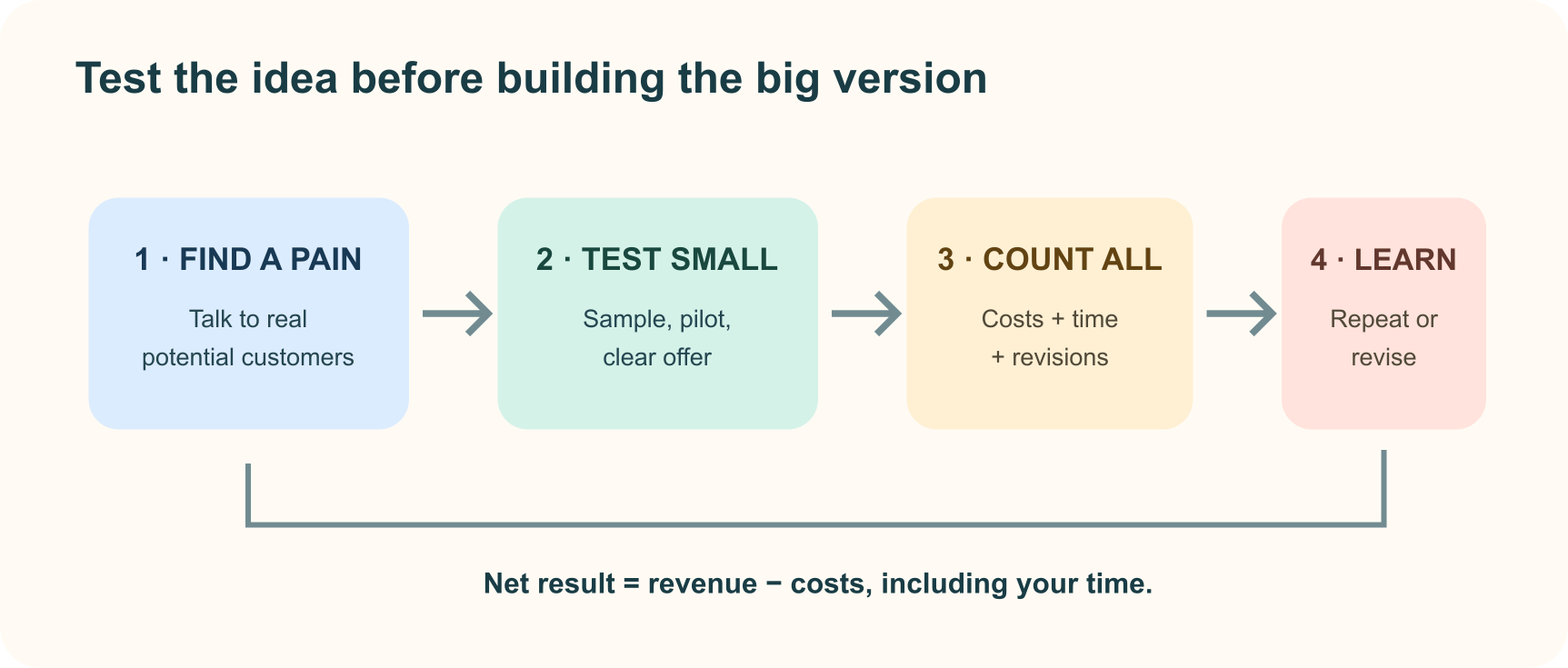
Validate before you invest
Use AI as a research helper, not as proof of demand. Ask it to list customer groups, competing solutions, questions for interviews, and assumptions that need evidence. Then speak with real people and check reliable market sources. The U.S. Small Business Administration recommends market research to find customers and competitive analysis to understand the market and potential advantage.
Try this prompt:
1I can [skill or resource] and want to help [specific group].
2Suggest three problems worth investigating, not guaranteed business ideas.
3For each, list who might pay, what people use now, what evidence I need,
4and a low-cost way to test demand before building. Flag your assumptions.
Then test a small offer: a sample, a short paid pilot, a service package, or a waitlist. Ask what people actually did, not only whether they liked your idea. Praise is nice; a real purchase, repeat use, or a useful referral is stronger evidence.
Use the tool to improve the work, not fake expertise
AI can draft a proposal, turn your notes into a checklist, generate interview questions, explain unfamiliar code, or produce alternatives for a design you can evaluate. It can also fabricate facts, misread a brief, or generate generic work that looks like everyone else’s. Build a repeatable review step around the deliverable:
- Compare every claim with the approved source or your expertise.
- Check names, numbers, citations, calculations, and product details.
- Test code and interactive work in a safe environment.
- Ask whether the result actually solves the customer’s problem.
- Keep a record of what you changed and what the client approved.
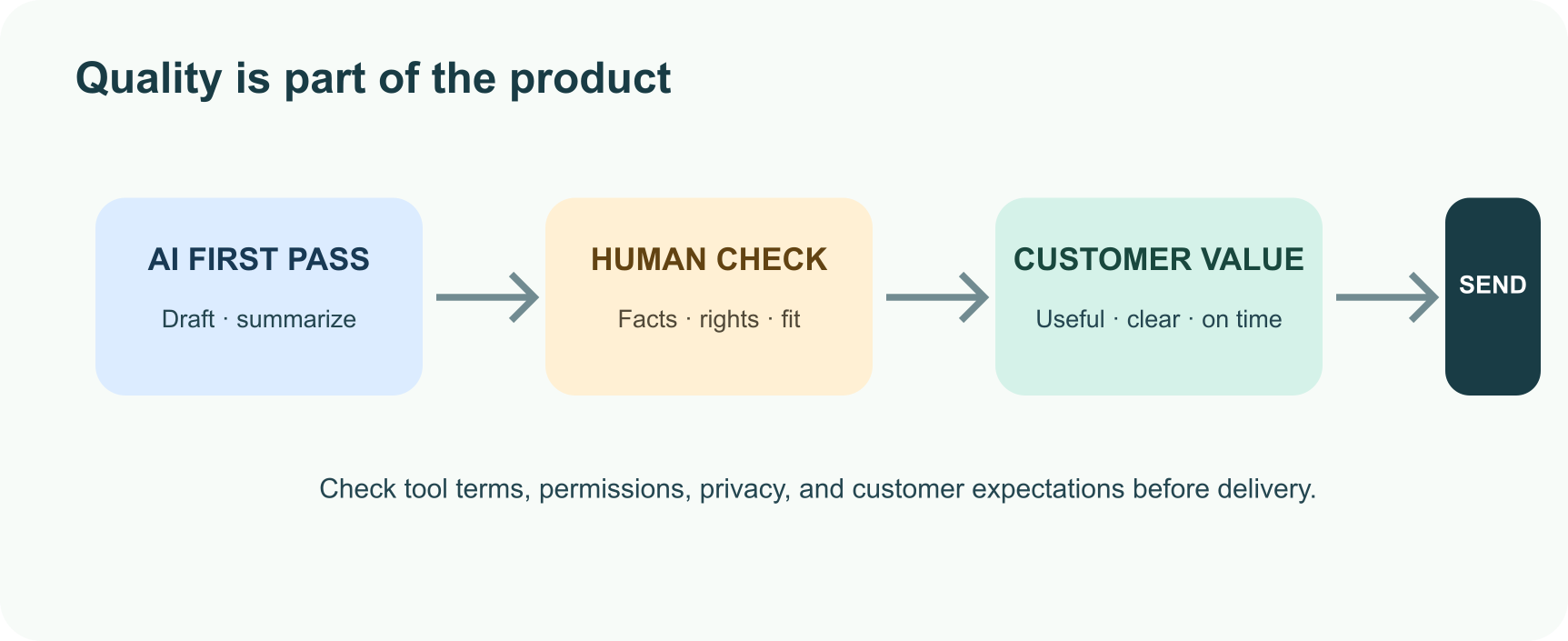
In the United States, the Copyright Office says copyrightability for AI-assisted works depends on human contributions and the facts of the work; rules differ across countries and continue to evolve. Do not promise customers exclusive rights or legal protection you have not verified. Check tool terms, licenses, client contracts, platform rules, and the law where you operate.
Count the full cost
Before pricing, include the time spent prompting, checking, editing, communicating, delivering, handling revisions, and supporting customers. Add subscriptions, transaction fees, materials, taxes, insurance, and other operating costs that apply to you.
Net result = customer revenue − all costs, including your time.
Track the hours from first conversation to accepted delivery. If AI cuts drafting time but doubles correction time, it has not improved the business yet. Start with tools you can afford, set a small budget, and avoid taking on debt based on an untested idea. Tax and registration obligations vary by location; check your local government guidance or a qualified adviser.
Protect trust and data
Do not paste a client’s private files, personal information, credentials, or confidential plans into a tool unless your agreement and the tool’s approved terms allow it. Remove identifying details where possible. Get permission before using someone’s likeness, voice, private writing, or other sensitive material. Tell customers what you use AI for when that affects the service, privacy, rights, or expectations.
Be skeptical of courses or “done-for-you AI stores” promising guaranteed passive income. The FTC has brought cases alleging deceptive earnings claims in AI-powered online-store schemes. Before paying for coaching or an opportunity, research the seller, demand written evidence for earnings claims, read refund and recurring-fee terms, and never rush because a seller says a deal expires tonight.
A seven-day experiment
Choose one audience and one problem. Spend the first two days talking to potential customers; use AI to organize interview questions and notes without exposing personal data. On day three, make a tiny sample. On day four, show it to people and ask what is missing. On day five, offer a small pilot with a clear scope and price. Then deliver it, track every hour and cost, and decide what to change.
The win might be a paying customer—or learning quickly that the idea needs work before you spend more. Either result beats buying a “secret system” because an ad promised a seven-figure side hustle by Thursday.
Further reading
- Plan your business and research your market — U.S. Small Business Administration
- AI income and business opportunity scams — Federal Trade Commission
- Impact of generative AI on jobs, productivity and work organization — International Labour Organization (2026)
- Copyright and Artificial Intelligence — U.S. Copyright Office
- NIST AI Risk Management Framework: Generative AI Profile
Read next

How to Generate Audio from Text with Text-to-Speech (TTS)
Turn a written script into spoken audio: try your browser’s built-in voice, then generate an MP3 with a modern text-to-speech API. Learn voice selection, SSML pronunciation fixes, and quality checks.
 nbkhope

How to Label AI Data: A Practical Guide to Better Training Examples
Learn to label AI data with a clear task, practical label rules, a small pilot, and quality checks that catch disagreements instead of hiding them. Includes a worked customer-support example.
nbkhope
Build Your Own MCP Server: Give AI a New Superpower
Build a tiny MCP server from scratch: expose a useful tool, connect it to an AI host, test the conversation, and learn the safety checks that turn a fun demo into a solid integration.
nbkhope
Comments
Be kind and specific. Comments with links from new accounts appear after a moderator reviews them.