The History of Social Media: From Bulletin Boards to Algorithmic Feeds
From dial-up bulletin boards to algorithmic feeds, explore how social media changed the way people find communities, share stories, and shape culture.

On this page
The History of Social Media: From Bulletin Boards to Algorithmic Feeds
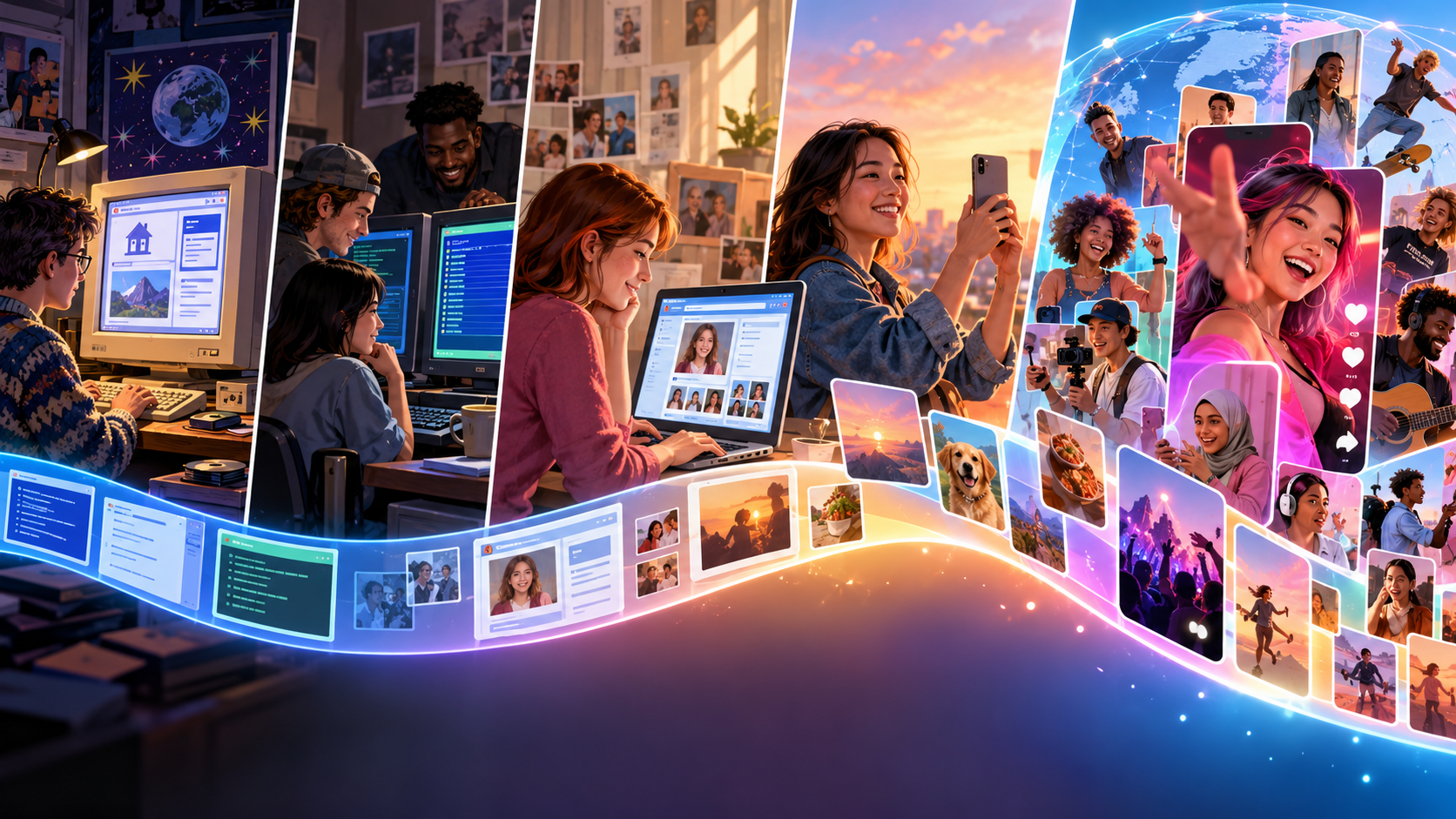
Long before anyone could “like” a cat video, people were dialing into computers to talk with strangers who loved the same things they did. The tools changed—from noisy modems and text forums to pocket cameras and recommendation feeds—but the impulse stayed familiar: find your people, share something worth seeing, and see what they think.
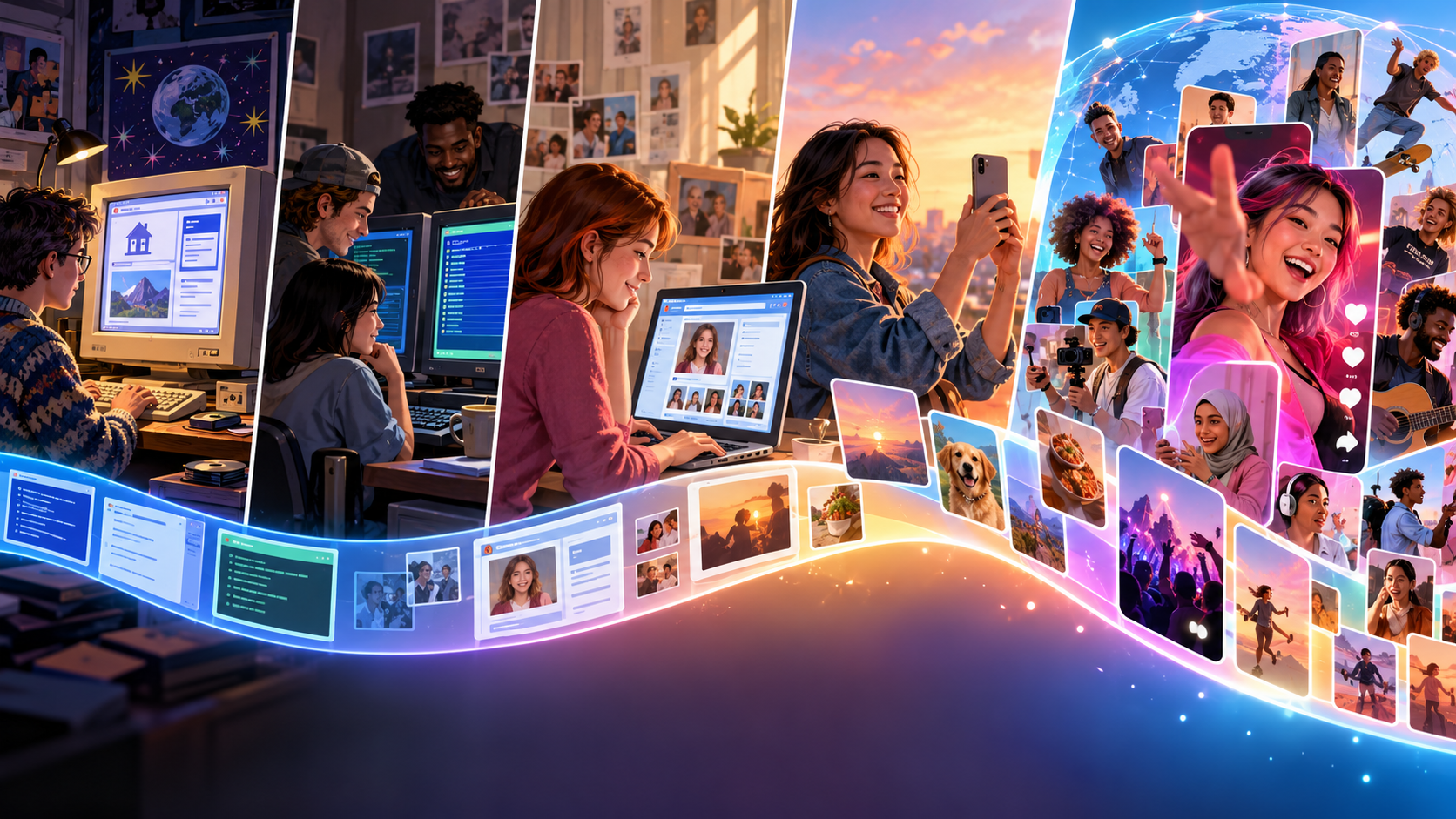
So when did social media begin? There is no single birthday. Online communities existed before the modern web; profile-based social network sites came later; today’s platforms blend publishing, messaging, entertainment, commerce, and community.
A timeline of connection
Before the feed: dial in and find your people
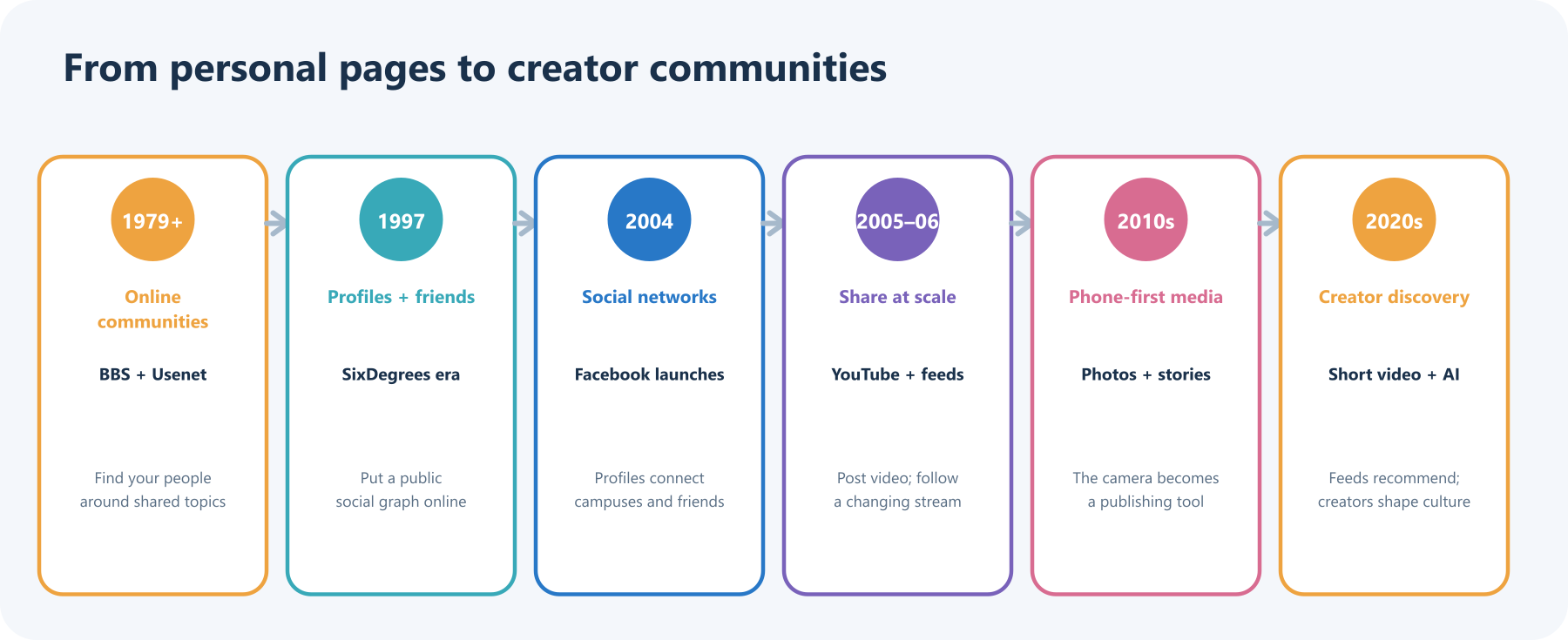
In the late 1970s and 1980s, bulletin board systems (BBSs) let people connect to a computer over a telephone line, leave messages, trade files, and join discussions. Usenet newsgroups organized conversations by topic. The Computer History Museum’s account of early online communities describes how these dial-up spaces laid groundwork for familiar online habits: posting, replying, sharing knowledge, and making friends around a common interest.
These places were not “social media” in the modern app-store sense. They were slower, smaller, and often local—but they already had moderators, community rules, regulars, newcomers, and the occasional argument about what counts as good netiquette.
The web gives social life a profile
In the 1990s, the web made it easier to create a public identity online. The first recognizable social network site, SixDegrees, launched in 1997, combining profiles with lists of friends. Researchers danah boyd and Nicole Ellison later described these services as sites where people create profiles, articulate connections, and view those connections. Their history and definition of social network sites is a useful reminder: the network graph—not just the posts—was a major innovation.
In the early 2000s, services such as Friendster, MySpace, LinkedIn, and others made profiles, friend lists, music, photos, and personal pages part of everyday web culture. Each site had its own flavor. Some were about work, some about dating, some about bands and friends. A profile could feel like a digital bedroom door: decorate it, pin up your favorites, and let visitors know who you were.
The feed turns a network into a daily show
Facebook launched in 2004; YouTube began in 2005 as a place to upload and share video. Then social platforms began organizing updates into feeds. Facebook’s News Feed arrived in 2006, turning a list of friends into a continually refreshed stream of their activities. Meta’s retrospective describes the challenge that followed: when everyone can publish, there is more information than one person can read in order.
That challenge helped shift the design from “show every update in time order” toward ranking and recommendations. A feed could surface a post from a distant friend, a breaking video, or a creator you had never met. More discovery meant more chances to stumble on something delightful—and more power for platforms to shape what became visible.
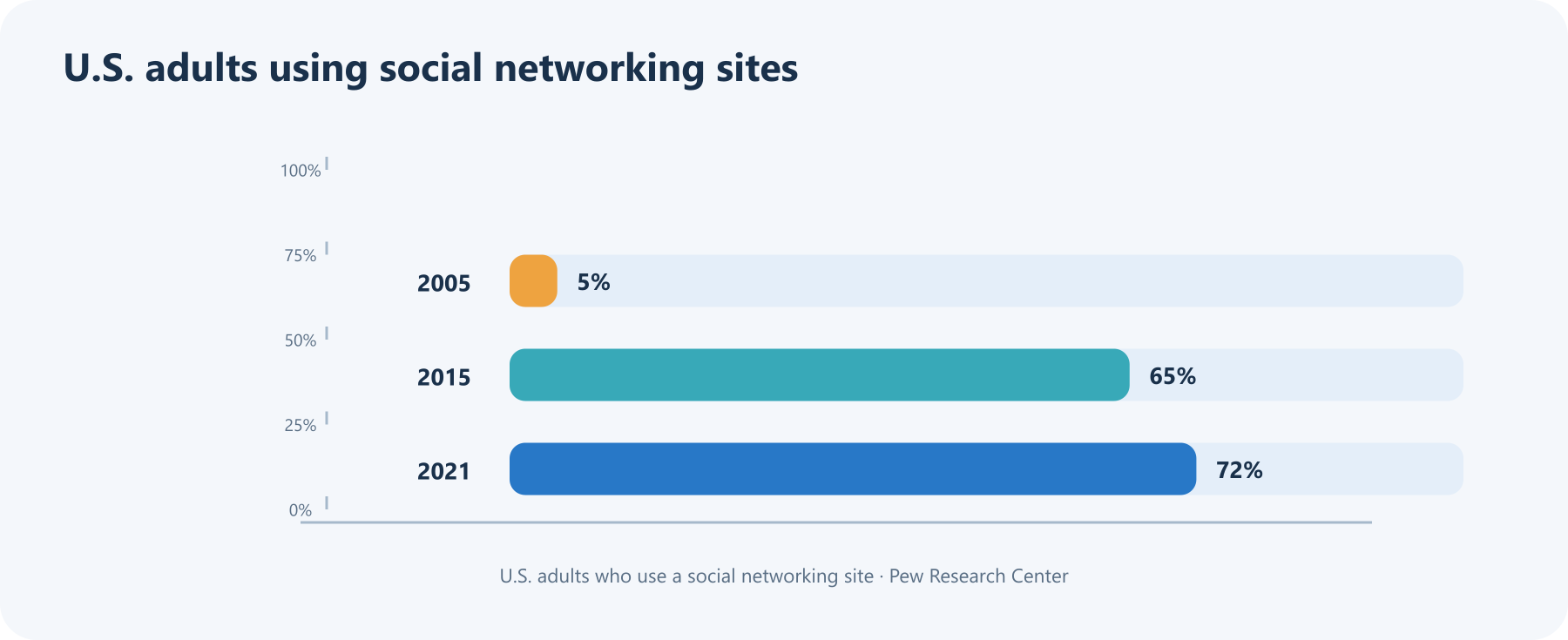
The chart tracks U.S. adults who said they used a social networking site, not every possible meaning of “social media.” Pew measured 5% in 2005, 65% in 2015, and 72% in 2021. Those numbers show how rapidly a once-niche activity became mainstream. Pew’s trend chart and survey notes include the definitions and methodology behind the figures.
The smartphone puts publishing in everyone’s hand
Touchscreen phones combined a camera, a network connection, and an app for sharing. Instagram launched as a photo-sharing service in 2010. Short posts, stories, livestreams, vertical video, and creator channels followed across the industry. You no longer needed a computer to publish a picture or respond to a trend; the camera and the audience were in the same pocket.
Platforms also became places to watch, learn, organize, shop, and follow the news. The latest comparable Pew survey available at publication, fielded in 2025, found YouTube and Facebook were the most widely used social media platforms among U.S. adults, with half using Instagram. The same report shows that age and platform matter: a person’s social media world can look very different from someone else’s. Pew Research Center, Americans’ Social Media Use 2025
How one post travels
Today, publishing is only the first step. Friends, followers, hashtags, recommendations, search, and resharing can each bring a post to a different audience.
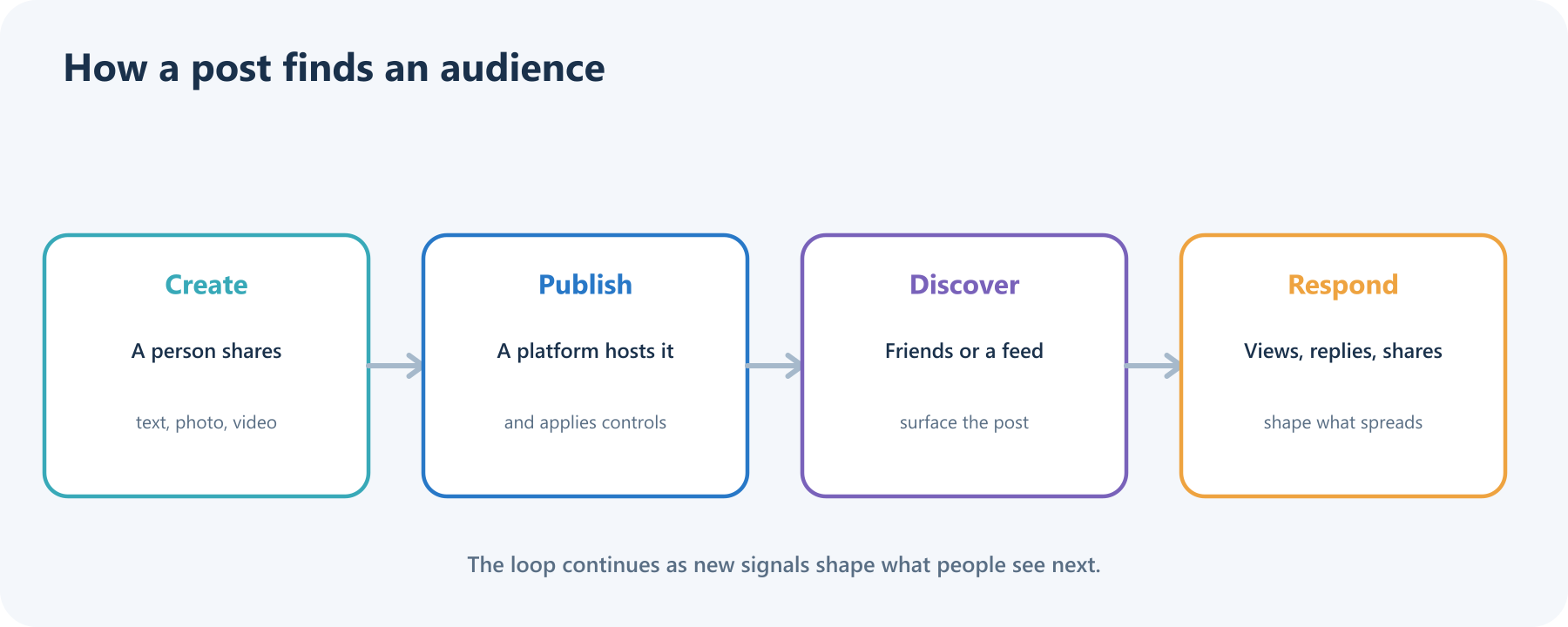
In 2018, TikTok united its app with musical.ly to create a global short-form video service and described a personalized “For You” feed as part of the experience. That helped make recommendation-led discovery a defining pattern: a post can reach people who do not already follow its creator. TikTok’s announcement describes the merger and personalized feed.
The modern chapter: creators, AI, and context
Social platforms increasingly mix friends’ updates with creator media, recommendations, live events, storefronts, private messages, and AI tools. Recommendation systems can connect people to niche communities, tutorials, and new voices. They can also make it harder to tell why a post appeared or how one viral clip became the main character of everyone’s afternoon. Platforms offer different feed controls, such as following selected accounts or switching to chronological views, though the options vary.
Generative AI adds another twist: posts may include synthetic images, altered video, or generated voices that look and sound real. Platforms have begun adding labels for some AI-created material. For example, YouTube asks creators to disclose realistic altered or synthetic content, and Meta says it applies “AI info” labels in some cases. YouTube’s disclosure policy, Meta’s approach to AI labels
That makes context more valuable than ever. Who made this? Is it satire, an ad, or a real recording? Why am I seeing it? A useful social platform helps people answer those questions while giving creators room to share and communities room to set norms.
What social media changed—and what it didn’t
Social media lowered the cost of publishing and made audiences easier to find. It connected neighbors and faraway friends, gave independent creators a route to viewers, and let communities form around almost any interest. It also moved the front page, the town square, the photo album, and the fan club into privately operated systems that sort posts and set rules.
The technology keeps changing, but the human ingredients are familiar: identity, attention, belonging, humor, and the wish to be heard. The next platform may look like a chat, a game, an AI assistant, or a live room. If people use it to create, connect, and respond together, some part of social media’s story will be starting again.
Sources and further reading
- Computer History Museum: early online communities and BBSs
- boyd and Ellison: Social Network Sites, Definition, History, and Scholarship
- Meta: Facebook’s News Feed in 2006 and feed ranking
- Pew Research Center: social networking use, 2005–2021
- Meta: company history and Facebook’s 2004 launch
- YouTube Blog: ten years of YouTube
- TikTok: TikTok and musical.ly unite
- Pew Research Center: Americans’ Social Media Use 2025
- YouTube: disclosure of AI-generated content
- Meta: labels for AI-generated and manipulated media
Read next

How to Generate Audio from Text with Text-to-Speech (TTS)
Turn a written script into spoken audio: try your browser’s built-in voice, then generate an MP3 with a modern text-to-speech API. Learn voice selection, SSML pronunciation fixes, and quality checks.
 nbkhope
How to Label AI Data: A Practical Guide to Better Training Examples
Learn to label AI data with a clear task, practical label rules, a small pilot, and quality checks that catch disagreements instead of hiding them. Includes a worked customer-support example.
nbkhope
Build Your Own MCP Server: Give AI a New Superpower
Build a tiny MCP server from scratch: expose a useful tool, connect it to an AI host, test the conversation, and learn the safety checks that turn a fun demo into a solid integration.
nbkhope
Comments
Be kind and specific. Comments with links from new accounts appear after a moderator reviews them.